
source: fdm.nrw
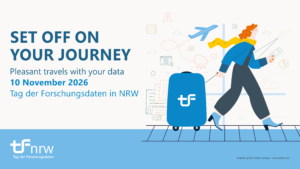
A diverse and informative program awaits you at Research Data Day in North Rhine-Westphalia 2026. At this event for researchers at all career stages, participants will receive an overview of research data management (RDM) services, individual advice tailored to their personal RDM needs, and the opportunity to exchange ideas with RDM experts and other researchers.
In this blog post, we’ll give you a glimpse into the extensive afternoon program and the various stations where you can prepare for your own research data journey.
Research Data Day will take place on November 10 under the motto “Embark on a Journey: Making the Most of Your Data” at the SuperC at RWTH Aachen University.
The RDM Travel Center forms the core of the event. There, participants can explore RDM tools firsthand at numerous stations and booths, receive personalized advice, and share experiences. They will be supported by experts from the RDM team at RWTH Aachen University and Forschungszentrum Jülich, the university library of the RWTH as well as from the Data Competence Center DKZ.2R. The experts will be available to assist you at the following stations:
Planning Your Research Data Journey
RDM supports efficient project workflows and the long-term reuse of research results. This station addresses the RDM requirements in grant proposals as well as the creation of data management plans (DMPs) as practical tools for planning and managing RDM throughout the entire research project.
Organizing and Managing Your Research Data
Well-organized data storage, consistent file structures and naming conventions, structured metadata, and version control help maintain an overview of research data, promote collaboration, and improve reproducibility. This station introduces practical methods and tools for organizing and managing research data, including Git, Coscine, and DataLad.
Documenting Data with Electronic Laboratory Notebooks
Electronic laboratory notebooks (ELNs) support structured research documentation and help organize laboratory workflows. This station introduces ELNs and related tools for automating documentation, extracting metadata, visualizing data, and managing samples and measurements, using examples from PASTA-ELN, eLabFTW, and SampleDB, among others.
Making Your Data Understandable
Consistent metadata and a common terminology help make research data understandable across disciplinary and technical boundaries. This station covers metadata standards, metadata profiles, and ontologies, and demonstrates how structured descriptions support interoperability, data integration, discoverability, and reuse.
Reuse and Publication of Data
Research data can serve as the foundation for new applications, innovative ideas, and further developments. This station explores approaches for identifying new uses for research data, selecting suitable repositories for publication, and addressing licensing and legal requirements for the sharing and reuse of research results.
RDM Support and Training
Appropriate services, tools, and training help researchers overcome the challenges of RDM throughout the entire research data lifecycle. Smartphone-based experiments and an interactive RDM card game provide practical insights into key RDM concepts and workflows.
Keynote by Richard Brand
The event will be rounded out by a keynote presentation by Richard Brand from the Institute of Steel Structures titled “From (nearly) Lost Files to Shared Infrastructure: A Research Data Journey.” In it, he will present the development of a dataset over a ten-year period. He highlights the decisions, mistakes, and insights gained along the path to publishing the data, and demonstrates how applying these insights has improved RDM in current projects and contributed to the establishment of a shared data infrastructure across three institutions.
Registration and Further Information
In the program flyer, you’ll find a detailed overview of the stations and presentations on offer, as well as useful tips for preparing for your visit.
No prior knowledge or preparation is required. However, depending on the activities at the Travel Center, it may be helpful to bring your own laptop, a specific question, or an example from your research to maximize the practical benefits of your visit.
Participation in the event is free of charge. However, registration via the RWTH event database is required.
The event will be conducted in English.
If you have any questions about Research Data Day or general RDM topics, the RWTH RDM team will be happy to assist you.
Responsible for the content of this article is Hedda Faber.







Leave a Reply
You must be logged in to post a comment.