

Kategorie: ‘General’
Our group at the K-Messe 2025 in Düsseldorf
On 9 October, our entire working group visited the K-Messe in Düsseldorf, the world’s leading trade fair for plastics and rubber. We learned about the latest developments in sustainable materials and innovative processing technologies. The exchange with industry partners and research institutions provided valuable inspiration for our own work and future projects.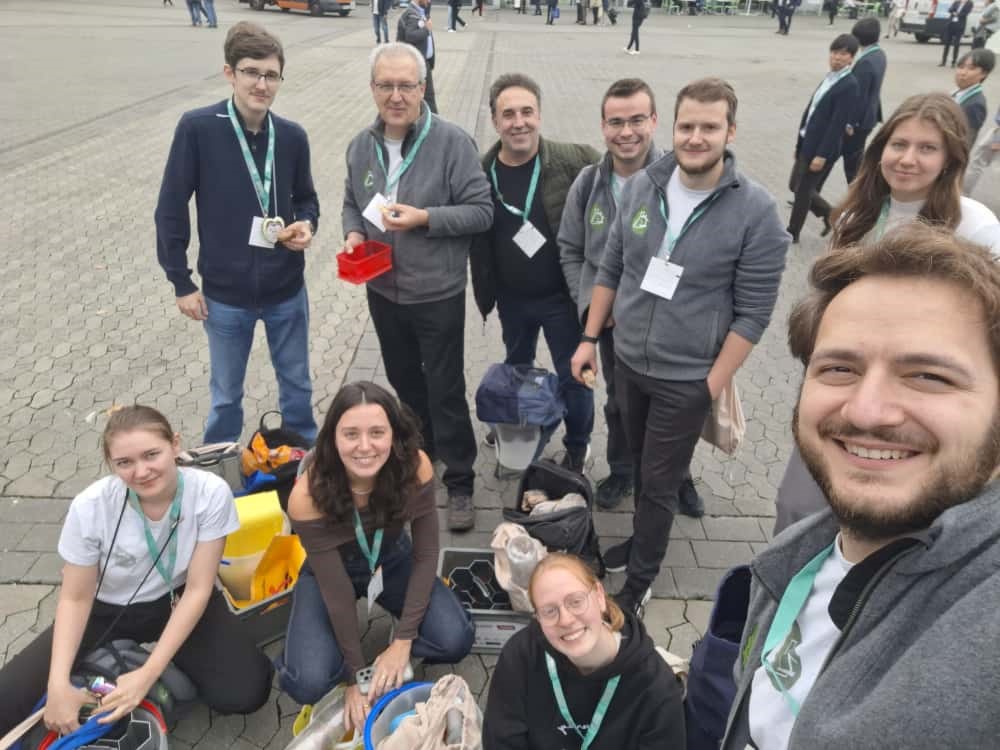
EPNOE 2025
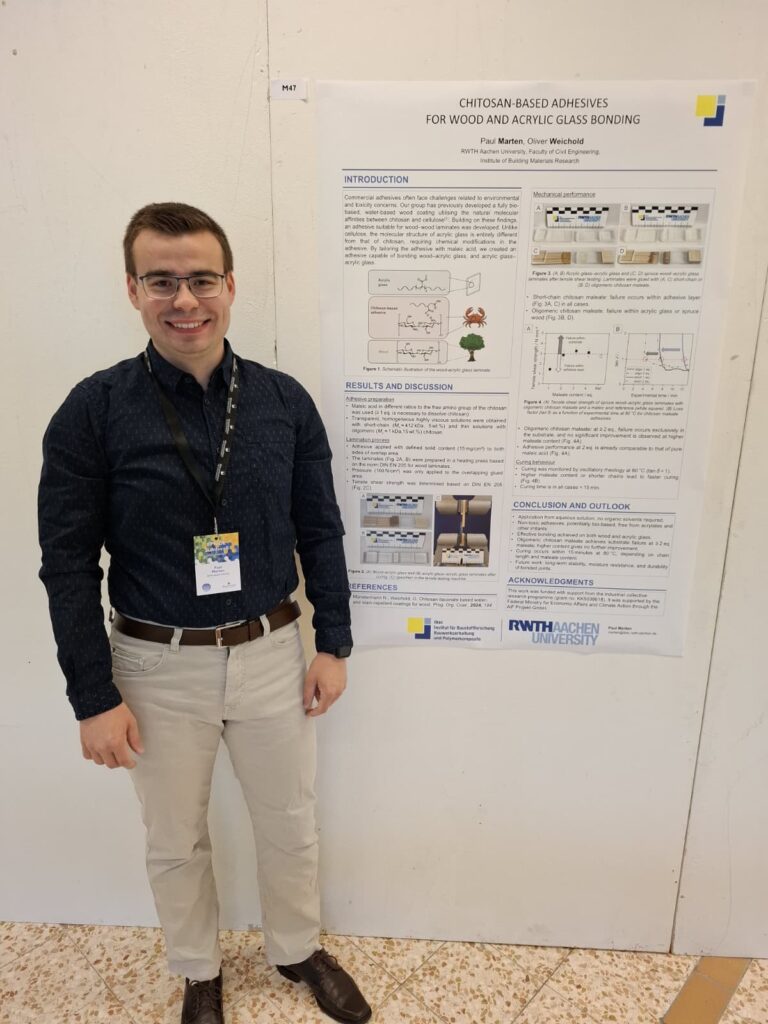
Nils Münstermann and Paul Marten attended EPNOE 2025 in Sundsvall, Sweden, last week.
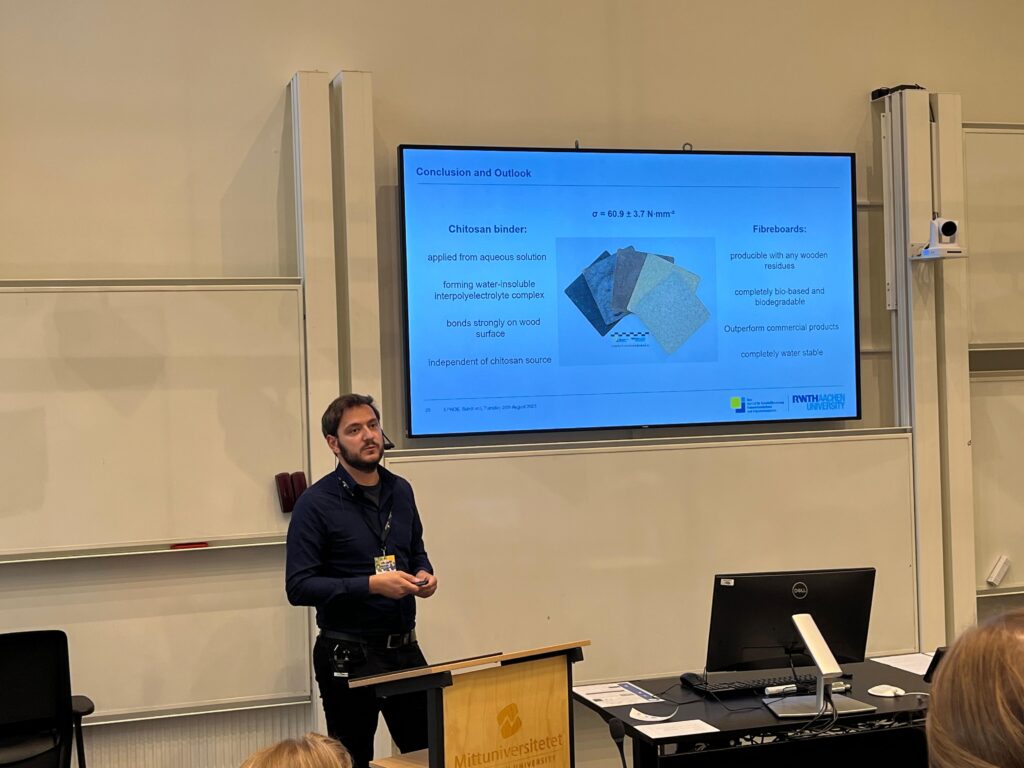
Nils Münstermann gave a presentation on ‘Chitosan-itaconate as binder for high-strength fibreboards’.
Paul Marten presented a poster on ‘Chitosan-based adhesives for wood and acrylic glass bonding’.
Hot-Line: Trident Measures Movement
New in the lab: Trident. Three testing methods in one device: bulk, film, or melt, we can now measure thermal conductivity precisely and make our research even more flexible.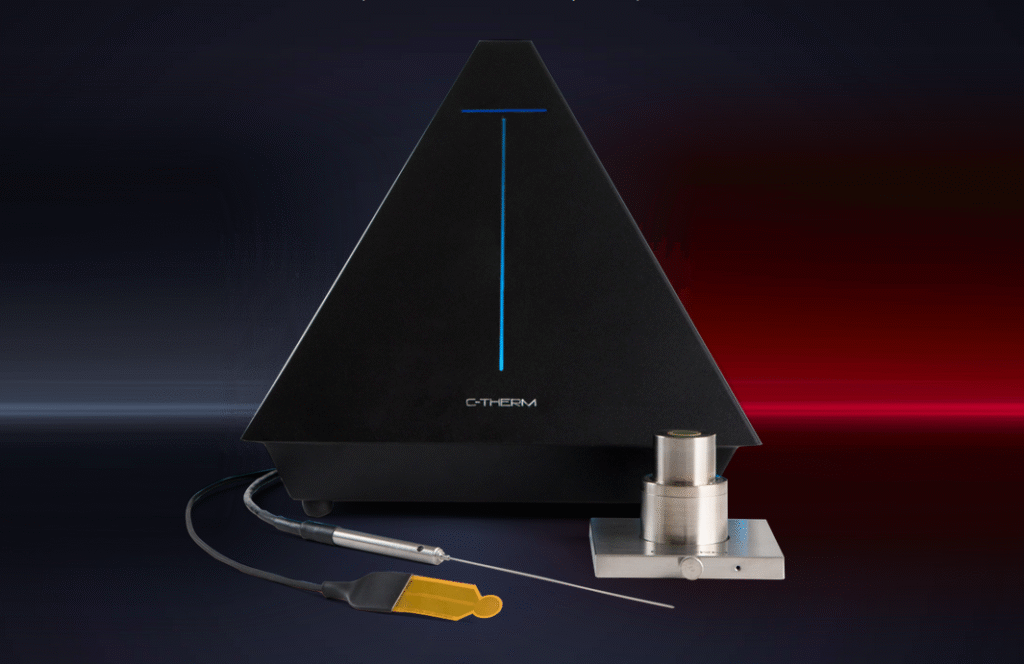
Visit from Maejo University
Last month, we welcomed Prof. Panwad Sillapawattana from Maejo University in Thailand. As part of a joint research project, she conducted initial experiments in our laboratory and engaged in intensive discussions with our team. The visit was not only scientifically enriching, but also a wonderful cultural and personal exchange. We look forward to continuing our collaboration.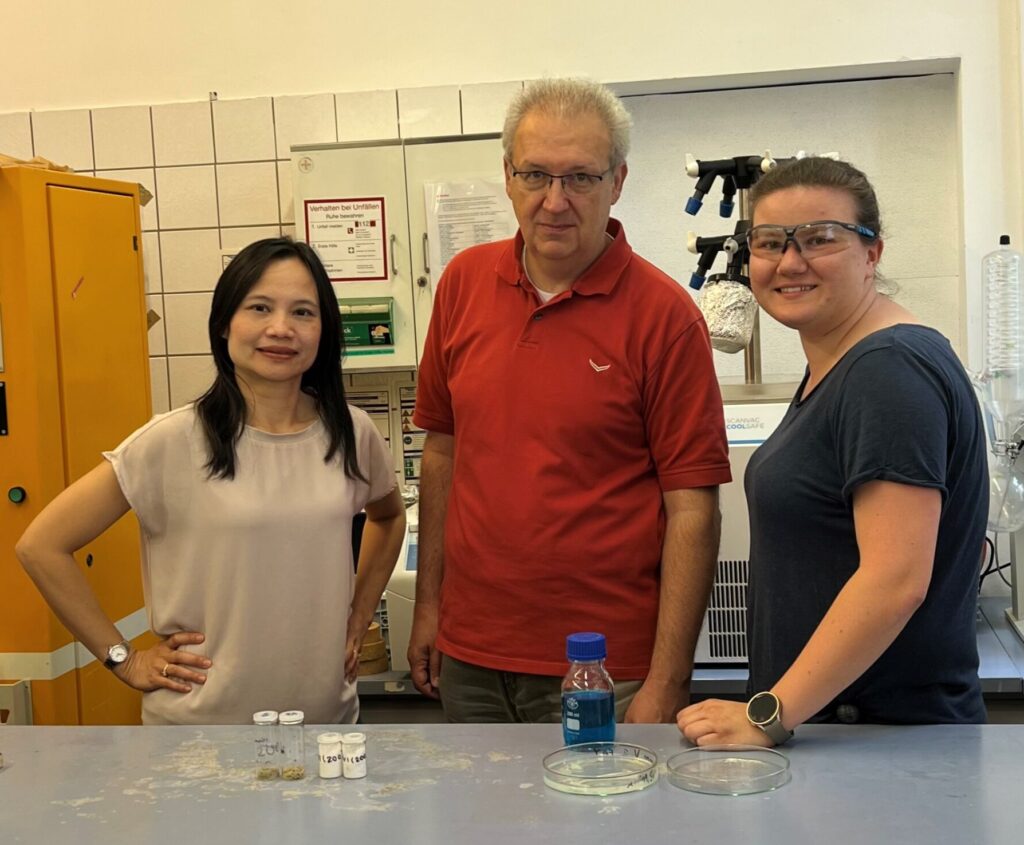
Award for our research into biobased polyester foams
The most recent publication by Fabian Weitenhagen and Oliver Weichold in the journal Polymers (MDPI) was honoured as a feature paper. This special recognition by the editors for outstanding and pioneering contributions. The article entitled ‘Preparation, Reaction Kinetics, and Properties of Polyester Foams Using Water Produced by the Reaction as a Foaming Agent’ was published in the May issue.
The work centres on the development of sustainable, bio-based foams using reaction water as a foaming agent. The results show not only a high degree of control over the foam structure and material properties, but also impressive thermal stability and improved fire protection properties compared to conventional foams.
We are particularly pleased about the award, as of the nine previous publications by ibac in Polymers, this honour has only been bestowed once before.
F. Weitenhagen, O. Weichold
Preparation, Reaction Kinetics, and Properties of Polyester Foams Using Water Produced by the Reaction as a Foaming Agent
Polymers 2025, 17(9):1266, DOI: 10.3390/polym17091266
Spruce wood in a fire test: the effect of chitosan itaconate as a coating
In our publication “A fire-retardant coating for wood made from chitosan itaconate”, Nils Münstermann and Oliver Weichold test the fire behaviour of untreated spruce wood and spruce wood coated with chitosan itaconate. While the untreated spruce wood burns down completely, the flame in the coated wood goes out by itself without the test specimen burning completely.
Spruce uncoated
Spruce coated
N. Münstermann, O. Weichold
A fire-retardant coating for wood made from chitosan itaconate
Progress in Organic Coatings 2024, 197, 108793 https://doi.org/10.1016/j.porgcoat.2024.108793
Polymer Blends & Eurofillers 2025
Paul Marten and Fabian Weitenhagen attended and delivered presentations at Polymer Blends & Eurofillers 2025 in Lyon this week.

Paul Marten presented the “Development and Characterisation of a Composite Material based on Polylactic Acid, Chitin, and Lecithin”.

Fabian Weitenhagen presented “Sustainable Biopolymer Composites Using Recycling Cellulose from Wastepaper”.
Contributions to our publication: Fire-retardant wood coating
The publication “Fire-retardant Coating For Wood Made From Chitosan Itaconate” is internationally recognised by an article in the Italian trade journal Pitture e Vernici – European Coatings (Issue 1/2025, page 36) and by a web post by European Coatings entitled “A fire-retardant coating for wood made from chitosan itaconate” – News and insights for the European coatings industry. The chitosan itaconate glaze is transparent, emphasises the natural wood grain and renders the surface water-repellent. It reliably protects the wood from moisture, prevents UV-induced greying and efficiently reduces the burning rate. With just two applications on spruce and three on beech wood, the glaze is self-extinguishing. Find out more.
This bio-based approach combines resource conservation with effectiveness and demonstrates how environmental preservation and safety requirements can be successfully combined. It fills us with joy and appreciation to see that our work is attracting greater attention.
Pitture E Vernici: Fire-retardant Coating For Wood Made From Chitosan Itaconate, Fascicolo 1/Gennaio – Febbraio 2025 – Pitture e Vernici, https://www.pittureevernici.it/archivio/archivio-2025/fascicolo-1-gennaio-febbraio2025/.
European Coatings: A fire-retardant coating for wood made from chitosan itaconate – News and insights for the European coatings industry, https://www.european-coatings.com/news/application-areas/a-fire-retardant-coating-for-wood-made-from-chitosan-itaconate/.
Poster
Tim Mrohs presented a poster entitled: ‘Influence of Environmental Factors on the Swelling Capacities of Superabsorbent Polymers Used in Concrete’ at the 3rd International Conference on the Chemistry of Construction Materials (ICCCM) 2021 of the GDCh Bauchemie, which took place online.
New Publication:Water-Repellent Layers Unveiled: Nondestructive Analysis with NMR
The recent study by Prof. Dr. Oliver Weichold and Udo Antons explores the use of single-sided nuclear magnetic resonance (NMR) as a nondestructive method to analyze hydrophobing agents on concrete. This technique examines the ingress behavior of 𝑛-octyltriethoxysilane and 𝑖-butyltriethoxysilane and the properties of the resulting water-repellent layers.
Remarkably, the study discovered that targeted blending and cross-linking of PEO- and PPO-based polyesters can create synergistic effects. A 1:1 blend of short-chain PPO and long-chain PEO exhibited a resistivity five times lower than pure PEO and three times lower than pure PPO. These effects are attributed to enhanced chain mobility and intrachain hopping mechanisms, which are amplified by the cross-linking process.
Beyond improved ion conductivity, these networks offer rubber-like elasticity and high water tolerance, making them suitable for diverse applications, particularly under mechanical stress, in atmospheric conditions, or even in aqueous environments where standard ion-conducting systems often fail.
Weichold, O.; Antons, U.C.
Assessing the Performance of Hydrophobing Agents on Concrete Using Nondestructive Single-Sided Nuclear Magnetic Resonance
Journal Of Infrastructure Systems 2017, 23 (4). https://doi.org/10.1061/(ASCE)IS.1943-555X.0000366


