
Kategorie: ‘Kompositmaterial’
Neue Veröffentlichung: Biobasiertes Chitin-Lecithin-Additivsystem für PLA
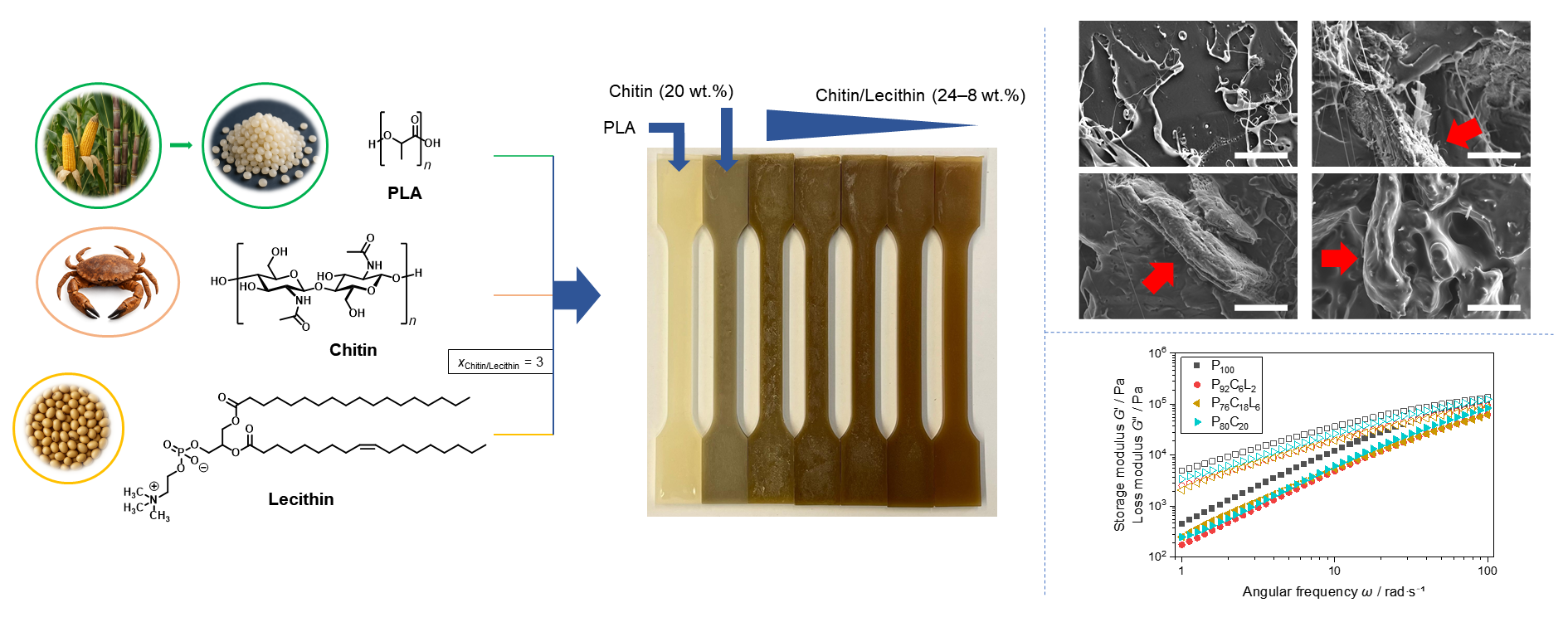
Polylactid (PLA), auch Polymilchsäure genannt, ist ein biobasierter Kunststoff, der aus nachwachsenden Rohstoffen hergestellt wird. Seine Einsatzmöglichkeiten werden jedoch durch die vergleichsweise hohe Sprödigkeit begrenzt. Weichmacher können die Beweglichkeit der Polymerketten erhöhen, verringern jedoch häufig deutlich die Glasübergangstemperatur oder können während der Verarbeitung und Nutzung aus dem Material austreten. Zudem basieren viele konventionelle Weichmacher auf petrochemischen Rohstoffen.
In unserer aktuellen Veröffentlichung untersuchten wir daher ein vollständig biobasiertes Additivsystem aus Sojalecithin und Chitin. Sojalecithin ist ein phospholipidreicher Naturstoff mit emulgierenden Eigenschaften. Chitin ist ein natürliches Polysaccharid, das unter anderem aus biogenen Reststoffströmen wie Krustentierschalen gewonnen werden kann. Lecithin allein ließ sich nicht stabil in PLA einarbeiten: Während der Schmelzverarbeitung trennte es sich von der Polymermatrix und lagerte sich an der Oberfläche ab. Durch die Kombination mit Chitin konnten dagegen makroskopisch homogene PLA-Blends mit einem gesamten Additivgehalt von bis zu 24 Gew.% im Spritzguss hergestellt werden.
Rheologische Untersuchungen zeigten eine deutlich verringerte Schmelzviskosität, während Extraktionsversuche auf eine verbesserte Rückhaltung lecithinhaltiger Bestandteile in Gegenwart von Chitin hinweisen. FTIR- und REM/EDX-Untersuchungen deuten dabei auf schwache physikalische Wechselwirkungen sowie eine räumliche Assoziation von Lecithin und Chitin hin. Die Glasübergangstemperatur des PLA wurde dagegen nur geringfügig verändert.
Das Chitin-Lecithin-System bildet damit eine Grundlage für schmelzverarbeitbare PLA-Formulierungen mit biobasierten Additiven. Mechanische Eigenschaften, Alterungsverhalten und mögliche Anwendungen sollen in weiteren Untersuchungen betrachtet werden.
P. Marten, O. Weichold
Rheological, thermal and morphological characterisation of a melt-processable bio-based chitin-lecithin plasticiser system for PLA
Materials Today Communications, 2026, 54, 115772 https://doi.org/10.1016/j.mtcomm.2026.115772
Neue Veröffentlichung: Spanplatten aus Pflanzenresten und Krabbenschalen

Spanplatten sind aus Möbelbau und Innenausbau kaum wegzudenken. Doch viele herkömmliche Holzwerkstoffe werden mit petrochemischen Bindemitteln hergestellt, die weder vollständig biobasiert noch problemlos abbaubar sind.
Wir zeigen, dass es nachhaltiger geht: Aus schnell wachsenden Pflanzenresten wie Miscanthus, Hanfschäben und Japanischem Staudenknöterich lassen sich stabile Holzfaserplatten herstellen. Als Bindemittel dient Chitosan-Itaconat, das aus Reststoffen der Lebensmittelindustrie und Itaconsäure gewonnen wird.
Beim Heißpressen polymerisert das Bindemittel zu einem wasserunlöslichen Interpolyelektrolytkomplex. Dadurch entstehen Faserplatten mit bemerkenswerten Eigenschaften: Die Biegefestigkeit liegt bei bis zu 76,5 N/mm² und liegt damit deutlich über typischen MDF-Werten und nähert sich massivem Fichtenholz an. Gleichzeitig bleiben die Faserplatten bei Wasserkontakt formstabil, sind kompostierbar und zeigten in Brandtests selbstverlöschendes Verhalten.
Besonders spannend ist die Vielseitigkeit des Ansatzes. Der Binder funktioniert mit unterschiedlichen cellulose- und ligninhaltigen Pflanzenmaterialien. Dadurch könnten regionale Reststoffe künftig direkt vor Ort zu hochwertigen Bau- und Möbelwerkstoffen verarbeitet werden. Wir sind überzeugt, dass dies ein vielversprechender Schritt hin zu Holzwerkstoffen, die stark, sicher und kreislauffähig sind, ist. Wir wollen Abfallstoffe zu echten Hochleistungsmaterialien transformieren.
N. Münstermann, O. Weichold
High-strength particleboards from fast-growing plant residues and food-industry by-products using chitosan-itaconate as orthogonal binder platform
Industrial Crops and Products, 2026, 245, 123251 https://doi.org/10.1016/j.indcrop.2026.123251
Promotion mit Auszeichnung abgeschlossen: Dr. Nils Münstermann
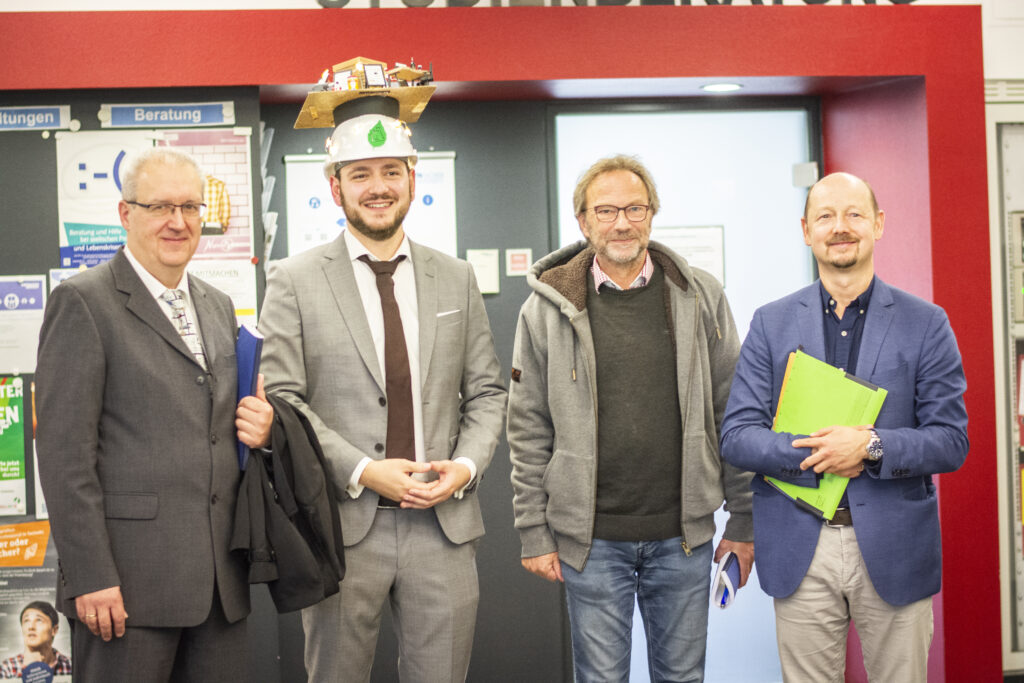
Wir gratulieren Dr. Nils Münstermann herzlich zum erfolgreichen Abschluss seiner Promotion, die er mit Auszeichnung (summa cum laude) bestanden hat.
In seiner Dissertation mit dem Titel „Biobasierte Chitosan-Interpolyelektrolytkomplexe zur Beschichtung und Verklebung von Holzwerkstoffen“ untersuchte er Chitosanitaconat als vollständig biobasiertes und multifunktionales Materialsystem. Die entwickelten Beschichtungs- und Klebstoffsysteme eröffnen neue Möglichkeiten zur Verbesserung der Wasserbeständigkeit, des UV-Schutzes und des Brandverhaltens von Holzwerkstoffen und verbinden den Einsatz nachwachsender Rohstoffe mit anwendungsnahen Lösungen für die Bau- und Holzindustrie.
Wir freuen uns, dass Dr. Nils Münstermann dem Institut als Arbeitsgruppenleiter erhalten bleibt, und wünschen ihm für seine weitere wissenschaftliche Arbeit viel Erfolg.
Ankündigung: Polymer Blends & Eurofillers
Wir freuen uns, bekannt zu geben, dass gleich zwei spannende Vorträge unserer Arbeitsgruppe auf der Polymer Blends & Eurofillers 2025 vom 27. bis 30. Januar 2025 in Lyon angenommen wurden:
Paul Marten
Development and Characterisation of a Composite Material based on Polylactic Acid, Chitin, and Lecithin
und
Fabian Weitenhagen
Sustainable Biopolymer Composites Using Recycling Cellulose from Wastepaper
Nutzen Sie die Gelegenheit, um die neuesten Ergebnisse aus dem Arbeitskreis zu erfahren und mit den Mitarbeitern ins direkte Gespräch zu kommen.
Abgeschlossene Masterarbeit
Wir gratulieren Sandra Czypionka herzlich zum erfolgreichen Abschluss ihres Masterstudiums im Studiengang Chemie. Der Titel ihrer Masterarbeit lautet: „Vergleich der Methoden zur Bestimmung der Bioabbaubarkeit nachhaltiger Polymerkomposite“.
WTA-Tage 2024
Mit insgesamt vier Vorträgen waren wir auf den WTA-Tage 2024, 14.–16.3.2024 in Brünn, Tschechien, vertreten.
Prof. Weichold präsentierte einen Vortrag mit dem Titel „Alkaline hydrogels as multifunctional repair materials“. Aus dem Bereich der biobasierten Bausstoffe hielten Fabian Weitenhagen einen Vortrag über „Renewable Polyester Resin Systems for Sustainable Construction Materials“, Paul Marten einen Vortrag über „Chitosan as a Key Component in the Production of Sustainable Acrylic Glass-Wood Laminates“ und Nils Münstermann einen Vortrag über „Chitosan as an Eco-Friendly Binder for High-Strength Fibreboards in Sustainable Construction“.
Neue Veröffentlichung:
Federn ersetzen Ruß in Gummi
 Die meisten heute verwendeten Elastomere („Gummi“) basieren auf Schwefel als Vernetzungsmittel und Ruß aus fossilen Rohstoffen, um die mechanischen Eigenschaften zu verändern. Hier zeigen wir, dassnatürliches Keratin, z. B. aus Geflügelfedern, ein sehr vielversprechender Ersatz für beide sein kann. Federn sind nicht nur zäh, sondern enthalten auch eine relevante Menge an Schwefel in Form von Disulfidbrücken. Diese können unter Vulkanisationsbedingungen aktiviert werden und dann kovalent an EPDM-Kautschuk binden, um ein vernetztes Netzwerk zu bilden. Das Vorhandensein von Federabfällen erhöht die Zug- und Druckfestigkeit sowie die Härte und verringert die Rückprallelastizität. Aufgrund ihres hohen Stickstoffgehalts von ca. 17 % verbessern die Federn auch die thermische Stabilität des Verbundstoffs, wobei der Hauptabbauschritt von 400 °C auf 470 °C verschoben und die Zersetzung deutlich verlangsamt wird. Da es sich bei Elastomeren um einen großen Markt und insbesondere bei Federn um einen voluminösen Abfall handelt, bietet die Kombination von beidem enorme ökologische und wirtschaftliche Perspektiven.
M. Brenner, O. Weichold
Poultry Feather Waste as Bio-Based Cross-Linking Additive for Ethylene Propylene Diene Rubber
Polymers 2021, 13, 3908. https://doi.org/10.3390/polym13223908
Neues Projekt:Recyclingschäume
Rückwirkend zum 1.11. wurde uns ein Projekt zur Entwicklung mechanisch stabiler Schäume bewilligt. Das Projekt baut auf die in Appl. Sci. 2020 beschriebenen Materialien auf. Zusätzlich wird die Wirkung von Füllstoffen aus Recyclingmaterialien getestet. Das Projekt wird von Fabian Weitenhagen betreut.
Neue Veröffentlichung:
Federn als Bindemittel und Flammschutz
 Die steigende Nachfrage nach nachhaltigen Baumaterialien erfordert alternative Flammschutzmittel, die eine bessere Nachhaltigkeit als die bisher verwendeten aufweisen. In diesem Zusammenhang präsentieren wir unsere ersten Ergebnisse mit aufgearbeiteten Geflügelfederabfällen für die Herstellung von flammhemmenden Faserplatten vor. Imprägnierte Holzfasern zeigen eine deutlich verringerte Zersetzungsgeschwindigkeit und um ca. 50 °C höhere Zersetzungstemperaturen. Zudem erfolgt die Zersetzung schrittweise und nicht unmittelbar wie bei unbehandeltem Holz. Bei einem Gesamtproteingehalt von ca. 10 Gew.-% sind die im Nassverfahren hergestellten Platten selbstverlöschend und glimmen nicht nach. Im Dreipunkt-Biegeversuch versagten diese Faserplatten bei 15 N/mm2, dem nach DIN EN 622 geforderten Grenzwert für kommezielle, Formaldehyd-gebundene MBH-Faserplatten. Dies zeigt, dass die verwerteten Federreste nicht nur eine beeindruckende flammhemmende Wirkung, sondern auch als vollwertiges Bindemittel für eine neue Generation ökologischer Faserplatten verwendet werden können. Da diese Platten Da diese Platten ausschließlich auf natürlichen Materialien basieren, können sie am Ende ihres Lebenszyklus geschreddert und kompostiert werden.
Der Artikel wurde vom Journal für das Cover der Ausgabe 5(50) ausgewählt.
M. Brenner, O. Weichold
Protein Hydrolysates from Biogenic Waste as an Ecological Flame Retarder and Binder for Fiberboards
ACS Omega 2020, 5, 32227−32233. https://dx.doi.org/10.1021/acsomega.0c03819
Neuer Doktorand
Seit Dezember verstärkt Fabian Weitenhagen unser Team im Bereich der biobasierten Baustoffe. Er forscht an biobasierten Polykondensationsharzen weiter und baut auf den Ergebnissen früherer Arbeiten auf. Zudem entwickelt er innovative biobasierte Komposite, um nachhaltige Lösungen für die Bauindustrie zu fördern.
Sprache:


