
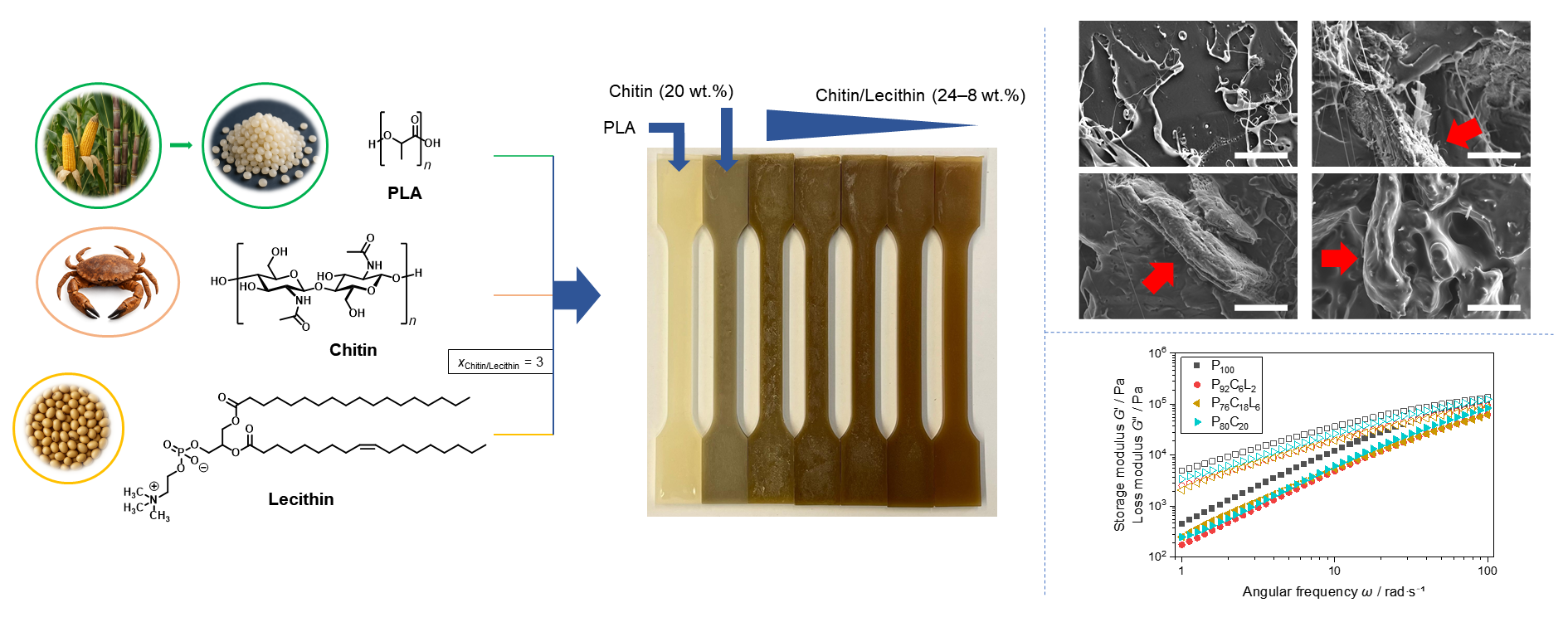
Polylactide (PLA), also known as polylactic acid, is a bio-based plastic that can be produced from renewable raw materials. However, its potential applications are limited by its comparatively high brittleness. Plasticisers can increase polymer-chain mobility, but they often substantially reduce the glass transition temperature or may migrate from the material during processing and use. Moreover, many conventional plasticisers are based on petrochemical raw materials.
In our recent study, we therefore investigated a fully bio-based additive system consisting of soy lecithin and chitin. Soy lecithin is a phospholipid-rich natural substance with emulsifying properties. Chitin is a natural polysaccharide that can be obtained from biogenic side streams such as crustacean shells. Lecithin alone could not be incorporated stably into PLA: during melt processing, it separated from the polymer matrix and accumulated at the surface. By combining it with chitin, however, macroscopically homogeneous PLA blends with a total additive content of up to 24 wt.% could be produced by injection moulding.
Rheological measurements showed a markedly reduced melt viscosity, while extraction tests indicated improved retention of lecithin in the presence of chitin. FTIR and SEM/EDX analyses further suggested weak physical interactions and a spatial association between lecithin and chitin. By contrast, the glass transition temperature of PLA changed only slightly.
The chitin-lecithin system therefore provides a basis for melt-processable PLA formulations containing bio-based additives. Mechanical properties, ageing behaviour, and potential applications will be investigated in future studies.
P. Marten, O. Weichold
Rheological, thermal and morphological characterisation of a melt-processable bio-based chitin-lecithin plasticiser system for PLA
Materials Today Communications, 2026, 54, 115772 https://doi.org/10.1016/j.mtcomm.2026.115772


Leave a Reply