
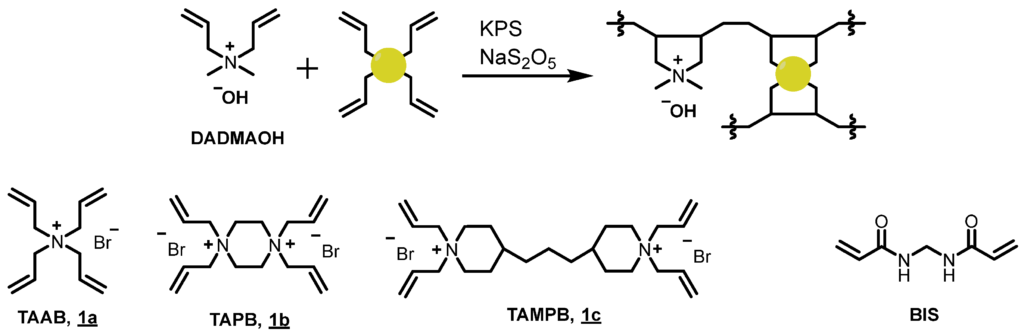
As part of our work on highly alkaline diallyldimethylammonium hydroxide (DADMAOH) hydrogels for the repair of mineral building materials, T. Mrohs and O. Weichold analysed the resistance of the four crosslinkers shown above. Classic amides such as N,N′-methylenebisacrylamide (BIS) decompose by slow hydrolysis, which leads to liquefaction of the gels. N,N,N′,N′-tetraallylpiperazinium dibromide (1b) decomposes surprisingly quickly due to chemical instabilities. In contrast, hydrogels with tetraallylammonium bromide (1a) or N,N,N′,N′,N′-tetraallyltrimethylene dipiperidinedibromide (1c) show no traces of degradation products even after 28 days at 60 °C. This corresponds to a shelf life of over 15 months at room temperature – sufficient for applications such as realkalisation or chloride extraction. These results show that such innovative materials are ideal for long-lasting construction applications.
T. B. Mrohs, O. Weichold
Hydrolytic Stability of Crosslinked, Highly Alkaline Diallyldimethylammonium Hydroxide Hydrogels
Gels 2022, 8, 669. https://doi.org/10.3390/gels8100669


Leave a Reply