
Kategorie: ‘Chitosan’
Presentation
Nils Münstermann gave a presentation entitled ‘Chitosan as an environmentally friendly binder for high-strength fibreboards’ at the 2024 doctoral seminar of the GDCh Construction Chemistry Division in Aachen, Germany.
Presentation
Paul Marten gave a presentation entitled ‘Development of a chitosan-based adhesive for wood-acrylic glass bonding’ at the 2024 doctoral seminar of the GDCh Construction Chemistry Division in Aachen, Germany.
Nils Münstermann earns an Award
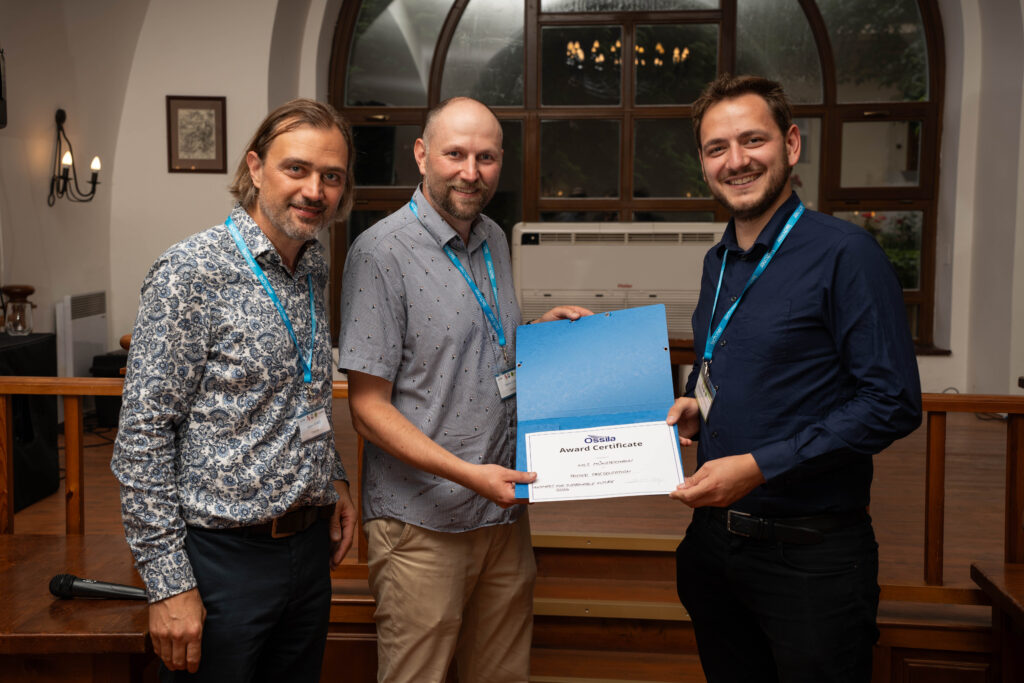
Nils Münstermann receives the poster prize at the Polymers for Sustainable Future 2024 conference in Prague for his contribution ‘Chitosan-Based Coatings for the Water-Proofing of Wood’.
WTA-Days 2024
We were represented with a total of four lectures at the WTA Days 2024, 14-16 March 2024 in Brno, Czech Republic.
Prof Weichold presented a lecture entitled ‘Alkaline hydrogels as multifunctional repair materials’. From the field of bio-based construction materials, Fabian Weitenhagen gave a presentation on ‘Renewable Polyester Resin Systems for Sustainable Construction Materials’, Paul Marten gave a presentation on ‘Chitosan as a Key Component in the Production of Sustainable Acrylic Glass-Wood Laminates’ and Nils Münstermann gave a presentation on ‘Chitosan as an Eco-Friendly Binder for High-Strength Fibreboards in Sustainable Construction’.
New PhD Student
Since July, we have welcomed Paul Marten to the bio-based building materials department. As part of his dissertation, he is working on the derivatisation of chitosan and its application, including as an additive for PLA and as an adhesive or primer for wood/PMMA composite systems or wood laminates, for example. The aim of his research is to develop bio-based, sustainable and biodegradable systems with outstanding physical properties, while avoiding petrochemical substances as far as possible. We wish him every success in his research and welcome him to the working group.
Completed Master Thesis
Congratulations to Paul Marten on successfully completing his Master’s thesis entitled ‘Development of chitosan lactate-based additives for polylactide (PLA)’ in the Chemistry degree programme.
New PhD Student
In January, we welcomed Nils Münstermann to the area of bio-based building materials. As part of his dissertation, he is researching sustainable and biodegradable chitosan-based binders, adhesives and glazes for use on wood. We wish him every success with his research and welcome him to the working group.
Completed Master Thesis
Congratulations to Nils Münstermann on successfully completing his Master’s thesis entitled ‘Synthesis and properties of superabsorbers based on chitosan hydrogels’ in the Chemistry degree programme. The thesis is part of the ongoing Biosuperabsorber project.
New project:Bio-based glazes and adhesives for wood
A new project focusing on bio-based building materials will start on 1 October 2021. Together with two industrial partners, we are developing glazes and adhesives for wood based on chitosan. The project is being supervised by Tobias Boehnke.
New publication:
Gentle dissolution of chitosan
Despite its very low pKa value, hydrochloric acid is one of the most commonly used acids in the production of chitosan hydrogels for biomedical applications. Although hydrochloric acid is widely used, the occurrence of unwanted depolymerisation in the production of hydrogels from chitosan hydrogels is often disregarded. In order to fully exploit the potential of chitosan as a renewable resource, a new, very mild method for the preparation of chitosan solutions is described here.
These solutions dry to clear, transparent films that remain completely water soluble and absorb up to 70 wt% water from the water in the 90 % RH vapour phase at 25 °C. Absorption follows simple first-order kinetics and the rate constants The rate constants increase with increasing humidity up to about 71 % RH, where a metastable chitosan trihydrate salt appears to be formed. Desorption is slightly faster, but more complex, as it involves two different first-order processes. In addition, the films produced in this way are thermally more stable than the usual chitosan hydrochloride.
M. B. Endres, O. Weichold
Sorption-active transparent films based on chitosan
Carbohydrate Polym. 2019, 208, 108–114. https://doi.org/10.1016/j.carbpol.2018.12.031


