
Kategorie: ‘Informationen & Beratung’
New Addition to DataStorage.nrw: DataArchive.nrw as a Storage Location for Cold Research Data!
Source: Own illustration
With DataArchive.nrw, North Rhine-Westphalia is launching a new service for the long-term archiving of large volumes of research data. Designed to complement DataStorage.nrw, the new system will enable the storage of so-called “cold” research data in the future. In this article, you’ll learn about the technology behind it and the role DataArchive.nrw will play in research data management (RDM).
NFDI at RWTH – NFDI-MatWerk

Source: Own illustration
How can research data from the materials sciences and materials engineering be made FAIR and reused over the long term? NFDI-MatWerk addresses this question. In the first post in our series on the consortia from the second round of NFDI funding involving RWTH, we introduce NFDI-MatWerk and highlight the role RWTH plays in it, what was achieved during the first funding phase, and the key objectives for the second funding phase.
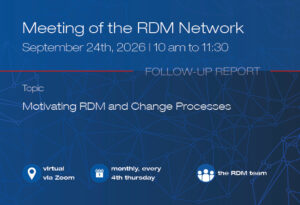
FDM Network Meeting, September 2026
source: own illustration
On September 24, the monthly FDM network meeting took place, giving data stewards and others interested in FDM the opportunity to discuss FDM-related topics.
This meeting focused on how data stewards can motivate researchers to use FDM resources and drive change processes forward. Participants discussed challenges and shared examples of best practices.
Bridging the Media Gap – RDMO Learns to Communicate with Coscine
Source: Own Illustration
When transitioning from one phase of the research process to the next, researchers often encounter media gaps. For example, when they have finalized their data management plan (DMP) in RDMO and want to create a corresponding Coscine project for data storage and management. Until now, the project metadata had to be transferred manually for this purpose. Through an incubator with DMP4NFDI, RDMO has now learned to communicate with Coscine and transfer the metadata directly. This blog post explains exactly how this works and what requirements must be met.
RDM Checklist: Be Well Prepared for Your Vacation

Source: Own Illustration
Vacation season is just around the corner, and for many researchers, that means a well-deserved break. But before you put your laptop away for a few days or weeks, it’s worth taking a quick look at research data management (RDM). With just a little preparation, you can ensure that your research data is protected, that projects can continue to run smoothly even while you’re away, and that your substitutes have all the necessary information at their fingertips. In this post, we provide an overview of the most important steps you should take regarding research data management before going on vacation.
Publishing Research Data: Questions to Clarify in Advance
Source: Own Illustration
In the previous post, “Creative Commons Licenses Explained Simply,” we explained how Creative Commons licenses work and the options they offer for making scholarly works available for reuse.
However, choosing an appropriate Creative Commons license is just one step toward publishing research data. Various legal and organizational issues should be clarified in advance. These include, for example, whether the research data may be published at all, whether intellectual property rights apply to it, and which license or repository is appropriate in each case.
This post provides an overview of the most important issues and highlights what researchers should keep in mind when publishing their research data.
Creative Commons Licenses Explained Simply

Source: creativecommons.org
Whether it’s a scientific publication, presentation, graphic, or teaching material: Anyone who publishes research findings should specify how others are permitted to use them. This is exactly where licenses come into play.
They clarify whether content may be shared, modified, or even used commercially. In this way, they promote the reuse of scientific findings and support the goals of Open Science.
Creative Commons licenses (CC licenses) are an internationally established licensing system. But what do the various abbreviations actually mean, and which license is suitable for which purpose?
Where Should I Store My Research Data? A Decision-Making Guide for RWTH

Source: Own Illustration
At the very latest when research data needs to be stored, archived, or published in a structured manner, an important question arises: Where is the best place to store the data?
At RWTH, various services are available to researchers. At the same time, there are numerous discipline-specific repositories tailored to the needs of individual fields. The right choice depends less on the file format and more on the goal: Will the data be actively used? Does it need to be preserved long-term? Or should it be published and made available for reuse?
ELN@RWTH: Digitizing Research Documentation
Source: Own Illustration
Experiment logs, measurement data, analyses, and notes are part of everyday research life. However, this information is often stored in various locations: in lab notebooks, on network drives, in email attachments, or on personal computers. This can make it difficult to retrieve data, trace workflows, or share information with colleagues.
Electronic Lab Notebooks (ELNs) offer a digital solution to this problem. They enable structured documentation of research processes and help researchers make their work traceable, efficient, and accessible over the long term.
Coscine in Everyday Work – Development, Service, and Marketing
Source: Own Illustration
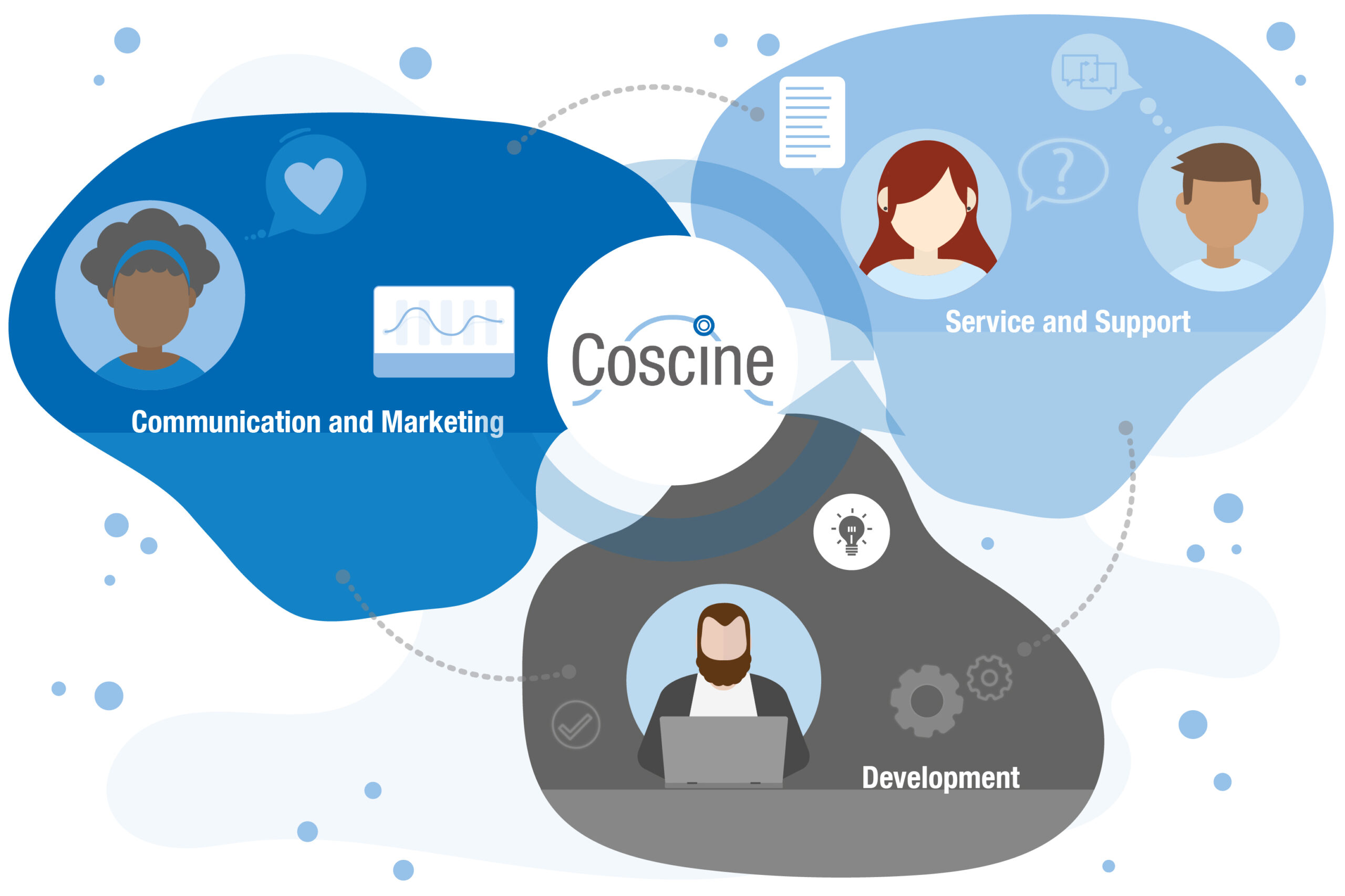
There is much more to a platform like Coscine than just technical development. To enable researchers to manage and store their data in a structured way and collaborate on projects, various departments must work closely together. At Coscine, two teams in particular take on key roles: the Development Team and the Service Management Team. These are complemented by other departments such as Communications and Marketing, which support the platform’s visibility.