
Schlagwort: ‘HPC’
NHR4CES – CFD Training Series: Introduction to Discontinuous Galerkin Methods for Flow Problems
 Name: CFD Training Series: Introduction to Discontinuous Galerkin Methods for Flow Problems
Date: 06.05.2025, 1.00 pm – 5.00 pm
Format: Online
Description
Short abstract:
In this course, we cover the main building blocks to solve fluid flow problems using the Discontinuous Galerkin (DG) method. The course consists of a combination of presentations and hands-on exercises in which a simple DG flow solver is implemented and run on some test cases within our open-source code framework BoSSS.
NHR4CES – CFD Training Series: Introduction to Scientific Computing with ParaView
Name: CFD Training Series: Introduction to Scientific Computing with ParaView
Date: 06.05.2025, 10.00 am – 5.00 pm
Format: Online via zoom
Description
Short abstract:
Scientific Visualization allows researchers to gain visual insights into complex data, that would otherwise be hidden within numbers and models. This is especially true for data describing physical phenomena, from blood flow simulations to combustion processes. The de-facto standard tool for visualization in these domains is ParaView. It is an open-source, multi-platform scientific data analysis and visualization tool that enables analysis and visualization of extremely large datasets.
In this course, attendants will learn the basics of scientific visualization and how these can be applied in ParaView, including filtering, rendering, and animating complex data.
NHR4CES – CFD Training Series: Introduction to Finite Element Methods for Flow Problems
Name: CFD Training Series: Introduction to Finite Element Methods for Flow Problems
Date: 29.04.2025, 01.00 pm – 05.00 pm
Format: Online
Description
Short abstract:
Carpentries Python Workshop
Name: Carpentries Python Workshop
Event Type: Workshop
Date: November 21-22. 2024
Time: 9:00am – 5:00pm
Location: IT Center RWTH Aachen – Kopernikusstraße 6, 52074 Aachen
Requirements: Participants must bring a laptop with a Mac, Linux, or Windows operating system (not a tablet, Chromebook, etc.) that they have administrative privileges on. They should have a few specific software packages installed.
Registration and more information here.
Description
The Carpentries project comprises the Software Carpentry, Data Carpentry, and Library Carpentry communities of Instructors, Trainers, Maintainers, helpers, and supporters who share a mission to teach foundational computational and data science skills to researchers.
Want to learn more and stay engaged with The Carpentries? Carpentries Clippings is The Carpentries’ biweekly newsletter, where we share community news, community job postings, and more. Sign up to receive future editions and read our full archive: https://carpentries.org/newsletter/
Software Carpentry aims to help researchers get their work done in less time and with less pain by teaching them basic research computing skills. This hands-on workshop will cover basic concepts and tools, including program design, version control, data management, and task automation. Participants will be encouraged to help one another and to apply what they have learned to their own research problems.
For more information on what we teach and why, please see our paper “Best Practices for Scientific Computing“.
The course is aimed at graduate students and other researchers. Priority will be given to students and researchers from Universities and research institutions in the region served by the DKZ.2R , as well as members of the NFDI4Microbiota consortium however all are welcome to register. You don’t need to have any previous knowledge of the tools that will be presented at the workshop.
Schedule
Day 1
| Before starting | Pre-workshop survey |
| 09:00 | Welcome / Summary and Setup |
| 09:30 | Running and Quitting |
| 10:00 | Variables and Assignment |
| 11:00 | Data Types and Type Conversion |
| 11:30 | Built-in Functions and Help |
| 12:00 | — LUNCH — |
| 13:00 | Libraries |
| 14:00 | Reading Tabular Data into DataFrames |
| 15:00 | Pandas DataFrames |
| 16:00 | Plotting |
Day 2
| 09:00 | Day 1 Recap |
| 09:30 | Lists |
| 10:30 | * Dictionaries |
| 11:00 | For Loops |
| 12:00 | — LUNCH — |
| 13:00 | Conditionals |
| 14:00 | Looping Over Data Sets |
| 15:00 | Writing Functions |
| 16:00 | Variable Scope |
| 16:15 | Programming Style |
| 16:45 | Wrap-Up |
| End | Post-workshop survey |
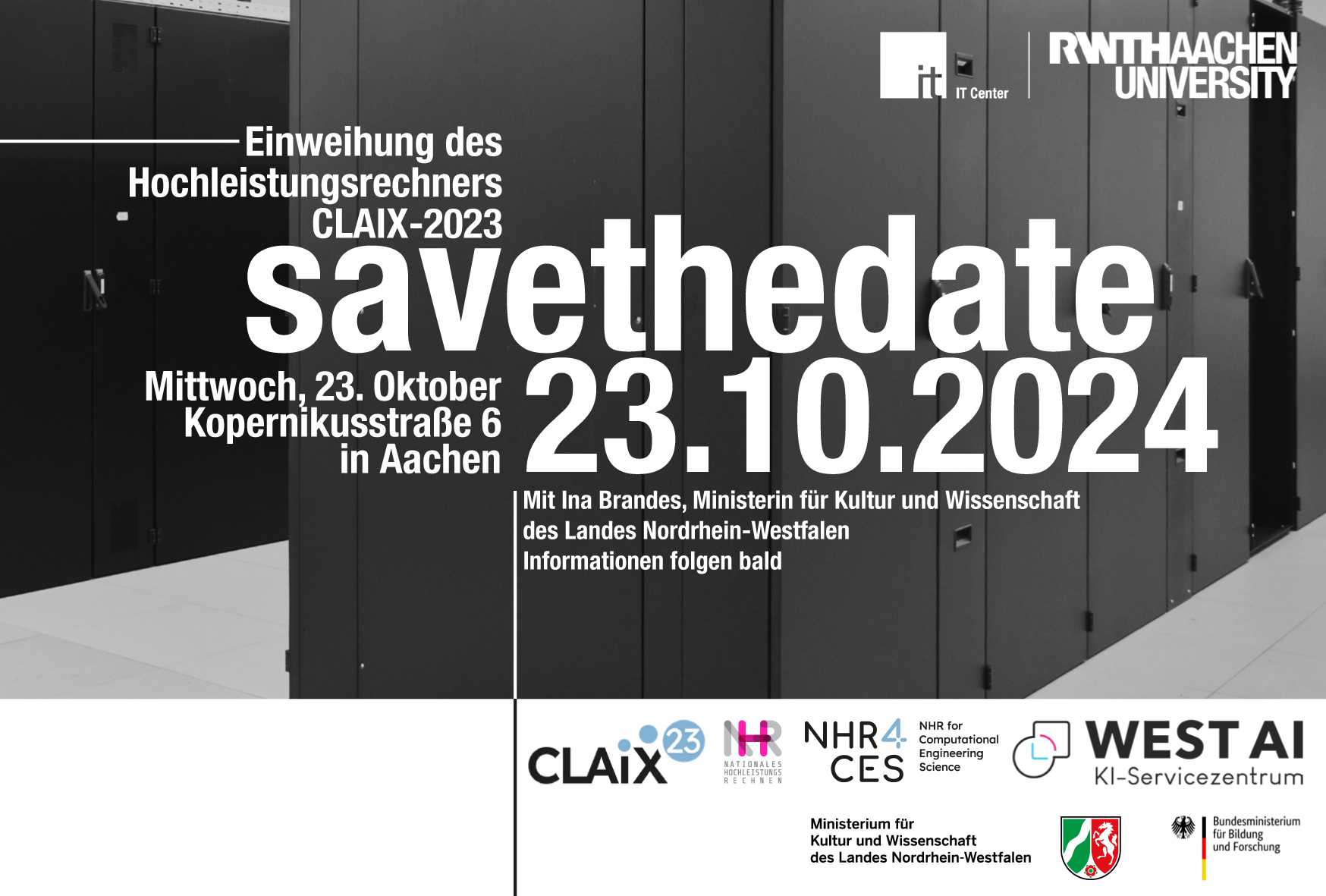
CLAIX-2023 Einweihung
 Veranstaltungsart: Feierlichkeiten
Datum: 23. Oktober ca. 14 – 19:30 Uhr
Ort: IT Center RWTH Aachen
Gäste: Eingeladene Gäste und Interessierte
Wichtige Information: Anmeldung
Anmeldefrist bereits abgelaufen – Bitte melden Sie sich bei dem Veranstaltungsteam für eine nachträgliche Anmeldung.
Beschreibung
Wir am IT Center der RWTH Aachen University freuen uns, die bevorstehende Einweihung unseres neuen Hochleistungsrechners CLAIX-2023 am Mittwoch, 23. Oktober 2024 bekannt zu geben.
Der CLAIX-2023 ist ein hochmoderner Rechner, ausgestattet mit Intel Xeon 8468 Sapphire Rapids CPUs und NVIDIA H100 GPUs, die in 52 spezialisierten Servern für maschinelles Lernen und künstliche Intelligenz integriert sind. Die Gesamtleistung des Systems erreicht beeindruckende 14 PFLOPS im ML-Segment und 4 PFLOPs im HPC-Segment, was ihn zu einer der leistungsstärksten Forschungsressourcen in Europa macht.
Umso mehr ein Grund, diese technische Leistung gebührend zu feiern!
Neben weiteren namhaften Gästen freuen wir uns sehr darauf, Ina Brandes, Ministerin für Kultur und Wissenschaft des Landes Nordrhein-Westfalen, bei dem Einweihungs-Event begrüßen zu dürfen.
Die Einweihung von CLAIX-2023 markiert einen Meilenstein in der digitalen Transformation der RWTH Aachen. Sie zeigt das Bestreben der Universität, ihre Position als führende Forschungseinrichtung in Deutschland und Europa zu festigen. Mit diesem neuen Hochleistungsrechner sind die Wissenschaftlerinnen und Wissenschaftler der RWTH bestens gerüstet, um die Herausforderungen der Zukunft zu meistern und bahnbrechende Entdeckungen zu machen.
Weiterführende Informationen zum CLAIX-2023 finden Sie auf dem IT Center Blog.
Agenda
14:00 – 15:45 Uhr Festliche Einweihung mit Grußworten und Pressefotos
15:45 – 18:15 Uhr Einblick in Forschungsfelder und Anwendungen
18:15 – 19:30 Uhr Führungen durch den “Cluster Aix-La-Chapelle” (CLAIX-2023) sowie Ausklang und Get-Together
Parallel Computing with MATLAB on the CLAIX Cluster
We are excited to announce the continuation of the successful collaboration between HPC.NRW and MathWorks for the third consecutive year, offering a comprehensive series of four workshops designed to empower researchers, engineers, and scientists. This unique series aims to enhance skills in high-performance computing (HPC), software development for research, and artificial intelligence (AI) with MATLAB.
The second part of the Parallel Computing with MATLAB series focuses on walking users through accessing the cluster, setting up a cluster profile, and submitting sample jobs. FastX is used to launch MATLAB interactively, where users are shown how to set job submission arguments before running both single node and multi node jobs. Users will follow along and submit various CPU-only jobs before discussion moves to using GPUs. Additionally, users will learn how to debug and troubleshoot if any errors appear.
Workshop Series
- Parallel Computing with MATLAB
- Parallel Computing with MATLAB on the CLAIX Cluster (this course)
- Introduction to Research Software Development with MATLAB
- AI for Predictive Maintenance
Organization
- There is no seminar fee.
- Presentations will be given in English. Slides will be available after the event.
- This is an online event and will be held in Zoom. Links are sent to registered attendees with the registration confirmation.
- You can/must register per topic, i.e., for each workshop separately.
Speaker
- Damian Pietrus (MathWorks)
Course level
- Intermediate
Target audience
- MATLAB users interested in scaling to HPC
- Existing HPC users of the interested in parallel MATLAB
Prerequisites
-
- Basic MATLAB familiarity
- Existing Account on the CLAIX cluster of RWTH Aachen University
- MATLAB Client and Parallel Toolbox installed on your local Workstation/Laptop
- Network Access to CLAIX (Networks external to RWTH Aachen University may need VPN Access)
Gained skills
- How to configure MATLAB to submit jobs to the CLAIX cluster
- The MATLAB job submission workflow
- Job optimization and tuning
- Using GPUs with MATLAB
- Troubleshooting job submission techniques
- Best practices for rehosting code onto the cluster
Registration
Course Material
Cooperation Partners
 |
 |
NHR4CES – Introduction to eXtended Discontinuous Galerkin Methods for Multi-Phase Flow Problems
Name: Introduction to eXtended Discontinuous Galerkin Methods for Multi-Phase Flow Problems
Date: 14.05.2024 1.00 pm – 5.00 pm
Format: online
Description
Short abstract:
NHR4CES – Introduction to Turbulence Modeling and Numerical Implementation
Name: Introduction to Turbulence Modeling and Numerical Implementation
Date: 07.05.2024, 1.00 pm – 5.00 pm
Format: online
Description
Short abstract:
NHR4CES – Efficient HPC implementation for Lagrangian particle tracking
Name: Efficient HPC implementation for Lagrangian particle tracking
Date: 30.04.2024 1.00 pm – 5.00 pm;
Format: hybrid
Description
NHR4CES – Introduction to Finite Element Methods for Flow Problems
Name: Introduction to Finite Element Methods for Flow Problems
Date: 23.04.2024 01.00 pm – 05.00 pm
Format: Online
 Events