Nils Münstermann earns an Award
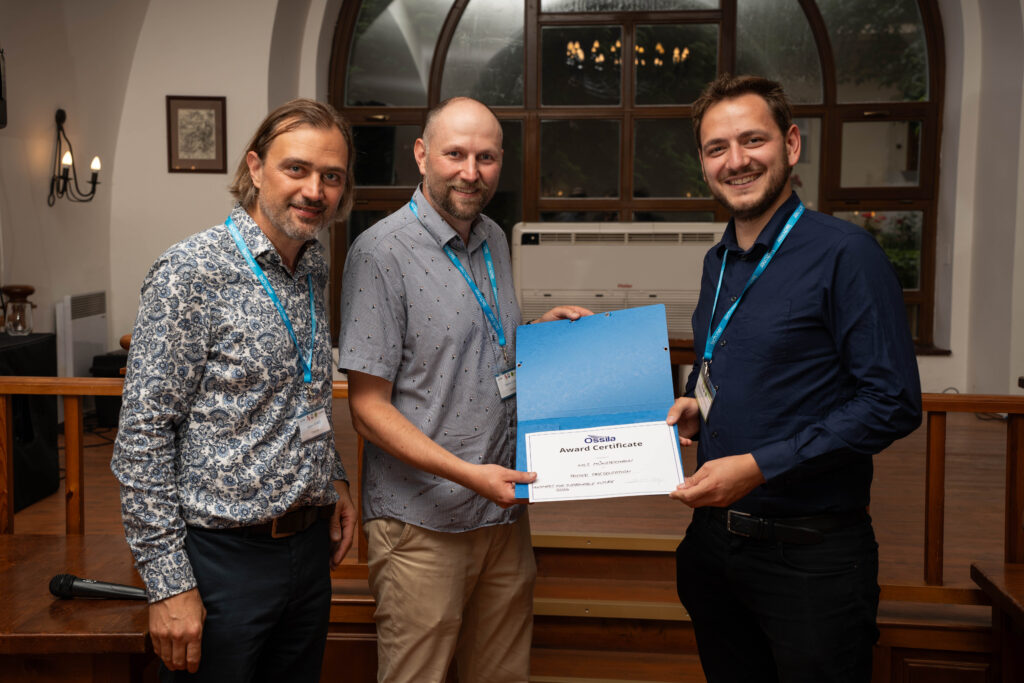
Nils Münstermann receives the poster prize at the Polymers for Sustainable Future 2024 conference in Prague for his contribution ‘Chitosan-Based Coatings for the Water-Proofing of Wood’.
Completed Master Thesis
We would like to congratulate Lena Schmitz on successfully completing her Master’s degree in Chemistry. The title of her Master’s thesis is: ‘The influence of additives on the mechanical properties of thermoplastic biocomposites made from hydrolysed keratins’.
Completed Master Thesis
We would like to congratulate Sandra Czypionka on successfully completing her Master’s degree in Chemistry. The title of her Master’s thesis is: ‘Comparison of methods for determining the biodegradability of sustainable polymer composites’.
WTA-Days 2024
We were represented with a total of four lectures at the WTA Days 2024, 14-16 March 2024 in Brno, Czech Republic.
Prof Weichold presented a lecture entitled ‘Alkaline hydrogels as multifunctional repair materials’. From the field of bio-based construction materials, Fabian Weitenhagen gave a presentation on ‘Renewable Polyester Resin Systems for Sustainable Construction Materials’, Paul Marten gave a presentation on ‘Chitosan as a Key Component in the Production of Sustainable Acrylic Glass-Wood Laminates’ and Nils Münstermann gave a presentation on ‘Chitosan as an Eco-Friendly Binder for High-Strength Fibreboards in Sustainable Construction’.
All in Focus!
The two microscopes in the BX53M series from Olympus offer a wide range of examination options thanks to their extensive equipment. They enable material analyses with a magnification of up to 50x in bright or dark field as well as under fluorescent light or a polarisation filter. In addition, panoramic and EFI images can be taken automatically with the motorised stage, ensuring efficient and precise documentation of samples.
Future in Print: Full Speed Ahead!
We have purchased a Prusa MK4 3D printer for the reproducible and high-quality production of prototypes and samples from our bio-based materials. With its high-precision printing technology and support for various materials, it enables the realisation of complex designs and detailed structures – ideal for our research projects.
The Prusa MK4 ensures consistent printing results thanks to its precise control and automatic calibration. This opens up new possibilities for the development and testing of innovative bio-based materials and devices.
We zoom in, til the electrons dance
The Philips XL-30 scanning electron microscope enables our research group to perform precise and advanced material analyses. It utilises field emission technology to create high-resolution images of samples, while offering the ability to analyse materials under realistic environmental conditions, such as increased humidity. This flexibility is particularly valuable for analysing complex building materials and their reactions in different environments.
62nd DAfStb Research Colloquium
Prof Weichold gave a lecture entitled ‘Highly alkaline hydrogels – the Swiss army knife of repair’ at the 62nd Research Colloquium of the German Committee for Reinforced Concrete, also the 10th Annual Conference, 26-27 September 2023 in Aachen.
17th ICPIC

Tim Mrohs was awarded 2nd place for a short paper and the presentation of his poster at the 17th International Congress on Polymers in Concrete (ICPIC) 2023 in Warsaw, Poland, entitled: ‘Alkaline Hydrogels – Multifunctional Materials for Concrete Rehabilitation’.
Prof Weichold gave a presentation entitled ‘Ionic Conductive Polyesters-Assessing the Risk of Corrosion in Steel-Reinforced Concrete’
Addendum Nov. 2024: Both articles are published in Springer Proceedings in Materials, Vol. 61 ‘Concrete-Polymer Composites in Circular Economy’. See also entry from 9 November 2024.
21st ibausil
Prof. Weichold gave a keynote lecture entitled ‘Alkaline, multifunctional hydrogels in repair’ at the 21st International Building Materials Conference (ibausil), 13-15 September 2023 in Weimar.


