Presentation
Tim Mrohs gave a presentation entitled: ‘Crosslinked, Highly Swelling Diallyldimethylammonium Hydrogels’ at the 13th International Symposium on Polyelectrolytes (ISP) 2023 in Prague, Czech Republic.
3rd ICSTI
Prof. Weichold gave an online lecture entitled ‘The potential of keratin as renewable resource’ at the 3rd International Conference on Science Technology & Innovation (3rd ICSTI), 11 August 2023 in Chiang Mai, Thailand.
IPC2023
At the 13th Society of Polymer Science Japan (SPSJ) International Polymer Conferences (IPC2023), 18-21 July 2023 in Sapporo, Japan, we were represented with two presentations:
Prof Weichold
Firefighting with feathers
Fabian Weitenhagen
Development of bio-based thermosetting polyester resins
Joint publication:
Metal complexes with keratin ligands
In collaboration with the research group led by Prof Panwad Sillapawattana from Maejo University, Chiang Mai, Thailand, complexes of Fe3+, Cu2+, Zn2+ and Ag+ with keratin ligands were produced and possibilities for application in the biomedical field were investigated. In particular, keratin hydrolysates with low molecular weight show higher metal adsorption. The overall results suggest that the specific properties of the complexes, including heat resistance, antibacterial activity and low cytotoxicity, are desirable for medical textiles.
A. K. Aldred, P. Klungsupya, W. Charerntantanakul, O. Weichold, P. Sillapawattana
Preparation of Keratin‑Metal Complexes Derived from Different Treatments of Chicken Feather Waste
Waste Biomass Valor. 2024, 15, 115. https://doi.org/10.1007/s12649-023-02154-z
Full steam ahead – hold on to your heads!
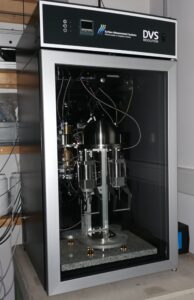
In order to better understand the sorption properties of our materials under real conditions, we are now using the DVS Resolution Advance from Surface Measurement Systems. This highly specialised device allows us to measure the water and gas adsorption of our materials precisely and under controlled environmental conditions.
The DVS Resolution Advance is characterised by its high sensitivity and flexibility. It enables detailed insights into the adsorption and desorption processes as well as the calculation of important parameters such as sorption isotherms and diffusion coefficients. This data is crucial for further optimising the functionality and efficiency of our materials.
Presentation
Tim Mrohs gave a presentation at the 59th Aachen Building Materials Day 2022 in Aachen, Germany entitled: ‘Low-acrylate gels for corrosion protection – theory’.
New publication:Resistance of crosslinkers in alkaline hydrogels
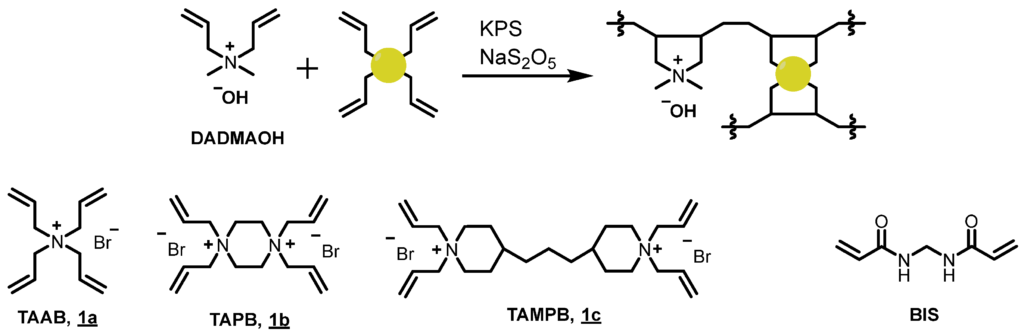
As part of our work on highly alkaline diallyldimethylammonium hydroxide (DADMAOH) hydrogels for the repair of mineral building materials, T. Mrohs and O. Weichold analysed the resistance of the four crosslinkers shown above. Classic amides such as N,N′-methylenebisacrylamide (BIS) decompose by slow hydrolysis, which leads to liquefaction of the gels. N,N,N′,N′-tetraallylpiperazinium dibromide (1b) decomposes surprisingly quickly due to chemical instabilities. In contrast, hydrogels with tetraallylammonium bromide (1a) or N,N,N′,N′,N′-tetraallyltrimethylene dipiperidinedibromide (1c) show no traces of degradation products even after 28 days at 60 °C. This corresponds to a shelf life of over 15 months at room temperature – sufficient for applications such as realkalisation or chloride extraction. These results show that such innovative materials are ideal for long-lasting construction applications.
T. B. Mrohs, O. Weichold
Hydrolytic Stability of Crosslinked, Highly Alkaline Diallyldimethylammonium Hydroxide Hydrogels
Gels 2022, 8, 669. https://doi.org/10.3390/gels8100669
New PhD Student
Since July, we have welcomed Paul Marten to the bio-based building materials department. As part of his dissertation, he is working on the derivatisation of chitosan and its application, including as an additive for PLA and as an adhesive or primer for wood/PMMA composite systems or wood laminates, for example. The aim of his research is to develop bio-based, sustainable and biodegradable systems with outstanding physical properties, while avoiding petrochemical substances as far as possible. We wish him every success in his research and welcome him to the working group.
New publication:
Gels as multifunctional repair materials
Alkaline hydrogels based on diallyldimethylammonium hydroxide (DADMAOH) can fulfil 3 important functions of repair materials for cracked concrete: Sealing of the crack to prevent water leakage, re-alkalisation of carbonated cement paste, which restores the alkali buffer, and re-passivation of steel reinforcement, which prevents corrosion of the reinforcement. In a proof-of-concept experiment, for example, the sealing properties of the gel were successfully tested on a cracked test specimen, where no leakage was observed under a water pressure of 5 metres for 28 days (WTA test W2.1-E).
A. Jung, O. Weichold
A 3-in-1 alkaline gel for the crack injection in cement-based materials with simultaneous corrosion protection and re-passivation of crack-crossing steel rebars
Construction Building Mater. 2022, 344, 128092. https://doi.org/10.1016/j.conbuildmat.2022.128092
Completed Master Thesis
Congratulations to Paul Marten on successfully completing his Master’s thesis entitled ‘Development of chitosan lactate-based additives for polylactide (PLA)’ in the Chemistry degree programme.


