Kategorie: ‘Allgemein’
Call for CITY CYCLING
© Martin Braun
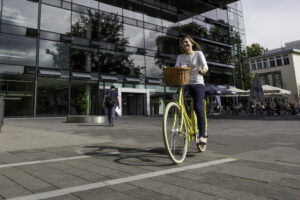
From 1 to 21 June, the CITY CYCLING competition goes into the next round. The aim of the competition is to use the bicycle as often as possible within the 21 days and thus not only to make a contribution to climate protection, but also to ensure a better quality of life in the municipalities.
The CITY CYCLING campaign contributes making cycling more present in public discourse and supports the targeted improvement of cycling infrastructure. The routes tracked by app during CITY CYCLING are evaluated anonymously by “Technische Universität Dresden” and the results are passed on to the municipalities.
Who can participate?
CITY CYCLING is intended for everyone. Regardless of whether the bicycle is already used as the main means of transport or spends most of its time in the basement. Every kilometre cycled counts. Even more so if it would otherwise have been covered by car.
The Faculty of Electrical Engineering and Information Technology is taking part in this campaign and has founded the team “Fakultät für Elektrotechnik & Informationstechnik”. To join the Faculty team, registration is required. You can join our team until the last of the 21 CITY CYCLING days.
The kilometres covered can either be entered online in the km-book or tracked via the CITY CYCLING app (Android and iOS). But participation is also possible without internet access. In this case, cyclists can report their cycling kilometres weekly to the local CITY CYCLING coordination via a kilometre log sheet.
Even though it is primarily about promoting cycling and protecting the environment, there are also prizes to be won, among others, for the most active municipalities and municipal parliaments.
For more information, feel free to take a look at the CITY CYCLING website.
We look forward to your participation!
Participation in the “Fast Track Bachelor Admission” Programme (FTBA)
 In the winter semester 2022/23, the Faculty of Electrical Engineering and Information Technology will participate in the “Fast Track Bachelor Admission” programme for the first time. This programme enables particularly talented pupils from abroad to directly enter a Bachelor’s degree programme.
What is the “Fast Track Bachelor Admission” programme?
Normally, students from abroad have to attend a “Studienkolleg” (preparatory course) in Germany or study for two semesters in their home country in order to be able to study in Germany. Through the support programme “Fast Track Bachelor Admission (FTBA)”, RWTH Aachen University enables particularly talented pupils to enter a Bachelor’s degree programme directly without the usual conditions.
The FTBA programme is offered for the Bachelor degree programmes Electrical Engineering and Information Technology, Computer Engineering, Mechanical Engineering, Business Administration and Engineering: Mechanical Engineering, Computational Engineering Science and Computer Science.
What makes the FTBA support programme so special?
Selected participants benefit from a support programme specially tailored to the target group. This includes close personal support from the FTBA team before arrival and throughout their studies at RWTH Aachen for example. Students also receive subject and language support through specific tutorials.
Would you like to support the upcoming FTBA students as a teaching assistant?
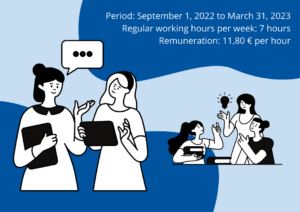
For the winter semester 2022/23, we are still looking for two teaching assistants, who make it easy for the international students to start at RWTH and support them with the preparation and follow-up of assignments as well as with all other questions related to their studies.
Please apply to the coordinator of the FTBA programme, Ms Azadeh Hartmann-Alampour, by June 30, 2022.
Further information and requirements can be found in the job vacancy.
Aachen VDE Award 2022
Bachelor students of “Electrical Engineering, Information Technology and Computer Engineering” or “Business Administration and Engineering – Electrical Power Engineering” with very good performance in their studies in combination with extraordinary commitment in university-related organisations can still apply for the Aachen VDE Award 2022 until May 15, 2022 and win prize money of 500 €.
All further information and requirements can be found in the following PDF file:
eCHECKUP- Alcohol Prevention Tool
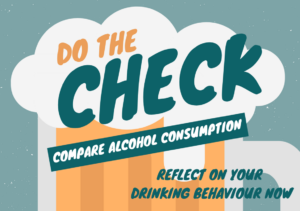 The Student Health Management recently started offering students at RWTH Aachen University the use of the eCHECKUP TO GO-Alcohol prevention tool for free.
By answering the tool’s questions anonymously, students can reflect on their drinking behaviour and compare their own alcohol consumption with that of their fellow students.
Meanwhile, students receive information about the risks and effects of alcohol consumption and a personal risk evaluation for possible addiction or problematic consumption levels. Among other things, alternative methods of action and goal setting are pointed out and the amount of money spent on alcohol is put in relation to other personal areas of life.
Finally, some counselling centres at RWTH Aachen University and in the Aachen city region are given to the students.
We also recommend our students at the Faculty of Electrical Engineering and Information Technology to use the prevention tool so that they can assess and improve the possible impacts of their personal alcohol consumption on their own bodies, finances and studies.
Fit During and After Pandemic – With Energy Boosters from Student Health Management

Copyright: Souhaila Chakkour
To give students a break from their daily pandemic routine, the Student Health Management of RWTH Aachen has launched the ” Fit During and After the Pandemic” workshop series. Once a month, starting on April 6 in the summer semester 2022, meetings will be held online to get new impulses for health topic. The following workshops will be offered:
- Live Cooking: Eastern Flair for Studying at Home
- Workshop: Restoring Your Balance
- Live Cooking: Brain Food – Smart Snacking
- Workshop: Better Vision
- Live Cooking: Eat in a Way That Helps the Planet
- Sports Nutrition (Including Live Cooking)
Workshops are held on Wednesdays starting at 6pm. For current dates and registration options, please visit the official Student Health Management workshop page.
Writing Workshop E-Technology SuSe 2022
Course offer
April 21 to June 30, 2022

Copyright: Martin Braun
Also this semester the “Writing Workshop E-Technology” is offered for the students of Faculty Electrical Engineering and Information Technology. The offer is the result of the collaboration of the Writing Center at the Language Center, the Student Advice Centre and the Faculty of EE & IT at RWTH Aachen University.
Students have the opportunity to register for one of the two courses offered and thus improve their skills in writing a term paper or final thesis. Necessary knowledge and writing strategies will be taught in a practical way. In addition, students can take advantage of an individual online writing consultation.
The course offer is aimed at all Bachelor and Master students of the Faculty of EE &IT who are writing a term paper or final thesis.
Dates
| Group 1 02.84000 |
Group 2 02.08496 |
| Thu, 28.04.2022 | Thu, 21.04.2022 |
| Thu, 12.05.2022 | Thu, 05.05.2022 |
| Thu, 02.06.2022 | Thu, 19.05.2022 |
| Thu, 30.06.2022 | Thu, 23.06.2022 |
Registration
Registration deadline: March 28 to April 4, 2022
Registration takes place via the user account at RWTH Writing Center.
Upon successful participation, students will receive a certificate and 3 CP, which are creditable for the core elective section. International students have to prove a German language skills of at least C1.2 as a participation requirement.
Contact for inquiries: schreibzentrum@sz.rwth-aachen.de
Study worldwide – the virtual fair on March 25, 2022
Copyright: Deutscher Akademischer Austauschdienst e.V. (DAAD)
The online fair “Studying worldwide – the virtual fair” will take place again this year. On March 25, 2022, students can get personal advice on studying or doing internships abroad. There will also be a wide-ranging program on financing options and recommended planning steps. Testimonials from former exchange students will give you personal insights that could be valuable for your own planning process.
- When? March 25, 2022, from 12:30pm to 4:30pm.
- Where? Online.
For more information and to register for free, visit the “Studying Worldwide” exhibition page.
Review of the 150th anniversary exhibition of the RWTH
From October 30, 2021 to February 13, 2022, the 150th anniversary exhibition of the RWTH took place at the Centre de Charlemagne in Aachen. ISEA – the Institute for Power Electronics and Electrical Drives – also contributed with some exhibits to illustrate the highlights from research and the development of RWTH since its foundation in October 1870.
For all those who could not be there and see this wonderful exhibition for themselves, we have a short review.
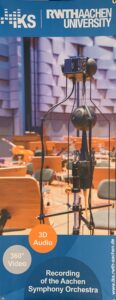
Among others, the IKS was also involved. The project “Virtual visit” dealt with the 3D telephony of the future: Who hasn’t had the wish to beam to the other side while talking on the phone? At least via audio, this would be possible in the future; for example, one could already sit virtually in the middle of a concert of the Aachen Symphony Orchestra.
Prof. Dr. Peter Jax presented the state of the art as well as current research topics in his lecture and invited to an exciting discussion afterwards.
It was very interesting to get to know a current research project of the IKS and to experience the research live.
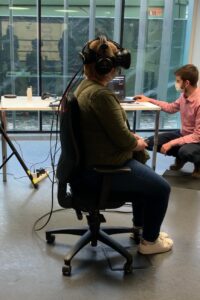
The content of the lecture was further illustrated in the exhibition by virtually sitting in the middle of the concert of the Aachen Symphony Orchestra. The aim was to perceive the sound in 3 dimensions. To experience this phenomenon, all one had to do was put on a pair of virtual reality glasses and enjoy the sounds of the Aachen Symphony Orchestra.
It was particularly fascinating to be able to hear the sounds from all directions and at the same time to be able to identify the direction from which they came. It was easy to follow the sounds more closely by turning around to look at them with the glasses. It was really a great insight into the research of the IKS.
The Future of Networking
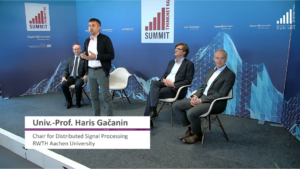 Professor Dr. Haris Gačanin, head of the Chair for Distributed Signal Processing and co-director of the Institute of Communication Technologies and Embedded Systems, presented the research activities of the 6GEM Research Hub at the Thinknet 6G Summit. The Thinknet 6G Summit is an international conference focused on the next generation of communication networks.
As digitalization progresses, mobile communications communication takes on the crucial role of providing the communication infrastructure for society as a whole. The current generation of mobile communication, 5G, is the first to shift focus away from individual end-user communications to industrial applications (Industry 4.0), logistics, transportation and eHealth. The subsequent generation, 6G, is expected to further expand network capacity and speed to enable applications with significantly higher connectivity requirements, such as fully autonomous driving.
In this regard, the 6GEM Research Hub is focusing more on the practical impact that 6G will have on our society. After all, this advanced infrastructure must provide adaptive and resilient communication systemss for a wide range of requirements and applications for the benefit of humanity.


