
source: own illustration
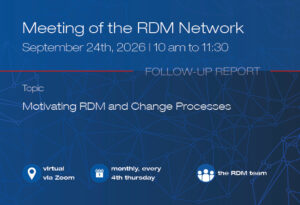
On September 24, the monthly FDM network meeting took place, giving data stewards and others interested in FDM the opportunity to discuss FDM-related topics.
This meeting focused on how data stewards can motivate researchers to use FDM resources and drive change processes forward. Participants discussed challenges and shared examples of best practices.
Challenges
Many data stewards face the challenge that researchers are reluctant to use existing research data management (RDM) services or do not use them at all.
Yet the widespread implementation of research data management in accordance with the FAIR principles offers many advantages. Nevertheless, there is often resistance to using RDM services, such as ELNs, Coscine, or RDMO. This resistance is usually rooted in the uncertainty associated with introducing new processes. Researchers prefer to stick to familiar workflows, even though these can have a detrimental long-term impact on the usability of research data.
One difficulty that the data stewards particularly highlighted at the network meeting was the lack of feedback from potential users. Although the data stewards are aware that researchers on certain projects do not use RDM tools, the reasons for this are largely unknown. The question of what potential users need to integrate RDM into their daily research routines remains unanswered.
Success Stories from Practice
However, the discussions among the data stewards at the network meeting were not limited to challenges. Several participants shared their success stories from practice and presented strategies they used to successfully advance the implementation of RDM within their research projects.
One key to success appears to be the early integration of RDM into the academic careers of early-career researchers.
Several degree programs at RWTH already include required courses in which RDM is implemented. RDM can be integrated into degree program curricula in various formats: In the bachelor’s program in chemistry, for example, there is a laboratory practicum in which students are required to work with ELNs. In the master’s program in architecture, students must complete a self-study module on RDM.
The departments that integrate RDM into their programs in this way report that future doctoral candidates already possess prior knowledge of RDM. They are prepared to integrate research data management into their research, thereby ensuring the long-term reusability of their data in accordance with the FAIR principles.
Change Processes for the Future
Finally, the network meeting discussed how to bring about a shift in the acceptance of RDM and motivate more researchers to use RDM resources themselves.
In addition to early integration into curricula, a solution-oriented presentation of RDM was proposed as a potential solution. Rather than making the use of RDM services mandatory, they should be viewed as solutions to existing problems. This approach can increase the acceptance and implementation of RDM services.
Save the Date – Network Meeting in October
All interested parties are cordially invited to attend the upcoming network meeting and actively participate in the discussion.
- Topic: ELN / eLabFTW
- Date: Thursday, October 22, 2026
- Time: 10:00 a.m. – 11:30 a.m.
- Location: Online (Zoom); registration via the RWTH event database
We look forward to an engaging exchange, new ideas, and continuing to develop the network together.
Learn More
Would you like to receive regular updates about the FDM network meetings? Then subscribe to the “DataStewards@RWTH” mailing list. If you have any questions about the network meeting or FDM topics, the RDM team at RWTH Aachen University is happy to assist you at any time.
Responsible for the content of this article is Hedda Faber.








Leave a Reply
You must be logged in to post a comment.