Kategorie: ‘Informationstechnische Systeme’
Rethinking Intensive Care Medicine
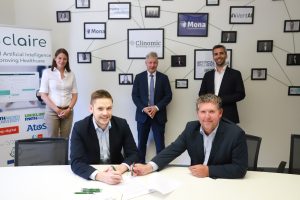 Nowadays, patients receive comprehensive treatment from a number of qualified medical professionals. Through a unique combination of translational medical research, data science and computational intelligence, Clinomic GmbH aims to serve as an interface between medical professionals and databases. The result? Mona, the intelligent assistance system for intensive care units, which is designed to support nurses and doctors in the optimal treatment of their patients.
Clinomic GmbH was founded in 2019 by an interdisciplinary research team. Among the founding members are Univ.-Prof. Anke Schmeink from the Department of Information Theory and Systematic Design of Communication Systems, Prof. Guido Dartmann from theInstitute for Communication Technologies and Embedded Systems and Dr. med. Arne Peine, Priv.-Doz. Lukas Martin and Univ.-Prof. Gernot Marx from the Universitätsklinik Aachen together with Univ.-Prof. Christoph Thiemermann from the William Harvey Research Institute of Queen Mary University of London.
Since its launch, Clinomic GmbH has not only won the RWTH Spin-off Award 2019, but has also received funding of 1.6 million euros and is a partner of renowned companies such as Microsoft, NVIDIA and Google.
Project “The People’s Ventilator – PV1000” enters the practice test
Since April 2020, employees, colleagues and alumni of the RWTH Aachen around Prof. Dr.-Ing. Dr. med. Steffen Leonhardt have been developing a ventilator that is medically suitable for ventilating COVID-19 patients in intensive care units over several weeks. It is intended to serve as a simple and robust device in situations where conventional ventilators are in short supply.
Now the project has reached an important milestone: the so-called “Graphical User Interface” is being tested by ventilation experts throughout Germany, including numerous medical directors of intensive care units. They are testing whether the result really does enable safe operation in intensive care units. The feedback is incorporated into the software as quickly as possible so that the next step – the integration of all individual elements of the PV1000 in a first prototype – can be completed soon.
Ventilators are complex technical systems that support different ventilation modes and must react correctly to many situations. An essential success factor is easy and comprehensible operation by medical personnel. In addition to the Chair for medical information technology (MedIT) , the Chair for medical technology (mediTEC) , another partner from the RWTH, was able to contribute its expertise in the safe and usable development of medical devices. For the PV1000, the operating concept developed by the Chair for computer science 11 – Embedded Software (i11) has now been implemented and the programming completed.
Artificial Synapses made to measure
“Resistance with memory” – As part of the research team of the Jülich Aachen Research Alliance (JARA), Professor Rainer Waser is working on memristive components together with the German technology group Heraeus. The latest results could pave the way for numerous applications, such as energy-efficient, non-volatile memories or neuro-inspired computers.
Jara.org, 11.05.2020
Contest 5G.NRW
State government supports 13 outstanding 5G projects with up to 26 million Euro
The new 5G generation of mobile communications not only enables higher data transmission rates, but also real-time transmission and the networking of machines, systems and robots in industry.
The Department of Information Theory and Systematic Design of Communication Systems ISEK has developed the project 5GComet, a real-time capable 5G-end-to-end infrastructure between field and cloud level for industrial applications in cooperation with Fraunhofer IPT, WZL and other partners. The aim is to achieve a cross-process network of smart workpieces, machines and services for intelligent applications to control and optimize production.
As one of 13 innovative projects, 5GComet is being funded with a total of 26 million euros.
Source: Wirtschaft.NRW
New Fraunhofer Center Digital Energy for Aachen
 Even in challenging times, future crises must be addressed:
How can the challenges for the energy sector and the energy-intensive industry resulting from the coal phase-out be mastered?
Scientists at the new Fraunhofer Center for Digital Energy in Aachen are researching answers to these questions. This week the starting signal was given for the construction of the center (construction work is expected to start in 2022 on the Melaten campus). Under the leadership of Fraunhofer FIT, our chairs Automation of Complex Power Systems (Prof. Monti) and Active Energy Distribution Networks (provisionally Prof. Moser) are also involved.
According to Prof. Wehrspohn, Fraunhofer Executive Board member responsible for technology marketing and business models, this launch will make an important contribution to the innovation-oriented structural change in the Rhenish region. The aim is to lay the foundations for technically reliable, hacker-proof and economically attractive digitalized energy infrastructures in the Rhenish mining area and to put them into operation.
You find more information on the website of Fraunhofer Center Digital Energy

