Kategorie: ‘Allgemein’
First Virtual Workshop Taiwan – Germany

Foto: Stefan Hense
On December 14, 2020 the first Virtual Workshop between several professors of our faculty and the National Chiao Tung University, Taiwan, will take place in the course of the international cooperation and research orientation of RWTH Aachen University.
The workshop will focus on the exchange of current research projects and the expansion of international collaborations. From the RWTH Aachen University, Professor Andrei Vescan, Professor Sven Ingebrandt and Professor Regina Dittman will lecture on current projects. Speakers from NCTU are Professor Pei-Wen Li, Professor Yu-Ting Cheng, and Professor Der-Hsien Lien.
The corresponding programme of the Virtual Workshop can be found on the website of the Institute for Materials in Electrical Engineering 1.
DFG priority program AUDICTIVE
Within the framework of the priority program AUDICTIVE of the DFG (German Research Foundation) three projects with the participation of Prof. Dr.-Ing. Janina Fels were approved. On the one hand, the coordination project, which focuses on interdisciplinary exchange and research data management, was approved. On the other hand, the project “Listening to, and remembering conversations between two talkers: Cognitive research using embodied conversational agents in audiovisual virtual environments”, which is a joint proposal with Prof. Dr. Torsten W. Kuhlen and Prof. Dr. Sabine J. Schlittmeier, will be funded. Furthermore, the project “Evaluating cognitive performance in classroom scenarios using audiovisual virtual reality – ECoClass-VR”, which is a joint proposal with Prof. Dr.-Ing. Alexander Raake, TU Ilmenau and apl. Prof. Dr. Maria Klatte, TU Kaiserslautern, will be funded.
The priority program “Auditory Cognition in Interactive Virtual Environments – AUDICTIVE” is intended to make it possible, by linking the three disciplines – acoustics, cognitive psychology and virtual reality/computer science – to significantly expand the knowledge about hearing-related cognitive performance in real scenes and thus to realize the development of an “auditory-cognitive-validated” VR technology. By applying interactive VR technology, it should be possible to understand auditory perception in complex audiovisual scenes that are close to real life. Situations such as classrooms, open-plan offices, multi-party communication or outdoor scenarios with multiple (and moving) sound sources should be better understood with the help of the results.
FGE-Kolloquium with devolo AG online – 3.12.2020
On Thursday, 03.12.2020 at 18.00 hrs, an event will take place as FGE Colloquium with the title: “The largest national IT project of all times: The digital transformation in the energy industry”.
Speaker of this lecture is Dr. Christoph July from devolo AG.
You will receive the dial-in information for the event at the following e-mail address
fge-kolloquien@iaew.rwth-aachen.de
The event will take place within the framework of the colloquia of the Forschungsgesellschaft Energie (FGE e.V.) planned for the winter semester 2020/21. Due to the corona pandemic, this event will be held online.
Event series FGE Colloquia
Further exciting FGE colloquia, which will take place in the winter semester on the topic of energy technology and economics, are on the following dates and can also be accessed via the online flyer:
| 17.12.2020 | Redispatch in Deutschland und Europa Dr. Niels Ehlers, 50Hertz Transmission GmbH |
| 04.02.2021 | Panel Discussion: Electricity war reloaded – is alternating current still up to date? Prof. Rik W. De Doncker, E.ON ERC, RWTH Aachen, Prof. Jochen Kreusel, ABB Power Grids Germany AG, Peter Barth, Amprion GmbH, Dr. Joachim Kabs, Schleswig-Holstein Netz AG |
SOGNO – Service Oriented Grid for the Network of the Future
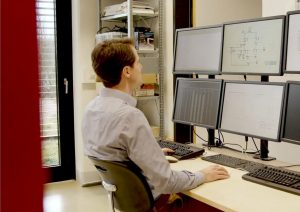
Institute for Automation of Complex Power Systems
RWTH Aachen University recently had a major role in the EU project „Service Oriented Grid for the Network of the Future“ (SOGNO). RWTH was represented by the Institute of Automation of Complex Power Systems (ACS), the Institute of Theoretical Information Technology (TI), and the Chair of Management Accounting. Moreover, Prof. Monti and Dr. Marco Pau from the Institute of Automation of Complex Power Systems served as technical managers of the project, thus coordinating the technical activities within the consortium.
The project SOGNO aims at developing a new concept of distribution grid management, based on the use of 5G communication, advanced deep learning techniques, and cloud virtualization to provide the intelligence needed to control future smart grids as a service for distribution system operators.
Project InductInfra – Will Roads Be Able to Supply Cars With Energy in the Future?
Within the project “InductInfra – Inductive Dynamic Energy Supply of Vehicles via Road Traffic Infrastructure” the Institute of Electrical Machines under the direction of Professor Kay Hameyer and the Institute of Highway Engineering under the direction of Professor Markus Oeser cooperate in this field. The project is financed by the Federal Ministry of Transport and Digital Infrastructure within the framework of the “Road Innovation Program” with about 1.6 million Euros until October 2023.
Both institutes want to develop concepts and material systems for energy transmission between vehicle and road and to research integration into the infrastructure. The aim is for vehicles to draw the energy required for operation or rapid charging from an induction field while driving. Induction modules embedded in the road generate the energy required for this. The project aims to develop the induction modules, the necessary materials and the technologies for their permanent integration into the transport infrastructure. Furthermore, the potential, operational safety and economic efficiency of supplying the induction modules with renewable energy will be determined.
Currently, the electrification of individual and commercial transport is in focus. There are still many problems for long-distance traffic, such as the lack of range, battery size, battery weight and the incomplete charging infrastructure. One possible solution could be continuous charging or energy transfer between the vehicle and the road during the journey. Electric vehicles with a virtually unlimited range, moderate battery size and low battery weight would thus become possible.
Source: Press and Communications RWTH
Neuromorphes Computing – DFG Funding Memristive Components
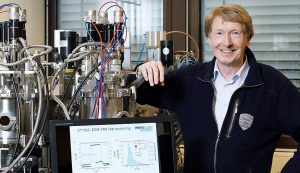
Prof. Dr.-Ing Rainer Waser, head of the Institute for Materials in Electrical Engineering at the RWTH Aachen, at a sputtering plant for surface coating
The German Research Foundation (DFG) is funding five projects under the priority program “Memristive Devices Toward Smart Technical Systems” with the participation of members of the Faculty of Electrical Engineering and Information Technology at RWTH Aachen University.
Four of them are projects at the chair of Prof. Rainer Waser IWE2 and the Peter Grünberg Institute of the Forschungszentrum Jülich. A further project was approved in the teaching and research area of Prof. Regina Dittmann “Technology of Oxide Electronics” also at the Peter Grünberg Institute.
The funding amount of the 5 Jülich-Aachen projects amounts to approx. 1.2 Mio € for a duration of 3 years. Within the framework of the different projects, Faculty 6 will develop memristive components in cooperation with other research institutions for use in novel energy-efficient computer structures or for intelligent sensor applications for the future Internet of Things.
Project ERIGrid 2.0 – validation approach for intelligent energy networks in the electrical sector
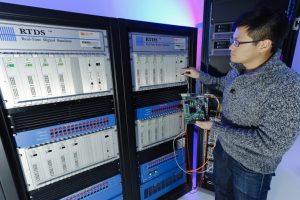
Image: www.erigrid2.eu/rwth
In April this year, the second version of the “ERIGrid 2.0” project of the Institute for Automation of Complex Power Systems at the E.ON Research Center was launched.
Its full name is as complex as the four-year project as “ERIGrid 2.0” stands for “European Research Infrastructure supporting Smart Grid and Smart Energy Systems Research, Technology Development, Validation and Roll Out – Second Edition”.
Professor Antonello Monti’s team is working on the holistic and cyberphysics-based validation approach for intelligent energy networks in the electrical sector. ERIGrid 2.0 provides support and training at system level for industrial and academic research and technology development for energy systems.
RWTH earns top positions in this year’s NTU ranking
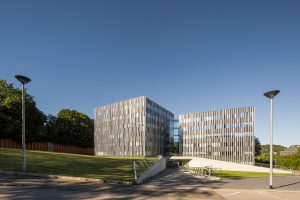
Image: Martin Braun
Every year, the National Taiwan University (NTU) compiles a ranking of the top 800 universities in the world in six different disciplines and a total of 24 individual subjects. For this internationally respected ranking, NTU evaluated various bibliometric indicators, such as international scientific publications, and ranked them according to scientific productivity, excellence, and influence in research.
RWTH Aachen University performed very well in the German ranking, since the institution is currently listed among the best universities in Germany for 18 of 24 subjects. RWTH scored first place in Germany for the subjects civil engineering, chemical engineering, and mechanical engineering. Finally, the University was ranked second in Germany for electrical engineering and third for chemistry, computer science, and mathematics. (Source: RWTH Press, Image rights: Martin Braun)
⚡ 5 Minutes About… Prof. Dr.-Ing. Haris Gačanin
Since April 2020, Prof. Dr.-Ing. Haris Gačanin is the new head of the Chair of Distributed Signal Processing and co-director of the Institute for Communication Technologies and Embedded Systems. In this interview, he talks about his reasons for coming to Aachen, the benefits of learning a new language, and how he can best switch off.

⚡ 5 Minutes About… Prof. Dirk Uwe Sauer
The professor from the Department of Electrochemical Energy Conversion and Storage Systems Engineering and winner of the 2019 Teaching Award talks about his studies, his current project and the future of electrical engineering.


