Kategorie: ‘Innovation’
A smart box for all space-related situations
Today, satellites perform critical tasks, such as locating hotspots, providing GPS signals, or collecting weather data. To ensure they can reliably fulfill these functions, they must be regularly adapted or expanded. This is precisely where the EU-funded “smartCASE” (Configurable Adaptive Spacecraft & Spacecraft Extensions) project, in which researchers from RWTH Aachen University are participating, comes into play.
The project’s goal is to develop modular components that allow satellites and space systems to be expanded, modified, or reconfigured even while in operation. The concept of modularization has been pursued at RWTH for several years and is gaining additional significance through current European funding programs.
The focus is on developing an intelligent “box,” which is being realized with a funding volume of 2.5 million euros. This box can dock with existing satellites and integrate new functions. The principle can be compared to an app on a smartphone: The satellite recognizes the new application and independently expands its range of functions.
The project is being coordinated at the Institute for Human-Machine Interaction (MMI) under the direction of Professor Jürgen Roßmann. Dr. Ulrich Dahmen initiated the project and assembled a team from various disciplines. In addition to the MMI, the Institute for Structural Mechanics and Lightweight Construction (SLA), led by Professor Kai Uwe Schröder, is also involved. The consortium is complemented by five international industry partners.
The tasks within the project are clearly divided. The Institute for Human-Machine Interaction (MMI) is responsible for software development, while the Institute for Structural Mechanics and Lightweight Construction (SLA) is developing the box’s mechanical structure. The goal is to create a stable, lightweight, and space-ready solution.
“smartCASE” is part of the major “ISOS” (In Space Operations and Services) mission, which aims to no longer view satellites as rigid, single-use systems, but rather as maintainable and expandable platforms. In this context, so-called satAPPs—modular applications for satellites—are being developed. These are intended to be connectable via a unified interface to expand, repair, or modernize satellites in space.
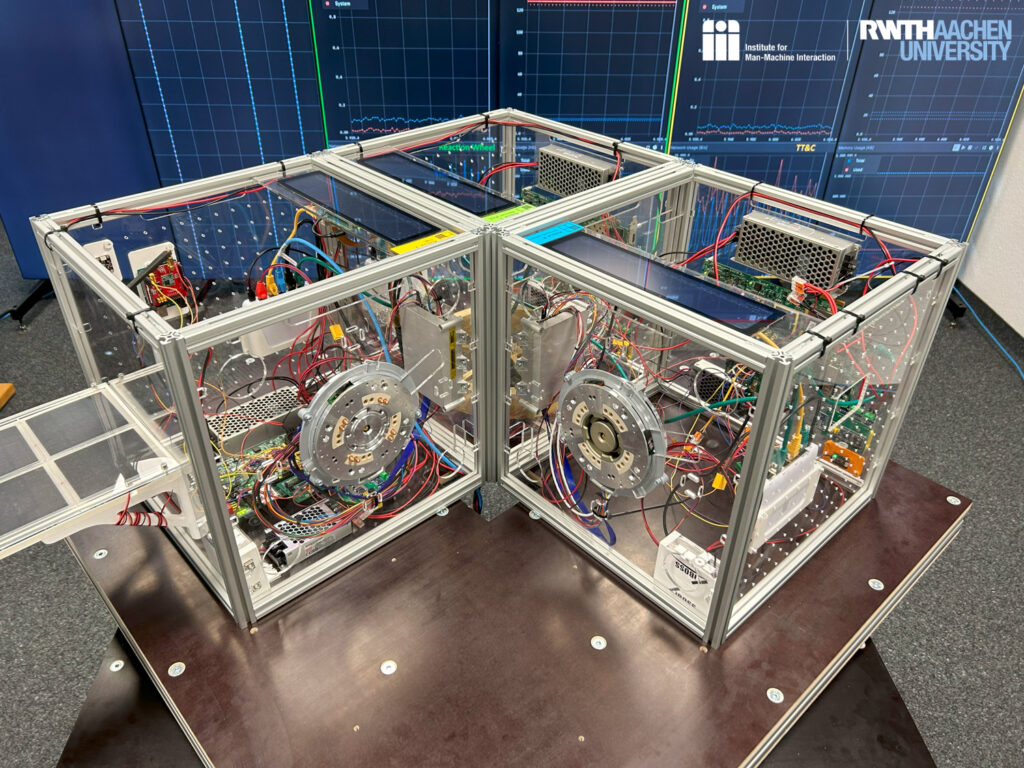
Image: Institute for Human-Computer Interaction (MMI) at RWTH
The foundation for this development was already laid in the “Twins4Space” project, which was completed at the end of 2025. The approaches to modular software infrastructure developed there are now being continued within the framework of “smartCASE.”
The participants have two and a half years to implement the project. The goal is to launch the developed technology into orbit as early as 2030.
The strategic importance of the project is also highlighted by the European Union. “smartCASE” bears the seal of quality from the “Strategic Technologies for Europe” (STEP) platform. This distinction is awarded to projects in the fields of clean, resource-efficient, and digital technologies. The EU considers the project a “high-quality project proposal” that contributes to strengthening Europe’s technological sovereignty.


