Schlagwort: ‘Heureka’
Worlds of Experimentation: Exploring Electrical Engineering
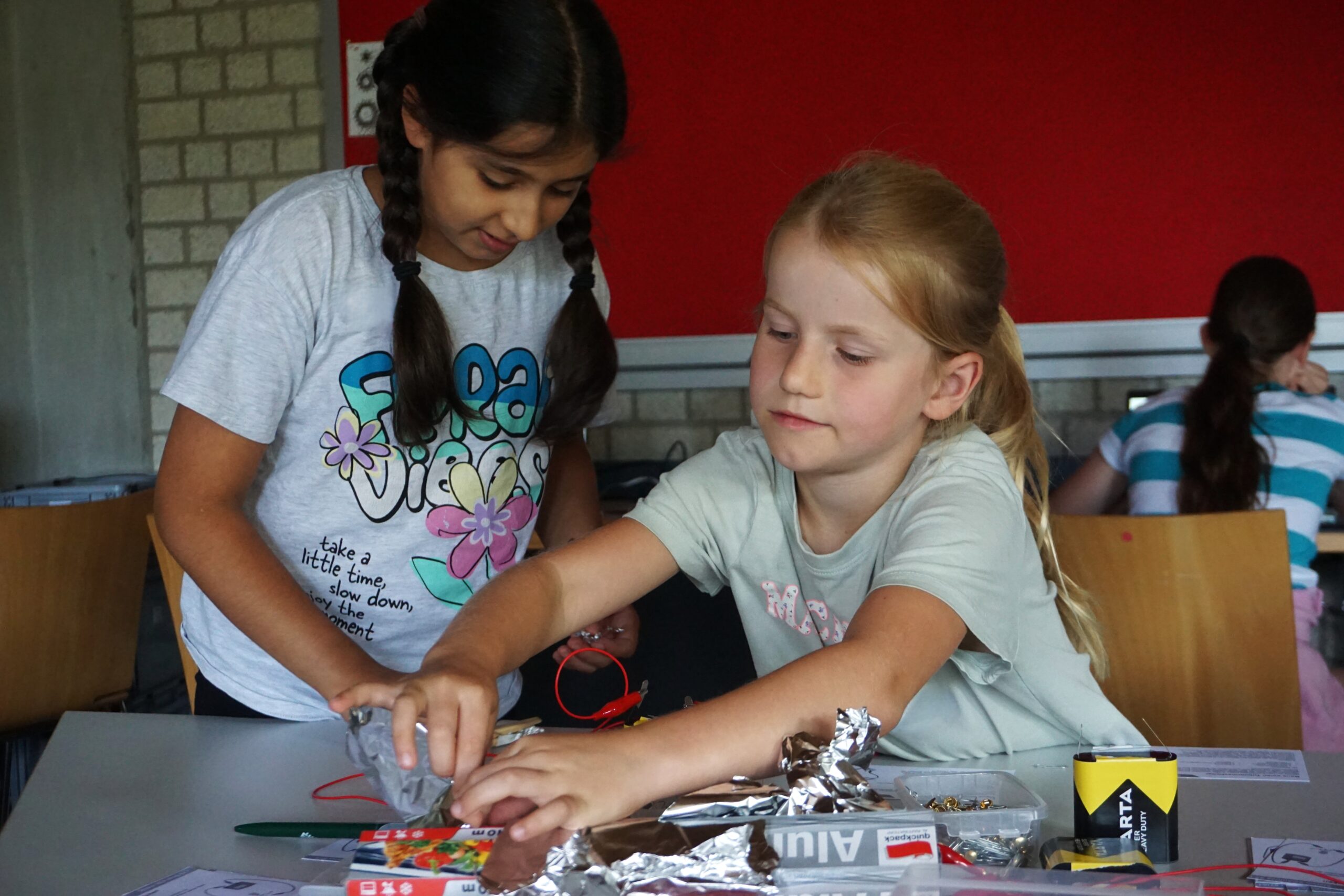
Two young participants are constructing their own slide and dead-man switches for their circuits.
How can you transform cables, a power source, and a small incandescent bulb into a functioning electrical circuit? In the “Experimentierwelten” summer program, children can try their hand at electrical engineering under the guidance of the Heureka Learning Lab.
She scans a row of tables covered with red cables, each of which ends on both sides with alligator clips. She quickly finds a light bulb. A few steps later, it’s securely in the correct socket.
“It really does glow,” says an elementary school student, beaming just as brightly as the light itself.
What we take for granted in everyday life becomes the starting point for a journey of discovery here: How does an electric circuit work? What makes a switch a switch? Why does a simple nail suddenly attract metal staples? And can the force of a magnet be made visible? The focus is on hands-on experimentation: Questions arise from the experiments and are then explored through practical investigation.
This free summer program, aimed at children and teens of various ages, takes place at the Nell-Breuning-Haus, centrally located in Herzogenrath. Depending on the target group and the daily program, participants can try out different STEM activities each year. This summer, the Heureka Learning Lab from the Faculty of Electrical Engineering and Information Technology was once again part of the “Experimentierwelten” program to guide the younger participants.
“What else do you have here?” asks a nine-year-old participant who was already there last year, delighted by the well-stocked experiment kit.
For the faculty, this participation is part of their efforts to support the next generation of researchers. Through the “Experimentierwelten” program, students have the opportunity to become familiar with electrical engineering and information technology at an early age, as well as gain experience with technical concepts. Rather, research here begins with a simple question—and with the courage to seek an answer on their own.
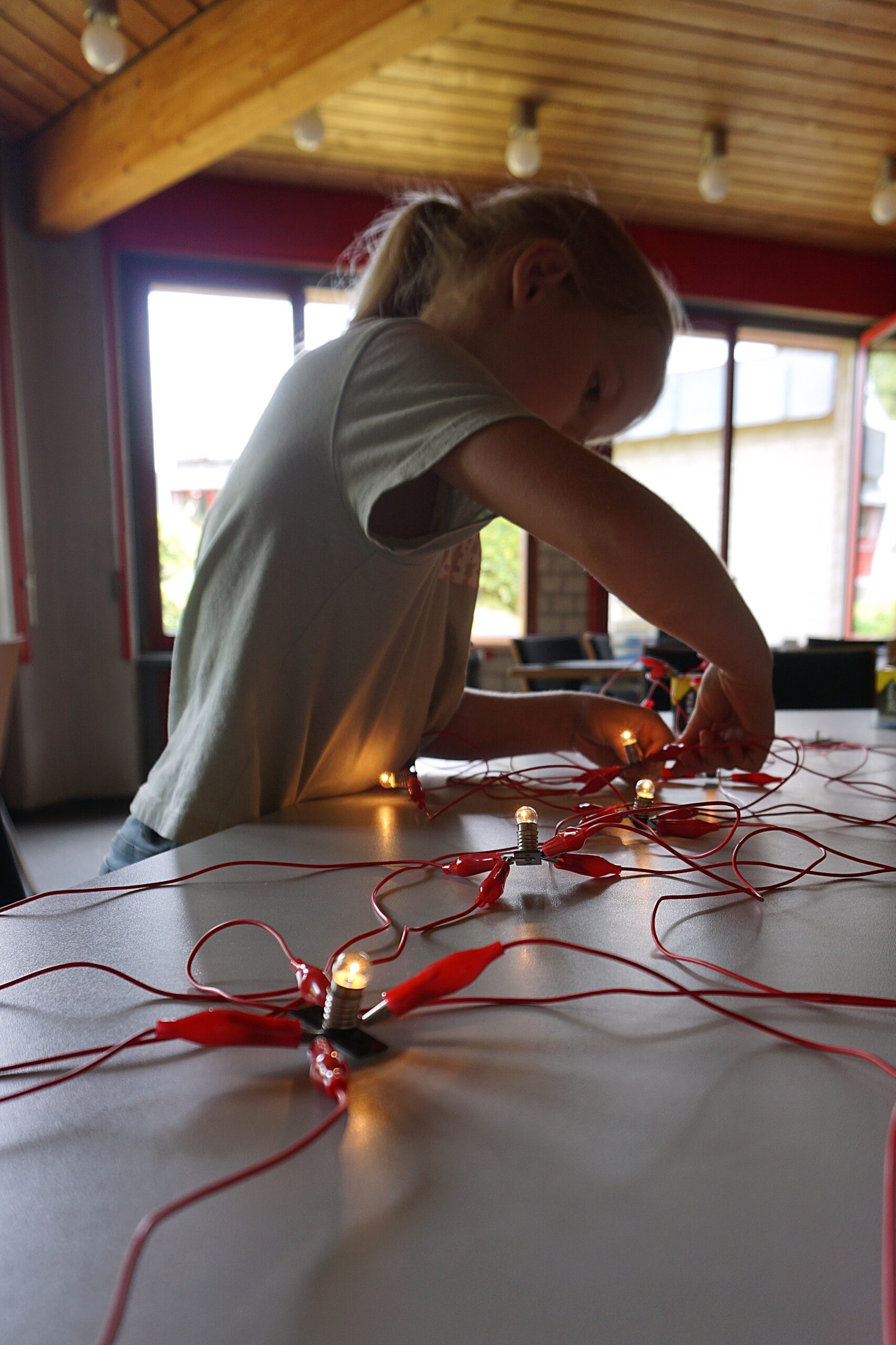
A student is conducting an experiment with several light bulbs connected in parallel.
The varied STEM program, jointly offered by various learning labs of RWTH Aachen University from August 4 to 14, 2026, took the younger children to other stations as well. For example, they programmed the small “Calliope mini” computer, made flower seed balls, and explored the secrets of tomato DNA. Meanwhile, the older students explored modern physics and learned how a scanning tunneling microscope works and makes individual atoms visible.
The fact that age doesn’t necessarily indicate technical skill when it comes to these offerings is noted by Gina Goffart, director of the SCIphyLAB learning lab at RWTH Aachen University:
“We’ve seen that soldering—for example, when building a ‘hot wire’—is generally easier for younger children. They are often more dexterous and quicker than older children. In fact, this year, even the youngest children set the record—they were the fastest to finish building their ‘hot wire’.”
The summer vacation program was made possible through a collaboration between the StädteRegion Aachen, RWTH Aachen University, and the Nell-Breuning-Haus. It was developed as part of the MINTplus project in the StädteRegion Aachen. The Federal Ministry of Education, Family Affairs, Senior Citizens, Women, and Youth supports the project as a funding agency, while the Bürgerstiftung Herzogenrath and HEAD acoustics GmbH provide financial support.
The Heureka Learning Lab also offers opportunities to foster a spirit of inquiry within the academic setting of RWTH Aachen University. Depending on the program, workshops allow students to conduct their own experiments, explore laboratories, and learn about various topics within electrical engineering and information technology. Topics range from STEM to micro- and nanotechnology to energy engineering.
“Labs on Tour” Brings Electrical Engineering to Schools

Fans built using soldering irons and 3D printers were in high demand. © Daphne Heil
At “Labs on Tour,” students had the opportunity to learn about and try out electrical engineering for themselves. For the first time, the Faculty of Electrical Engineering and Information Technology participated with its Heureka learning lab, demonstrating how exciting technology can be when students experiment on their own.
First experiences with a soldering iron, a circuit board they assembled themselves, a hand-soldered LED keychain: For many students, “Labs on Tour” brought electrical engineering to life. This project by RWTH Aachen University brings science and technology topics directly to schools, enabling young people to gain hands-on experience with STEM subjects through extracurricular clubs.
This school year, the Faculty of Electrical Engineering and Information Technology participated in the program for the first time. Heureka Learning Lab staff members organized a soldering workshop focused on hands-on work and firsthand experience.
“I really liked the students’ explanations. I enjoyed how playful the experiments were,” said Carina, a student from Aachen, who particularly remembers the soldering and 3D printing.
The Heureka Learning Lab takes exactly this approach. In workshops held regularly at institutes and academic departments, students gain insights into the diverse fields of electrical engineering and information technology—from micro- and nanotechnology to energy engineering. Through experiments and projects of their own, students learn to understand and connect complex technical concepts to their everyday lives.
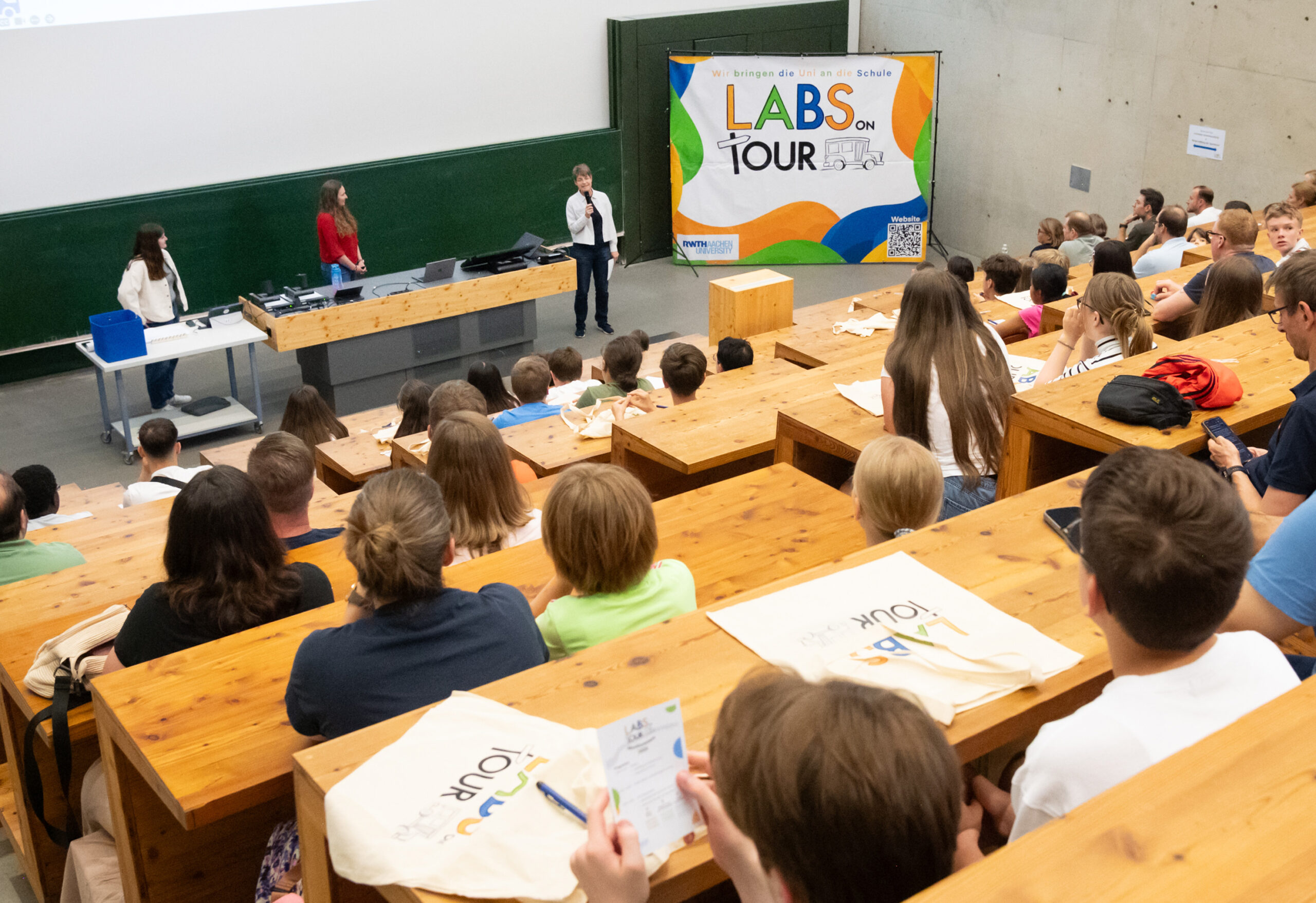
Welcoming the participants at the closing event of “Labs on Tour” at the Physics Center of RWTH Aachen. © Heike Lachmann
At the closing event for this year’s “Labs on Tour,” approximately 150 guests gathered at the Physics Center at RWTH Aachen University. In addition to students and their families, teachers and RWTH staff also attended.
„“The closing event gives the students the opportunity to experience the university up close, reconnect with their mentors, and show their families what they’ve experienced and learned in the club,” says Maria Hinkelmann, a research assistant in the Physics Department at RWTH Aachen University.
“Labs on Tour” is aimed at seventh- and eighth-grade students. RWTH students and staff bring workshops from various departments directly into the schools’ afternoon programs. In addition to electrical engineering and information technology, the extracurricular program includes physics, biology, mathematics, materials science, and mechanical engineering, among other subjects. The goal is to reduce reservations about technical and scientific topics and to foster interest in STEM subjects.
Supporting the next generation is an important part of the Faculty of Electrical Engineering and Information Technology’s work. Programs like “Heureka” show young people the importance of electrical engineering and information technology in everyday life, science, and society from an early age. At the same time, students gain insight into future study opportunities and various career fields.
The faculty staff is looking forward to continuing to guide young people in exploring technical topics as part of “Labs on Tour” next year again.
More information about the Heureka Learning Lab and “Labs on Tour” is available online.


