Schlagwort: ‘Informations- und Kommunikationstechnologie’
Funded internship in Tokyo

The Chair of Distributed Signal Processing at RWTH Aachen University, in cooperation with its Japanese partner, is offering a fully funded internship for students demonstrating exceptional potential in the area of networking and wireless communications. The programme is aimed at both Bachelor and Master of Science students.
As Japan’s only national research institute specialising in the field of information and communication technology, NICT maintains the Beyond 5G R&D Promotion Unit, which collaborates with the Chair of Distributed Signal Processing on joint research projects. The aim of the scientific work is to design and evaluate next-generation wireless networks, taking into account cutting-edge information and communication technology and other technology areas.
An internship at the National Institute of Information and Communications Technology (NICT) involves the study of Beyond 5G use cases, with the verification of relevant communication functions and interfaces being a key element of this. One use case that proves relevant in this context is, for example, the integration of radio resource management and optimised energy management. In addition to this, contributions to the development of Beyond 5G Proof-of-Concept are to be expected, based on the defined use cases. This will be developed in cooperation with the testbed facilities of the Chair of Distributed Signal Processing. Interns will participate in regular meetings and discussions with the NICT team during their internship work, where they will receive guidance. At the end of the internship period, students are required to summarise the results and prepare a report.
The internship is based on the Beyond 5G/6G White Paper and aims to establish a long-term international research cooperation between NICT and the Chair of Distributed Signal Processing. The interns will spend four to six months in Tokyo. The financial costs associated with the stay, including travel, accommodation, overseas travel insurance and a daily allowance, are covered by the offer.
In order to participate, it is necessary to have a general knowledge of programming with pseudo-code, as well as excellent written and oral English skills and an excellent knowledge of fundamental principles in communications. Furthermore, the following Bachelor of Science or Master of Science courses must have been completed with a grade of at least 2.0:
For Bachelor of Science students: Fundamentals of Computer Science 4 – Introduction to Machine Learning Methods.
For Master of Science students: Signal Processing for Mobile Communications, Signal Processing in Multi-Antenna (MIMO) Communication System, Estimation and Detection Theory.
Applications must be submitted three months before the planned start of the internship. They can be sent throughout the year to Professor Haris Gacanin at the following e-mail address: harisg@dsp.rwth-aachen.de. Further information can also be requested at the above e-mail address.
Excellent researchers on an interdisciplinary stage: lecture by Professor Monti
© Peter Winandy
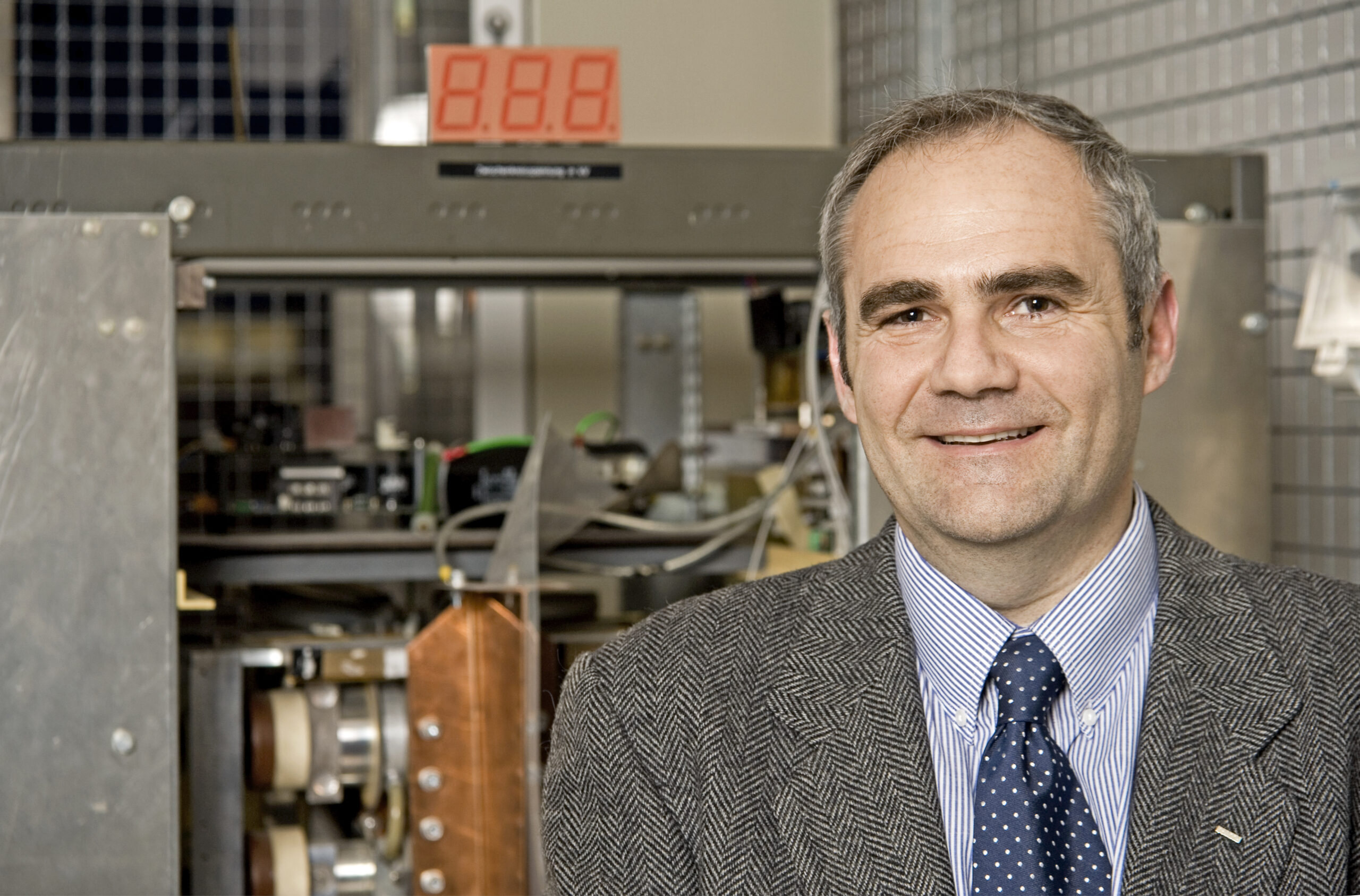
On 17 April, Professor Antonello Monti of RWTH Aachen University will speak at the scientific meeting of the engineering and economics class of the “Nordrhein-Westfälische Akademie der Wissenschaften und der Künste” about the development goals of his discipline in terms of solving major societal challenges.
Against the background of the international situation, the energy transition process is more important than ever.The necessary technological transformation of the energy system must be approached from two angles: On the one hand, a new major player in energy supply has emerged: renewable energy. On the other hand, there are new consumers such as electromobility and heat pumps. Digitalisation is proving to be a key enabler in this process. You could even say that digitalisation is not an option, but a necessity. The power system is consequently becoming a large, programmable cyber physical infrastructure with a high level of complexity. In his presentation “The Digitalisation of the Energy Systems: from the electrons to the cloud”, Professor Monti addresses this complexity by analysing the solutions currently being developed for the different levels of the infrastructure.
” Rethinking the whole architecture means reconsider the basic principles of operation of the new power system but also the corresponding IT systems”,
announced Professor Monti, Director of the Institute for Automation of Complex Power Systems (ACS).
So what does it mean to run a digital grid? And will we be able to build a digital grid that is as reliable as the current infrastructure?
The solutions he proposes in his presentation are the result of concrete experience from large European research projects. Professor Monti leads a research group with about 50 full time scientists working intensively on the the border between energy and information and communication technologies. He is responsible for coordinating some of the most relevant European projects in this field, such as OneNet, TwinEU und int:net. His research work has received several awards, including the prestigious “IEEE Field Medal Award for Innovation in Public Infrastructure” and the “NRW Innovation Award”.
In another presentation – “Sustainable metals: contributions from basic research” – Professor Dierk Raabe from the Max Planck Institute for Sustainable Materials will address the question of whether we can succeed in decarbonising a key industry with “green steel”.
Further information on the Nordrhein-Westfälische Akademie der Wissenschaften und der Künste can be found on the organisation’s homepage.


