
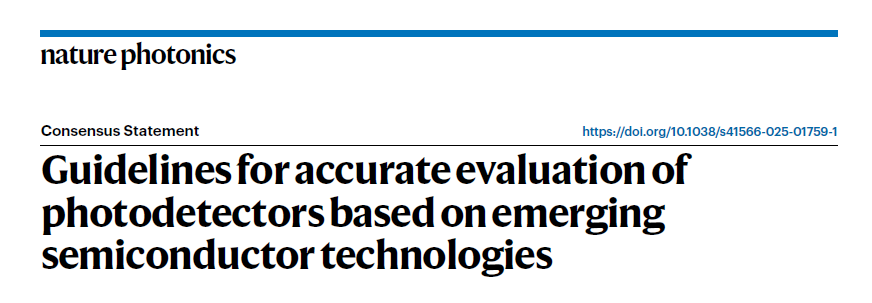
The Faculty of Electrical Engineering and Information Technology congratulates Prof. Max Lemme on a special scientific achievement: as co-author, he contributed to a consensus statement publication in the renowned journal Nature Photonics. The publication is entitled ‘Guidelines for accurate evaluation of photodetectors based on emerging semiconductor technologies’ and provides important impetus for the international research community.
A consensus statement publication summarises the current state of knowledge in a specialist field and formulates recommendations, standards or procedures that promote reliable and uniform scientific practice. In this article, leading experts from research and industry have developed for the first time a comprehensive framework for the precise characterisation, documentation and comparability of photodetectors based on novel semiconductor materials.
There is a great need for such guidelines: photodetectors made from innovative material classes such as organic semiconductors, perovskites, quantum dots, two-dimensional materials, metal oxides and carbon nanotubes have made enormous progress in recent years. At the same time, inconsistent measurement methods and reporting standards have so far made it difficult to compare different studies and thus hindered scientific development in this field.
The recommendations that have now been published create a common foundation for the community and support transparent, reproducible and comparable research practices. This benefits not only academic working groups, but also industrial development processes and the emergence of future photonic technologies.
Prof. Max Lemme is not only the holder of the Chair of Electronic Components at our faculty, but also the managing director of AMO GmbH, whose research focuses are closely linked to the topics covered in the publication. The development and integration of novel materials for optoelectronic components is one of the company’s core activities. Participation in this international consensus paper underscores the great scientific and technological relevance of this work.
AMO GmbH has also highlighted the publication in its own article. Further information can be found on the website and on LinkedIn.


Leave a Reply