
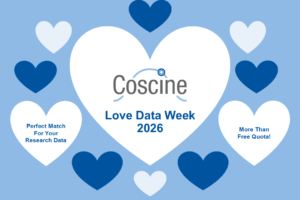
Source: Own illustration
“Where is the data?” – This question was at the heart of Love Data Week 2026 and describes a challenge shared by many research projects. Research data is continuously generated, processed, shared, and archived. At the same time, there is a growing need to keep this data findable, traceable, and usable in the long term. With a presentation and a workshop during Love Data Week, Coscine showed how research data management can be implemented in practice in this area of tension.
What is Coscine?
Coscine is a platform for research data management that helps researchers store and link data and metadata centrally and map projects in a structured way. Role and rights concepts facilitate collaboration within projects.
The platform addresses a key challenge in everyday research: FAIR data handling is often not firmly anchored in work routines. Without suitable tools, metadata is lost, data is stored in isolation, or data reproducibility becomes impossible.
Coscine provides an environment for data storage and linking that supports the FAIR principles. Through structured metadata collection and connection to storage resources such as DataStorage.nrw, data can be secured for the long term and embedded in a traceable context. Depending on their organizational affiliation, researchers automatically receive 100 GB of web storage space or can request additional storage space via Coscine JARDS.
Coscine as the “Perfect Match” for Research Data
The presentation “Coscine – Perfect Match for Your Research Data” focused on the entire research lifecycle of research data. The starting point was the question of how data can be structured in a meaningful way from the beginning of a project so that it remains understandable not only during the active research phase, but also beyond.
A central theme was the close link between data and metadata. The presentation made it clear that metadata is not an additional documentation requirement, but a prerequisite for findability, traceability, and reuse.
In addition, Coscine was presented as a collaborative working environment. Projects can be worked on jointly, roles and rights can be clearly assigned, and changes can be documented in a traceable manner. Storage resources such as DataStorage.nrw also offer researchers the possibility of secure and redundant storage.
Discussion & Questions From the Audience
The subsequent discussion focused primarily on specific application scenarios and organizational issues.
For example, it was asked whether Coscine can also be used without data storage. In fact, some projects use Coscine exclusively to manage their metadata and link to external data sources. The added value lies in the structured integration into a knowledge graph (RDF & SHACL) and in the assignment of PIDs for projects and resources.
Regarding sensitive data, it was clarified that the storage of personal data on DataStorage.nrw is possible in principle. However, the responsibility for checking legal requirements and any necessary additional security measures lies with the researchers. Coscine does not currently offer an integrated encryption function. Encryption must be carried out independently if required.
Storage space requests and changes in storage space requirements during the project period were also discussed. It is possible to submit an extension request or a new storage space request for the same Coscine project.
Coscine Is More Than Just Storage Space
In the workshop “Coscine – More Than Free Quota,” participants had the opportunity to try out the platform for themselves after the presentation of Coscine.
Using typical work steps, it was shown how projects can be set up in Coscine, resources structured, and metadata recorded during ongoing research. Special focus was therefore placed on the core functionalities of Coscine.
The practical part showed how Coscine helps to organize data consistently and facilitate collaboration within the project team.
There was also plenty of time in the workshop for questions and comments about the use of Coscine. The participants’ questions related, among other things, to the possible uses of Coscine and DataStorage.nrw beyond the participating universities of DH.NRW.
The participants were also interested in the process of setting up storage space requests and the subsequent review process. In a breakout session at the end of the workshop, the participants also had sufficient time to exchange experiences about the workshop and the platform itself.
Where Is the Data? More Than Just a Location
Both the lecture and the workshop made it clear that the question of where data is located goes far beyond a technical determination of location. Data must not only be stored, but also contextualized, documented in a comprehensible manner, and made usable in the long term.
The events held as part of Love Data Week showed how Coscine can support researchers in meeting these requirements.
Learn more
Would you like to receive regular updates about Coscine? Then visit the Coscine website and subscribe to the Coscine newsletter to stay up to date once a month.
If you have any questions about Coscine or research data management, the RDM team at RWTH Aachen University is happy to help.
Responsible for the content of this article are Katja Jansen and Arlinda Ujkani.








Leave a Reply
You must be logged in to post a comment.