
Kategorie: ‘Allgemein’
Awardees of the Brigitte-Gilles-Award 2020
The Brigitte Gilles Award 2020 honors projects and initiatives that improve the conditions for women’s study, teaching, and research at the university. In this way, they contribute to increasing the number of female scientists and students in courses with a low representation of women.
We congratulate all the winners but are especially pleased for the two winners from our faculty. Professor Janina Fels and Ms. Karin Loh from the Chair and Institute of Hearing Technology and Acoustics (IHTA) were awarded for their initiative “The interactive world of acoustics for big and small children”. Here, concepts were developed that enable girls between the ages of three and twelve to explore and learn about hearing and acoustics in a playful and interactive way.
The awards were presented in a total of four categories and are endowed with up to 2500 euros. The awards in the other categories were given to the following researchers and projects: Katharina Müller from the Chair of Production Systems, the project “Hlumani – giving the future a fair chance” from the Chair of Landscape Architecture at RWTH, the University of Stuttgart, and the University of Cape Town and Dr. Anna Stertz from the Chair and Institute of Psychology.
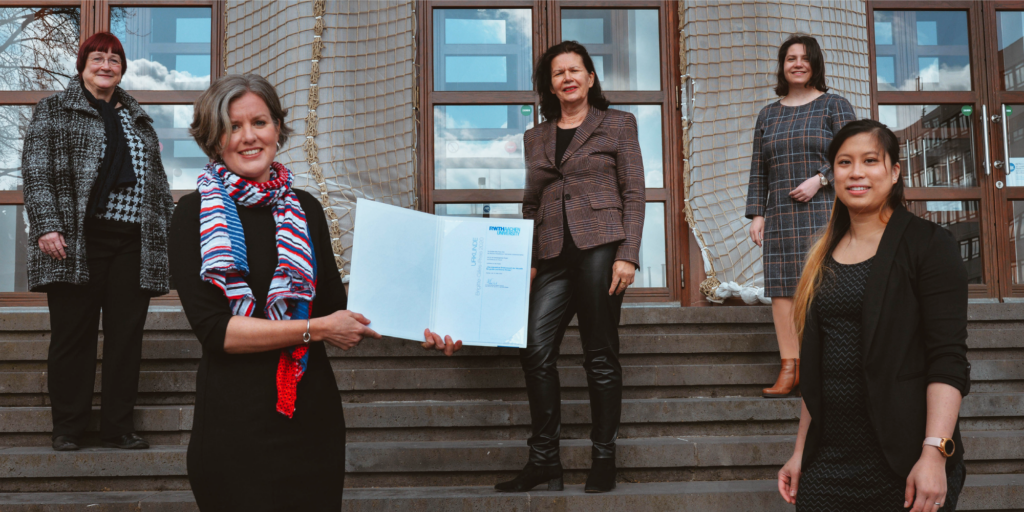
Foto: Andreas Schmitter
(Deutsch) Online-Themenabend: “Karriereplanung in der Wissenschaft für junge Wissenschaftlerinnen”
Publication – Contactless, Battery-free, and Stretchable Wearable for Continuous Recording of Seismocardiograms
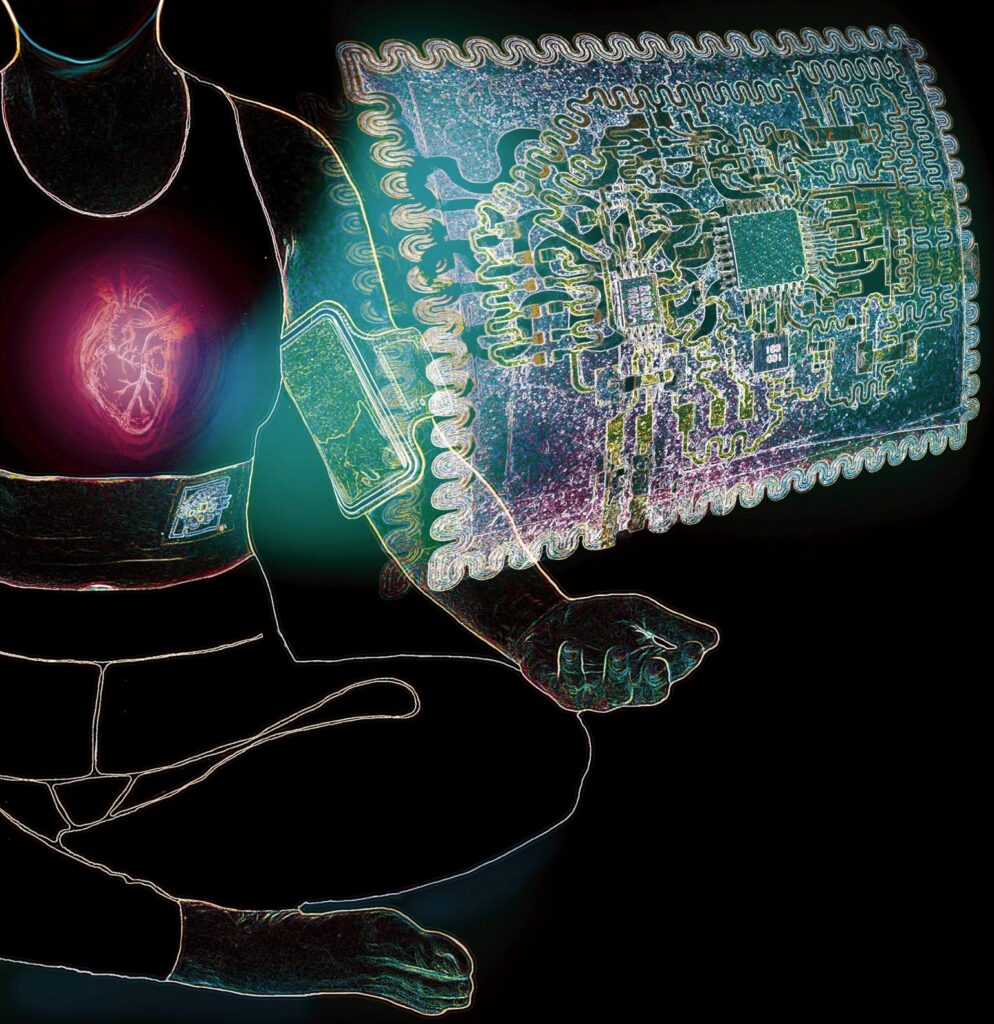
Photo: IWE1
Prof. Dr.rer.nat. Sven Ingebrandt and his research team published the article “Contactless, Battery-free, and Stretchable Wearable for Continuous Recording of Seismocardiograms” in the journal ACS Applied Electronic Materials.. This article presents a study to enable remote measurement of mechanical cardiac activity using a contactless wearable patch and seismocardiography (SCG). Near-field communication (NFC) technology is used for power supply and wireless recording of SCG data. A separate electrocardiogram (ECG) is used as a reference. The results of this study show a good signal-to-noise ratio and a close correlation between SCG and ECG recordings. This method could become another valuable tool for cardiac monitoring in the future.
Contactless, Battery-free, and Stretchable Wearable for Continuous Recording of Seismocardiograms
2D materials for high-volume production of electronic components
RWTH Professor Max Lemme and research partners publish in Journal “Nature Communications”
Professor Max Lemme, Chair of Electronic Devices at RWTH Aachen University, and his research partners publish a new method to integrate 2D materials into semiconductor manufacturing lines in the journal Nature Communications. The RWTH Aachen University researchers were supported by the KTH Royal Institute of Technology in Stockholm, the University of the Federal Armed Forces in Munich, AMO GmbH and Protemics GmbH. Currently, most experimental methods are not compatible with large-scale production. Moreover, they lead to significant degradation of the 2D material and its electronic properties. The method now being researched attempts to solve these problems. The two-dimensional materials will enable devices with significantly smaller sizes and enhanced functionalities compared to current silicon technologies. Overall, the range of potential applications extends from photonics to sensor technology and neuromorphic computing.
Further information on the website of AMO GmbH
5 Years Helmholtz Institut Münster “Center for Ageing, Reliability and Lifetime Prediction of Electrochemical and Power Electronic Systems” (CARL)
Powerful battery technology is a core element that benefits us in many everyday applications. From smartphones to wireless work devices and electric vehicles – batteries are shaping our lives to an ever-increasing degree.
Around 2012, the idea was born to combine the expertise of Forschungszentrum Jülich, RWTH Aachen University, and the University of Münster in battery research. Thus, 5 years ago now, the Helmholtz Institute Münster “Ionics in Energy Storage” was founded, which has now become a respected part of the battery research landscape and leads to the continuous development of research infrastructures at the different locations. In Aachen, this is reflected by the construction of the “Center for Ageing, Reliability and Lifetime Prediction for Electrochemical and Power Electronic Systems (CARL)”.
You can find further information in the Newsletter of ISEA
IKS Startup – Elevear
Digital ear-opening – Hearing aids and other hearables often cause wearers to perceive their own voice in a distorted way, and chewing, swallowing, and even walking also generate unpleasant noise. The reason for this is the so-called occlusion effect, which occurs when headphones or hearing aids close off the auditory canal. This problem is addressed by the startup Elevear, which emerged from the Institute for Communication Systems and was successfully founded by Stefan Liebich, Johannes Fabry, Raphael Brandis, and Elfed Howells on February 4, 2021. Their Occlear® technology suppresses the occlusion effect and allows natural voice perception.
The project has already received the RWTH Innovation Award in 2019 and was accepted into the RWTH Incubation Program in January 2021 as one of twelve outstanding founding teams.
Improving Communication Systems Using Machine Learning
Prof. Dr. Laurent Schmalen from Karlsruhe Institute of Technology (KIT) contributes to our IKS event series with an online lecture entitled: „Improving Communication Systems Using Machine Learning“ Today, communication engineering still follows a model‐based design methodology influenced by the seminal design guidelines that were formulated by Claude Shannon in the 1940s. Such a model‐based approach may however not be suitable for many modern communication scenarios. In this talk, we show how we can augment communication systems using machine learning and in particular deep learning. In the first part of the talk, we show how machine learning can be used to optimize channel‐agnostic waveforms for an optical communication system. In the second part of the talk, we show how machine learning can be used to augment existing receiver algorithms and in particular channel decoding. We illustrate that short channel codes can be decoded with a performance close to the theoretical performance limits with significantly lower complexity than other state‐of‐the‐art methods
Prof. Dr. Laurent Schmalen, Karlsruhe Institute of Technology
Date: March, 5th 2021 | 13.00 Uhr
You can find the access data in our event calendar
Hybrid Provision of Energy based on Reliabilty and Resiliancy via Integration of Dc Equipment
The project HYPERRIDE started on 1 October 2020. The four-year project contributes to the field implementation of DC and hybrid AC-DC grids. It will actively identify and provide solutions to overcome barriers to successful roll-out of new infrastructure concepts throughout Europe.
The Institute for Automation of Complex Power Systems (ACS) will concentrate its work on the development of automation services for the hybrid AC/DC grid. The focus here is on optimal power flow and fault management, as well as on the realization of a metering device specifically dedicated to DC technology: the DC Measurement Unit (DMU).
These solutions will be integrated into the open ICT platform, specifically tailored for integration with hybrid AC/DC distribution systems, and tested, among the others, in the demo site of the RWTH Aachen Campus Melaten.
Further Information on the Website of Institute for Automation of Complex Power Systems
2021 The Female Future of Tech
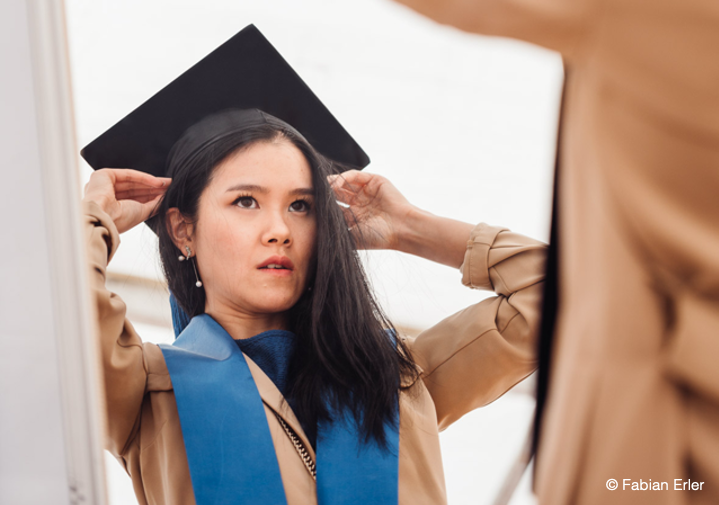 The Women’s Leadership Initiative was established to significantly increase the number of women entering the semiconductor market, as well as elevate their participation on both boards and leadership positions. The event will start with an insightful keynote from one of the most successful women in the European technology industry: Françoise Chombar, co-founder and CEO of MELEXIS, an integrated-circuits world leader. Furthermore, recently graduated women will share their personal experiences and explain why they recently chose to work in the technology and semiconductor industry. Participants will be encouraged to ask questions and facilitate virtual networking.
The event is complimentary to all students.
You can find the registration link and further information in our event calendar
You Never Walk Alone – How do I find a Study Group?
Image: Martin Braun
Most study groups are formed somewhat by chance: you probably sat next to each other in a lecture, chatted over coffee between lectures and exercises, or were in the same first-year tutorial. In the current situation, these opportunities no longer occur.
If you can now turn to a study group or fellow students from the last semesters, you are lucky. Start networking! Ask your fellow students if they are interested in forming a study group, working out a plan together on how to get through the exam phase separately but still together.
If you don’t have a study group yet, why not reach out in Zoom in one of your small group exercises (KGÜs) if someone would like to join up with you. Maybe someone from your first-year tutorial is interested? What other ways do you know of for finding a study group in times of Social Distancing?
Written by: Iris Heisterklaus


