Schlagwort: ‘AI’
The future of battery technology: Revolution using AI
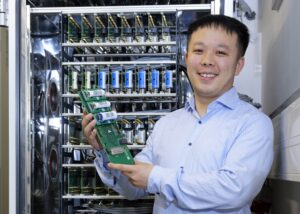
Prof. Weihan Li . © Peter Winandy
Innovative Battery Research at RWTH Aachen
Junior Professor Weihan Li is revolutionizing battery research at RWTH Aachen by developing AI-powered testing methods that enable precise predictions about the future performance and lifespan of battery cells already during the production phase.
Utilizing advanced technologies such as digital twins, data-driven models, and automated diagnostic procedures, his approach transforms traditional battery management into a proactive system—moving from mere observation to anticipatory strategies.
Shortened Development Processes and Sustainable Innovation
At the core of his research is the goal of significantly shortening development cycles, reducing production costs, and simultaneously enhancing sustainability throughout the entire battery lifecycle. Prof. Li succinctly states:
“Ultimately, we want to accelerate the development of high-quality, affordable batteries and make the entire battery life cycle more sustainable.”
The Synergy of Artificial Intelligence and Electrochemistry
Early on, Li recognized that the combination of artificial intelligence and electrochemistry is the key to the future of the battery industry. This insight drives him to push forward innovative solutions:
“That’s when I realized: this is the future,” he recalls. “Since then, I’ve been working on integrating AI and electrochemistry.”
RWTH Aachen as an Innovation Engine
For Prof. Li, RWTH Aachen is more than just a research location—it provides an inspiring environment that nurtures young talent through strong networks and a pronounced spirit of innovation. The close collaboration with industry not only underscores the demand for modern battery solutions but also secures a significant share of funding.
Data-Driven Modeling as a Key Component
The extensive data base provided by the RWTH infrastructure is a central pillar in precise AI modeling. This essential resource not only guarantees research success but also forms the foundation for highly advanced analytical methods:
“This massive dataset is essential for building our AI models.”
Proactive Battery Management
Finally, Li’s approach aims not only to monitor the aging process of battery cells but to intervene proactively—well before they reach their maximum performance limits. In his own words:
“We don’t just want to understand how batteries age – we want to intervene before aging even begins.”
The advanced, AI-enabled methods of Prof. Li at RWTH Aachen pave the way for faster, cost-effective, and sustainable battery solutions. This groundbreaking work sets a new standard in battery development and reinforces Europe’s leading role in the energy transition.
Cheerfully building bridges from neuroscience to computer technology to AI

On 18 June 2025, as part of the RIA lectures, Senior Professor Rainer Waser will present research on interfaces in the fields of neuroscience, computer technology and AI.
In his online lecture, which will be followed by a panel discussion, Professor Rainer Waser from the Institute of Materials of Electrical Engineering 2 at RWTH Aachen University and the Electronic Materials division of the Peter Grünberg Institute 7 at Forschungszentrum Jülich, will discuss the current concepts, solutions, consequences and perspectives of research collaboration between different faculties. This free, one-and-a-half-hour event can be attended via Zoom and starts at 5 pm.
Professor Rainer Waser was awarded the prestigious Leibniz Prize in 2014 in recognition of his exceptional contributions to research in the field. The researcher’s interdisciplinary approach proved to be a pivotal element in this endeavour. At the beginning of 2025, he was awarded an honorary senior professorship at RWTH Aachen University. He continues to dedicate himself to researching memristive phenomena, neuromorphic computing and the relationship between functional oxides and their defect chemistry.
‘Not just immersing myself in one discipline, but building bridges – that’s what has driven me my whole life,’ says the researcher, talking about what motivates him.
The Regional Informatics Group Aachen (RIA) is part of Gesellschaft für Informatik, the German professional organisation for computer scientists. Members of the group work together to facilitate the exchange of information, discuss relevant topics, and represent common interests in computer science and IT in the region. RIA works closely with REGINA e.V., the Regional Computer Science Industry Club of RWTH Aachen University and Aachen University of Applied Sciences.
The Gesellschaft für Informatik is a local and international organisation that opens doors to the professional and scientific worlds. It enables computer scientists to engage in continuous dialogue with the scientific community. The Gesellschaft für Informatik acts as an intermediary body, bringing together scientists, industry professionals, and administrators, and representing their interests in politics.
You can participate in the event via this Zoom link. A video of the lecture and discussion will be made available on the YouTube channel of the Chair of Software Engineering shortly after the event ends.
If you would like to receive information about future RIA lectures, please e-mail vortrag@i3.informatik.rwth-aachen.de.


