Schlagwort: ‘Energie’
The future of battery technology: Revolution using AI
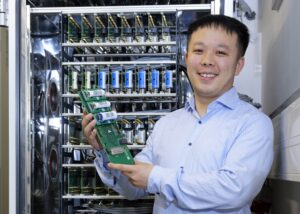
Prof. Weihan Li . © Peter Winandy
Innovative Battery Research at RWTH Aachen
Junior Professor Weihan Li is revolutionizing battery research at RWTH Aachen by developing AI-powered testing methods that enable precise predictions about the future performance and lifespan of battery cells already during the production phase.
Utilizing advanced technologies such as digital twins, data-driven models, and automated diagnostic procedures, his approach transforms traditional battery management into a proactive system—moving from mere observation to anticipatory strategies.
Shortened Development Processes and Sustainable Innovation
At the core of his research is the goal of significantly shortening development cycles, reducing production costs, and simultaneously enhancing sustainability throughout the entire battery lifecycle. Prof. Li succinctly states:
“Ultimately, we want to accelerate the development of high-quality, affordable batteries and make the entire battery life cycle more sustainable.”
The Synergy of Artificial Intelligence and Electrochemistry
Early on, Li recognized that the combination of artificial intelligence and electrochemistry is the key to the future of the battery industry. This insight drives him to push forward innovative solutions:
“That’s when I realized: this is the future,” he recalls. “Since then, I’ve been working on integrating AI and electrochemistry.”
RWTH Aachen as an Innovation Engine
For Prof. Li, RWTH Aachen is more than just a research location—it provides an inspiring environment that nurtures young talent through strong networks and a pronounced spirit of innovation. The close collaboration with industry not only underscores the demand for modern battery solutions but also secures a significant share of funding.
Data-Driven Modeling as a Key Component
The extensive data base provided by the RWTH infrastructure is a central pillar in precise AI modeling. This essential resource not only guarantees research success but also forms the foundation for highly advanced analytical methods:
“This massive dataset is essential for building our AI models.”
Proactive Battery Management
Finally, Li’s approach aims not only to monitor the aging process of battery cells but to intervene proactively—well before they reach their maximum performance limits. In his own words:
“We don’t just want to understand how batteries age – we want to intervene before aging even begins.”
The advanced, AI-enabled methods of Prof. Li at RWTH Aachen pave the way for faster, cost-effective, and sustainable battery solutions. This groundbreaking work sets a new standard in battery development and reinforces Europe’s leading role in the energy transition.
Excellent researchers on an interdisciplinary stage: lecture by Professor Monti
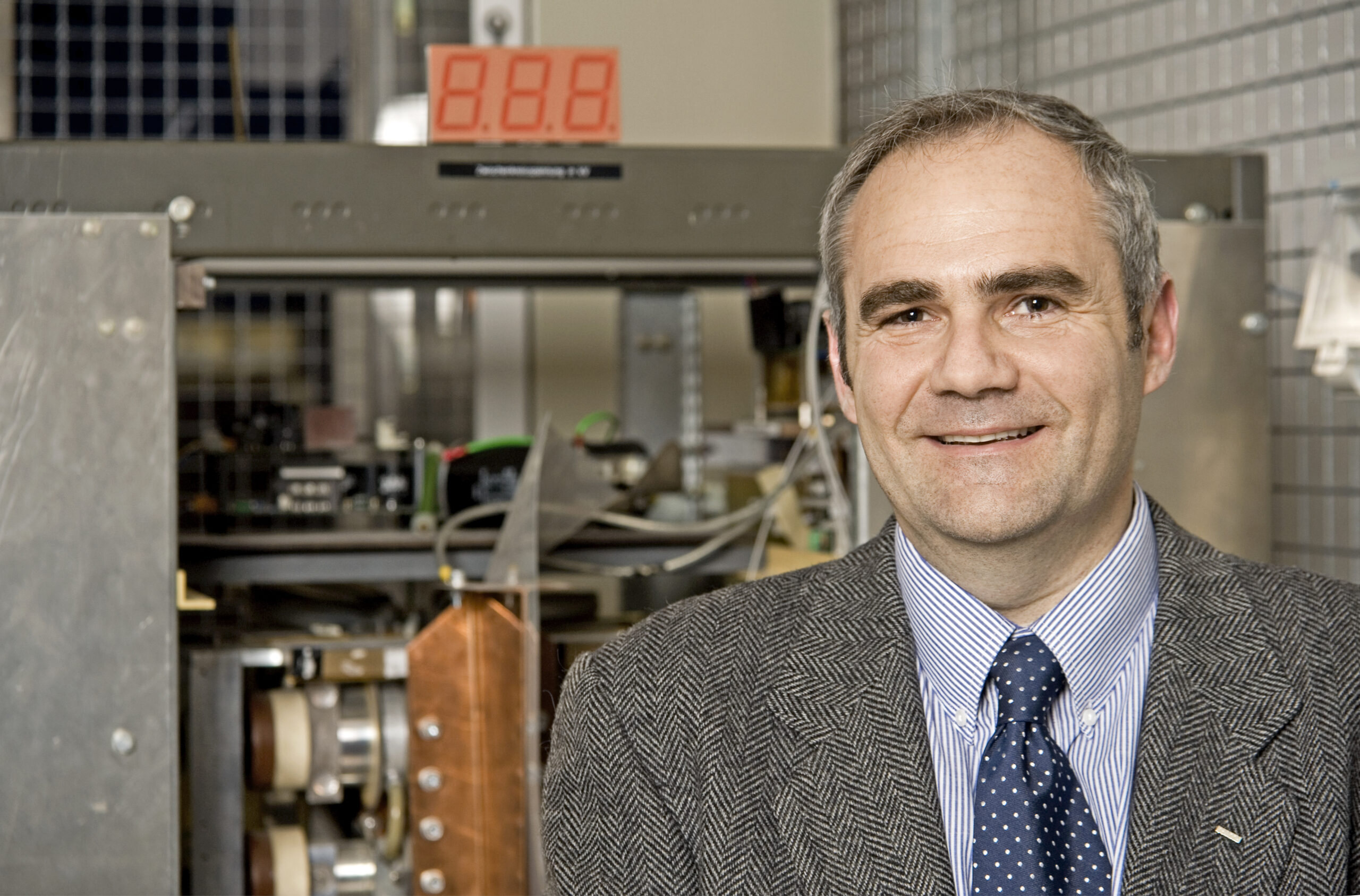
© Peter Winandy
On 17 April, Professor Antonello Monti of RWTH Aachen University will speak at the scientific meeting of the engineering and economics class of the “Nordrhein-Westfälische Akademie der Wissenschaften und der Künste” about the development goals of his discipline in terms of solving major societal challenges.
Against the background of the international situation, the energy transition process is more important than ever.The necessary technological transformation of the energy system must be approached from two angles: On the one hand, a new major player in energy supply has emerged: renewable energy. On the other hand, there are new consumers such as electromobility and heat pumps. Digitalisation is proving to be a key enabler in this process. You could even say that digitalisation is not an option, but a necessity. The power system is consequently becoming a large, programmable cyber physical infrastructure with a high level of complexity. In his presentation “The Digitalisation of the Energy Systems: from the electrons to the cloud”, Professor Monti addresses this complexity by analysing the solutions currently being developed for the different levels of the infrastructure.
” Rethinking the whole architecture means reconsider the basic principles of operation of the new power system but also the corresponding IT systems”,
announced Professor Monti, Director of the Institute for Automation of Complex Power Systems (ACS).
So what does it mean to run a digital grid? And will we be able to build a digital grid that is as reliable as the current infrastructure?
The solutions he proposes in his presentation are the result of concrete experience from large European research projects. Professor Monti leads a research group with about 50 full time scientists working intensively on the the border between energy and information and communication technologies. He is responsible for coordinating some of the most relevant European projects in this field, such as OneNet, TwinEU und int:net. His research work has received several awards, including the prestigious “IEEE Field Medal Award for Innovation in Public Infrastructure” and the “NRW Innovation Award”.
In another presentation – “Sustainable metals: contributions from basic research” – Professor Dierk Raabe from the Max Planck Institute for Sustainable Materials will address the question of whether we can succeed in decarbonising a key industry with “green steel”.
Further information on the Nordrhein-Westfälische Akademie der Wissenschaften und der Künste can be found on the organisation’s homepage.


