Schlagwort: ‘KI’
New building for computer science with an integrated AI center planned
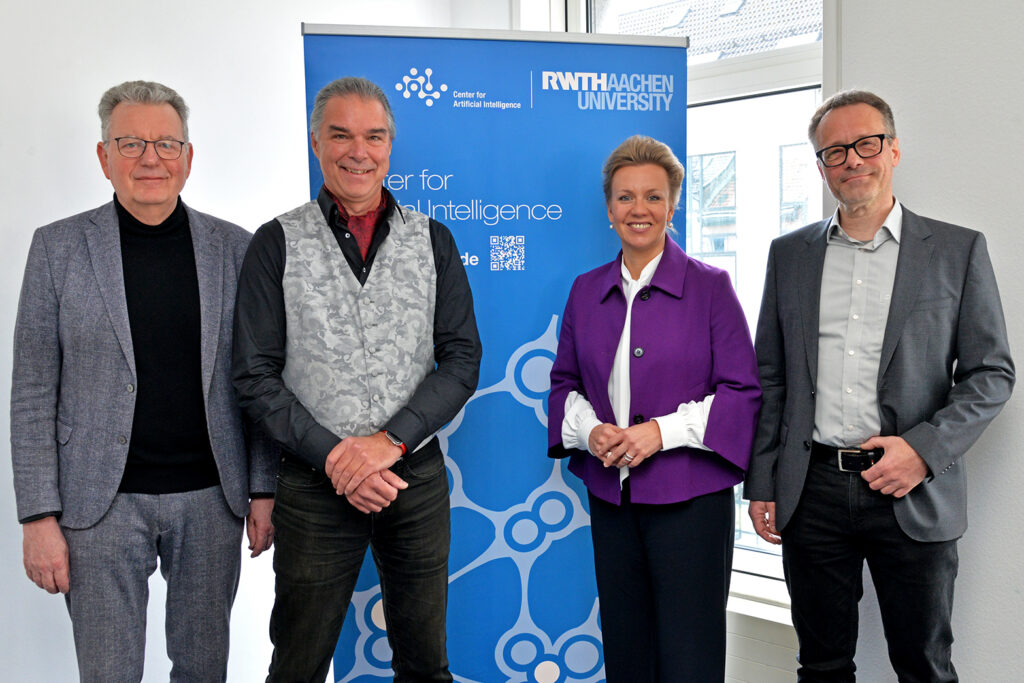
180 million euros are being invested in the new Computer Science building at RWTH. Science Minister Ina Brandes delivered this good news to (from left) Vice Rector Matthias Wessling, Professor Holger Hoos, and Leif Kobbelt, Dean of the Faculty of Computer Science.
Photographer: Andreas Schmitter
The Department of Computer Science at RWTH Aachen University is set to undergo a significant expansion of its infrastructure. Up to 180 million euros from the “North Rhine-Westphalia Plan for Good Infrastructure” will be invested in a new building featuring an integrated “AI Center.” This will create new spatial and structural conditions for research and teaching in the field of artificial intelligence and related disciplines.
The new building on Ahornstraße is expected to accommodate approximately 400 academic, technical, and administrative staff members, as well as nearly 5,000 students. In addition to traditional workspaces, the plan includes real-world laboratories and co-working spaces designed to facilitate new forms of collaboration. The goal is to expand the existing structures of computer science while simultaneously creating modern working conditions that meet the demands of current research.
“Excellent research and teaching require excellent infrastructure,” emphasized Science Minister Ina Brandes during the presentation of the funding commitment. The new “AI Center” is intended to further enhance the appeal of North Rhine-Westphalia as a location and create an environment that is internationally competitive. The investment is part of a strategic focus on future-oriented topics, particularly in the field of artificial intelligence.
Within RWTH as well, the new building is viewed as an important step forward. “The AI Center is coming home,” said Professor Leif Kobbelt, Dean of the Faculty of Computer Science, referring to the planned relocation of the center—currently located on Theaterstraße—to Ahornstraße. Professor Ulrich Rüdiger emphasized that modern infrastructure is a key prerequisite for transferring research results to society and further expanding RWTH’s role as a high-performing research hub.
The “AI Center” is led by Professor Holger Hoos together with Professor Sebastian Trimpe. “The new building for the RWTH Aachen AI Center is another essential step on the path from coal to AI,” explained Hoos. The focus is on developing secure, reliable, and sustainable AI systems.
The new buildings are also intended to strengthen interdisciplinary collaboration. RWTH Chancellor Thomas Trännapp noted that computer science involves a high degree of interdisciplinary networking and that the planned structures meet this need. The goal is to create optimal conditions for researchers and staff and to support the long-term development of computer science.
Visibility for cutting-edge research: Professor Weihan Li once again among the most cited researchers
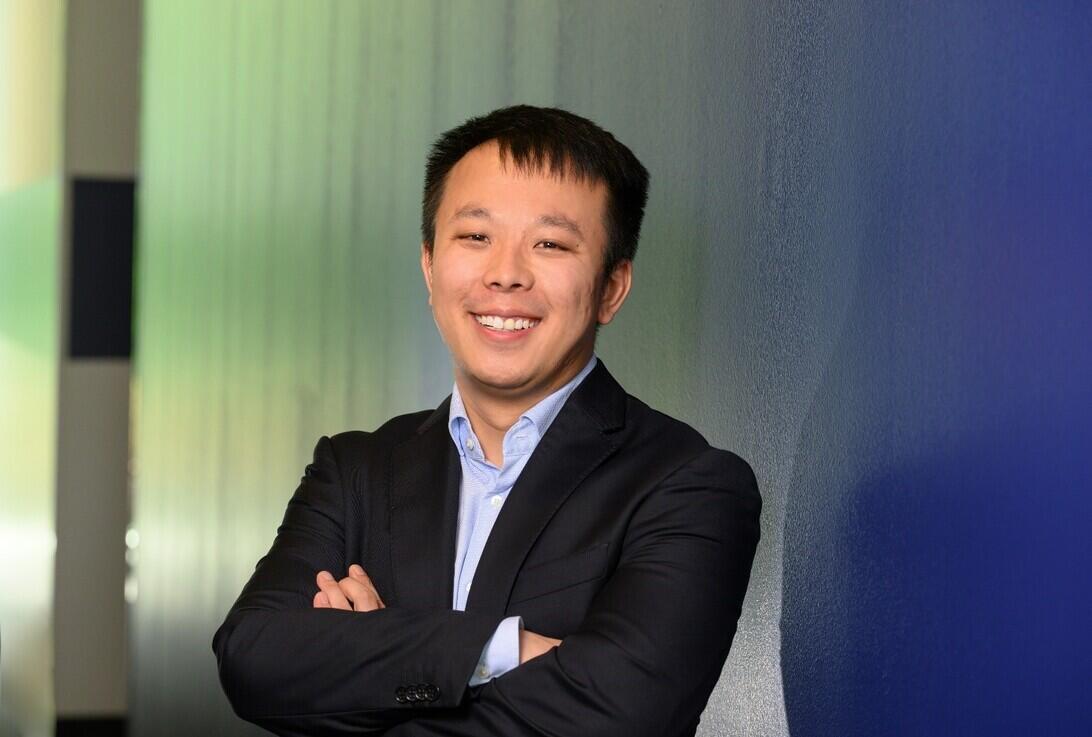
Professor Weihan Li, holder of the Junior Professorship in ‘Artificial Intelligence and Digitalisation for Batteries’ © David Ausserhofer
Professor Li, from the Institute for Power Electronics and Electrical Drives (ISEA) at RWTH Aachen University, has once again been included in the list of the world’s most cited scientists, known as ‘Highly Cited Researchers’. This recognition is a testament to the influence of his work in the field of AI-supported battery research.
The list of ‘Highly Cited Researchers’ is published annually by Clarivate Analytics. Based on the citation index of the Web of Science Core Collection, it identifies scientists whose publications are among the top one per cent most cited in their field and publication year. In scientific contexts, citations serve as an indicator of a publication’s relevance and are considered a measure of its quality. The more frequently a text is cited, the greater its visibility and the greater the global perception of the author. The current list includes 7,131 researchers who, according to the database, are among the most influential 0.1 per cent of the international research community.
Batteries are a key technology in the energy transition. Their performance largely determines the range, safety, service life and cost of their technical applications. Professor Li is investigating how accurately the condition and performance of battery cells can be predicted during production. He has held the Junior Professorship for ‘Artificial Intelligence and Digitalisation for Batteries’ at RWTH Aachen University since March 2025. At the Centre for Ageing, Reliability and Lifetime Prediction of Electrochemical and Power Electronic Systems (CARL), his junior research group develops data-based models, digital twins and automated diagnostic procedures.
The aim is to make the battery digitally communicative, characterised by precision and real-time capability – Weihan Li is working on this future.
His project, ‘SPEED: Fast Performance Characterization of Lithium-ion Batteries from Production Lines with Machine Learning’, has been awarded a grant of €1.85 million by the Federal Ministry of Research, Technology and Space as part of the ‘BattFutur – Junior Research Group Battery Research‘ competition.
Professor Li was born in China and completed his studies in automotive engineering at Tongji University. In 2014, he came to RWTH Aachen University to undertake a Master’s degree in Electrical Engineering and Information Technology, subsequently completing his PhD at the Institute for Power Electronics and Electrical Drives. His research has also taken him to Imperial College London, the University of Oxford and the Massachusetts Institute of Technology (MIT). He completed his doctorate with distinction in 2021 and founded the junior research group ‘Artificial Intelligence for Batteries’ the following year. With support from industry collaborations (accounting for around 40% of third-party funding) and CARL’s infrastructure, which comprises over 6,000 test circuits and provides a reliable database for AI modelling, he has grown the group to include 13 doctoral students.
The scientist can now look back on receiving a number of awards and prizes, including the highly prestigious German Study Prize from the Körber Foundation, one of the most highly endowed prizes for young scientists in Germany. He has published 53 scientific articles, two monographs, three patents and has supervised over 40 theses.
Further information on Professor Weihan Li’s research and career can also be found on the RWTH Aachen University website.
The future of battery technology: Revolution using AI
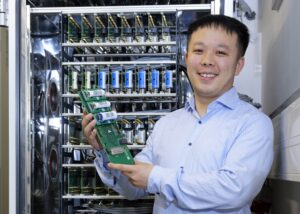
Prof. Weihan Li . © Peter Winandy
Innovative Battery Research at RWTH Aachen
Junior Professor Weihan Li is revolutionizing battery research at RWTH Aachen by developing AI-powered testing methods that enable precise predictions about the future performance and lifespan of battery cells already during the production phase.
Utilizing advanced technologies such as digital twins, data-driven models, and automated diagnostic procedures, his approach transforms traditional battery management into a proactive system—moving from mere observation to anticipatory strategies.
Shortened Development Processes and Sustainable Innovation
At the core of his research is the goal of significantly shortening development cycles, reducing production costs, and simultaneously enhancing sustainability throughout the entire battery lifecycle. Prof. Li succinctly states:
“Ultimately, we want to accelerate the development of high-quality, affordable batteries and make the entire battery life cycle more sustainable.”
The Synergy of Artificial Intelligence and Electrochemistry
Early on, Li recognized that the combination of artificial intelligence and electrochemistry is the key to the future of the battery industry. This insight drives him to push forward innovative solutions:
“That’s when I realized: this is the future,” he recalls. “Since then, I’ve been working on integrating AI and electrochemistry.”
RWTH Aachen as an Innovation Engine
For Prof. Li, RWTH Aachen is more than just a research location—it provides an inspiring environment that nurtures young talent through strong networks and a pronounced spirit of innovation. The close collaboration with industry not only underscores the demand for modern battery solutions but also secures a significant share of funding.
Data-Driven Modeling as a Key Component
The extensive data base provided by the RWTH infrastructure is a central pillar in precise AI modeling. This essential resource not only guarantees research success but also forms the foundation for highly advanced analytical methods:
“This massive dataset is essential for building our AI models.”
Proactive Battery Management
Finally, Li’s approach aims not only to monitor the aging process of battery cells but to intervene proactively—well before they reach their maximum performance limits. In his own words:
“We don’t just want to understand how batteries age – we want to intervene before aging even begins.”
The advanced, AI-enabled methods of Prof. Li at RWTH Aachen pave the way for faster, cost-effective, and sustainable battery solutions. This groundbreaking work sets a new standard in battery development and reinforces Europe’s leading role in the energy transition.
Cheerfully building bridges from neuroscience to computer technology to AI

On 18 June 2025, as part of the RIA lectures, Senior Professor Rainer Waser will present research on interfaces in the fields of neuroscience, computer technology and AI.
In his online lecture, which will be followed by a panel discussion, Professor Rainer Waser from the Institute of Materials of Electrical Engineering 2 at RWTH Aachen University and the Electronic Materials division of the Peter Grünberg Institute 7 at Forschungszentrum Jülich, will discuss the current concepts, solutions, consequences and perspectives of research collaboration between different faculties. This free, one-and-a-half-hour event can be attended via Zoom and starts at 5 pm.
Professor Rainer Waser was awarded the prestigious Leibniz Prize in 2014 in recognition of his exceptional contributions to research in the field. The researcher’s interdisciplinary approach proved to be a pivotal element in this endeavour. At the beginning of 2025, he was awarded an honorary senior professorship at RWTH Aachen University. He continues to dedicate himself to researching memristive phenomena, neuromorphic computing and the relationship between functional oxides and their defect chemistry.
‘Not just immersing myself in one discipline, but building bridges – that’s what has driven me my whole life,’ says the researcher, talking about what motivates him.
The Regional Informatics Group Aachen (RIA) is part of Gesellschaft für Informatik, the German professional organisation for computer scientists. Members of the group work together to facilitate the exchange of information, discuss relevant topics, and represent common interests in computer science and IT in the region. RIA works closely with REGINA e.V., the Regional Computer Science Industry Club of RWTH Aachen University and Aachen University of Applied Sciences.
The Gesellschaft für Informatik is a local and international organisation that opens doors to the professional and scientific worlds. It enables computer scientists to engage in continuous dialogue with the scientific community. The Gesellschaft für Informatik acts as an intermediary body, bringing together scientists, industry professionals, and administrators, and representing their interests in politics.
You can participate in the event via this Zoom link. A video of the lecture and discussion will be made available on the YouTube channel of the Chair of Software Engineering shortly after the event ends.
If you would like to receive information about future RIA lectures, please e-mail vortrag@i3.informatik.rwth-aachen.de.


