
Schlagwort: ‘transmission electron microscopy’
Observing 2D Memristors with Operando TEM: Another Step Toward Neuromorphic Computing
Understanding of conductive filament dynamics in memristive devices based on two-dimensional (2D) materials has been substantially advanced by a research team from AMO GmbH, RWTH Aachen University (Chair of Electronic Components), and Forschungszentrum Jülich.
The researchers used a transmission electron microscope (TEM), which instead of light uses a beam of electrons to make images, thus achieving imaging down to the scale of atoms through the short wavelengths of electrons. The operando state for TEM was used to observe the 2D components as they are operating, and not in before or after states. Which allows the nanoscale phenomena to be observed in real time.
Memristors are a key part of neuromorphic computing, which allows computation and memory in the same physical location so that the use of energy is radically minimized.
For this research, 2D sheets of molybdenum disulfide (MoS₂) were used. It is a compelling candidate for memristive devices owing to its atomically thin, layered two-dimensional structure, which features interlayer van der Waals gaps, which are nanoscale spacings maintained by weak van der Waals interactions that provide efficient transport pathways for ions and metal atoms. These pathways facilitate the controlled formation and dissolution of conductive filaments, thereby enabling the resistive switching behavior required for device operation.
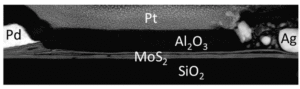
Image 1 – Sheets of 2D Memristor and Pd-Ag Poles to create potential difference – nature.com
Silver ions were directly observed by the researchers as they moved through the MoS₂ medium along surface routes, within interlayer van der Waals gaps, and between bundles under applied voltage. There, they gather into metallic conductive filaments that bridge the electrodes and change the device into a low-resistance state; reversing the polarity dissolves these filaments and returns the device to a high-resistance state. In order to directly evaluate switching reliability as well as the causes of anomalous events and cycle-to-cycle variability, the operando TEM imaging is synced with current-voltage measurements. This allows them to track the nucleation, growth, motion, and rupture of individual filaments in real time and correlate these physical events to electrical signatures. They deduced the factors that influence switching performance from these observations, offering specific recommendations for the construction and functioning of devices.

Image 2 – Silver filament formation and deformation under TEM

Image 3 – Silver contrast under TEM
These results give us specific ways to make memristive synapses more reliable for neuromorphic computing. By figuring out where silver filaments form (on MoS₂ surfaces, in interlayer van der Waals gaps, and between bundles) and measuring their sizes, the study makes it possible to better control how filaments grow and nucleate. By customizing the MoS₂ morphology and device geometry, engineers can adjust the SET/RESET voltages, limit the filament thickness, and thus improve the switching current and energy use. All of these physics-based ideas support device design and operation plans that are based on mechanisms and make memristive hardware for neuromorphic systems more stable, efficient, and scalable.
Looking ahead, as filament dynamics become programmatically controllable and device variability is tamed, neuromorphic systems could progress from lab prototypes to wafer-scale accelerators that learn on-device, operate at microwatt power levels, and approach brain-like energy efficiency. Hybrid 2D-material crossbars integrated atop CMOS may enable dense, 3D-stacked synaptic fabrics for lifelong on-chip learning, powering adaptive robotics and privacy-preserving cognition in everyday devices. With native plasticity at the device level, future machines could continuously adapt to their environments, compress and interpret sensory streams in real time, and deliver robust intelligence in battery-powered wearables and autonomous agents, bringing us measurably closer to brain-inspired computing platforms that transcend the limits of conventional digital architectures.
Source: nature.com
The illustrations were taken from the above-mentioned source. They are not in their original sizes and have been adjusted to aid in the explanation.


