

Source: NFDI4ING
How can engineering data be collected in a structured manner, documented in a traceable way, analyzed, and used sustainably? Participants from various engineering disciplines addressed these and other questions at the joint “Driving RDM” Summer School organized by NFDI4ING, the DKZ.2R, and the Research Data Management Department at Otto von Guericke University Magdeburg (OVGU) in Aachen. Participants from Jülich and Clausthal were also in attendance.
The event combined theoretical fundamentals with hands-on labs. This allowed participants not only to familiarize themselves with the content but also to apply it directly to a specific use case.
From a Building-Block Car to Research Data Management
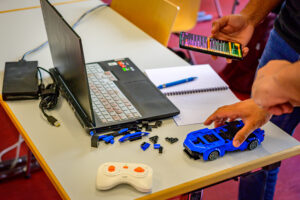
A small building-block car was at the center of the hands-on exercises. The first task was to rebuild the car as faithfully as possible based on various sets of documentation. It quickly became apparent that not all documentation is created equal. Depending on how detailed and clear the information was, the original model could be reconstructed with varying degrees of success.
The exercise thus vividly illustrated why good documentation and structured data presentation are important for research. The participants then developed their own “wish list” and outlined the characteristics research data should have in order to be traceable and reusable.
Collecting, Documenting, and Analyzing Data
Next, the building-block car was equipped with a smartphone and the phyphox app developed at RWTH Aachen University. This allowed data to be collected during the drive and subsequently analyzed.
Documentation also played a central role in this process. Without appropriate metadata, it is often impossible to tell from a dataset alone what information it contains. A dataset without metadata can be compared to an unlabeled box: The contents are there, but without further information, they are difficult to categorize.
NFDI Jupyter Notebooks were used for the analysis. They make it possible, for example, to analyze data using Python while simultaneously documenting the individual steps of the analysis. This allows analysis and documentation to be combined, making research processes more traceable and reproducible.
Creative Formats for the Results
At the conclusion of the Summer School, the findings were not recorded in the form of a traditional scientific publication. Instead, participants were able to get creative and use a variety of formats. This resulted in, among other things, a comic, a video, a podcast, a social media post, and a poster highlighting the key facts. Some of the results were also shared in an Instagram post.
The Summer School thus demonstrated in a practical way that good research data management goes far beyond simply storing data. From planning through data collection and documentation to analysis and dissemination, transparent structures and appropriate tools play a crucial role.
More NFDI4ING Summer Schools
Anyone interested in research data management in the engineering sciences who would like to gain practical experience can find more information about NFDI4ING’s summer schools on the NFDI4ING website.
Responsible for the content of this article is Hania Eid.








Leave a Reply
You must be logged in to post a comment.