
Kategorie: ‘IT-Services’
Your Feedback for the Future of Coscine
Source: Own illustration
In 2026, we would like to invite you once again to participate in our Coscine user survey. From March 23 to April 30, 2026, you will have the opportunity to share your experiences with us and actively help shape the future of Coscine.
Coscine Meets RDMO – Incubator Launched With DMP4NFDI
Source: Own illustration
How can data management planning and research data management be more closely integrated without duplicating form filling, copying, and manual transfers? This is precisely where a new incubator comes in: Coscine and RDMO are being technically linked for the first time. Together with DMP4NFDI, an interface is being developed over six months that will simplify workflows and merge processes. Find out what this will look like in this article.
Where Is the Data? In Coscine, of Course!
Source: Own illustration
“Where is the data?” – This question was at the heart of Love Data Week 2026 and describes a challenge shared by many research projects. Research data is continuously generated, processed, shared, and archived. At the same time, there is a growing need to keep this data findable, traceable, and usable in the long term. With a presentation and a workshop during Love Data Week, Coscine showed how research data management can be implemented in practice in this area of tension.
Get Ready to Use LaTeX in the RWTH Design!
Source: RDM Team RWTH Aachen University
There’s good news for everyone who works with LaTeX: official RWTH LaTeX templates are now available! They make it easier and more convenient for LaTeX users to create letters, posters, and presentations and other documents with the uniform corporate design of RWTH Aachen University.
Marei Peischl (peiTeX) and Dr. Lukas C. Bossert, a member of the RDM team at RWTH Aachen University, developed the templates in close cooperation with the Marketing Department. They have been officially approved. The templates provide a solid foundation, save valuable formatting time, and ensure compliance with RWTH’s formal requirements.
How Does LaTeX Work?
It differs fundamentally from traditional word processing programs. Rather than seeing the final document immediately, you mainly work with text markup. The text is written in an editor. This can be any text editor, though there are also specialized LaTeX writing programs.
You use commands to tell LaTeX what something is (e.g., chapter, table, or figure), not what it looks like. During the compilation process, LaTeX “calculates” the document, automatically determining the optimal positions for text and images before generating a finished PDF.
Therefore, the principle is not “What you see is what you get,” but “What you see is what you mean.”
Although there is a slight delay between typing and seeing the final result, the result is particularly stable, consistent, and professional. The RWTH LaTeX templates were recently published on CTAN and are now included in TeXLive and MikTeX. To work with LaTeX locally, you need a LaTeX distribution, such as TeXLive or MikTeX.
All you need to do is install a distribution. Updates are managed and installed automatically on your computer without requiring additional licenses.
Uniform Design — Technically Clean Implementation
One major advantage of the RWTH LaTeX templates is that the RWTH corporate design is fully implemented in the background. Users no longer have to worry about layout issues.
- All color values of the RWTH corporate design (CD) are stored, including RWTH blue, green, and other color variants in various gradations and color models (RGB, CMYK).
- Letterheads and sender and address details are predefined. Any text entered is automatically placed in the correct position.
- Fonts, spacing, and page layout comply with the official design specifications.
In short, you write the content, and LaTeX takes care of displaying it correctly.
Logos, Images, and Formats
For licensing reasons, RWTH logos are not included automatically. This means that:
- The logo must be added manually to the project folder as an image file so that LaTeX can recognize it automatically.
- Almost all common image formats (except .tif) are supported.
- Official logos can be requested from the Marketing Department.
Practical Application
The RWTH LaTeX templates are suitable for numerous applications;
- Letters,
- Presentations,
- Scientific posters.
If you are interested or need assistance, please contact the IT-ServiceDesk at any time. (*)
Working with Overleaf: LaTeX in the Cloud
If you don’t want to or can’t install LaTeX locally, you can work via Overleaf, a cloud-based LaTeX service.
- Overleaf allows you to write, compile, and manage LaTeX documents directly in your browser.
- You can log in via single sign-on (SSO), such as through RWTH.
- Overleaf is available to RWTH students and staff depending on the license model.
- Projects can be created online and edited collaboratively.
Overleaf is currently provided as “software as a service” via servers at TU Darmstadt. Soon, RWTH templates will be available there, eliminating the need to import them into a LaTeX project. The goal is to integrate this service more closely with the RWTH infrastructure in the future.
One major advantage is that you won’t start from scratch, but rather from a pre-prepared template with much of the information already structured.
Digital Sovereignty and Resilience
For over 40 years, LaTeX has represented stability, openness, and future-proofing. As open-source software, LaTeX does not require any paid licenses, promoting digital sovereignty and representing a “resilient technology”:
- Independence from proprietary software, such as Microsoft Office
- A global standard for scientific and technical documentation
- Use in not only mathematics and the natural sciences, but also the humanities and social sciences
LaTeX is an extremely sustainable solution, especially for long-term, reproducible documentation.
New LaTeX Workshop Series Starting in February 2026
To coincide with the release of the templates, a new LaTeX workshop series will begin in February 2026. Both introductory and advanced courses will be offered:
- An Introduction to Using LaTeX for Academic Publishing
February 25 to 26, 2026 - RWTH Corporate Design Template for LaTeX (Letter)
March 4, 2026
- RWTH Corporate Design Template for LaTeX (Presentation)
- March 5, 2026
- RWTH Corporate Design Template for LaTeX (Scientific Poster)
March 5, 2026 - Creating LaTeX Documents with CI/CD Pipelines
March 12, 2026
Feedback and Further Information
Feel free to contact the RDM team at any time with questions about LaTeX, the workshop series, or general RDM topics.
We are thrilled to present this new service and hope you find great fulfillment and joy in your writing endeavors!
Responsible for the content of this article is Lina-Louise Kaulbach.
(*) The paragraph was updated on February 4, 2026.
ELN@RWTH: eLabFTW on Its Way to Becoming a Standard
Source: Own illustration
Research data is the foundation of modern science, and its careful documentation is crucial for traceability and reusability. However, traditional paper lab books have their limitations. Electronic lab notebooks (ELNs) offer a digital alternative that simplifies work processes and makes research data available in the long term.
In 2024, RWTH Aachen University launched a pilot phase with the open-source system eLabFTW. Now an important milestone is approaching: on October 1, 2025, the ELN@RWTH service will officially go into regular operation – a reason to celebrate!
Coscine at CoRDI 2025
Source: RDM Team RWTH Aachen University
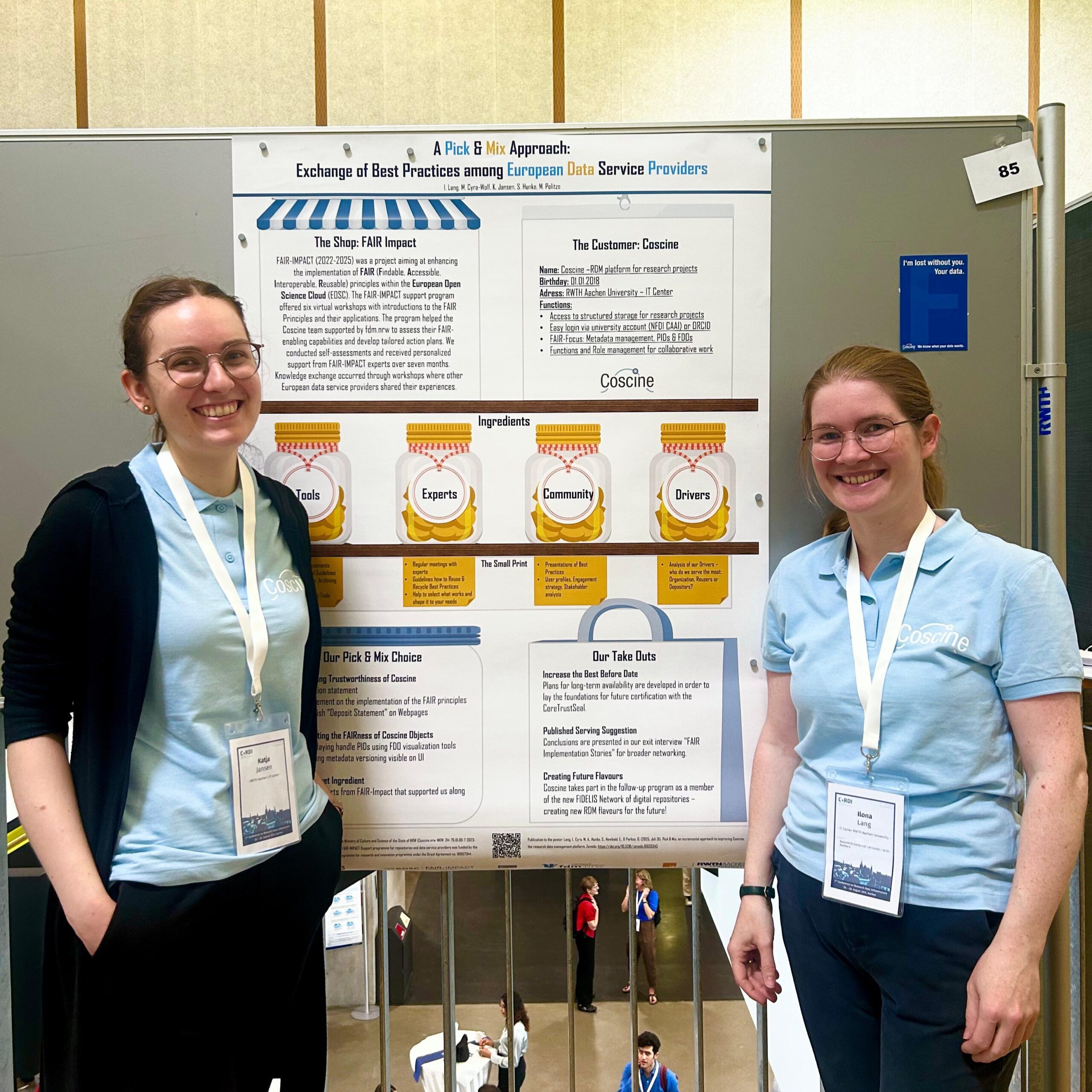
Coscine was also represented with a poster at this year’s Conference on Research Data Infrastructure (CoRDI). The poster showcased Coscine’s participation in the European FAIR-IMPACT Support program, which assists research data infrastructures in implementing the FAIR principles (Findable, Accessible, Interoperable, Reusable). In this article, you will find all the information you need about Coscine and the FAIR-IMPACT Support program.
Announcement: Workshop “Data Stewardship Goes Germany 2025” in Karlsruhe!

Source: University Library RWTH Aachen University
Following the successful 2024 event at RWTH Aachen, the Research Data Management Working Group of the TU9 Alliance, in cooperation with FIZ Karlsruhe, and RDM@KIT are inviting data stewards, data managers, data curators, and other experts from the fields of research data management and research software engineering experts to this year’s workshop, “Data Stewardship goes Germany.”
Europe’s Answer to Search Engine Monopolies: Pilot Phase of the European Open Web Index

Source: Freepik
On June 6, 2025, the OpenWebSearch.eu consortium, an alliance of 14 renowned European research institutions, including CERN, launched the pilot phase of the European Open Web Index (OWI). The aim is to strengthen Europe’s digital sovereignty by creating open and balanced access to web data that is based on European values, data protection standards, and legislation. This should also provide new impetus for research data management (RDM).
Storage Change in Coscine – DataStorage.nrw
Source: Own illustration
With DataStorage.nrw, a new storage system will soon be available behind Coscine, replacing the previous Research Data Storage (RDS). This step does not only bring technical improvements but is also a strategic further development as part of the implementation of fdm.nrw’s RDM state concept.
Research Data Management in Action: CoRDI 2025 at RWTH

Source: Freepik
From August 26 to 28, 2025, RWTH Aachen University will host the second Conference on Research Data Infrastructure (CoRDI). The event will bring together stakeholders from academia, infrastructure, and the community to discuss the current state and future of research data management (RDM).
The conference is organized by the National Research Data Infrastructure (NFDI) in close cooperation with RWTH. The venue is the C.A.R.L. lecture hall center, which offers modern facilities and a central location, providing ideal conditions for a lively conference atmosphere.