

Source: Own Illustration
After several years of intensive planning and implementation work, the network renewal at RWTH Aachen University is approaching an important milestone: Since its launch in 2018, the finish line for the end of 2026 is slowly coming into view. You can also read about our interim status in 2022 in our previous blog article. The completion of the measures in the individual university buildings marks the transition from project to regular operation. The aim of the network renewal is to modernize the communication infrastructure, which is in some parts severely outdated, and to put it on a future-proof footing—technically, organizationally, and operationally.
The challenges of the transition are not only technical in nature. As a university, RWTH is spread across around 350 buildings throughout the city – a logistical feat that required close coordination between the IT Center, building users, and external service providers. The measures are therefore being implemented in stages with clearly defined communication, coordination, and quality assurance.
What Exactly Has Been Renewed?
The network renewal aims to achieve a powerful but also secure network. To this end, the entire centrally managed network technology – from the backbone to the floor distributors to the end devices – is being comprehensively overhauled. This includes the creation of a structured network, the replacement of outdated hardware with modern components, additional security standards, comprehensive Wi-Fi coverage in the office and work areas, and the replacement of the existing Alcatel telephone system with a VoIP-based (Voice over Internet Protocol) solution from Cisco with video telephony and softphone clients.
Transition to Regular Operation
Source: Own Illustration
Once network renewal has been completed in a building, the transition to regular operation and generally applicable processes takes place automatically. Basic support for network components, telephones, and Wi-Fi access points is provided by the IT Center, Networks Division. Authorized network contacts at the institutions can use specially developed web applications such as Interface Admin, TK Portal, Firewall Admin, DHCP Admin, and DNS Admin to make standard changes and adjustments themselves. For more information, please visit IT Center Help.
To ensure the stability and security of network operations, network devices such as switches, Wi-Fi access points, or Cisco telephones must not be removed, reconnected, or used in other locations without authorization—not even temporarily, for example during holidays, vacation periods, or because they are not currently needed. The devices are part of a central location documentation system and form the basis for efficient support in the event of a malfunction. Automated update procedures for switches, telephones, and Wi-Fi access points can cause problems with inactive devices if they are later put back into operation with outdated software.
For reasons of network security and management, the use of private switches (by departments or employees) is strictly prohibited on the official RWTH networks (Internet access). If you require network access, please speak to your direct network contact or contact the IT Center, Networks Division.
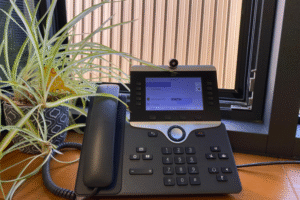
The following also applies when using the new telecommunications infrastructure: Cisco telephones must remain permanently installed at their designated locations. They are not only used for communication, but are also relevant in emergencies – among other things, for location purposes by the university security service. The locations are documented so that the origin of emergency calls can be clearly determined. Relocations, new registrations, or replacement requirements are handled via the electronic telephone request form or the IT Center, Networks Division.
Order and Safety in Cabling
Another important point concerns the physical infrastructure: Patch cables at data connections may only be reconnected in consultation with the network contact person. When furnishing rooms, care must also be taken to avoid tripping hazards, such as loose cables. The use of cable protection channels can help here and also protect the cables themselves. Particular attention must be paid to proper cable routing in passageways and escape routes.
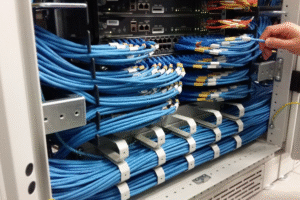
Clear standards have been defined for the central network cabling itself: For example, patch cables in the network cabinet are routed through patch panels, and excess lengths are wound up exclusively on the patch panel side. Cable labeling also follows a uniform system with yellow and white clips for clear identification.
Has the Network Upgrade Made a Noticeable Difference?
After seven years and more than 200 completed buildings, it is fair to ask whether the network renewal at RWTH has had any noticeable impact. The clear answer is YES.
The network at RWTH and its facilities is now much more transparent, tidier, standardized, and also much more comprehensively documented. This makes it easier to locate and rectify faults, but also to implement special requirements for projects. In some facilities, the network renewal was taken as an opportunity to rethink and revise the existing structures.
We have received feedback from many administrators that the structured and transparent networks, the significantly more comprehensive documentation, and the web applications offered have made network administration much easier. This also makes it much easier to train new administrators.
The intensive collaboration during the network renewal also helped maintain contacts. Thanks to the increased exchange of information, the IT Center, Networks Division, was called upon more often for consulting support on network issues for projects. The many standardizations also made it possible to set up automations, e.g., for updates or security settings. This helps with device management, as time is often a crucial factor.
A Glimpse Into the Digital Future
The network renewal is not only a major technical project, but also a strategic step toward a digital, resilient, and networked university. With its scope, it is one of the largest infrastructure projects at RWTH, which began in 2018 and will be completed in two phases by the end of 2026. The focus was not only on technological renewal and future-proofing, but also on IT security, user orientation, and location attractiveness. Work has already begun on a follow-up application to the Ministry of Culture and Science in order to continue the standard that has now been established in the future.
The network renewal is embedded in larger developments in the IT landscape at RWTH, such as the introduction of modern cloud strategies, new IT security concepts, and the strengthening of mobile and hybrid working models. The modernized network structure forms the backbone for these transformations. With the new infrastructure, RWTH Aachen University now has a future-proof platform at its disposal that is flexible, scalable, and secure. This creates the conditions for research, teaching, and administration at one of Europe’s leading technical universities to continue to be reliably supported digitally in the future.
Responsible for the content of this article are Hania Eid, Frank Lindner and Malak Mostafa.