

Source: Own illustration
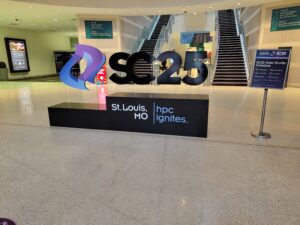
The Supercomputing Conference 2025 (SC25), one of the world’s most important conferences in the field of high-performance computing, took place this year in St. Louis, Missouri (USA). Under the motto “HPC ignites,” around 15,000 participants gathered to discuss current research results, technological developments, and future trends in supercomputing. The IT Center was represented by three participants, who took the opportunity to exchange ideas with international experts and gain valuable insights from the vibrant HPC community.
Focus On OpenMP Tasking
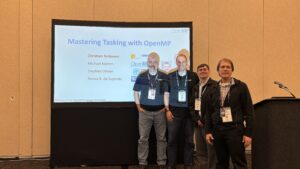
A particular highlight of the extensive tutorial program was the OpenMP tutorial “Mastering OpenMP Tasking: From Start to Free-Agent Tasks.” The event provided an in-depth understanding of modern tasking concepts and used concrete examples to show how these can be applied in complex HPC scenarios. Christian Terboven, chief HPC officer at the IT Center, was one of the speakers and presented the content with great expertise. The tutorial provided an ideal setting for gaining practical experience and gaining a better understanding of both basic and advanced aspects of OpenMP tasking.
Source: Own illustration
Michael Klemm, Christian Terboven, Stephen Olivier, Bronis R. de Supinski

Source: Own illustration
Impressions From Workshops, Sessions and Posters
Source: Own illustration
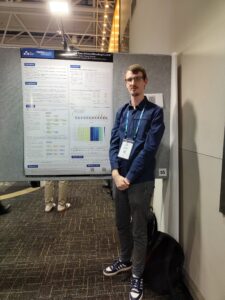
Jan Kraus
The technical program was once again the centerpiece of this year’s conference and impressed with its variety of workshops, paper sessions, Birds-of-a-Feather meetings, panels, and the poster session. A particularly memorable moment was the Correctness@SC25 workshop, in which Professor Matthias Müller, director of the IT Center, appeared as a featured speaker and explained in his presentation “Runtime Correctness Checking with MUST and Assisting Tools” how runtime verification tools contribute to the reliability of parallel software.
Our group also made a strong contribution to the poster session. Jan Kraus presented his work on performance optimization of task scheduling for OpenMP-based accelerator programming, in which he examined various tasking workflows. The discussions clearly showed how important efficient tasking methods are for future HPC systems.
Culture, Nature and Architecture
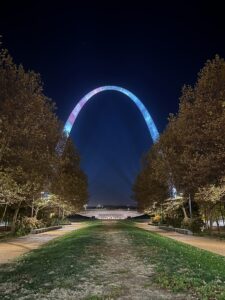
Away from the conference, St. Louis offered numerous opportunities to experience the city’s culture and scenery. The Gateway Arch, the city’s iconic landmark, impressed with its futuristic steel construction and unique view of the Mississippi River and the skyline.
Another central attraction was the sprawling Forest Park, one of the largest inner-city parks in the US. It is home to the popular zoo, the art museum, the history museum, and the science museum, which also became an important part of our conference experience. The SC25 technical reception was held at the science museum – an evening of drinks, good food, and numerous opportunities to chat with other participants in a relaxed atmosphere. The combination of scientific flair and informal atmosphere made this evening a special highlight.
Source: Own illustration
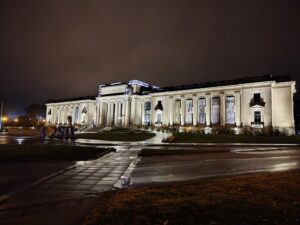
Source: Own illustration
Conclusion and Outlook for SC26
SC25 in St. Louis was a success for us in every respect. Inspiring presentations, valuable discussions, and the lively atmosphere of the international HPC community made the conference an intense and enriching experience. The city itself also played its part, offering exciting places that made the stay unforgettable.
We are already looking forward to SC26 in Chicago, Illinois (USA), which will be held under the motto “HPC unites.” We are excited to see what new developments, encounters, and impulses await us there and how the HPC community will continue to unite and strengthen itself in the coming year.
Responsible for the content of this article is Jan Kraus.








Leave a Reply