

Source: Own illustration
The SupercomputingAsia (SCA) is the largest conference in the field of high-performance computing (HPC) for the global supercomputing community in Asia. This year, the SCA was jointly hosted with the International Conference on High Performance Computing in the Asia-Pacific Region (HPCAsia) in Osaka, Japan. More than 2,500 participants from 45 countries and regions attended SCA/HPCAsia 2026 to discuss current research results, technological developments, and future trends in supercomputing. Keynote speakers highlighted important developments for the convergence of HPC, AI, and Quantum Computing.
The IT Center was represented by three participants, who exchanged ideas with international experts and made strong contributions to the conference’s workshops by presenting current research results on HPC & AI and energy efficiency.
Paper Contributions at Workshops
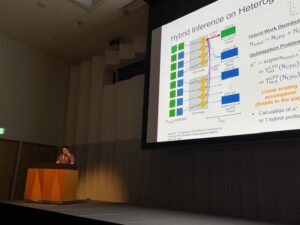
Fabian Orland presented important results on “Hybrid Inference Optimization for AI-Enhanced Turbulent Boundary Layer Simulation on Heterogeneous Systems” at the Multi-Scale, Multi-physics, Coupled Problems and AI enhanced simulations on HPC (MMCP) workshop. The presented approach cooperatively involves CPUs and GPUs in the inference of a TBL-Transformer during a coupled AI-enhanced simulation and fully exploits current heterogeneous hardware systems resulting in significantly reduced runtimes and improved energy efficiency. These insights resulted from a collaboration between the Institute of Aerodynamics and Chair of Fluid Mechanics (AIA) at RWTH Aachen University, the Jülich Supercomputing Centre (JSC), and the IT Center’s Chair for High Performance Computing in the context of the National High-Performance Computing Center for Computational Engineering Science (NHR4CES) and support future research to save power and reduce emissions of environmentally harmful greenhouse gases!
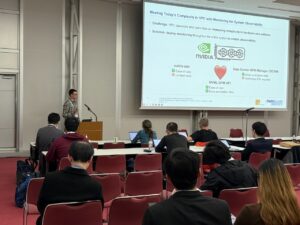
At the Energy Efficient HPC State of the Practice (EE HPC SOP) workshop, Christian Wassermann presented insights from their paper on “Leveraging NVML GPM for NVIDIA GPU Monitoring“. The work enables observability of user applications at the system scale by providing a light-weight, open-source monitoring tool that leverages the NVML GPM API. The utility of the collected data is highlighted in three use cases for evaluating the performance of GPU kernel executions, modeling the GPU energy consumption of workloads, and analyzing the overall cluster workload. A validation of the available metrics is included, and a post-processing methodology is proposed to increase the value of the NVML GPM data for application-level insights. These methods allow a deeper understanding of machine learning workloads to ensure the efficient utilization of the available computational resources.
Source: Own illustration
Source: Own illustration

Source: Own illustration
Asian HPC Infrastructure Workshop
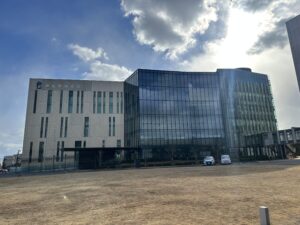
Before the SCA/HPCAsia 2026, the RIKEN Center for Computational Science (R-CCS) hosted the Asian HPC Infrastructure Workshop 2026, bringing together specialists for HPC data center design and operation to discuss the latest infrastructure trends and technologies. Christian Wassermann presented on their sustainability efforts as part of the HPC Sustainability Working Group: They are working on defining a new sustainability metric for data centers that promotes the use of renewable energy, considers the efficiency of the cooling infrastructure, and encourages higher cluster allocation rates.
If you are interested in joining the discussions or just staying up to date with the recent developments, please visit the HPC sustainability interest form. As we are looking to broaden the diversity of participating organizations, new members from all countries are welcome to contribute towards the common goal of reducing the global carbon emissions related to the operation of HPC resources.
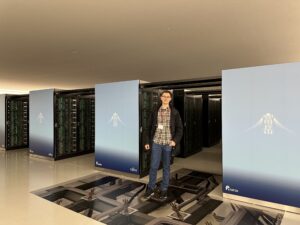
A Visit to the Fugaku Supercomputer
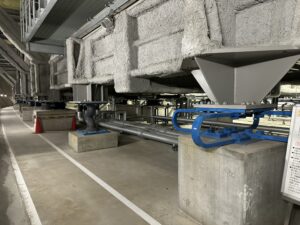
During a tour through R-CCS, the scale of Japan’s flagship cluster Fugaku was impressive to witness. Due to Japan’s high seismic activity, special care had to be taken to suspend the IT equipment on large springs that dampen the effect of seismic activity. Combined with a noted low general failure rate of individual components, such reliable computational resources are vital for scientific research to advance.
With Fugaku being designed in a pre-AI (or at least early-AI) era, it will be exciting to see the AI-targeted innovations that are being integrated into FugakuNEXT, Japan’s next-generation flagship supercomputer, scheduled to begin operations around 2030.
Source: Own illustration
Source: Own illustration
Source: Own illustration
In Japan, History Meets Modernity
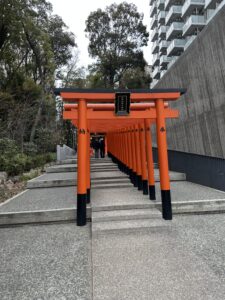
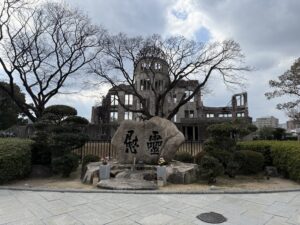
Throughout our visit in Japan, we realized how well Japan manages to honor its history while not missing critical new trends. The slogan found in Tokyo Tower expresses this sentiment well: revisiting the old, learning the new. To progress scientifically, we always need to find a balance between relying on past findings as a basis for new developments while re-evaluating previous dead-ends when external conditions change. Even architecturally, Japanese cities manage to harmoniously collocate historical sites and modern skyscrapers.

Source: Own illustration
Source: Own illustration
Source: Own illustration
Outlook for Future Collaborations and ISC 2026
With the new connections made in Japan, we look forward to establishing new collaborations in the Asia Pacific region. Of course, the current partnership between NHR and JHPCN, the Joint Usage/Research Center for Interdisciplinary Large-scale Information Infrastructures in Japan, is being continued and deepened with joint research efforts in 2026.
With ISC 2026 around the corner, we look forward to welcoming you at our NHR-Verein exhibition booth J10. You can stay up to date with our developments by following us on LinkedIn and subscribing to the RSS feed of our IT Center blog.
Responsible for the content of this article are Fabian Orland and Christian Wassermann.








Leave a Reply