

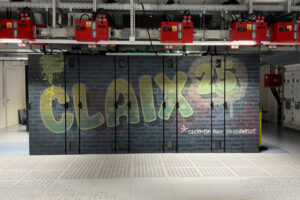
Source: Own illustration
With CLAIX-2023, a major step was taken in 2023 toward a modern, energy-efficient, and scalable High Performance Computing (HPC) infrastructure at RWTH Aachen University. Now, CLAIX-2025 marks the next milestone, bringing significant additional CPU computing power to strengthen the field of traditional HPC simulations. In addition, a targeted expansion in the field of machine learning (ML) marks an important step forward. The new system went live on July 13, 2026, and seamlessly complements CLAIX-2023 as part of the proven 1-cluster concept at the Tier-2 level.
State of the Art CLAIX-2023
With the Aix-la-Chapelle 2023 Cluster (CLAIX-2023), RWTH Aachen University has been operating a modern HPC system since late 2023 that is specifically tailored to the needs of university research. It is a system designed for national HPC (Tier-2), local computing (Tier-3), and state-wide AI computing (WestAI). It is specifically designed for computationally intensive scientific applications, ranging from materials simulation and fluid dynamics to climate modeling. CLAIX-2023 consists of over 660 compute nodes, each equipped with 2x Intel Sapphire Rapids processors—each with 48 cores—and 256 to 1,024 GB of DDR5 memory. In addition, there are 51 compute nodes with an identical base architecture, each equipped with four NVIDIA Hopper H100 GPUs (including NVLink) as accelerators and available for specific applications such as ML. For interactive work with the system, CLAIX-2023 also features six interactive systems with compatible architecture. All nodes are connected via an NVIDIA/Mellanox NDR InfiniBand 200-gigabit-per-second network. With its modular design, it forms the backbone of numerous research projects and was designed to be seamlessly expandable, as is now the case with CLAIX-2025.
CLAIX-2023 & CLAIX-2025 in a Network
Instead of a complete system overhaul, the IT Center is focusing on continuity and scalability: CLAIX-2023 and CLAIX-2025 will be operated as a unified cluster. As a result, researchers benefit from a consistent environment in terms of both the software stack and the file system. At the same time, CLAIX-2025 expands the system with specialized resources for HPC and ML. The supercomputer is primarily funded by the NHR4CES and WestAI projects, which specifically support engineering, the natural sciences, and ML.
Technical Highlights of CLAIX-2025
The new system is positioned as a Tier 2 system within the Nationalen Hochleistungsrechnen (NHR) initiative and complements the existing infrastructure as follows:
Computing Power
- Theoretical Peak Performance (CPUs): 6.2 PFlops
- Theoretical Peak Performance (GPUs): 1.6 PFlops
- Available Resources per Year:
- 708 million core-hours (CPU)
- 210,000 GPU-hours
- In addition, there are 491,000 GPU-hours with a theoretical peak performance (GPU) of 3.7 PFlops for WestAI
HPC segment
- 421 nodes with AMD EPYC “Genoa” 9654 (2×96 cores, 2.4 GHz)
- 313 nodes with 384 GB RAM
- 108 nodes with 768 GB RAM
ML segment
- 6 ML nodes with AMD EPYC “Turin” 9535 (2×64 cores, 768 GB RAM)
- Per node: 4× NVIDIA H100 SMX5 GPUs (80 GB HBM3e)
- Additionally: 14 more ML nodes as part of the WestAI project
Storage & Network
- 26 PiB Lustre storage
- SSD-based BEEOND system with 1.6–3.2 TB per node
- High-performance network: Cornelis CN5000 HFA 200 with 2:1 blocking
Additional Infrastructure
- Additional login nodes (4× HPC, 1× ML)
- Direct Liquid Cooling (DLC) for CPUs and GPUs at a 35 °C flow temperature
Rethinking Research
With targeted expansion in the field of ML, the use of state-of-the-art hardware components, and energy-efficient architecture, the IT Center is positioning itself for the future. CLAIX-2025 was designed not only to meet growing demand but also as a strategic investment in the data-driven scientific research of tomorrow.
For more information on CLAIX-2025 and HPC at RWTH, please visit our HPC landing page.
Responsible for the content of this article is Malak Mostafa.









Leave a Reply