

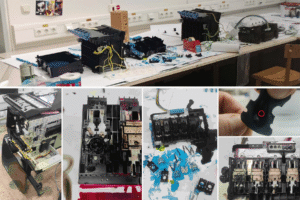
Source: Own illustration
For many decades, the IT Center’s Printing Service has provided professional printing solutions for the departments and chairs at RWTH Aachen University. Unfortunately, the Printing Service as we know it will soon be a thing of the past. In this blog post, you’ll learn what’s behind the Printing Service’s closure and what happens next.
Our Printing Service
Print media remain an important part of academic work. At RWTH, printing needs have been met until now by the university’s in-house print shop at the Central University Administration and the IT Center’s Printing Service. While the in-house print shop handled print jobs up to DIN A3 size, the print service was responsible for large-format prints. Equipped with the Pro-4000S and Pro-6000S color inkjet plotters, the service produced numerous posters and banners for conferences, site visits, events, presentations, and much more. Our printing service team has always strived to provide excellent customer service. Thanks to reliable advice and communication, we were able to fulfill even last-minute requests. But all of this is only possible if the hardware is up to the task.
The Beginning of the End
In the summer of 2025, we noticed an unusually high consumption of printer ink in the Printing Service. Cyan ink, in particular—which produces the RWTH blue—was being used up at an increasingly rapid rate. Cartridges that were supposed to last a month were running out within a week. Due to the delivery times for new ink cartridges, there were backlogs in orders. When a technical outage occurred in early January, our Printing Service team worked to find a solution to the ink problem. Thanks to some resourceful cost-saving measures, they managed to resume operations on short notice.
A Chain Reaction
From February through March, the situation stabilized. Unfortunately, a setback occurred in March: one of the plotters could no longer be started up due to a hardware failure. With only one functioning plotter, operations could continue only on a limited basis. By early June, the second plotter would no longer turn on either.
The Rescue Attempt
Unfortunately, professional repair was no longer possible for the ten-year-old models, and purchasing new ones didn’t make sense for the IT Center. So, our Printing Service team decided to try repairing them themselves.
The first step: finding the cause of the hardware failure. A look inside the plotters quickly revealed the problem—the trays beneath the ink system were completely filled with ink. This also solved the mystery of the high ink consumption. The trays were so full of ink that the gears controlling the ink system became contaminated with ink, triggering a sensor error.
So, the first step was to clean the reservoirs and the gears. Next, we had to find the leak. After completely disassembling the plotter, the Print Service team discovered perforated seals in the ink inlet. But this is where the next problem arose: replacement parts are no longer manufactured for such small components in a device that is over ten years old.
Since the plotters are from the same series and therefore have the same ink systems, our resourceful Print Service team came up with the idea of cobbling together a functional plotter from the two defective ones. Using parts from the four defective ink systems, they were able to build two functional ink systems. The hardware issue was thus resolved. But during a test print, the next setback occurred: the color calibration was no longer working. This is a problem for which we have not yet found a solution.
What’s next?
After thorough analysis and various repair attempts, we unfortunately had to admit that the devices are beyond repair due to their advanced age and numerous existing defects.
However, as we considered how to maintain the service at RWTH, synergies with the ZHV’s in-house print shop quickly became apparent.
After consulting with Department 5.0, we jointly concluded that transferring the service to the in-house print shop—and thereby creating a central point of contact for printed materials at RWTH—makes sense and is beneficial for our customers.
The university’s in-house print shop intends to launch the Print Service shortly, so that plotting will once again be possible under similarly straightforward conditions.
Further information about the new Print Service announced by Department 5.0.
We would like to thank all RWTH institutes, chairs, and organizations that have used the Printing Service for their trust and long-standing loyalty.
Responsible for the content of this article is Masimba Koschke.









Leave a Reply