

Source: Own illustration
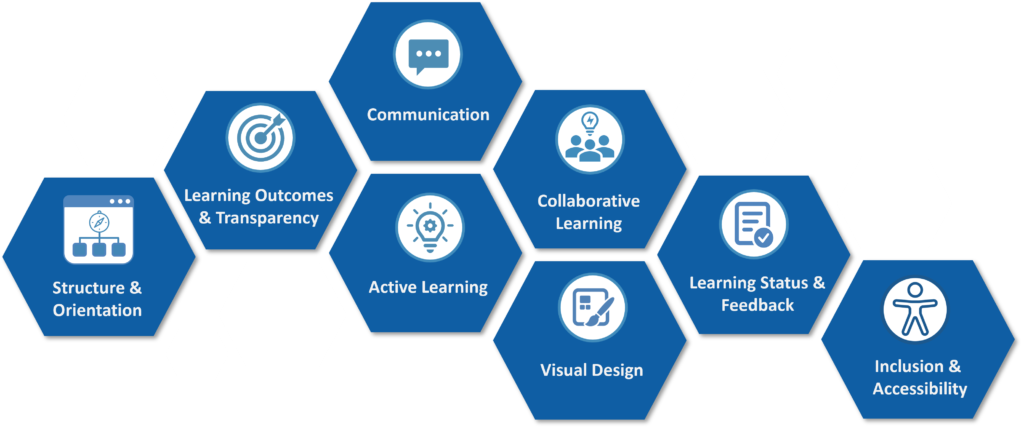
Students will be familiar with this: course rooms in RWTHmoodle either contain summaries of the respective lecture or seminar or are a hodgepodge of content. But they can also look different: clearly structured and filled with all the content that is important for the course. In addition, there are also various options for interactively deepening learning content or submitting assignments. Although forums, assignments, and tests are among the most frequently used activities, Moodle offers much more to facilitate the learning experience for students. The fifth MoodleCafé therefore focused on course room design. Two practical examples were used to show how design principles can be implemented effectively.
Source: Own illustration
Course rooms with structure and clear goals
In the first practical example, Dr. Sarah Heinemann from the Chair of Contemporary German Language presented her learning space from her seminar on linguistics and communication science. The course room complements the face-to-face course and thus serves not only as a repository for presentations. It also offers students a place to follow up on material if, for example, they were unable to attend the face-to-face course. At the same time, the course room is also used for learning and exchange. Interactive content is used both in the seminar, in other words face-to-face, and outside of the face-to-face sessions.
During the seminar, students can, for example, access a lesson in the course room via a QR code. In this way, the course room is actively integrated into the face-to-face event. A popular activity in the course room is the “board.” Here, interesting content that fits the seminar’s theme is collected anonymously. The course room is also intended to serve as a guide for students. For example, it provides an overview of the course program and clearly defines the learning objectives. Lecturers’ contact details can be found in a block in the right-hand sidebar, along with office hours. The onetopic format was set up for a better overview. This way, not all content is listed on a single page, but is organized thematically on separate subpages.
A course room to support thesis work
In the second example, Lena Schlumbohm from the Institute for Technology and Innovation Management showed that RWTHmoodle can also be used as a support tool during the thesis phase. On the one hand, academic work is a topic covered in the course room. On the other hand, the aim is to promote exchange between students and with their supervisors. This allows students to receive feedback or give feedback themselves. In short lessons, students complete short quizzes and earn badges by working on and completing various activities.
The course room is visually appealing, and short comics guide students through the course room and the often-difficult phase of writing their thesis. In addition to tips and help with academic work, there is also information about counselling services at RWTH Aachen University. Students and supervisors meet regularly via Zoom to ask questions and discuss other issues. Self-study units are thus combined with personal exchange.
By applying various design principles, a course room can become an added value for students. There is no need to reinvent the wheel every semester. Courses can be reused and filled with different content by importing them.
Preview: The next MoodleCafé
At the next MoodleCafé on January 27, 2026, Dr. Anja Zierhut and Peter Kleber from the Chemistry Service Center will present their course design in more detail. These course rooms are aimed at first-year chemistry students and enable them to refresh their chemistry knowledge in a playful way in RWTHmoodle by discovering numerous Moodle activities such as quizzes, books, and the gamification tool Stash, all embedded in a successful visual design.
This format is aimed at all interested teachers and teaching assistants who are looking for new Moodle ideas for their teaching or who want to optimize their course rooms. It offers the opportunity to gain inspiration for your own teaching and to engage in direct exchange with colleagues.
The MoodleCafé will take place on January 27, 2026, at 2 p.m. via Zoom. Registration is via the event database (available only in German). The access data will then be sent to the email address provided.
If you are interested in best practices and have missed the previous MoodleCafé events, you can register yourself in the corresponding learning room and watch the recorded presentations. There you will also find further information on each topic.
Would you like to present your own best practice? Then please contact the RWTHmoodle advisory service.
Responsible for the content of this article are Verena Grouls and Valetin Koser.









Leave a Reply