Kategorie: ‘Auszeichnungen’
Teaching awards at RWTH Aachen University: Recognition for innovative teaching and dedicated lecturers
RWTH Aachen University has awarded this year’s teaching prizes, recognizing outstanding commitment and innovative approaches in university teaching.
Special Teaching Award for the Phyphox app
This year’s RWTH Special Teaching Award goes to the Phyphox app, which allows physical experiments to be carried out directly with a smartphone. The application transforms mobile devices into versatile measuring instruments and makes it possible, among other things, to measure the speed of an elevator or the acceleration of a roller coaster.
Phyphox was developed by a team led by experimental physicists Professor Christoph Stampfer, Dr. Sebastian Staacks, Professor Heidrun Heinke, and Dr. Dominik Dorsel. The app is used in schools and universities as well as in everyday life and relies on the sensors built into smartphones. The collected measurement data can be processed directly and displayed graphically.

Professor Joost-Pieter Katoen (right), Vice Rector for Teaching, presented the certificate to the Phyphox development team, Professor Heidrun Heinke, Dr. Dominik Dorsel, Professor Christoph Stampfer, and Dr. Sebastian Staacks (from left).
The application is available free of charge and without advertising for Android and iOS and has been continuously developed since 2016. Phyphox now has several million installations and supports more than 20,000 smartphone models. A particular focus is on long-term compatibility with older devices. Thanks to volunteer translators, the app is also available in 19 languages.
The Rectorate justified the award of the Special Teaching Prize with the high national reach and the great appeal that Phyphox has for RWTH. The app is considered a sustainable model of success for innovative teaching. With this award, the Rectorate wishes to emphasize the importance of the project for the entire university and support its further development.
Teaching award for Dr. Stefan Lankes
In the teaching category, Dr. Stefan Lankes from the Chair of Automation of Complex Power Systems receives the teaching award. He was nominated by the student council for electrical engineering and information technology, which particularly highlights his ability to convey complex content in a comprehensible, structured, and practical manner.

The student council emphasizes the clear relevance of his courses to professional skills and their consistent focus on learning objectives. Particular mention is also made of his targeted use of digital tools to support students’ independent study. Through interactive tasks, automated tests, and regular feedback, Dr. Lankes promotes independent learning and motivation.
His cooperative style in lectures and exercises creates an appreciative learning atmosphere and enables an exchange on an equal footing. In projects, theses, and interdisciplinary seminars, Dr. Lankes also attaches great importance to practical relevance and the connection to current research. He consciously takes time for student feedback and is open and willing to engage in conversation.
Beyond his own teaching, Dr. Lankes is involved in student initiatives and international cooperation projects, including summer schools and research projects with partner universities. He was involved in the planning of the Computer Engineering program for the 2021/2022 winter semester from the very beginning and advocated for future-oriented development and student-friendliness of the program in the advisory board
RWTH Aachen University among the world’s leading universities

TIME magazine has published its first international university ranking, listing the 500 best universities worldwide. RWTH Aachen University has successfully positioned itself in this global comparison and is now officially one of the leading universities at the international level.
Of the more than 400 universities in Germany, only 44 made it into the ranking. RWTH Aachen University ranks 120th worldwide and an outstanding seventh in the national comparison. This result underscores RWTH’s strong position within the German and international university landscape.
The ranking is based on several indicators that reflect key performance dimensions of universities. These include scientific performance, innovative capacity, influence on the economy, and internationality. These criteria reflect essential aspects that also shape everyday university life in research and teaching.
There is a particular focus on the area of internationalization. This is measured by the number of staff and students who come to the respective university from abroad. In this category, RWTH Aachen University achieved 68.82 points, placing it 89th worldwide. Within Germany, RWTH ranks second in this area.
RWTH’s performance in the TIME magazine ranking confirms the university’s position as a high-performing and internationally oriented research location and at the same time provides a solid foundation for the further development of research, teaching, and academic exchange.
Picture Coding Symposium 2025: Global Video Coding Experts at RWTH Aachen
Aachen became the global hub for image and video coding this December. For the first time, the renowned Picture Coding Symposium (PCS) was held at RWTH Aachen. Led by Professor Mathias Wien and Professor Jörn Ostermann, 162 participants from 19 countries gathered at the SuperC to share cutting-edge research.
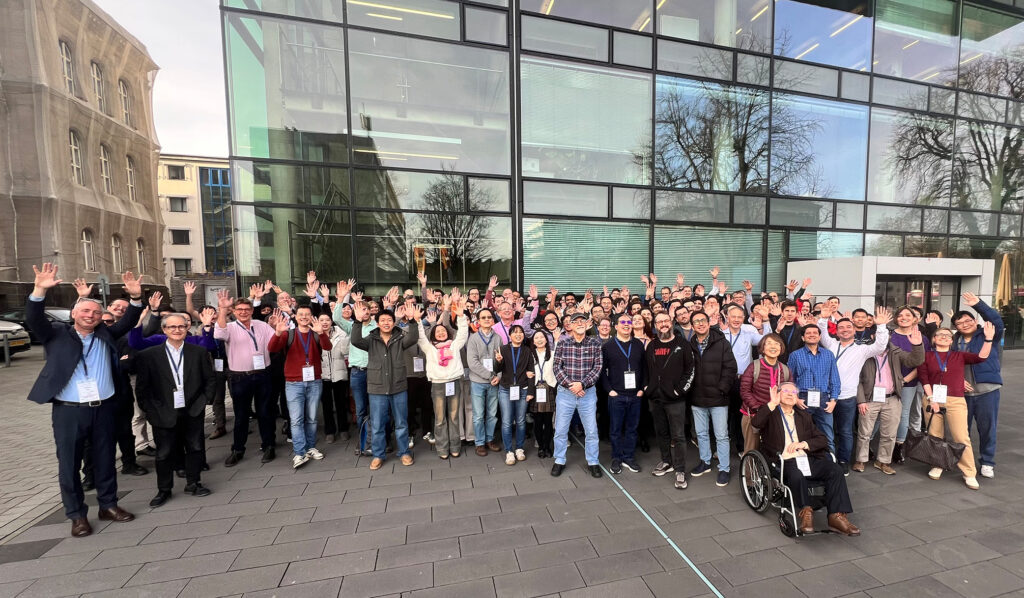
Foto: Mirco Seidler
A Tribute to Professor Jens-Rainer Ohm A major highlight was the honoring of Professor Jens-Rainer Ohm, former head of the Institute for Communications Engineering. His work on global standards like AVC, HEVC, and VVC is the foundation for video transmission on nearly every modern television and mobile phone.
The interactive atmosphere promoted the exchange of knowledge and ideas between international researchers from both academia and industry. The organizers were pleased with the positive feedback and emphasized the importance of such events for scientific progress and international cooperation.
RWTH Electrical Engineering Ranks 8th in Europe
Our Faculty of Electrical Engineering and Information Technology continues to set benchmarks for excellence. In the latest EngiRank 2025, RWTH Aachen secured the 7th position among 239 technical universities in Europe, with our department leading the way:
Top 10 in Europe: Our Electrical Engineering program is officially ranked 8th across the entire continent.
Excellence in Scores: Achieving 91.91 out of 100 possible points, RWTH has shown steady improvement and maintains its position as the #2 technical university in Germany.
Driven by Innovation: The ranking highlights our outstanding performance in research, internationalization, and the number of patents filed.
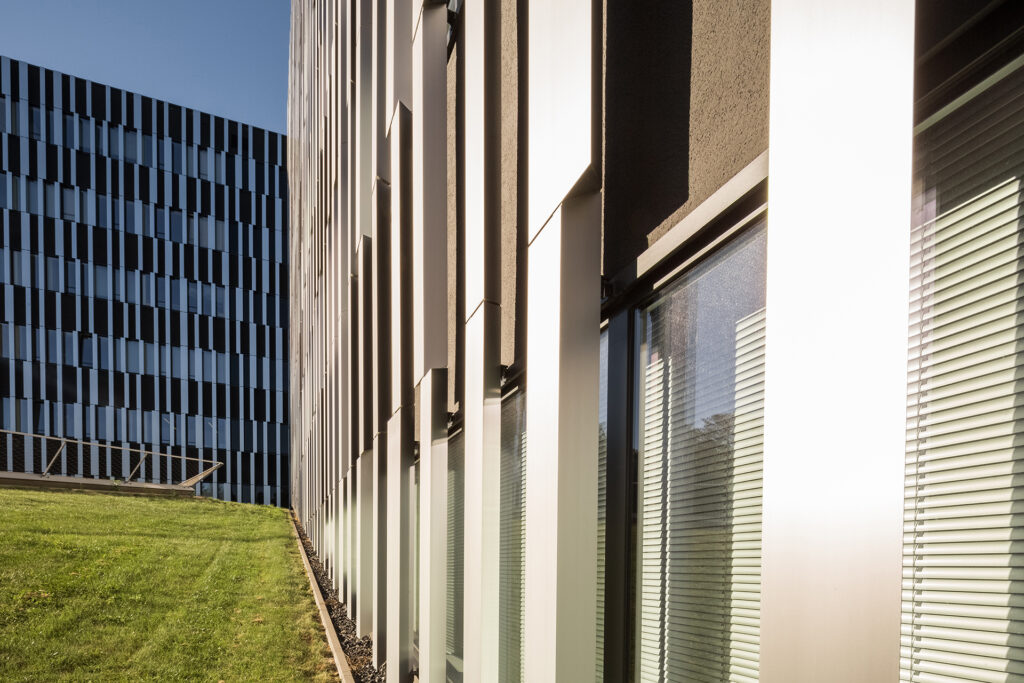
Martin Braun
This ranking reinforces our faculty’s reputation as a global leader in technology and innovation. To our students and staff: thank you for making us one of Europe’s elite engineering institutions!
Three outstanding theses from our faculty awarded the Friedrich Wilhelm Prize 2025
At the Friedrich Wilhelm Prize award ceremony on Friday, a total of 17 students and doctoral candidates from RWTH Aachen University were honoured for their outstanding scientific work. Among them were three award winners from the Faculty of Electrical Engineering and Information Technology.
The award winners from our faculty were Jonas Timon Schroeder, M.Sc., for his master’s thesis (supervised by Prof. Monti), Dr.-Ing. David Wasylowski for his dissertation (supervised by Prof. Sauer) and Dr.-Ing. Felix Jiang for his dissertation (supervised by Prof. Ingebrandt). The prizes were presented by RWTH Rector Ulrich Rüdiger in the auditorium of the main building; with musical accompaniment provided by the RWTH Big Band.
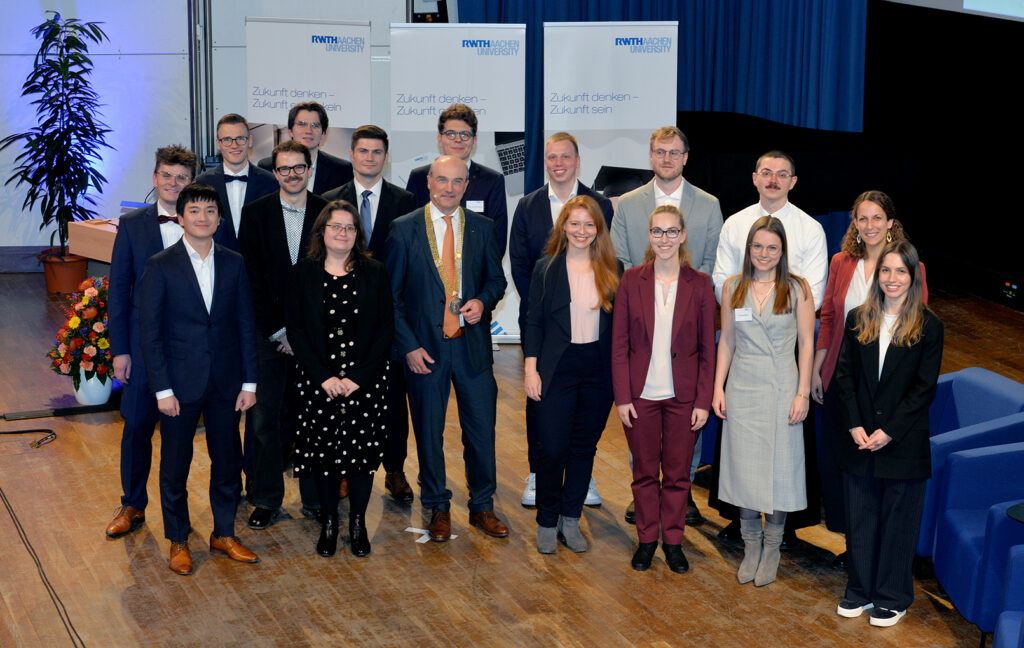
Photo: Andreas Schmitter
The Friedrich Wilhelm Prize is awarded by the Friedrich Wilhelm Foundation, which was established in 1865 by the legal predecessor of today’s Aachener und Münchener Beteiligungsgesellschaft. Its main focus is to promote research and teaching and to support students and scientists at RWTH Aachen University. The foundation is named after Friedrich Wilhelm III, Crown Prince of Prussia and later Emperor. In 1858, he received a donation of 5,000 talers to establish a polytechnic institute in the Rhine Province. This donation formed the basis for the later Friedrich Wilhelm Foundation and thus for the development of RWTH Aachen University.
The award-winning theses impressively demonstrate the scientific breadth and capabilities of our faculty. The award winners represent key areas of modern electrical engineering and contribute to the visibility and strength of our research with their outstanding theses. The faculty warmly congratulates Mr Schroeder, Dr Wasylowski and Dr Jiang on this significant award.
Prof. Max Lemme as co-author in Nature Photonics
The Faculty of Electrical Engineering and Information Technology congratulates Prof. Max Lemme on a special scientific achievement: as co-author, he contributed to a consensus statement publication in the renowned journal Nature Photonics. The publication is entitled ‘Guidelines for accurate evaluation of photodetectors based on emerging semiconductor technologies’ and provides important impetus for the international research community.
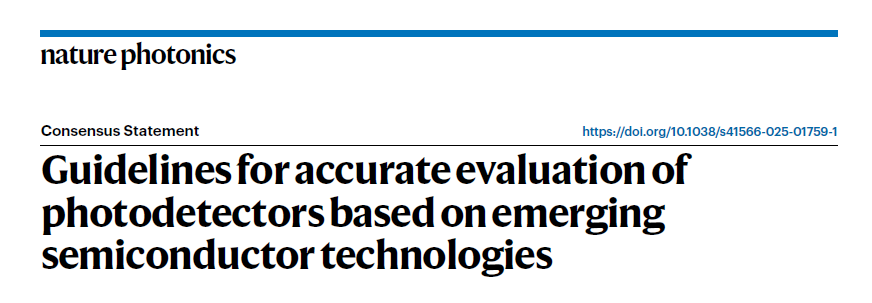
A consensus statement publication summarises the current state of knowledge in a specialist field and formulates recommendations, standards or procedures that promote reliable and uniform scientific practice. In this article, leading experts from research and industry have developed for the first time a comprehensive framework for the precise characterisation, documentation and comparability of photodetectors based on novel semiconductor materials.
There is a great need for such guidelines: photodetectors made from innovative material classes such as organic semiconductors, perovskites, quantum dots, two-dimensional materials, metal oxides and carbon nanotubes have made enormous progress in recent years. At the same time, inconsistent measurement methods and reporting standards have so far made it difficult to compare different studies and thus hindered scientific development in this field.
The recommendations that have now been published create a common foundation for the community and support transparent, reproducible and comparable research practices. This benefits not only academic working groups, but also industrial development processes and the emergence of future photonic technologies.
Prof. Max Lemme is not only the holder of the Chair of Electronic Components at our faculty, but also the managing director of AMO GmbH, whose research focuses are closely linked to the topics covered in the publication. The development and integration of novel materials for optoelectronic components is one of the company’s core activities. Participation in this international consensus paper underscores the great scientific and technological relevance of this work.
AMO GmbH has also highlighted the publication in its own article. Further information can be found on the website and on LinkedIn.
Otto-Junker Prize 2025: Two ETIT Graduates Honored
This year’s Otto-Junker Prize 2025 brings double success for our faculty:
Two ETIT graduates have been honored for outstanding academic achievements.
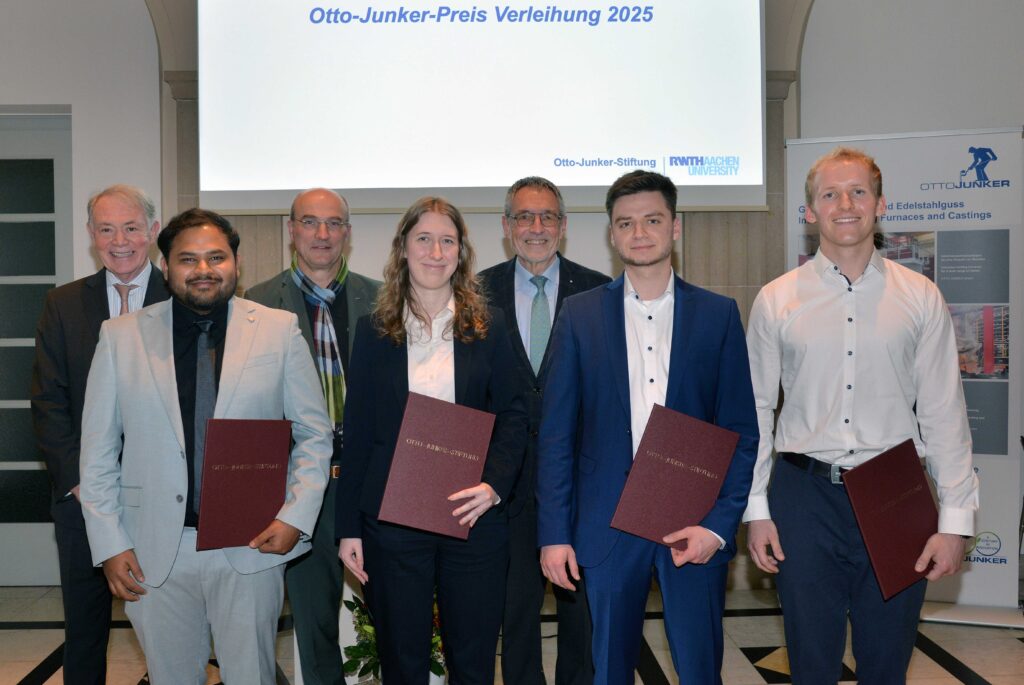
Foto: Andreas Schmitter
Antoni Chajan was awarded for his excellent master’s thesis on topology detection in electrical distribution grids using machine learning, supervised at IAEW by Prof. Andreas Ulbig. He now works as a project engineer at FGH. In the photo: front row, second from the right.
Fenja Celine Lobenstein, Industrial Engineering – Electrical Power Engineering, completed her T.I.M.E. double degree at RWTH and CTU Prague with distinction. Her master’s thesis on the prediction of prices and market values of cross-zonal balancing capacities was supervised by Prof. Albert Moser at IAEW. Since 2025, she has been working as a portfolio manager at the energy utility Bonn/Rhein-Sieg. In the photo: front row, second from the left.
The Otto-Junker Prize is awarded annually to graduates of the Faculty of Electrical Engineering and Information Technology as well as the Materials Science group. The awards were presented by RWTH Rector Prof. Ulrich Rüdiger and the Otto Junker Foundation Board.
We warmly congratulate our award winners and celebrate this strong achievement for ETIT!
European Research Council Funds Two Groundbreaking RWTH Projects
The RWTH Aachen celebrates a major success: Two researchers have been awarded the prestigious ERC Starting Grant, each receiving €1.5 million in funding over five years.
Prof. Dr. Daniel Truhn, senior physician at University Hospital RWTH Aachen and lecturer at the Chair of Image Processing at our Faculty of Electrical Engineering and Information Technology, where he teaches the lecture “Biomedical Engineering”, is launching SAGMA (Semantic-Aware Generative Medical AI), a project that rethinks AI in radiology by connecting specialized AI modules into an expert team that supports doctors with complex diagnoses.
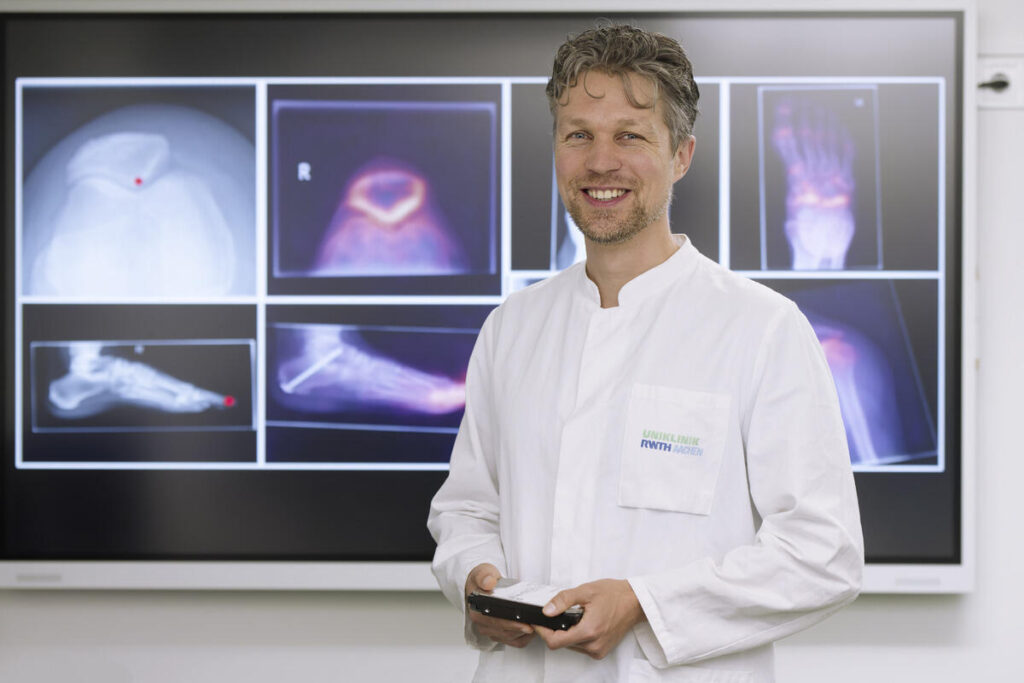
© Peter Winandy / RWTH Aachen University
A second grant goes to, Dr. Khiêm Vu Ngoc, at the Chair of Continuum Mechanics, is developing PolyFun (Polymer Mechanics through Function Spaces), a novel approach that combines physics and machine learning. His models are designed to be not only precise but also reliable and transparent – with wide-ranging applications in materials science, medicine, and robotics.
These grants highlight RWTH’s international recognition and the strong role of our Faculty in advancing AI and medical technology.
Klee Prize 2025: Controllable exoskeletons – Support instead of replacement
Dr.-Ing. Lukas Bergmann impresses with his award-winning doctoral thesis, in which he developed an active exoskeleton and a cooperative controller to support movement intentions in real time.
Dr.-Ing. Lukas Bergmann won second place in the Klee Prize 2025 with his doctoral thesis. He received the award for the development of an active exoskeleton that uses innovative control technology to record and support movement intentions.

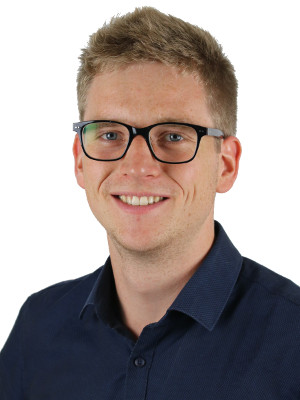
Dr.-Ing. Lukas Bergmann | @mediT
Worldwide, strokes result in mobility problems, and traditional treatments are frequently resource-intensive. Robotic rehabilitation systems can provide support when patients initiate movements independently. Dr. Lukas Bergmann explains:
„In the long term, research into exoskeletons can make a significant contribution to supporting people with musculoskeletal disorders. The exciting thing for me is that control technology has a very practical application here.“
It describes an active exoskeleton that enables safe coupling between humans and devices, as well as a cooperative controller that supports joint torques in real time.
It is also worth mentioning that Dr.-Ing. Sonja Ehreiser (mediTEC, RWTH Aachen University) won first place in the Klee Prize 2025 for her dissertation on improving the care of patients with knee prostheses.
The VDE, a leading technology organization in Europe, has been promoting innovation and technological progress for over 130 years. With the Klee Prize 2025, the VDE honors outstanding research work that offers great benefits for patients and shapes the future of medical technology.
The VDE (VDE Association for Electrical, Electronic & Information Technologies) is based in Frankfurt am Main. More information at VDE Website
Source: VDE Press Release
Professor Janina Fels is the designated president of the German Acoustical Society
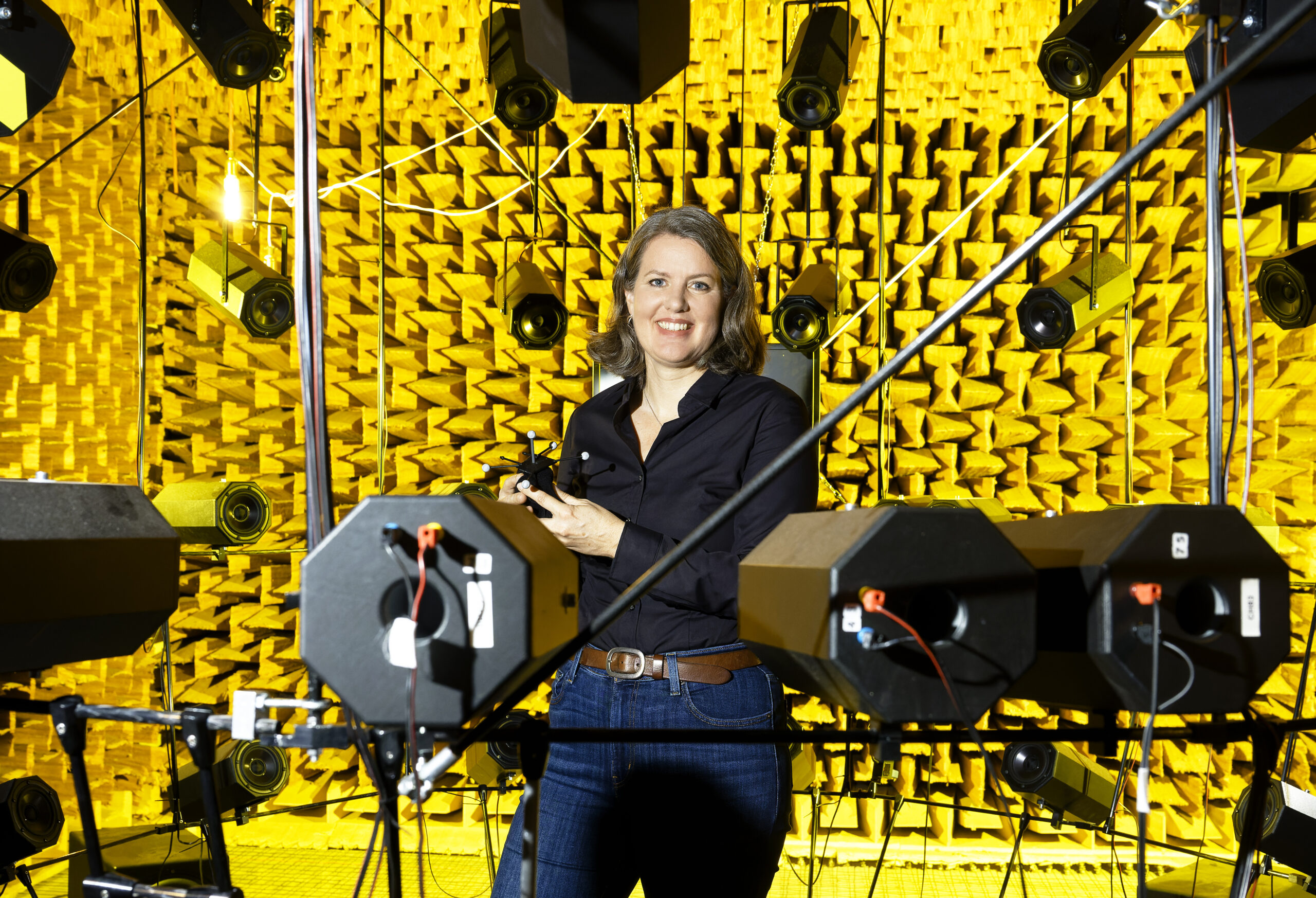
Professor Fels in the soundproofed laboratory, surrounded by loudspeakers at different room heights. © Peter Winandy
We are delighted and honoured to announce that Professor Janina Fels, Head of the Institute for Hearing Technology and Acoustics (IHTA) at the Faculty of Electrical Engineering and Information Technology, has been elected Vice President and designated President of the German Acoustical Society (DEGA).
Professor Fels will begin her term as Vice President on 1 July 2025 and will be appointed President of DEGA in 2028 in accordance with the statutes. This election is not only a personal success for her, but also a significant recognition of the excellent work in the field of acoustics at RWTH Aachen University. With her scientific expertise, which ranges from acoustic virtual reality to medical and psychoacoustics to room and building acoustics, she has had a lasting influence on the field and has built up an excellent reputation both nationally and internationally.
However, her path also began with a degree in electrical engineering at the RWTH, before Professor Janina Fels completed her doctorate with honours at the Institute of Technical Acoustics under the title ‘From Children to Adults: How Binaural Cues and Ear Canal Impedances Grow’.
‘The election of Professor Fels to head this important institution is a strong sign of the visibility and relevance of acoustics research at RWTH Aachen – and an incentive for young scientists to continue along this path,’ says Martina Dahm, Managing Director of the Faculty of Electrical Engineering and Information Technology.
The German Acoustical Society (DEGA) is the central scientific society for acoustics in the German-speaking world. It was founded in 1988 and currently has around 1,900 individual members and more than 70 sponsoring institutions. DEGA promotes interdisciplinary cooperation in acoustics, organises the renowned annual DAGA conference, awards prizes for scientific excellence and is internationally networked in associations such as the European Acoustics Association (EAA) and the International Commission on Acoustics (ICA).
We warmly congratulate Professor Janina Fels on her election and wish her every success for the coming term, scientific impetus and a continued inspiring contribution to shaping the acoustics community.
Further information on acoustics research can be found on the IHTA and DEGA homepages.


