
Source: own illustration
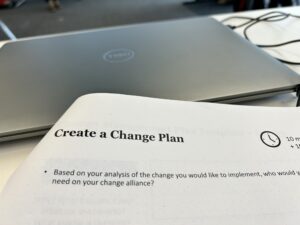
On March 9 and 10, 2026, the one-and-a-half-day workshop “Agents of Change: Change Management for Data Stewards—Strengthening Roles, Shaping Change” took place. The workshop was specifically aimed at the FDM network at RWTH Aachen University and thus at all those who support researchers in research data management (FDM) and contribute to achieving the goals of FAIR research data and Open Science. The workshop provided an opportunity to reflect on one’s own role in FDM and to develop concrete strategies for change processes within one’s own work environment.
Profiles of Data Stewards within RDM
They are called Data Stewards, Data Management Experts, Research Data Officers, or Data Curators. What do they all have in common? They support researchers in handling research data, facilitate processes related to data management, reusability, and quality assurance, and serve as a vital interface between science and infrastructure. In doing so, they are key actors in a cultural shift toward greater transparency in research and, in this role, consistently focus on supporting people through change processes. The workshop served as a platform to exchange experiences, opportunities, challenges, and long-term goals. A key focus of the workshop was reflecting on one’s own role profile.
Challenges for Data Stewards in Germany
The discussion began by addressing the challenges faced by data stewards in Germany: their scope of work and areas of responsibility lack uniformity; there is a lack of clearly defined qualifications, stable career paths, sufficient resources, and a reliable structural foundation. Their responsibilities are often unclear, which complicates goal-setting, action planning, and measuring success. Under these challenging conditions, it is all the more important to have clear goals in mind and to act strategically. The workshop provided participants with concrete methods to actively shape their role as change agents.
Change Management for Data Stewards
A first important step in the change process is stakeholder analysis and building alliances. Workshop participants learned to identify relevant stakeholders, assess their interests and resources, and develop appropriate communication strategies. Self-promotion is also of strategic importance here to make one’s own role visible, position one’s own expertise, and win others over to the change initiatives.
Furthermore, clear goals are of central importance for the strategic implementation of change processes. The overarching goal and its concrete significance should be clearly communicated. For the process itself, however, many small goals can be defined to make progress measurable. In times of scarce resources, it is important to prioritize tasks according to their importance and urgency.
Practical Application of the Content
A particular strength of the workshop concept is that, in addition to teaching change management methods, it also covers topics such as self-management, resilience, and emotional intelligence. These are essential skills for data stewards to support change processes with confidence, reflection, and effectiveness.
To apply what they have learned directly, a buddy program was initiated. For this, participants select a change project to which they want to apply what they have learned. In small groups of three to four people, they will meet again after a few weeks to reflect on progress, exchange experiences, and provide each other with constructive feedback.
Any questions?
The workshop was led by Antje Manske, a certified change management expert. The underlying materials are published on Zenodo and can be viewed there.
Are you involved in research data management, interested in furthering your education in this field, or simply want to learn more about RDM?
Connect with the RWTH RDM team via the RDM Network!
The RDM team is here to assist you with any questions regarding research data management: at monthly FDM network meetings, during regular seminars and workshops, or via the “DataStewards@RWTH” mailing list.
The FDM team looks forward to guiding you step by step through your research project.
Responsible for the content of this article are Hedda Faber, Alice-Cathérine Mackenstein and Ute Trautwein-Bruns.








Leave a Reply
You must be logged in to post a comment.