
Source: Own Illustration
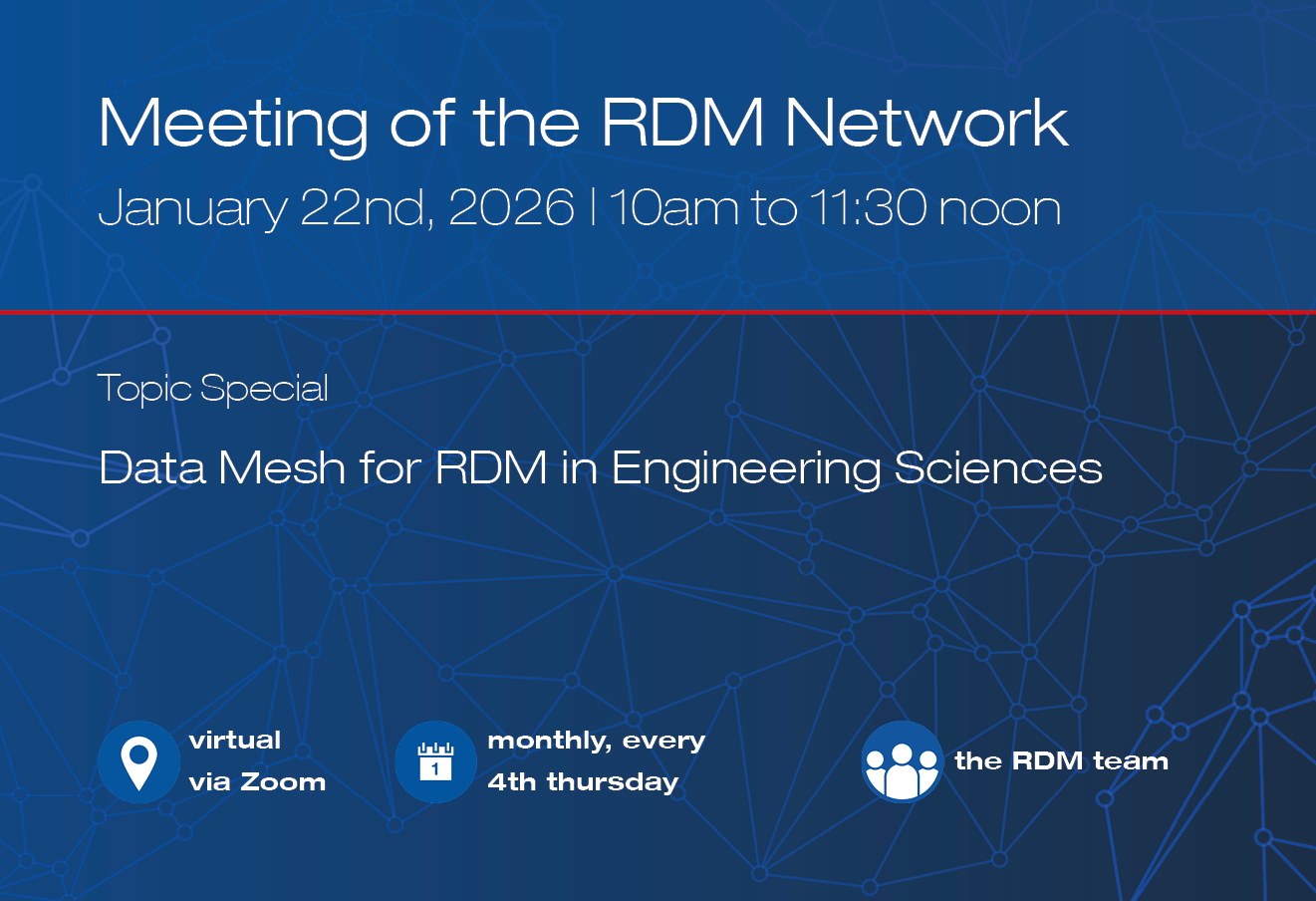
On January 22, 2026, the RDM team welcomed the RDM community at RWTH Aachen University to the first RDM network meeting of the year. The monthly event takes place online or in person on the fourth Thursday of every month and offers anyone interested in RDM the opportunity to exchange ideas and discuss practical examples.
The January meeting focused on the presentation “Data Mesh for RDM in the Engineering Sciences” by Mario Moser from the Laboratory for Machine Tools and Production Engineering (WZL) of RWTH Aachen University. In his presentation, he provided exciting insights into his doctoral thesis topic and, as part of the NFDI4ING consortium, presented conceptual considerations and designs for the use of the data mesh approach in RDM in the engineering sciences.
Efficient Networking in Science-Speed-Dating
As is customary at RDM network meetings, the event began with Science-Speed-Dating. In two short rounds of four minutes each, the participants engaged in conversation in small groups, first briefly exchanged information about their backgrounds, and discussed their experiences with the reuse of research data. Thoughts on the findability, use, and quality of research data were collected on a shared Miro board.
Presentation: Data Mesh for RDM in Engineering
The core of the meeting was a presentation by Mario Moser, who provided insights into how the data mesh approach can facilitate the exchange and reuse of data in engineering sciences. This approach, which originated in industrial data management, combines technical, organizational, and social components to support researchers in effectively sharing and using research data.
According to the core idea, responsibility and data management are organized in a decentralized manner. The data is stored in various repositories – institutional, discipline-specific, or generic – which is good practice in scientific data management, but also makes it difficult to search for/research a data set due to the large number of repositories. The research environment also has decentralized characteristics and is changing dynamically: research data is continuously collected, both in projects and over longer periods of time. Various research institutions and chairs are networked with each other through projects, without a strict hierarchical structure being prescribed. Data quality is relevant for reuse, but is often not reflected in repositories.
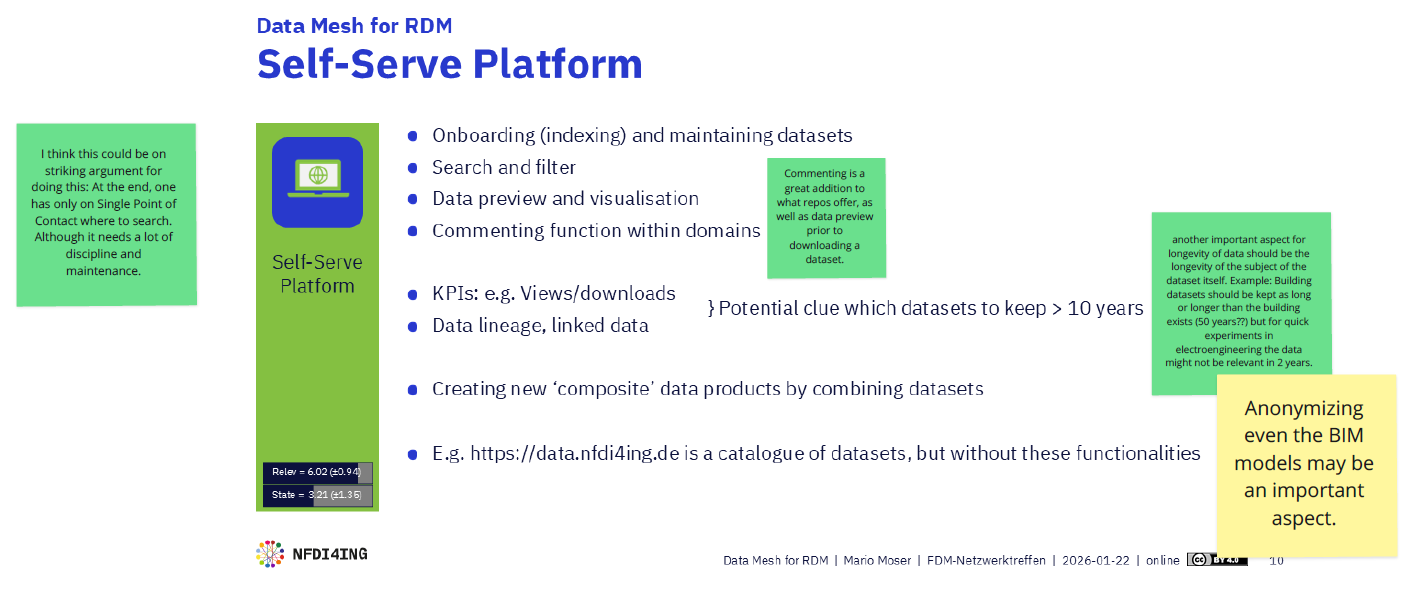
In the data mesh for research data management, responsibility for the content of the data created and any queries is assigned to the researchers (“domain ownership”), while repository operators are responsible for technical provision and accessibility. In order to make the distributed data sets in the various repositories findable in one place, the data sets from the various repositories are presented in a defined form (“data products”) via API on a central platform (“self-serve platform”). Data governance and data quality rules are applied and displayed on the data set. The approach fits into the existing research landscape by allowing existing data, tools, and structures—for example, within the framework of NFDI4ING for engineering sciences—to be used and integrated into a decentralized network. This creates an infrastructure that supports data work in research in a flexible, collaborative, and sustainable manner.
Technically, implementation is relatively simple, but organizationally it requires ongoing coordination within subject domains, e.g., on standards and domain-specific data quality criteria for data sets. The approach complements the infrastructure as an additional layer, but does not increase its resilience.
We would like to thank Mario Moser for his exciting presentation and insightful look at the data mesh approach for engineering sciences.
Source: Mario Moser
Discussion: Potential and Limitations of Data Mesh
In the ensuing discussion, the limitations of the data mesh approach were critically examined. There was agreement that the reusability of research data and its quality depend heavily on the respective application context and cannot be guaranteed by infrastructure concepts alone. Long-term availability and data quality are key challenges, as are the repositories that connect the data mesh.
The motivation for participation was also discussed. On the one hand, it was assumed that the additional effort involved would be a significant hurdle for many researchers. On the other hand, the great potential of the data mesh approach was highlighted: The scientific visibility of one’s own data can be significantly increased by linking it to other resources via APIs, integrating additional information, and promoting exchange and discussion about the data sets. Such exchange on the data platform offers the opportunity for communities to keep data sets understandable even when the original authors are no longer active in research.
Learn More
Are you interested in the RDM network and would like to be kept up to date? Then subscribe to the “DataStewards@RWTH” mailing list.
If you have any questions about the RDM network or topics related to research data management, please do not hesitate to contact us. The RDM team looks forward to hearing from you and will be happy to help!
Responsible for the content of this article are Lina-Louise Kaulbach and Ute Trautwein-Bruns.








Leave a Reply
You must be logged in to post a comment.