
Source: Own Illustration
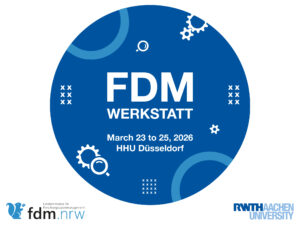
From March 23 to 25, 2026, the FDM Workshop organized by fdm.nrw took place at Heinrich Heine University Düsseldorf. Coscine was also represented with several program items and offered diverse insights into the practical use of the platform: In two hands-on workshops, researchers were able to learn about specific use cases and test them directly. In addition, together with git.nrw, a discussion panel explored the development of peer-to-peer structures in research data management.
Coscine Workshops
A workshop on the automated transfer of (meta)data to Coscine was already on the agenda at the FDM-Werkstatt 2023. Since the workshop generated a great deal of interest at the time, it was held again in a slightly modified form. The workshop “Automating (Meta)data to Coscine” took place on the very first day of the FDM Workshop from 3:00 to 5:00 p.m. and was led by Catherine Gonzalez. Participants learned how to use the Coscine Python SDK to automatically upload data, including descriptive metadata. To make the exercise as realistic as possible, participants were able to bring their own dataset and apply the processes they had learned directly.
On Wednesday, March 25, 2026, the workshop “Building Interactive Visualizations with Streamlit in Python” led by Jonathan Hartman continued from 9am to 12pm. Over the course of three hours, participants learned how to create interactive visualizations in Python using the Streamlit application and how to integrate data from external sources, such as a Coscine resource.
Peer-to-Peer Discussion
This year’s FDM-Werkstatt concluded with a two-hour discussion titled “Promotion of Knowledge Exchange: The Need for Peer-to-Peer Structures for Users of fdm.nrw State Services.” During the session, Miriam Petry, git.nrw, and Lukas C. Bossert, Coscine.nrw, presented the existing support structures and community exchange opportunities for the services. This was followed by an extensive discussion on the extent to which researchers need peer-to-peer exchange opportunities and where existing structures might already be in place that are being utilized. Participants exchanged views based on three key questions.
In response to the question, “Which bilateral exchange formats do you find most helpful or feasible, and why?” it became clear that both informal and structured approaches are important. Examples mentioned included coffee breaks, interest groups, and conferences, as well as targeted formats such as “Problem Tinder” or short speed-dating sessions. Digital offerings such as chats or forums also play a role but require active community management. It is also particularly important that results are documented, summarized, and made accessible as a knowledge base.
In response to the question “What experiences have you already gained in the peer-to-peer context within RDM, and what specific challenges have arisen from them?” participants reported positive experiences with formats such as workshops, hackathons, data cafés, or mailing lists. These enable self-help, the validation of problems, and the development and sharing of solutions. At the same time, challenges were identified, including a high time commitment, a lack of structures and infrastructure, and the difficulty of motivating participants over the long term. The role of moderation or facilitation was also highlighted as central.
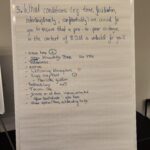
In response to the question “What conditions (e.g., time, facilitation, interdisciplinarity, confidentiality) are crucial for you to ensure that a peer-to-peer exchange in the context of RDM is valuable to you?” participants cited several key requirements. These include an open and, as far as possible, barrier-free knowledge base – for example, without a VPN – sufficient resources, and clear structures, such as a central entry point with guidelines. Equally important are an active community, functioning feedback mechanisms, and various exchange formats, ranging from forum-like platforms to open consultation hours. An appreciative and welcoming atmosphere was emphasized as a decisive success factor.
Overall, the discussion showed that peer-to-peer structures in RDM have great potential, but their establishment requires targeted framework conditions, moderation, and ongoing maintenance.
-

- Sources: Own Illustrations
Lean More
Would you like to receive regular updates about Coscine? Then visit the Coscine website and subscribe to the Coscine newsletter to stay up to date once a month.
If you have any questions about Coscine or research data management, the RDM team at RWTH Aachen University is happy to help.
Responsible for the content of this article are Katja Jansen and Arlinda Ujkani.








Leave a Reply
You must be logged in to post a comment.