
Source: Nationale Forschungsdateninfrastruktur
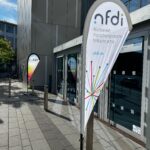
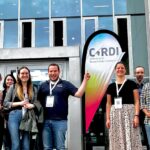
From August 26 to 28, 2025, the second Conference on Research Data Infrastructure (CoRDI) 2025 took place at RWTH Aachen University. The conference was organized by the National Research Data Infrastructure (NFDI) in cooperation with the Chair of Intelligence in Quality Sensing WZL at RWTH and proved to be an extremely important event for many stakeholders in research data management (RDM) to come together. Under the motto “RDM in Action,” the focus was on the practical use of research data. In this blog post, we summarize the highlights of the RWTH’s RDM team and provide an insight into the event.
International Stage for Research Data Management
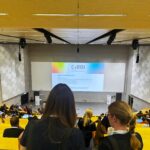
Over the three days of the conference, 660 experts from 13 countries took part: Australia, Belgium, Germany, Greece, Italy, the Netherlands, Austria, Russia, Switzerland, Slovenia, Spain, the Czech Republic, and the United Kingdom. They took advantage of the opportunity to exchange ideas in an international setting and discuss the future of research data management together. With 140 presentations and 173 posters, the program offered an extraordinary variety of perspectives and approaches from all scientific disciplines.
Opening and Welcome Speeches
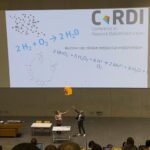
The conference was opened by Professor Robert Schmitt, Head of the WZL Chair and spokesperson for the NFDI4ING consortium, who led the introductory event together with Nathalie Rathgeb from the NFDI, Professor York Sure-Vetter from the Karlsruhe Institute of Technology, and Professor Paul Groth from the University of Amsterdam. In his speech, Schmitt emphasized the central importance of data for research and society and highlighted that it was an honor to welcome the international research data community to Aachen. Professor Dr. Sonja Herres Pawlis (Chair of Bioinorganic Chemistry) kicked off the conference with a special experiment. With the help of Professor Dr. York Sure-Vetter, they presented a chemical experiment that produced a loud bang and smoke.
Representatives from politics and academia also emphasized the relevance of research data for scientific progress in their contributions. Dorothee Bär, Federal Minister of Research, Technology, and Space (BMFTR), spoke in a virtual welcome message about the necessity of open data access in order to enable high-quality research. Dr. Heide Ahrens, Secretary General of the German Research Foundation (DFG), highlighted the role of CoRDI as a driving force for the further development of research data management. Professor Petra Gehring from the Council for Information Infrastructures (RfII) and Ute Gunsenheimer, Secretary General of the European Open Science Cloud (EOSC), pointed out the enormous scientific and economic importance of data.


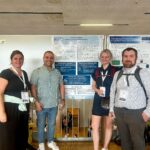
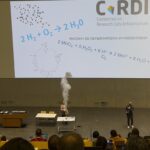

-

- Sources: RDM Team RWTH Aachen University
Program Diversity and Scientific Exchange
A highlight of the program was the keynote speech by Robert Finn from the European Bioinformatics Institute, who provided insights into the challenges and opportunities involved in providing data in the life sciences.
Another highlight of the second day was the fishbowl discussion organized by the DFG on the topic “What makes an NFDI consortium successful?” In two parts, participants discussed criteria and success factors for NFDI consortia with members of the NFDI expert committee. Among other things, they addressed the question of how to make the diversity of activities more visible, what role they should play in evaluation procedures, and how the results can be integrated into the long-term development of “OneNFDI” beyond 2028.
The panel discussion on digital sovereignty also met with great interest. Moderated by Professor York Sure-Vetter, Professor Dr. Frank Oliver Glöckner (PANGAEA, NFDI4Biodiversity), Professor Dr. Stefan Decker (Fraunhofer FIT), Professor Dr. Wolfram Horstmann (FIZ Karlsruhe), and Mercè Crosas (CODATA, Barcelona Supercomputing Center) discussed how science can secure and strengthen its digital independence in the field of research data infrastructures.
Another highlight on the third day of CoRDI was the keynote speech by Cathrin Stöver (GÉANT). Under the title “GÉANT in a nutshell,” she provided insight into the role of GÉANT as a key European infrastructure for research and education. She showed how a global network of national research and education networks has been built up over decades, which today enables a harmonized service for the international scientific community. She also highlighted the importance of GÉANT for Europe’s digital leadership, EuroHPC, and EOSC.
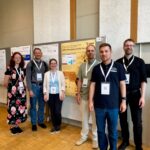
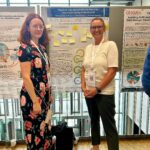
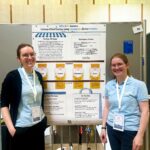
In addition to the presentations, the conference offered a wide range of interactive formats such as poster sessions, workshops, lightning talks, and discussion panels, which were intensively used by the participants. The program was complemented by guided tours at WZL and Fraunhofer IPT, as well as a joint barbecue on the second evening, which promoted informal exchange.
RWTH Aachen University was involved in the program in a variety of ways. Professor Dr. Sonja Herres Pawlis was represented in the “Educating RDM” track and showed how research data management can be integrated into teaching in a practical way. In addition, numerous NFDI consortia in which RWTH Aachen University is involved were present with contributions.
Accompanying Events
The main conference was enriched by additional events. The DALIA Satellite Meeting, dedicated to the topic of data literacy, took place the day before. Immediately following CoRDI, the Base4NFDI User Conference took place, further deepening the exchange between base teams and NFDI consortia.
Conclusion
Aachen proved to be the ideal host for the second edition of CoRDI. Modern conference rooms at the C.A.R.L. Center, a lively scientific environment, and the historic backdrop of the city offered participants a harmonious overall package.
For the RDM team at RWTH Aachen University, CoRDI 2025 was a special opportunity to gather international inspiration, expand networks, and gain new perspectives for their own work. The great response, with over 600 participants from all over the world, the diversity of topics, and the intensive discussion showed that research data management is becoming increasingly anchored in practice and is gaining further importance through joint action.
Responsible for the content of this article is Arlinda Ujkani.








Leave a Reply
You must be logged in to post a comment.