
Schlagwort: ‘KI’
KI:Inferenz.nrw Launches Offering for Universities in North Rhine-Westphalia

Source: Own illustration
The demand for powerful AI models at universities continues to grow rapidly. Applications such as chatbots and AI-supported services in the KI:connect environment are leading to more and more institutions using generative AI in research, teaching, and administration. At the same time, demand for locally operated open-source models is increasing.
RWTH Aachen University is currently testing several open-source models via KI:connect through the WestAI service center. The KI:Inferenz.nrw initiative was launched in January 2026 to provide universities in North Rhine-Westphalia with comprehensive access to open-source AI models in the future. It aims to provide universities in North Rhine-Westphalia with an infrastructure for the use of language models that is independent of the universities themselves.
AI Hallucination – What Is It?
Source: Freepik
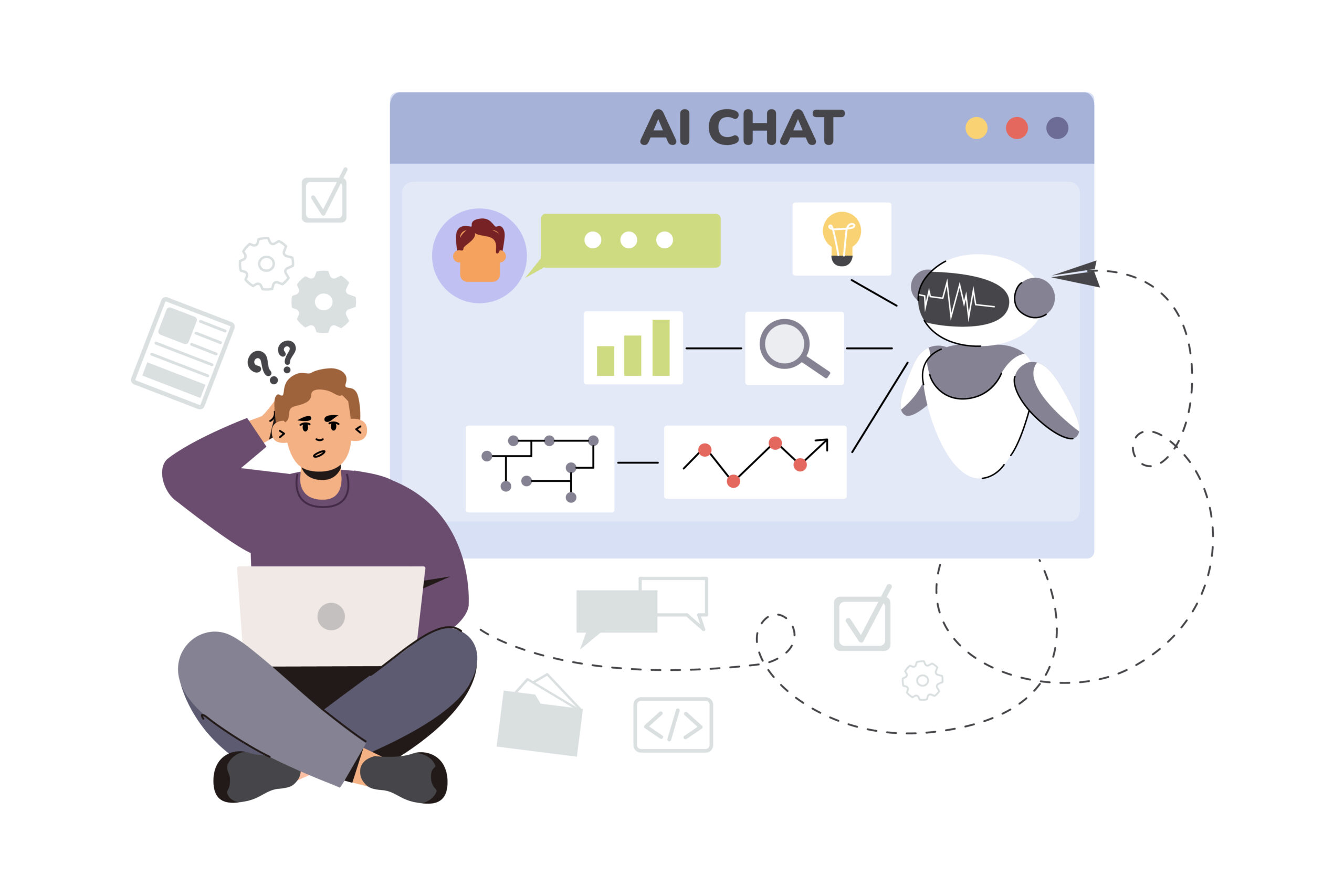
The internet seems to have an answer for everything. And even the generative AI models of our time seem to know almost everything. But can that really be true?
Not quite. As powerful and helpful as generative AI is, it is not without its weaknesses. One of these is what are known as AI hallucinations. These are convincing-sounding but factually incorrect or fictitious pieces of content. In this article, we take a closer look at this central problem in the development and application of AI models.
Artificial Intelligence Meets Virtual Reality

Source: Kühlem et al., 2025
Whether in digital learning spaces or virtual museum tours, virtual reality (VR) makes an important contribution to immersive learning. In this context, users can interact with virtual teachers. At RWTH Aachen University, research is being conducted into how these conversations can be made as realistic and natural as possible.
KI:connect.nrw – In Use Throughout the State

Source: Own Illustration
A lot has happened since our last post on the KI:connect.nrw project. More and more universities in North Rhine-Westphalia are joining the project, which enables state-wide, data protection-compliant, and legally secure access to generative AI via the central web application KI:connect.
Why Acceptance Research is so Important in IT
Source: Freepik
IT systems have become an integral part of our everyday lives. They simplify work processes, enable communication, and drive digital innovation. And yet, many IT projects fail not because of technical hurdles, but because they are not accepted by users. This is precisely where acceptance research comes in.
KI:connect.nrw: 2025 in Review

Source: Own Illustration
We have reported on KI:connect.nrw several times on this blog, most recently in October when it reached a milestone of over 350,000 potential users at universities in North Rhine-Westphalia. Now we look back on the year 2025, in which KI:connect.nrw has developed from a pilot project into a statewide AI infrastructure that covers almost the entire university landscape in North Rhine-Westphalia.
WestAI: Review, Exchange, and Outlook – An Overview of the Consortium Meeting
Source: WestAI
The AI Service Center WestAI, funded by the Federal Ministry of Education and Research (BMFTR, formerly BMBF), is one of four nationally funded AI service centers in Germany and is a central point of contact for applied artificial intelligence in North Rhine-Westphalia. The center aims to accelerate the transfer of AI research into practical applications and, in particular, to provide small and medium-sized enterprises and research teams with low-threshold access to modern AI technologies.
In this blog post, we take a look at the current role of WestAI, summarize the most important results of the latest consortium meeting, and provide an outlook on the further developments planned for the coming years.
Basic AI Supply in North Rhine-Westphalia: How the IT Center Is Contributing With KI:connect.nrw
Source: Own Illustration
Artificial intelligence is developing rapidly at universities in North Rhine-Westphalia. To ensure that they are well positioned in the long term, common technical foundations and responsible solutions are needed.
A new paper by Digitale Hochschule NRW (DH.NRW) describes precisely this approach. It shows how basic AI services can be established for all universities in North Rhine-Westphalia.
Ritchy – Your Opinion Matters!

Source: Own Illustration
Since April 2025, our chatbot Ritchy has been available to assist you around the clock, even after our regular support hours. It provides answers, tips, and suggested solutions, and is designed to complement our personal customer support services.
We have already introduced Ritchy in a previous blog post and explained its advantages and special features.
If you would like to learn more about our chatbot, we highly recommend taking a look at this article.
Learning with AI – How effective is it really?

Source: Freepik
AI systems are revolutionizing the way we absorb information and process knowledge. Examples include voice assistants such as Siri and Alexa, learning platforms such as Duolingo, a wide range of commercial AI chatbots, and, in a university context, RWTHgpt and Ritchy at RWTH Aachen University. These technologies use machine learning to provide personalized learning experiences tailored to the needs of individual users.
But the key question is: How can AI be used in a way that truly improves learning and is not counterproductive?