

Source: Own illustration
The Chair of Electrochemical Energy Conversion and Storage Systems (ISEA) led by Professor Dirk Uwe Sauer is investigating, among other things, the question: How long does a smartphone battery last in real-world university life, and how does it age in the process?
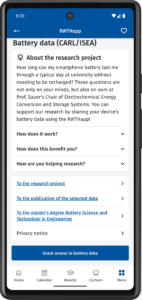
In collaboration with the RWTHapp, you can now share battery data from your Android device and help the department better understand batteries and make them last longer.
What Can the New Feature Do?
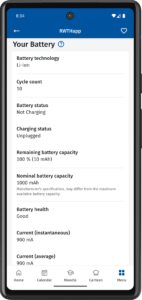
With the new feature, you allow the RWTHapp to read technical battery data from your smartphone and transmit it to ISEA in a pseudonymized form. This includes, for example:
- Charge level and capacity
- Battery voltage, current, and temperature
- Number of charge cycles, as well as the battery’s status and health
- Device type, manufacturer, and operating system
Important: No personal or location data is stored. The data is exclusively technical and battery-related and is processed using a device-specific data ID.
How Does It Work?
You can enable this feature directly in the RWTHapp settings (version 2.51.0 and later):
- Allow access to your battery data in the app.
- Disable battery optimization for the RWTHapp so that the app can collect data in the background.
- Depending on your device, additional settings may be required. You can find instructions in the app and on the website Don’t kill my app!
Source: Own illustration

Source: Own illustration
Source: Own illustration
The app then collects the battery data in the background and transmits it at regular intervals to servers at RWTH Aachen University. Since Apple does not allow the collection of battery data, this feature is only available in the Android version of the RWTHapp. After a successful upload, the locally stored battery data on your device is deleted.
- The upload volume is small: about 2 MB per month.
- This does not affect your device’s battery life.
- You can disable access to your battery data at any time in the app, effective immediately.
How Does This Benefit You?
Researchers at ISEA can use the collected data to train battery aging models. The goal is to better predict the lifespan of smartphone batteries based on real-world usage.
For you, this means:
- You can better estimate when it’s worth replacing your battery or upgrading your device.
- In the future, we’re working on being able to show you personalized predictions about your device’s battery aging in the RWTHapp.
- If you want to write a research paper using real-world data later on, you’ll benefit from exactly these kinds of datasets.
How Do You Help Research?
Your pseudonymized battery data helps the RWTH battery community and international researchers develop and improve battery models based on real-world application data.
The processed datasets will be published in scientific journals and made available to the community. You can find more information about the research project on the website of the Center for Ageing, Reliability and Lifetime Prediction of Electrochemical and Power Electronic Systems (CARL) and on the doi Foundation website.
If you’re interested in learning more about this topic, you might also find the Master’s program in Battery Science and Technology in Engineering exciting.
What’s Next
We warmly invite you to try out the new feature and contribute to battery research at RWTH.
If you have any questions or encounter any issues, our IT-ServiceDesk is here to assist you as usual. We look forward to hearing about your experiences with the new battery data feature!
Responsible for the content of this article is Marc Steffens.









Leave a Reply