
Unmanned aerial systems (UAS), commonly referred to as drones, are being deployed in an increasing number of applications, including delivery, inspection, mapping and surveillance. Beyond the single-aircraft operations established today, current developments point towards the swarm concept, in which several UAS operate in coordinated formation. Such formations offer gains in efficiency and a reduction in logistical effort, but they also raise concerns regarding noise, particularly in urban environments. The acceptance and deployment of drone swarms may therefore depend on how they sound — a question that has to be addressed in advance if the technology is to be environmentally compatible. Acoustic simulation and auralization methods developed at IHTA make such an assessment possible: rather than describing predicted noise as a value on a noise map, the virtual swarm is auralized. Swarm formation, routing and operating conditions can thus be varied systematically, and the resulting perceptual consequences, in particular the annoyance experienced by listeners, quantified in listening experiments that can inform early-stage planning and the regulation of swarm deployment and routing.
A swarm flyover in an urban environment places substantial demands on the simulation: higher-order reflections between building facades, diffraction, multiple moving sources with direction-dependent radiation, and propagation through an inhomogeneous medium must all be accounted for simultaneously. The simulation workflow therefore has to be verified against measured data.
-

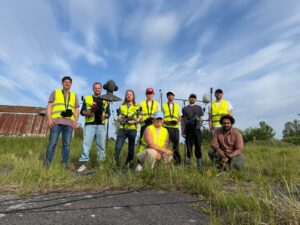
- Researchers of the SWOISE project, supported by members of the Department of Engineering Acoustics at TU Berlin
-

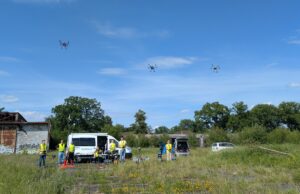
- Three UAS operated by project members
-

- Flyover of three UAS during recording
-
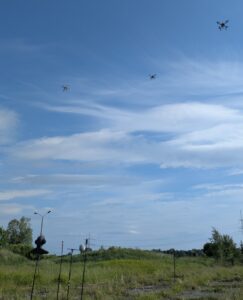
- Recording devices in front of building complex
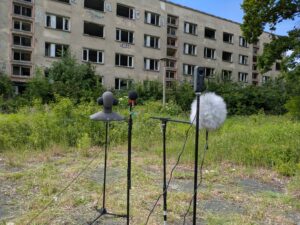
To provide such a reference, and as part of the LuFo VI-3 funded SWOISE project, in-situ recordings of drone swarms were conducted by our postdoctoral researcher Jithin Thilakan together with researchers and staff from the Chair of Flight Guidance and Air Transport and the Department of Engineering Acoustics. The measurement campaign covered conditions ranging from hemi-free-field to building facades and street-canyon geometries, with configurations from a single drone up to multi-drone formations. These scenarios will be recreated using simulation models, and the resynthesized signals will be objectively and perceptually compared with the recordings. Agreement between resynthesized and measured signals validates the simulation model and the auralization workflow, which can then be applied to predict how a swarm of a given configuration will sound under specified acoustic conditions, long before it takes off.


Schreibe einen Kommentar
Du musst angemeldet sein, um einen Kommentar abzugeben.