
Kategorie: ‘IHTA’
Paper published: Vehicle pass-by measurements in simplified roadside wall configurations
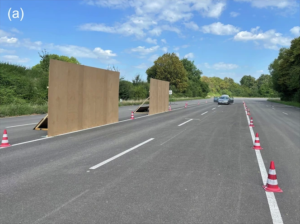
We are happy to share that our article “Vehicle pass-by measurements in simplified roadside wall configurations” by Chalotorn Möhlmann, Lukas Aspöck, and Janina Fels has been published open access in npj Acoustics (https://doi.org/10.1038/s44384-026-00077-2)!
-

- Vehicle pass-by measurement setup on the ISO 10844-compliant asphalt surface (Fig. 7a from paper)
-

- Time-varying acoustic metrics for the two-wall configuration (Fig. 3 from the paper)
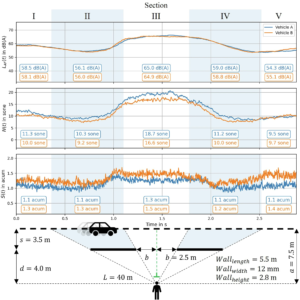
We measured vehicle pass-bys at urban speeds with one or two roadside walls to investigate how shielding, reflection, and diffraction affect the sound at different receiver positions. The recordings are also openly available on Zenodo for use in validating traffic-noise auralizations and urban sound-propagation models: https://doi.org/10.5281/zenodo.21469910
Promotionsprüfung Cornelius Frankenbach
Am 25. September 2026 durfte das IHTA die erfolgreiche Promotionsprüfung von Cornelius Frankenbach feiern.
Cornelius Frankenbach promovierte zum Thema Localization Accuracy in Dynamic Binaural and Near-Field Transaural Synthesis: Influence of HRTF Individualization and Crosstalk Cancellation.
Das IHTA gratuliert sehr herzlich!
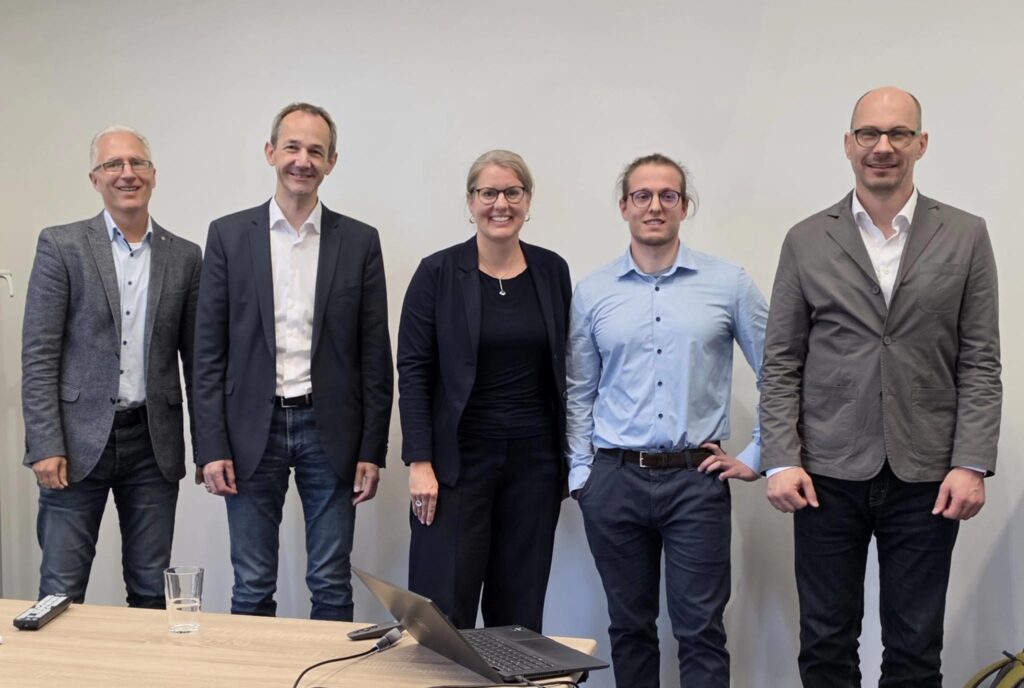
Promotionskommission: Prof. Dr. Joachim Knoch, Prof. Dr. Peter Jax, Prof. Dr. Janina Fels, Cornelius Frankenbach, Prof. Dr. Jens Ahrens
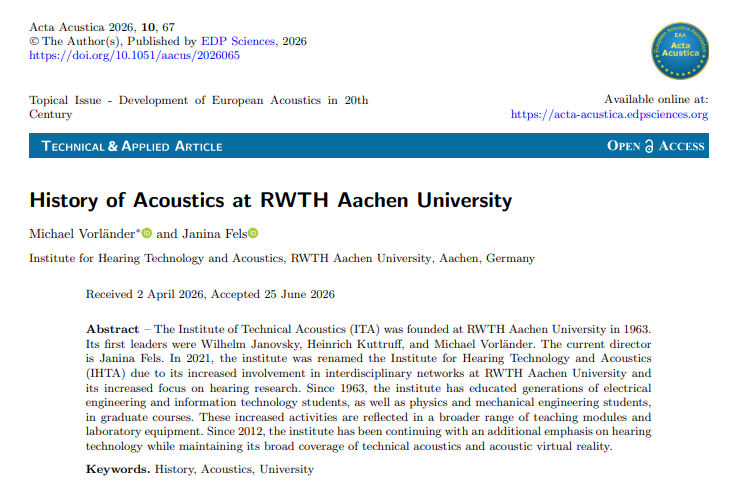
Journal-Artikel über die Geschichte der Akustik an der RWTH Aachen University
Das Institut für Hörtechnik und Akustik (IHTA) der RWTH Aachen hat seit seiner Gründung im Jahr 1963 als Institut für Technische Akustik (ITA) eine beachtliche Entwicklung durchlaufen.
Seit über sechs Jahrzehnten bildet das Institut Generationen von Ingenieur:innen und Physiker:innen aus. Im Jahr 2021 wurde das Institut umbenannt. Damit soll die zunehmende Ausrichtung auf Hörforschung und interdisziplinäre Zusammenarbeit unterstrichen werden. Das Institut bleibt aber seinen starken Grundlagen in der technischen Akustik und der akustischen virtuellen Realität treu.
Der vollständige Artikel kann hier gelesen werden:
Michael Vorländer, Janina Fels
Acta Acust. 10 67 (2026)
IHTA contributions to Forum Acusticum 2026
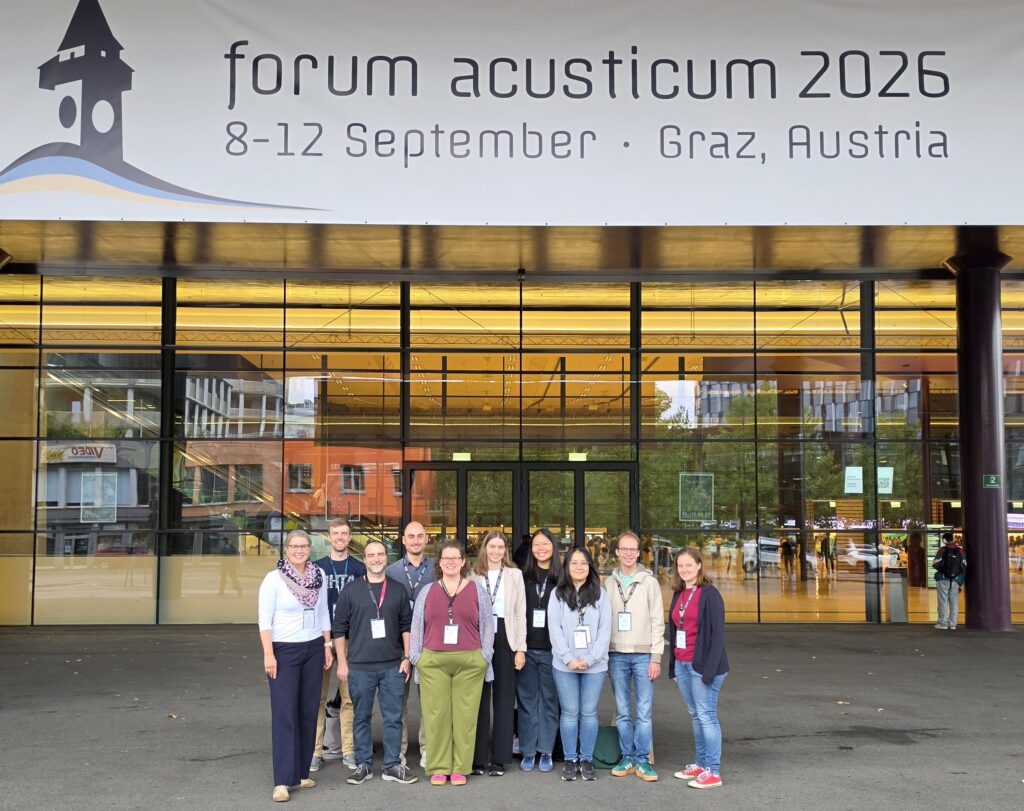
This year’s Forum Acusticum 2026, the annual European Conference on Acoustics and Noise Control Engineering, has now concluded after a highly successful week in Graz. The conference took place from 8 to 12 September and was organized by the Austrian Acoustics Association and the European Acoustics Association (EAA).
IHTA was actively involved in the conference with a wide range of contributions, as well as in the organization and chairing of special sessions, as listed below. Each item links to its entry in the web app, where the corresponding abstract can be found.
The full conference programme remains available on the conference website or in the conference app.
We would like to thank everyone who attended our presentations, visited our posters, and engaged in inspiring discussions with us. It was a great pleasure to contribute to such a successful Forum Acusticum 2026 and to meet so many colleagues from the acoustics community in Graz.
| Tuesday, September 8 | ||||
| Jonas Heck, Hyeju Park, Janina Fels | Influence of the Curb Shape on Road Traffic Auralization | A24.01 Auralization of complex environments | 13:30-14:00 | Saal 12B |
| Wednesday, September 9 | ||||
| Janina Fels | Interactive Virtual Reality for Hearing Research: Opportunities, Limitations, and New Insights |
Plenary lecture | 12:00-13:00 | Halle A |
| Jonas Heck, Haoyue Liu, Lukas Aspöck, Janina Fels, Michael Vorländer | Impact of Positioning Errors in the Two-microphone Method for Surface Impedance Measurements | A16.02 Reliable Characterization of Acoustic Absorption, Reflection, and Scattering | 15:20-15:40 | Saal 12B |
| Anne Heimes, Lukas Aspöck, Janina Fels |
Simulation of the acoustics in open-air venues using bidirectional scattering |
A16.02 Reliable Characterization of Acoustic Absorption, Reflection, and Scattering: S410 | 17:00-17:20 | Saal 12B |
| Thursday, September 10 | ||||
| Carolin Breuer, Janina Fels | Exploring the Impact of Audiovisual Noise on Listening Effort and Presence | A15.02/A24.05 Hearing Research in Virtual Environments | 10:20-10:40 | Saal 12B |
| Pascal Palenda, Michael Vorländer | Validation of the Image Edge Model for Sound Propagation in Urban Environments | A05.04 Outdoor sound propagation | 17:00-17:20 | Saal 11B |
| Friday, September 11 | ||||
| Pascal Palenda, Michael Vorländer | Database of Scale-Model Validation Measurements for Urban Sound Propagation | Poster board 3a | 9:04-9:06 (Teaser) | Speakers‘ Corner, Stadthalle |
| Lara Stürenburg, Lukas Aspöck, Janina Fels | Annoyance Ratings of Heat Pump Noise in Different Auralised Scenarios | A03.08/A05.07 Heat pump acoustics in residential environments | 10:40-11:00 | Saal 5 |
| Organized Sessions & Events | ||||
|
Summer School ST2: Room Acoustics Simulation and Auralization |
Lukas Aspöck, Marco Berzborn | Saturday, 05.09.2026, until Monday, 07.09.2026 |
||
| A24.01 Auralization of complex environments – part 1 | Jonas Heck, Josep Llorca-Bofí | Tuesday, 08.09.2026 | 13:20-14:40 | Saal 12B |
| A24.01 Auralization of complex environments – part 2 | Tuesday, 08.09.2026 | 15:20-16:20 | ||
| A16.04/A24.06 Acoustics for learning environments across physical and virtual realities- part 1 | Janina Fels, Arianna Astolfi | Wednesday, 09.09.2026 | 08:40-10:20 | Saal 12B |
| A16.04/A24.06 Acoustics for learning environments across physical and virtual realities – part 2 | Wednesday, 09.09.2026 | 10:40-12:00 | ||
| A15.02/A24.05 Hearing Research in Virtual Environments – part 1 | Carolin Breuer, Janina Fels | Thursday, 10.09.2026 | 09:00-10:00 | Saal 12B |
| A15.02/A24.05 Hearing Research in Virtual Environments – part 1 | Thursday, 10.09.2026 | 10:20-11:40 | ||
Das IHTA beim Fakultätsfußballfest 2026
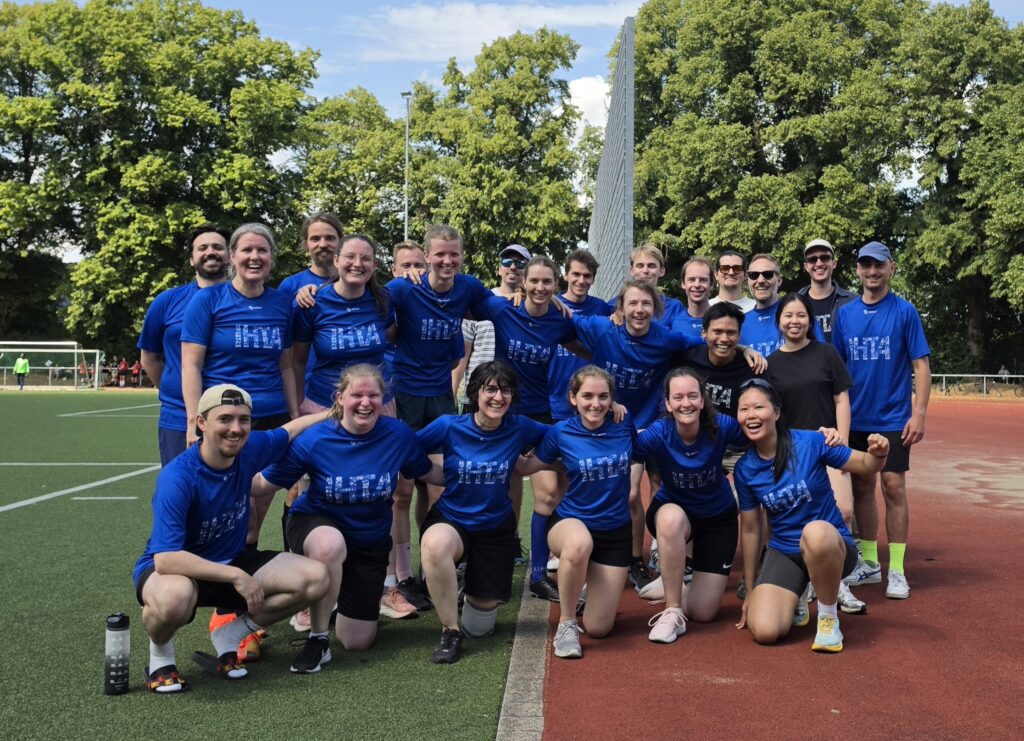
🥅 Das diesjährige Fußballfest der Fakultät für Elektrotechnik und Informationstechnik fand am Freitag, dem 17. Juli 2026, statt.
⚽ Das Institut für Hörtechnik und Akustik (IHTA) war mit zwei Teams, einem Herren- und einem Damen-Team, bei bestem Wetter dabei.
🥉 Nachdem die Damen letztes Jahr den Titel geholt hatten, konnten sie sich diesmal einen guten dritten Platz sichern. Herzlichen Glückwunsch! 🎉
🥇 Das gesamte IHTA-Team hat sich aber den ersten Platz in den Kategorie Stimmung und Spaß auf und neben dem Platz verdient! Die Spieler*innen wurden mit selbst gemischten und erstellten IHTA-Fan-Songs unterstützt.
Vielen Dank an das IAEW für die tolle Organisation und herzlichen Glückwunsch an die Sieger*innen:: Damen IAEW und Herren ISEA!
Bis zum nächsten Jahr!
The sound of drone swarms – contribution to the Quiet Drones conference 2026
The traffic in the skies above our cities is changing. Drones are rapidly moving from novelty to necessity — deployed for deliveries, inspections, mapping, and surveillance. Yet with expanding applications comes an increasingly relevant acoustic challenge: How do we manage their acoustic impact in urban environments? In the last week of June, these questions brought researchers, industry representatives, regulatory bodies, and research institutes together at Quiet Drones 2026 in Delft, Netherlands — the fourth edition of the international conference dedicated to all aspects of UAS and UAM acoustics, covering topics from aero-acoustic modelling to community noise perception.
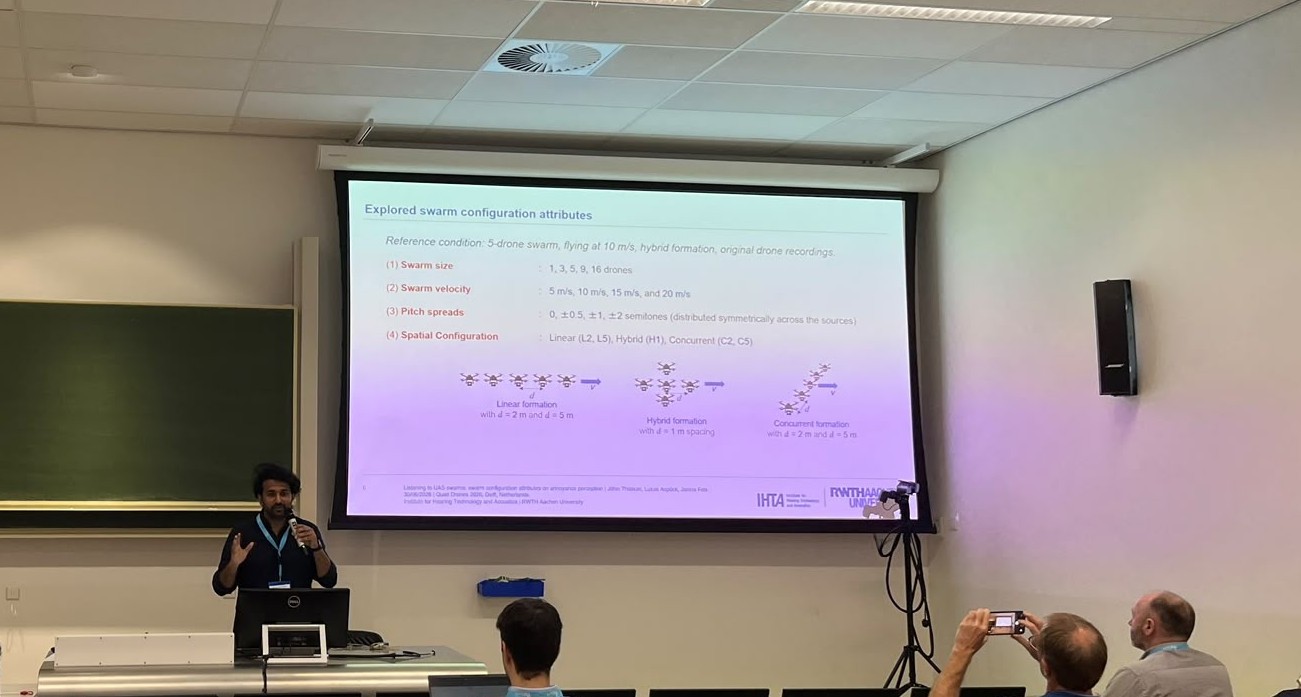
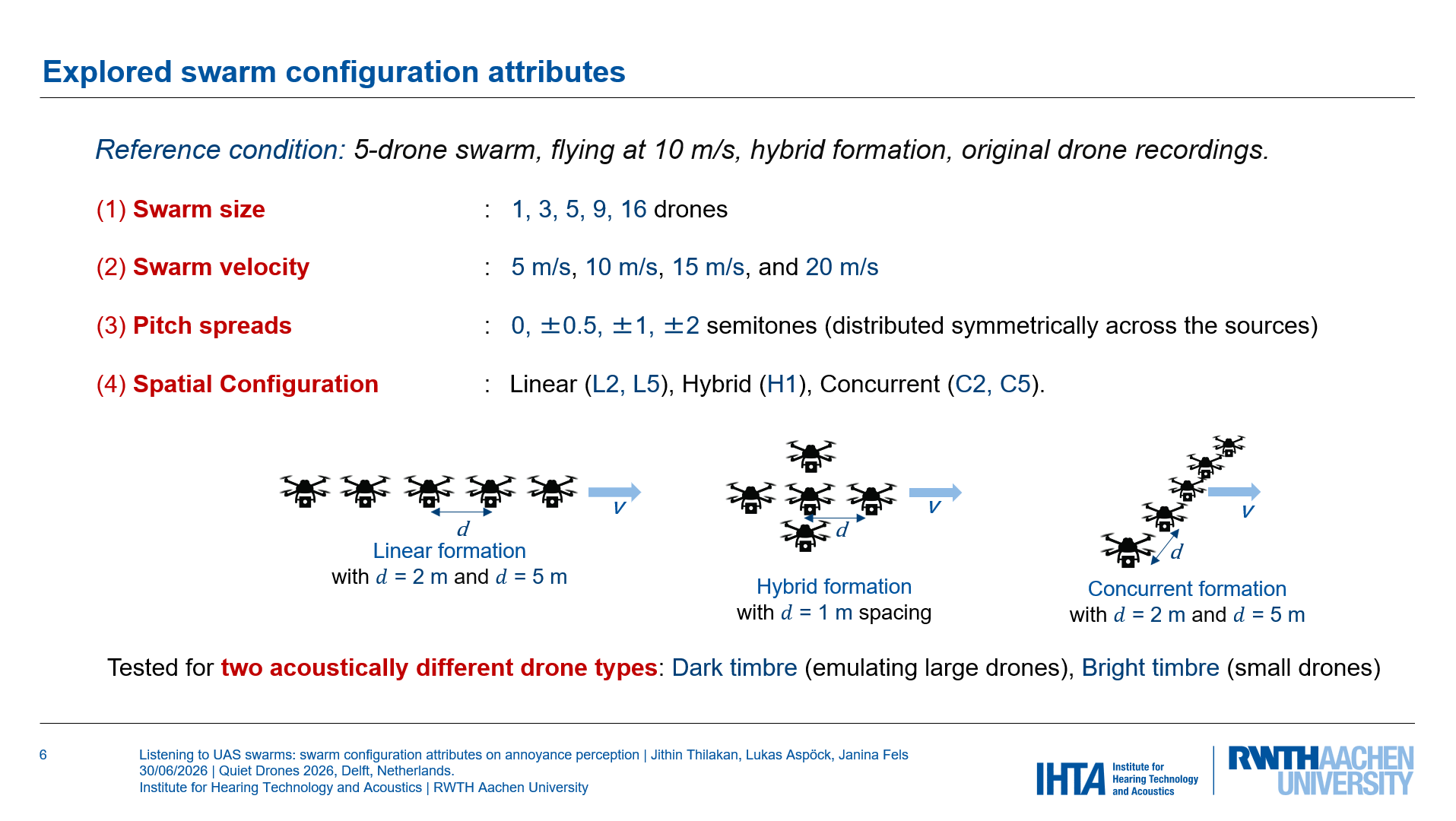
Among the exciting research presented, IHTA’s research contribution is addressing one of the next steps in urban avaiation and drone technology— UAS swarms, where multiple drones operate in a coordinated formation. Though still in the early stage of deployment, swarms hold enormous potential for large-scale applications, and understanding their acoustic impact now is helpful to shape the regulations and design standards of tomorrow. As a first step towards acoustically designing and optimising drone swarms in line with human perception, our postdoctoral researcher Jithin Thilakan presented his work titled „Listening to UAS swarms: exploring the impact of swarm configuration attributes on annoyance perception.“ The study explored how swarm configuration attributes, such as the number of drones, their spatial arrangement, etc., shape annoyance perception, offering early evidence that smarter swarm design could pave the way for environmental friendly drone swarm operations in urban environments. The presented work was carried out as part of the SWOISE project, funded by the LuFo VI-3 programme of the Federal Ministry for Economic Affairs and Energy.
-

- Jithin during his presentation at the Quiet Drones Conference in Delft.
-

- Presentation slide explaing the variation of drone swarms.
ICBEN 2026: Congress on Noise as a Public Health Problem
From 14–18 June 2026, Julia Seitz attended the 15th ICBEN Congress on Noise as a Public Health Problem in Copenhagen. The conference brought together researchers and practitioners from around the world to discuss the broad public health implications of noise, with a strong focus on its effects on cognition, well-being, and daily functioning.
During the conference, Julia Seitz presented two parts of her work on children’s listening effort. The oral presentation, Understanding Listening Effort in Primary School Children: Effects of Classroom Activity Noise, focused on how different classroom activities influence listening demands in primary school children. The results showed that interactive situations such as group work can place particularly high demands on listening compared to quieter classroom activities.
The speed talk, Age Matters: Developmental differences in children’s listening effort across classroom environments – Insights from three studies, highlighted developmental differences in children’s listening effort across classroom settings. Taken together, the findings suggest that listening effort decreases with age during the primary school years, underlining the importance of considering developmental factors when designing acoustically supportive learning environments.
In addition, Julia Seitz and Janina Fels contributed to a presentation on the recent Equal-Life project work, presented by Irene van Kamp, on the effects of early noise exposure on mental health and cognition across the life course. This work placed the research in a broader context, showing how environmental noise can shape health outcomes well beyond the classroom.
Beyond the scientific sessions, the congress offered many valuable opportunities for exchange with international colleagues in the beautiful city of Copenhagen.

Julia Seitz’s presentation at ICBEN 2026
IHTA’s contribution to the Equal-Life project: Understanding Sound Environments Across the Lifespan
How does the sound environment affect children’s listening and learning? This question guided IHTA’s contribution throughout five years of the Equal-Life project. Now, as the project concludes, the Equal-Life Toolbox provides accessible insights into how environmental factors, including acoustics, shape well-being across the lifespan.
The sound environment section highlights contributions from the Institute of Hearing Technology and Acoustics (IHTA) at RWTH Aachen University, showing how age influences auditory perception and listening effort. Children, in particular, face increased challenges in noisy classroom settings, where interactive activities such as group work can substantially increase listening demands compared to quieter, individual tasks.
Explore how these evidence-based insights can support healthier and more inclusive sound environments:
https://www.equal-life-toolbox.eu/post/sound-environment
The Equal-Life Toolbox on Sound Environment
Iced Coffee and the AC Adventure
Heat. Everywhere you looked, just flaming, engulfing heat. Everywhere? No! In a tiny café the team of IHTA defies the extreme conditions with the help of iced coffee and the hope to enter the air conditioned Centre Charlemagne soon. But how did we get here?
New year, new outing. The staff of IHTA was about too explore Maastrichts old town and courageously descend into the ancient caves. But all of the sudden the unfavorable weather conditions with temperatures way above 30°C threatened the whole expedition. Just the evening before, Maastricht announced the infamous code red, effectively cancelling all events due to the heat. This could’ve been the end of the whole event, but in a spontaneous reorganization the meeting point was reset to a sufficiently cool café in the heart of Aachen.
After an extensive breakfast and an acoustic evaluation of Aachens cathedral (It has a long reverb time) it was time for the next part of the new plan: visiting the Centre Charlemagne to learn more about Aachens history (and enjoy the air conditioned rooms). The exhibition guided everyone through time: from the beginnings of early roman settlements towards the modern city of Aachen we all knew.
And so it ended, our spontaneously rearranged institute outing. Despite the heat with a nice experience for everyone and ice-cream for some. In this spirit thank you to everyone who made this possible, even with the unplanned adversities!

Heat Pump Conference 2026 – Advancing Research on Heat Pump Acoustics
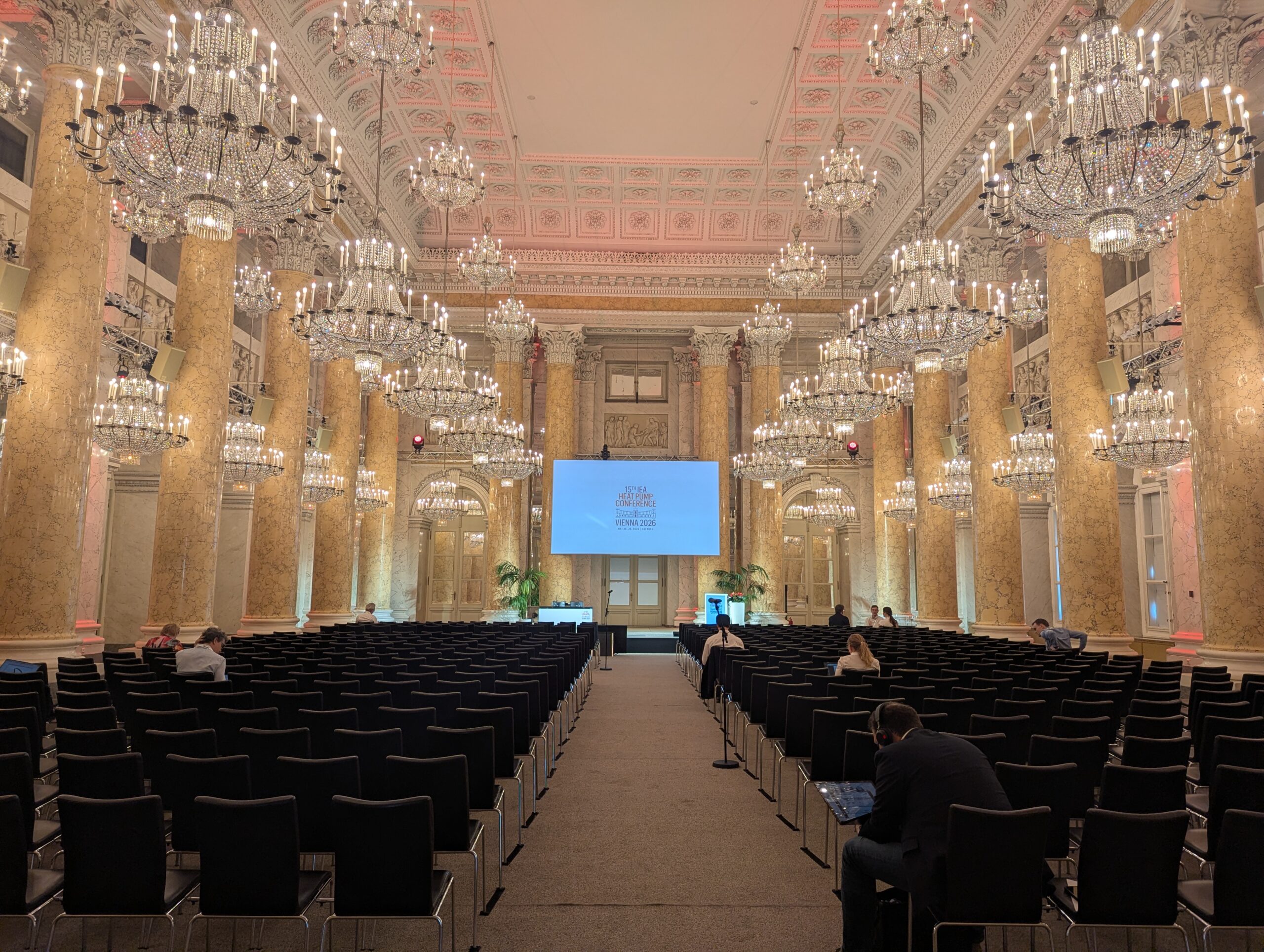
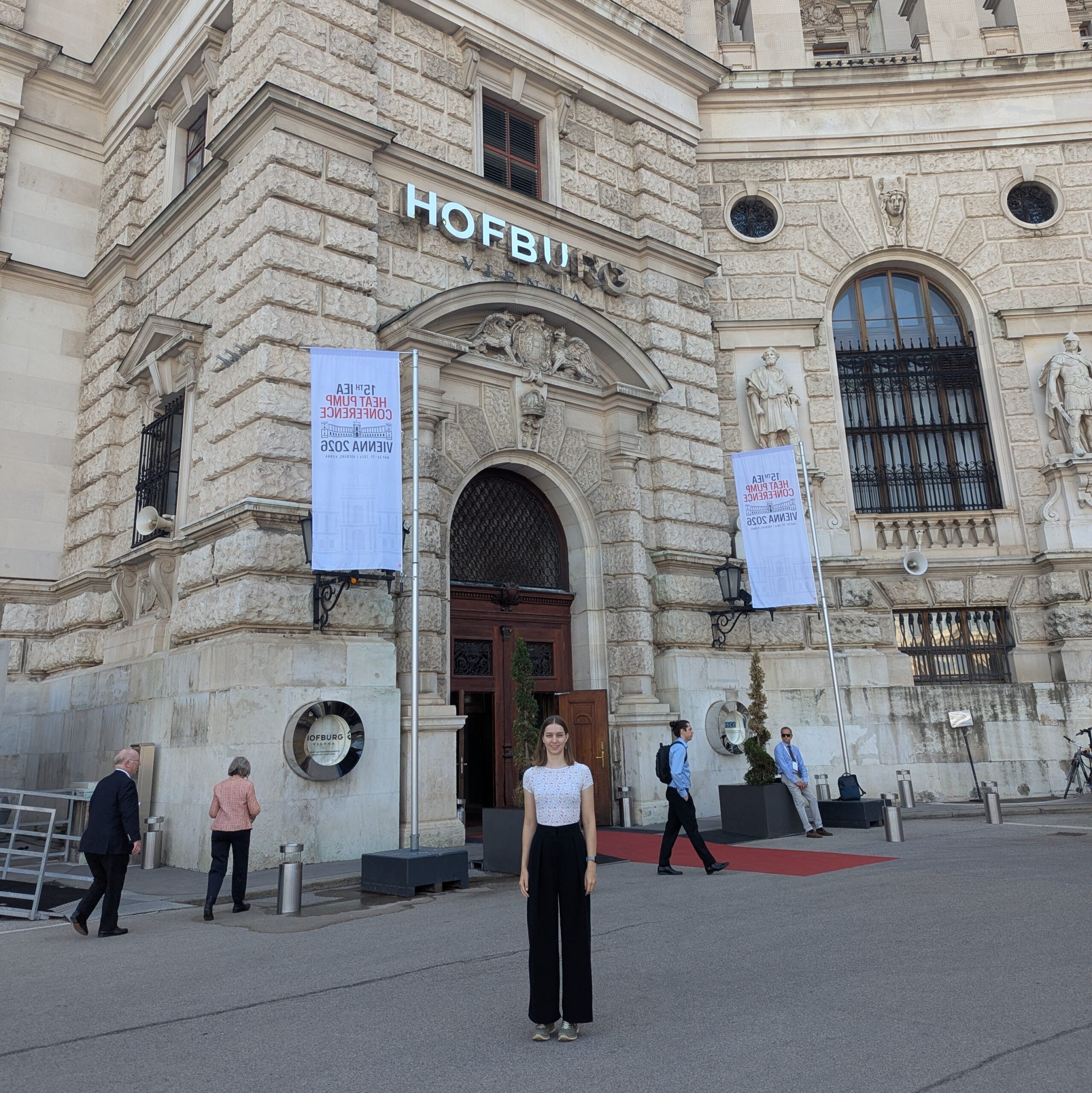
From 26–29 May 2026, Lara Stürenburg attended the Heat Pump Conference 2026 at the historic Hofburg in Vienna. The conference brought together researchers, industry representatives, and policymakers from around the world under the motto Decarbonisation through Innovation to discuss the latest developments in heat pump technology and its contribution to achieving global zero-carbon targets.
During the conference, Lara Stürenburg presented the work titled Study on human response to the cumulative impact of air source heat pump noise. The presentation focused on a large-scale listening experiment conducted at ten sites across seven European countries, involving more than 270 participants. This research is part of the international Annex 63 project Placement Impact on Heat Pump Acoustics. Within the task group Psychoacoustics of Heat Pumps, the aim is to better understand how the combined sound emissions of multiple air source heat pumps in residential back gardens influence human perception and annoyance.
Four other Annex 63 project partners also presented their research on heat pump acoustics. However, among the 367 contributions presented at the conference, this resulted in only five contributions focusing on acoustics and noise emissions of heat pumps. This highlights that acoustic aspects are still underrepresented in the broader heat pump research community. It is crucial to increase awareness of their noise emissions and their impact on both the environment and human perception. Greater consideration of acoustic aspects will be essential for the successful and sustainable integration of heat pumps into residential environments.
Beyond the scientific sessions, the conference provided a valuable opportunity to exchange ideas with experts working on heat pumps from various disciplines and countries. The policy forums particularly emphasised the central role of heat pumps in reducing greenhouse gas emissions and reaching the climate goals of many nations. It was inspiring to see how innovation, engineering, and interdisciplinary research contribute together to making sustainable heating technologies more efficient, accepted, and environmentally compatible.
-

- Lara during her conference presentation

-
- Conference venue indoors
-
- Lara in front of conference venue
Karriere und Familie in der Wissenschaft – Geht das?
Am 10. Juni 2026 fand im Rahmen vom Schwerpunktprogramm SPP2236-AUDICTIVE ein Lunch Talk zum Thema Karriere und Familie statt. Vier Professor*innen berichteten offen über ihre Karrierewege und ihre Erfahrungen mit Familie im Wissenschaftssystem: Janina Fels (RWTH Aachen University), Sabine Langer (TU Braunschweig), Axel Ahrens (DTU) und Johannes M. Arend (Aalto University). Teilnehmende hatten die Möglichkeit, eigene Fragen zu stellen.
Die Diskussion zeigte schnell: Den einen Weg gibt es nicht. Die Familiensituationen, Karriereverläufe und Prioritäten unserer Gäste waren sehr unterschiedlich. Dennoch zogen sich einige gemeinsame Themen durch die gesamte Gesprächsrunde.
Familie verändert nicht nur den Alltag, sondern auch den Blick auf die Karriere
„Ohne meine Kinder wäre ich vielleicht gar nicht Professorin geworden.“
Familie wird häufig als Hindernis für eine wissenschaftliche Karriere diskutiert. Gleichzeitig berichteten mehrere Teilnehmende davon, dass Kinder ihnen geholfen haben, Prioritäten neu zu setzen, Entscheidungen bewusster zu treffen und den eigenen Karriereweg kritisch zu hinterfragen.
Karrierewege seien ohnehin selten planbar. Familie verstärke diese Unvorhersehbarkeit zwar noch, könne aber auch helfen, den eigenen Weg klarer zu definieren.
Wissenschaft braucht noch mehr Vereinbarkeit
Die Gäste berichteten von Situationen, in denen familiäre Verpflichtungen mit den Erwartungen des Wissenschaftsbetriebs kollidierten: späte Meetings, lange Dienstreisen, Konferenzen.
Wer Familie habe, könne nicht jederzeit verfügbar sein. Gleichzeitig wurde deutlich, dass sich die Kultur an vielen Stellen bereits verändere. Teilzeit werde zunehmend akzeptiert, Elternzeit werde sichtbarer und die Diskussion über Vereinbarkeit finde heute deutlich offener statt als noch vor einigen Jahren.
Dennoch wurde auch berichtet, dass nicht überall das gleiche Verständnis für familiäre Verpflichtungen herrsche und es manchmal Gegenwind gebe.
Muss man für die Wissenschaft ständig umziehen?
Ein besonders kontrovers diskutiertes Thema war die wissenschaftliche Mobilität.
Internationale Erfahrungen und Ortswechsel gelten in vielen Fachbereichen weiterhin als wichtiger Baustein einer wissenschaftlichen Karriere. Gleichzeitig stellen sie insbesondere für Familien eine große Herausforderung dar.
Die Erfahrungen der Gäste waren dabei unterschiedlich. Während einige Ortswechsel als belastend und karrierehemmend empfanden, beschrieben andere sie als wichtige Chance, neue Perspektiven, Arbeitsweisen und Netzwerke kennenzulernen.
Einigkeit bestand jedoch darin, dass Mobilität heute vielfältiger gelebt werden kann als früher. Internationale Kooperationen, gemeinsame Publikationen, kurze Forschungsaufenthalte oder gezielte Laborbesuche können helfen, Netzwerke aufzubauen, ohne über Jahre den Wohnort wechseln zu müssen.
Alleine klappt es nicht
Ein weiteres zentrales Thema war die Bedeutung von Unterstützung durch andere.
Wer empfiehlt mich für eine Stelle? Wer übernimmt kurzfristig die Kinderbetreuung? Wer ermutigt mich, eine Chance wahrzunehmen, die ich mir selbst vielleicht nicht zugetraut hätte?
Erfolgreiche Karrieren entstehen selten allein. Mentor*innen, Kolleg*innen, Freund*innen, Partner*innen und Familien bilden häufig das Netzwerk, das Karriere und Familie überhaupt erst vereinbar macht.
Ebenso wichtig sind Vorbilder, die zeigen, dass unterschiedliche Lebens- und Arbeitsmodelle möglich sind – sei es Teilzeit, Elternzeit oder ein bewusst begrenztes Reiseaufkommen.
Wissenschaft oder Wirtschaft?
Auch die Unterschiede zwischen Wissenschaft und Industrie wurden diskutiert.
Während in der Industrie häufig eine stärkere Trennung zwischen Arbeits- und Privatleben wahrgenommen wird, bietet die Wissenschaft oftmals mehr Flexibilität bei Arbeitsort und Arbeitszeit. Das kann gerade für Familien ein großer Vorteil sein, beispielsweise wenn Kinder nachmittags betreut werden müssen und die Arbeit später fortgesetzt wird.
Entscheidend sei jedoch, Erwartungen transparent zu kommunizieren und gesunde Grenzen zu setzen.
Fazit
Die Gesprächsrunde machte deutlich: Eine wissenschaftliche Karriere mit Familie ist möglich, aber selten geradlinig. Unterstützende Strukturen, gute Netzwerke, Vorbilder und eine Kultur, die unterschiedliche Lebensrealitäten anerkennt, können dabei einen entscheidenden Unterschied machen.
Wir bedanken uns herzlich bei Janina Fels, Sabine Langer, Axel Ahrens und Johannes Arend für ihre Offenheit, ihre persönlichen Einblicke und die vielen ermutigenden Gedanken. Ebenso danken wir allen Teilnehmenden für die spannenden Fragen und den offenen Austausch sowie Cosima Ermert und Carolin Breuer für die Organisation der Veranstaltung.
Promotionsprüfung Julia Seitz
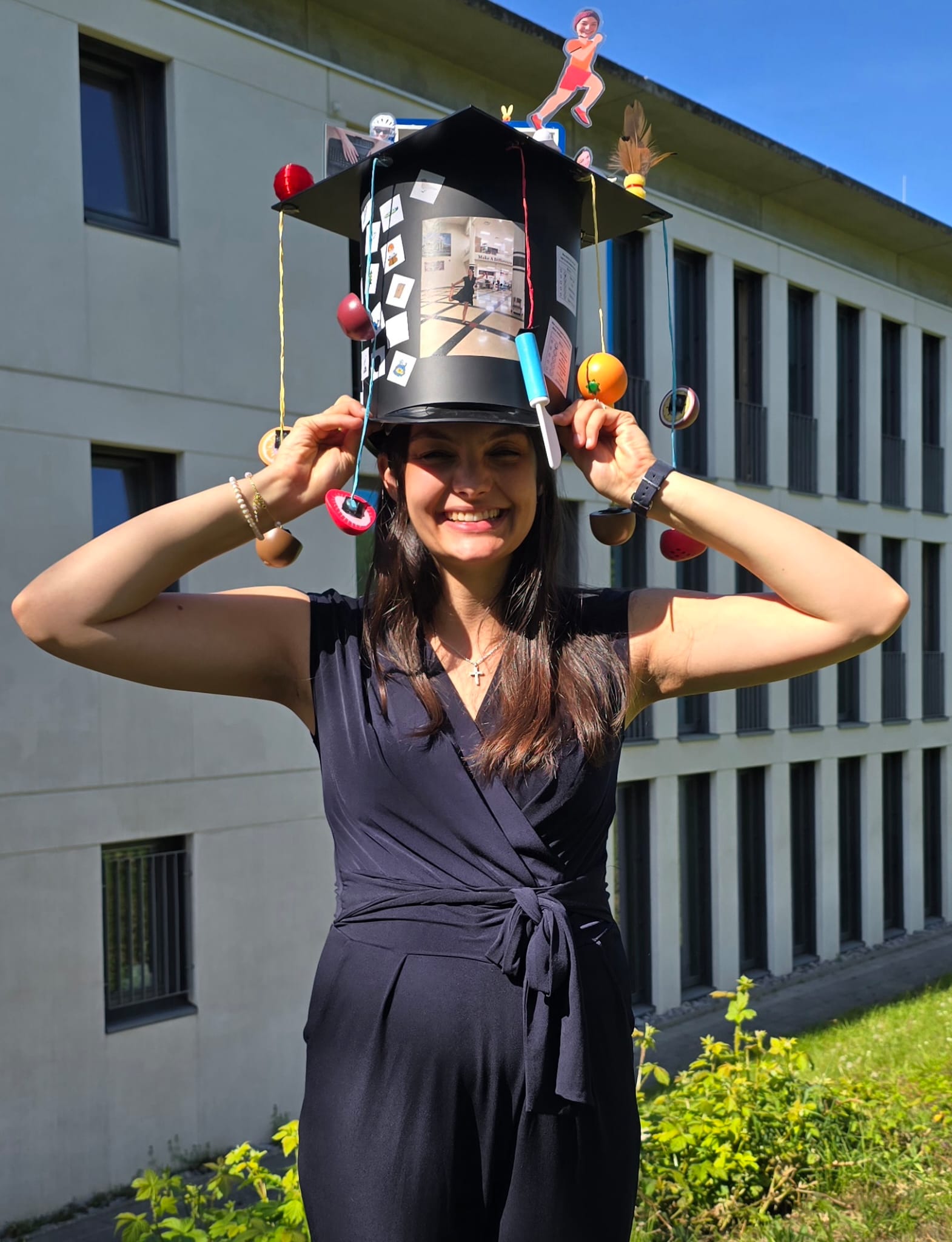
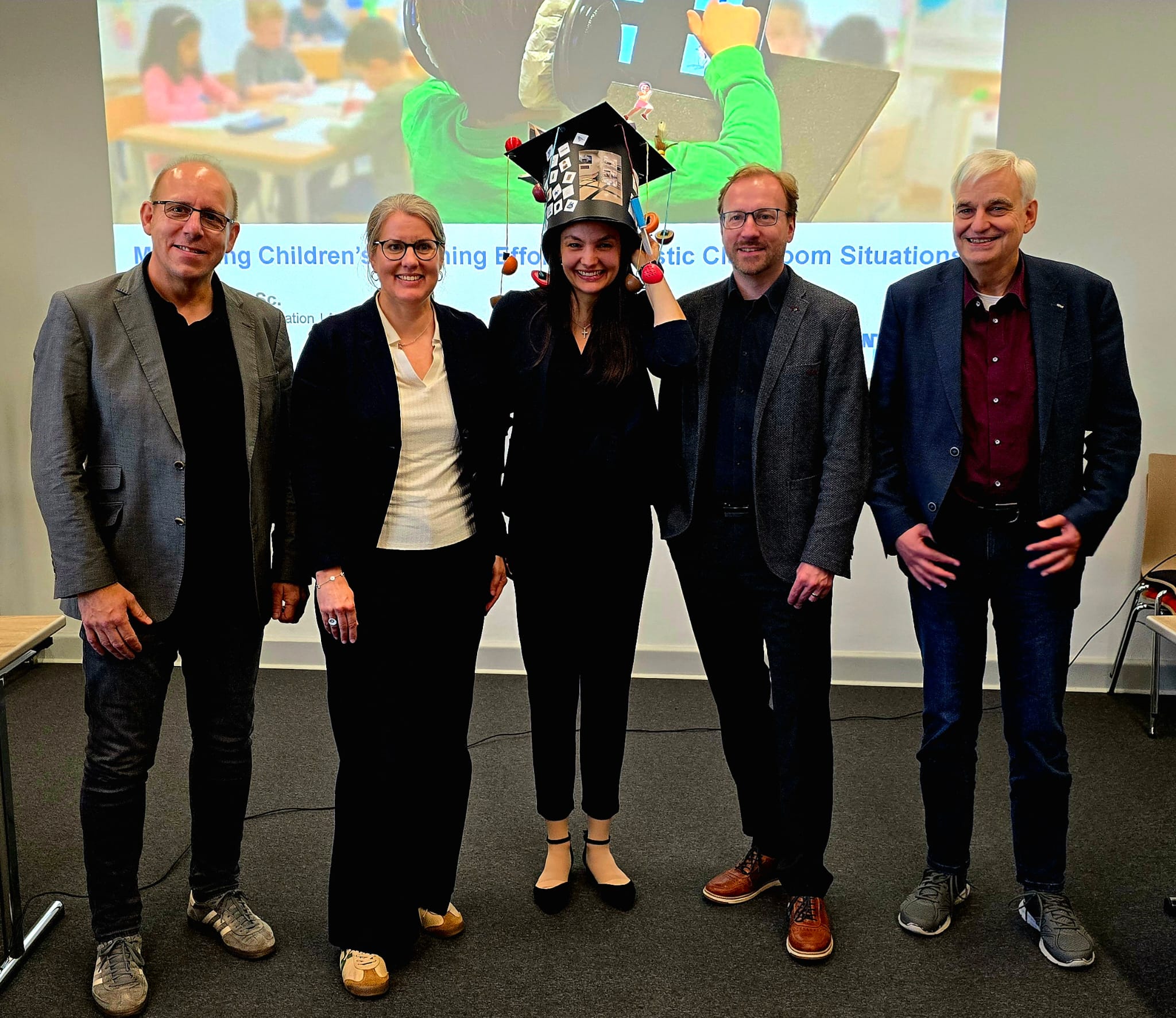
Am 24.04.2026 durfte das IHTA die erfolgreiche Promotionsprüfung von Julia Seitz feiern.
Julia Seitz promovierte zum Thema „Measuring children’s listening effort in realistic classroom situations“.
Das IHTA gratuliert sehr herzlich!
-

- Dr. Seitz
-

- Prüfungskommission: Prof. Dr. rer. nat. Sven Ingebrandt, Prof. Dr.-Ing. Janina Fels, Julia Seitz, Prof. Dr. Jan Rennies-Hochmuth, Prof. Dr.-Ing. Albert Moser
IHTA Contributions to DAGA 2026
This year’s DAGA 2026 is the 52. annual meeting of the German Acoustical Society (DEGA). The conference takes place in Dresden from 23th to 26th of March, 2026. As usual, IHTA members will present their lovely work on the variety of research topics covered at IHTA. This year, the IHTA is involved in a total of 22 contributions. In addition, the IHTA has been very active in organizing special sessions and events (see below).
We are happy to invite you to our presentations and posters!
You can find the full conference program in the DAGA-Web-App Every contribution in the table below links to its entry in the web-app, where you can read its abstract and add it to your personal conference schedule.
We are looking forward to meet you there!
| Monday, March 13 | ||||
| Janina Fels | Audiovisuelle Interaktion in Virtueller Realität: Realitätsnahe Hörforschung im Labor | Vorkolloquium: Multimodale Interaktion und Virtuelle Realität | 13:10 | Konferenz 6 |
| Tuesday, March 24 | ||||
| Chalotorn Möhlmann, Janina Fels | Evaluation of Urban Vehicle Pass-By Noise Measurements and Auralizations Using Psychoacoustic Metrics | Fahrzeugakustik (Poster) | 15:20 | Poster-Forum |
| Maximilian Will, Karin Loh, Lukas Aspöck, Janina Fels, Anselm Goertz | Perception of phase distortion caused by Linkwitz-Riley crossover filters in a 3-way loudspeaker system | Elektroakustik und Audiosignalverarbeitung 2 | 16:40 | Saal 5 |
| Wednesday, March 25 | ||||
| Isabel S. Schiller, Karin Loh, Janina Fels, Sabine J. Schlittmeier | Effects of Background Noise and Visual Talker Cues on Memory for Content and Source in Heard Conversations | Auditory Cognition in Interactive Virtual Environments 1 | 08:40 | Konferenz 4 |
| Omar Fahmi Jubran, Maria Klatte, Carolin Breuer, Larissa Leist, Thomas Lachmann, Alexander Raake, Janina Fels | Effects of Monaural and Binaural Classroom Noise Scenarios on Speech Perception and Listening Comprehension in Native Speakers and L2 Learners | Auditory Cognition in Interactive Virtual Environments 1 | 09:00 | Konferenz 4 |
| Anne Heimes, Michael Vorländer | Angle Dependent Absorption Coefficients from Free-Field Measurement | Raumakustik 1 | 09:20 | Saal 1 |
| Gülnihan Atay, Josep llorca-Bofi, Michael Vorländer | Perception of Loudness Based on Source-Receiver Distance | Virtuelle Akustik 2 | 09:40 | Saal 2 |
| Carolin Breuer, Matthias Tillmann, Larissa Leist, Stephan Fremerey, Alexander Raake, Maria Klatte, Janina Fels | Exploring the Impact of Audiovisual Noise on Auditory Selective Attention | Auditory Cognition in Interactive Virtual Environments 1 | 11:00 | Konferenz 4 |
| Ann-Christin Schlupek, Franck Sgard, Kevin Carillo, Olivier Doutres, Janina Fels, Simon Kersten | From Ear Canal to Perception: Numerical Simulation of the Occlusion Effect for Hearing Technologies | Audiologische & Physiologische Akustik | 11:00 | Konferenz 6 |
| Jithin Thilakan, Lukas Aspöck, Janina Fels | Acoustic impact of UAS swarms: Auralization and objective evaluation | Akustik von Drohnen 1 | 11:20 | Seminar room 3-4 |
| Florian Denk, Sven Redlin, Aks Arora, Janina Fels, Christin Grill, Ralf Brinkmann, Hendrik Husstedt, Simon Kersten | Optical stimulation of the human eardrum for hearing devices – towards finite-element models for parameter optimization | Audiologische & Physiologische Akustik | 11:20 | Konferenz 6 |
| Aron Schliep, Konstantin Fontaine, Amneh Hamida, Alena Wagner, André Fiebig, Marcel Schweiker, Janina Fels | A survey instrument for measuring the affective component of acoustic well-being as part of the MOSAIC research training group | Soundscape 1 – Theorie und Praxis | 14:20 | Konferenz 6 |
| Hark S. Braren, Janina Fels | Localization Accuracy of Children using different HRTFs | Virtuelle Akustik & Binauraltechnik (Poster) | 15:20 | Terrassenebene (Posterinsel G) |
| Rouben Rehman, Aron Schliep, Simon Kersten, Janina Fels | Extending the Least-Squares-Based Transparency Equalization Method to Simulate Occlusion in Perception Experiments | Audiologische, physiologische & medizinische Akustik (Poster) | 15:20 | Konferenzebene (Posterinsel B) |
| Pascal Palenda, Michael Vorländer | Dynamic Auralizations Considering Diffraction | Virtuelle Akustik 3 | 16:00 | Saal 2 |
| Thursday, March 26 | ||||
| Lara Stürenburg, Abdurrahman Alakus, Janina Fels | Influence of an Image on Annoyance Ratings of Heat Pump Noise | Psychoakustik 2 | 08:40 | Saal 2 |
| Jana R. Berger, Julia Seitz, Janina Fels | Einfluss unterschiedlicher Unterrichtsformen auf Sprachverstehen und verhaltensbezogene Höranstrengung bei Kindern | Höranstrengung in alltäglichen Situationen | 08:40 | Konferenz 4 |
| Julia Seitz, Jana R. Berger, Janina Fels | Einfluss unterschiedlicher Unterrichtsformen auf subjektive und physiologische Höranstrengung bei Kindern | Höranstrengung in alltäglichen Situationen | 09:00 | Konferenz 4 |
| Anastasia Sinarso, Julia Seitz, Janina Fels | Unequal Burdens: Socioeconomic Background and Listening Effort in Noisy Classrooms | Höranstrengung in alltäglichen Situationen | 09:20 | Konferenz 4 |
| Cosima A. Ermert, Janina Fels | Listening Effort in Virtual Reality: The Role of Background Speech, Room Acoustics, and Talker Visualization | Höranstrengung in alltäglichen Situationen | 10:20 | Konferenz 4 |
| Jonas Heck, Michael Vorländer | Revisiting Ground Impedance Measurements for Predicting Outdoor Sound Propagation | Technische Akustik | 10:40 | Konferenz 2 |
| Thomas Deutsch, Luigi Falanga, Iring Koch, Janina Fels | Investigating Auditory Selective Attention Across Audio Reproduction Methods and Age Groups: Experimental Dissociation of Hearing Thresholds and Attention | Psychoakustik (Poster) | 11:00 | Posterinsel A |
| Organized Sessions | ||||
| Höranstrengung in alltäglichen Kommunikationssituationen 1 | Julia Seitz und Jan Rennies-Hochmuth | Thursday, 26.03.2026 | 08:40-11:00 | Konferenz 4 |
| Höranstrengung in alltäglichen Kommunikationssituationen 2 | Thursday, 26.03.2026 | 14:00-15:20 | ||
| Auditory Cognition in Interactive Virtual Environments 1 | Janina Fels and Carolin Breuer | Wednesday, 25.03.2026 |
08:40-11:40 | Konferenz 4 |
| Auditory Cognition in Interactive Virtual Environments 2 | Wednesday, 25.03.2026 |
14:00-15:20 | ||
| Junge DEGA Events | ||||
| Icebreaker | junge DEGA Jonas Heck and Lara Stürenburg |
Monday, 23.03.2026 | 15:30-17:00 | Foyer vor Saal 5 |
| Kneipenabend | Monday, 23.03.2026 | 19:00-23:00 | BBC – Bar Brasserie Cassis, Alaunstraße 16, 01099 Dresden | |
| Speed Dating — Meet the Acousticians | Thursday, 24.03.2026 | 16:40-18:00 | Restaurant (neben Saal 5) | |
| Research in short(s) & Power-Point-Karaoke | Wednesday, 25.03.2026 | 13:40-15:20 | Großer Saal | |
| Mentoring-Café | Wednesday, 25.03.2026 | 16:00-16:40 | Seminar 1-2 | |
| Other Events | ||||
| Hands-On Workshop: PYFAR – Python Packages for Acoustics Research | IHTA RWTH Aachen University, TU Berlin, TH Köln | Thursday, 26.03.2026 | 13:00-14:00 | Seminar 3-4 |
Turn Sound into Your Future at the Institute for Hearing Technology and Acoustics
What does your future sound like?
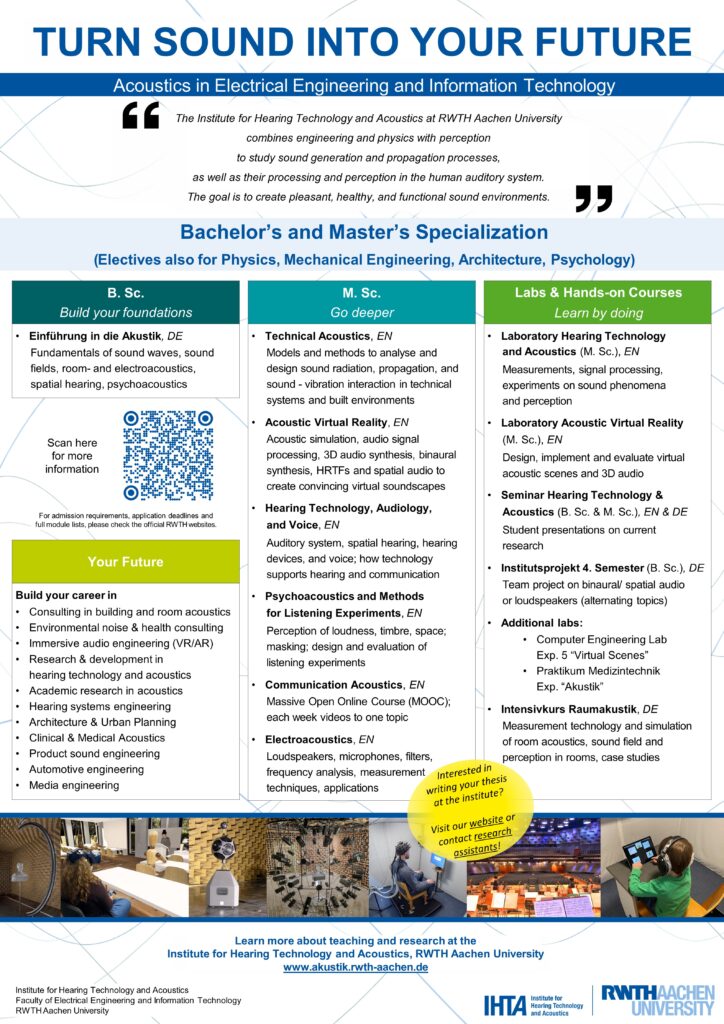
At the Institute for Hearing Technology and Acoustics (IHTA) at RWTH Aachen University, we study sound from its physical foundations to its perception by the human auditory system. Our new overview poster provides a compact insight into the acoustics specialization within Electrical Engineering and Information Technology.
Study Acoustics
The Bachelor’s program introduces the fundamentals of sound waves, spatial hearing, room acoustics, and psychoacoustics. In the Master’s program, students can specialize in areas such as Technical Acoustics, Hearing Technology, Audiology and Voice, Psychoacoustics and Methods for Listening Experiments, Acoustic Virtual Reality, Electroacoustics, and an Intensive Course on Room Acoustics.
Hands-on Experience
Labs, seminars, and project work enable students to apply theory to practical problems, including virtual acoustic scenes, measurements, and listening experiments.
Your Future
Graduates can pursue careers in a wide range of fields, such as immersive audio (VR/AR), product sound design, environmental acoustics, or research and development.
Learn more: www.akustik.rwth-aachen.de
Einladung zur Abschlussveranstaltung des BaLSaM-Projekts am 21.1.2026
Das Projekt “Braunkohlereviere als attraktive Lebensräume durch Straßengeräuschsimulation auf Basis bestehender Verkehrsdaten zur Minimierung von Lärm” (BaLSaM) lädt Interessierte zur öffentlichen Abschlussveranstaltung ein. Sie wird am 21.1.2026 von 8:30-11:30 Uhr im Institut für Hörtechnik und Akustik (IHTA) der RWTH Aachen University stattfinden (Adresse: Kopernikusstraße 5, 52074 Aachen, Deutschland).
Im Rahmen des BaLSaM-Projekts wurde die Modellierung der Schallausbreitung von Verkehrslärm in urbanen Umgebungen sowie deren Auswirkung auf die menschliche Wahrnehmung untersucht. Das BaLSAM-Konsortium setzt sich zusammen aus dem Institut für Kraftfahrzeuge (IKA) und dem Institut für Hörtechnik und Akustik (IHTA) der RWTH Aachen University sowie RHA REICHER HAASE ASSOZIIERTE GmbH und HEAD acoustics GmbH. Gefördert wird das Projekt von dem Bundesministerium für Verkehr im Rahmen der mFUND-Initiative.
Während der Abschlussveranstaltung werden die Projektpartner die Ergebnisse des Projekts zu präsentieren. Darüber hinaus wird das Event die Gelegenheit bieten, Erfahrungen auszutauschen und gemeinsam über zukünftige Fragestellungen zu diskutieren. Neben der Teilnahme vor Ort ist auch eine digitale Teilnahme an der Veranstaltung möglich.
Agenda:
| 08:30 | Anreise |
| 09:00 | Begrüßung |
| 09:15 | Vorstellung des Projektes |
| 09:30 | Vorstellung der Ergebnisse aus den Arbeitspaketen |
| 11:00 | Diskussion mit dem Teilnehmerkreis |
| 11:15 | Beginn der Demo & Ausklang des öffentlichen Teils |
| Im Anschluss: Projekt-interner Abschluss (nicht öffentlich) | |
— English version —
The BaLSaM project invites interested parties to the public closing event. It will take place on January 21, 2026, from 8:30 a.m. to 11:30 a.m. at the Institute for Hearing Technology and Acoustics (IHTA) at RWTH Aachen University (address: Kopernikusstraße 5, 52074 Aachen, Germany).
The BaLSaM project investigated the modeling of traffic noise propagation in urban environments and its impact on human perception. The BaLSAM consortium consists of the Institute for Automotive Engineering (IKA) and the Institute for Hearing Technology and Acoustics (IHTA) at RWTH Aachen University, as well as RHA REICHER HAASE ASSOZIIERTE GmbH and HEAD acoustics GmbH. The project is funded by the German Federal Ministry of Transport as part of the mFUND initiative.
During the closing event, the project partners will present the results of the project. In addition, the event will provide the opportunity to exchange experiences and discuss future topics. In addition to attending in person, digital participation in the event is also possible.
—————
Anmeldung / Registration:
https://www.balsam-projekt.de/de/abschlussveranstaltung.html
Digitale Teilnahme per Teams / Online participation via Teams:
Jetzt an der Besprechung teilnehmen
Besprechungs-ID: 317 428 128 635 50
Passcode: zg6pV6Yw
Flatterechos und Streuselbrötchen: Cosima Ermert gewinnt den Science Slam der RWTH
Im Rahmen der am 14.11.2025 stattgefundenen RWTH Wissenschatftsnacht „5 vor 12“ hatten beim Science Slam Interessierte (nach Voranmeldung) die Möglichkeit, ein wissenschaftliches Thema in lockerer und kreativer Art und Weise einem breitem Publikum in einem kurzen Vortrag von 5-8 Minuten vorzustellen. Neben fünf anderen Slammerinnnen und Slammern nahm dabei unsere Mitarbeiterin Cosima Ermert mit dem Beitrag „Flatterechos und Aachener Backwaren“ teil und zeigte, wie man Akustik anschaulich und unterhaltsam erklären kann. Basierend auf dem Applaus der fast 1000 Besucher*innen im großen Hörsaal der RWTH, wurde ihr Beitrag zum ersten Platz bei diesem Wettbewerb gekürt. Herzlichen Glückwunsch zu dieser beeindruckenden Leistung, Cosima!
Im Zentrum von Cosimas Slam stand die Frage: Können Aachener Streuselbrötchen als akustische Diffusoren gegen Flatterechos helfen? Messungen eines selbstgebackenen Riesenstreuselbrötchens und Simulationen an 3D Scans echter Streuselbrötchen – gemeinsam mit unserer Expertin für akustische Streuung, Anne Heimes – ergaben: Aufgrund ihrer Größe und Struktur streuen Streuselbrötchen vor allem Schallwellen hoher Frequenzen.


Um die Simulationen in unserem skalierten Hallraum zu valideren, braucht es jetzt nur noch ein echtes Streuselbrötchen mit einem Durchmesser von 80cm… Die Forschung an Aachener Spezialitäten ist also noch lange nicht vorbei!
Wir freuen uns über Cosimas Erfolg und sind schon gespannt auf weitere akustische Erklärungen mit Aachener Köstlichkeiten. Herzlichen Glückwunsch!
PAAD: Visual documentation of Berlin Philharmonie
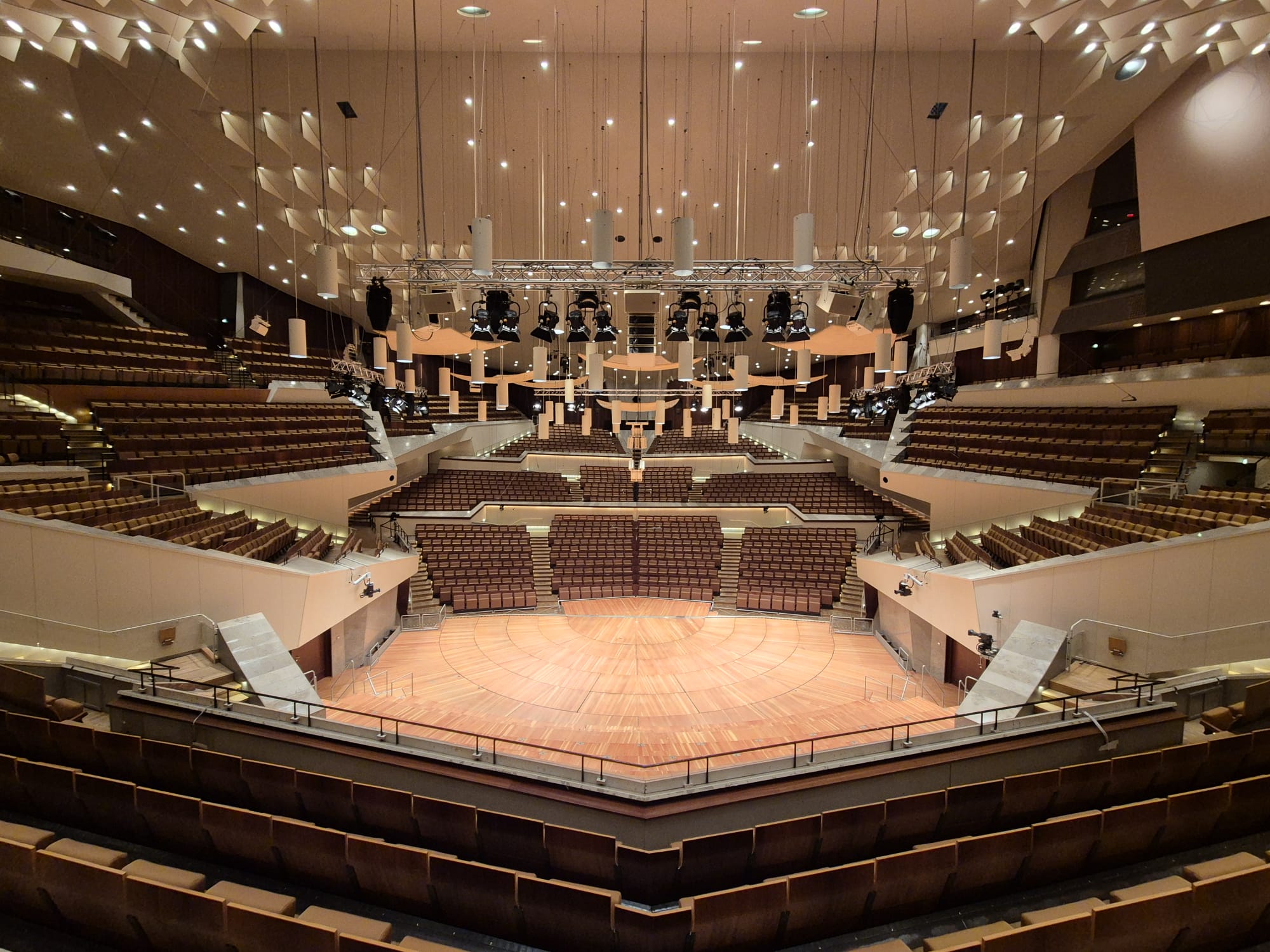
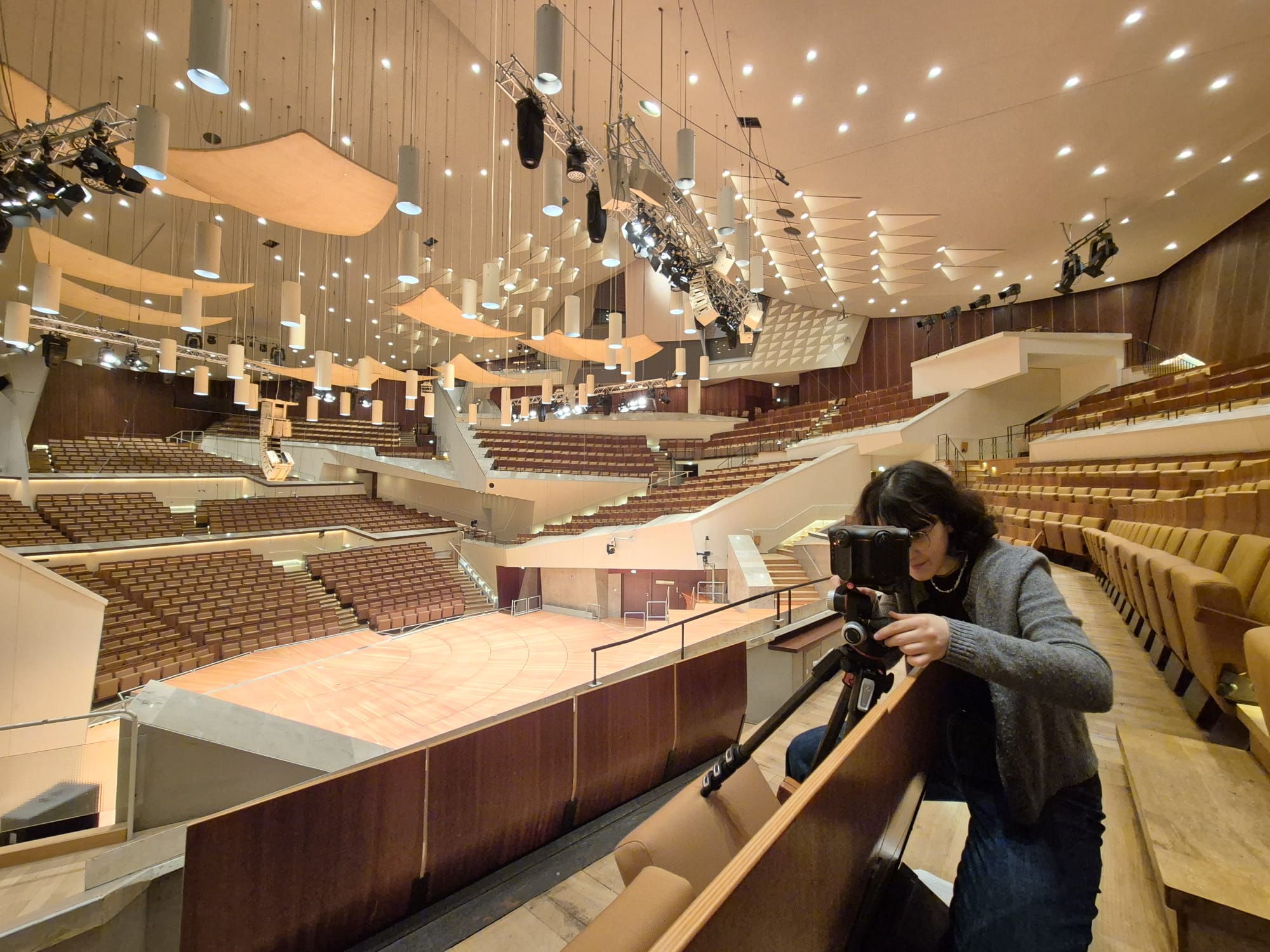
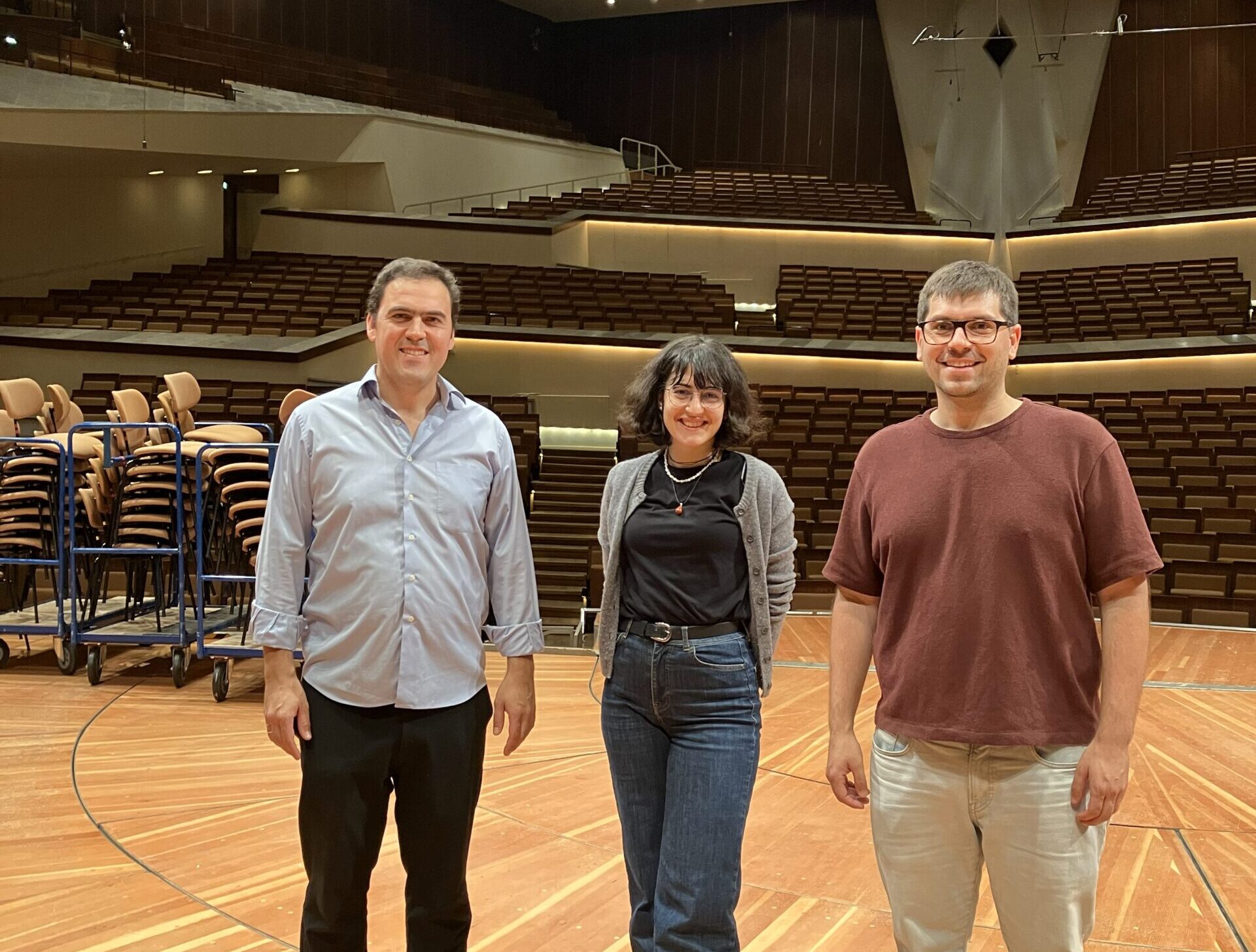
PAAD „Person-focused Acoustics of Architectural Design“ research group has recently visited Berlin Philharmonie to capture 3D data of the auditorium for the MUSKLA Database: a growing collection of narrow angle and spherical photographs of major concert halls in Europe. The goal is to support state of the art multimodal perceptual studies in auditoriums by providing a reference database accessible to the scientific community. In collaboration with our colleagues from Universitat Politècnica de Catalunya and Fraunhofer-Institut für Bauphysik, our team was able to conduct a comprehensive 3D capture of the auditorium.
We documented the auditorium combining imaging techniques to ensure both geometrical accuracy and photorealistic texture:
– 360° panoramic photography to record the spatial impression and visual atmosphere of the hall, located in multiple seating positions from the audience view.
– Narrow angle photo capture to enrich the textures and surface details needed for realistic visualization and to produce accurate photogrammetric model of the hall.
-

- Berlin Philharmonie
-
- Setting up the camera equipment
-

- Project team
The data collected will become openly available through the MUSKLA database providing researchers and practitioners with resources to create immersive virtual experiences as well as accurate 3D models of major auditoriums.
We thank the staff who welcomed our team and supported a smooth operation throughout the day!
The GRAS Innovation Award – The Game-Changer 2025 – has been awarded to IHTA
We are proud to announce that we received the GRAS Award – The Game-Changer 2025 by GRAS Sound and Vibration. The project: A High-Resolution Head-Related Transfer Function Data Set and 3D-Scan of KEMAR by the authors Hark Braren and Janina Fels won the award in the category „the Game-Changer“.
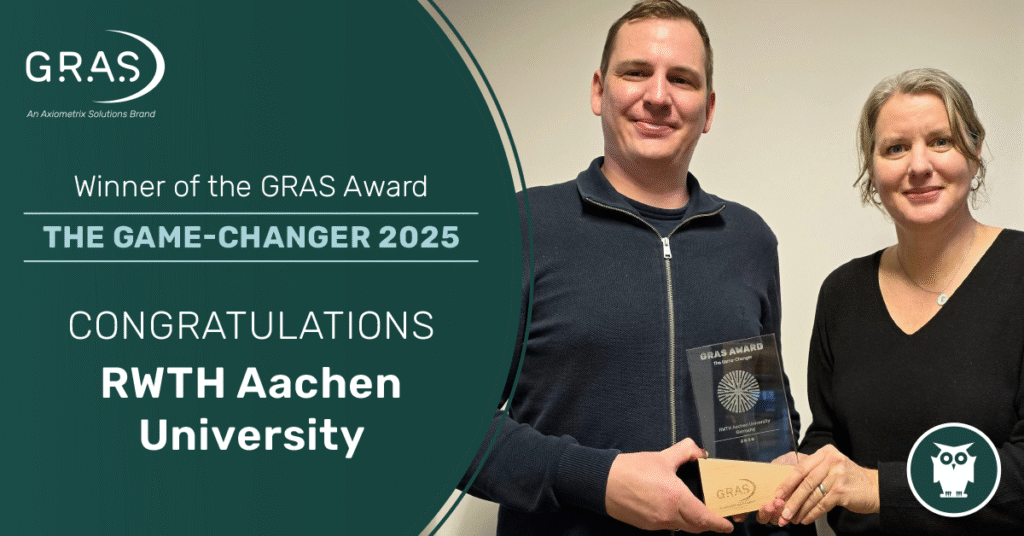
GRAS Award Winner – The Game Changer 2025, Hark Braren and Janina Fels, RWTH Aachen University
The RWTH team created an open, high-resolution HRTF dataset using the GRAS KEMAR Head and Torso Simulator — bridging physical measurement and acoustic simulation. Their work sets a new benchmark for spatial audio realism and paves the way for future breakthroughs in 3D sound and headphone design.
The innovation speaks directly to our core mission: enabling the highest quality in acoustic measurement and supporting industry breakthroughs.
The dataset can be found here: https://doi.org/10.18154/RWTH-2020-11307
We would like to express our sincere thanks to GRAS Sound & Vibration for this special award!
3rd IHTA Retreat
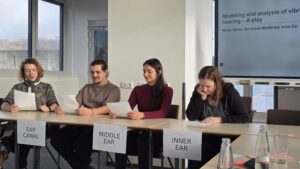
The third IHTA Retreat took place on November 21st. The day began with unconventional yet exceptionally entertaining and informative project presentations with an amazing view of Aachen from the Skylounge in the main building. Participants were challenged to present their projects either as a short, powerful science pitch or in a creative way. We heard short stories about children’s hearing experiences in classrooms and saw theater plays with the inner, middle, and outer ears as the main characters. There will surely be many new contestants for Research in Shorts at DAGA 2026.
During the afternoon, we discussed challenges related to writing and publishing scientific papers, as well as strategies for overcoming them. Most importantly, we took time to learn from one another, develop new inspiration, and take the first steps to overcome writer’s block and support each other.
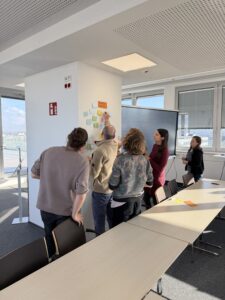
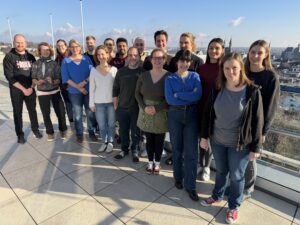
Thank you to Bastian Hughes for guiding us through the day with his excellent moderation! Thanks also to Julia Seitz, Lara Stürenburg, and Carolin Breuer, who organized the event.
Paper published: Exploring auditory selective attention shifts in virtual reality: An approach with matrix sentences
We are happy to share that our paper “Exploring auditory selective attention shifts in virtual reality: An approach with matrix sentences” has been published in the Journal of the Acoustical Society of America:
https://doi.org/10.1121/10.0039864
In this study, we explored voluntary shifts of auditory selective attention in complex and more naturalistic acoustic environments. To move beyond earlier paradigms based on single-word stimuli, we introduced unpredictable German matrix sentences to simulate more realistic listening conditions.
Overall results were comparable to previous versions, but no strong reorienting effect emerged. Interaction patterns still indicate that shifting auditory attention is more demanding than maintaining it, and that preparing attention benefits performance, as reflected in decreasing reaction times for later target onsets.
This approach contributes a paradigm for investigating auditory perception and attention in dynamic room acoustic environments, helping to close the gap between laboratory setups and real-world listening.
This work was created by Carolin Breuer and Janina Fels and was funded by the German Research Foundation (DFG) as part of the Priority Program SPP2236 AUDICTIVE.

