Kategorie: ‘Noise’
Paper published: The influence of complex classroom noise on auditory selective attention
We are very glad to share that our paper “The influence of complex classroom noise on auditory selective attention”, based on the bachelor’s thesis of Robert Schmitt, which we co-authored, has just been published in Scientific Reports: https://www.nature.com/articles/s41598-025-18232-2
It has been a real pleasure to supervise this work and to see it evolve into a full publication. In the study, we examined how plausible classroom noise affects auditory selective attention in a virtual reality classroom environment.
Our results underline the importance of studying realistic and complex acoustic scenarios to gain more reliable and valid insights into auditory perception by showing higher error rates in the auditory attention task under complex noise conditions, as well as an increased perceived listening effort when the background contained intelligible speech.
The paper was developed within the ECoClass-VR project, part of the DFG Priority Program SPP 2236 AUDICTIVE on Auditory Cognition in Interactive Virtual Environments. More information at www.spp2236-audictive.de.
We hope these findings contribute to advancing our understanding of auditory attention in complex, real-world listening situations.
Many thanks to the co-authors Robert Schmitt, Larissa Leist, Stephan Fremerey, Alexander Raake, Maria Klatte, and Janina Fels, and to the AUDICTIVE community for the inspiring collaboration and support.
Janina Fels und Cosima Ermert beim „International Symposium on Auditory and Audiological Research – ISAAR 2025“
Vom 19. bis 22. August 2025 reisten Janina Fels und Cosima Ermert nach Dänemark, um das „International Symposium on Auditory and Audiological Research – ISAAR 2025“ in Nyborg zu besuchen.
Janina Fels hielt einen eingeladenen Vortrag zum Thema „Exploring Auditory Cognition: Connecting Real-World Contexts with Interactive Virtual Environments” und stellte dabei mehrere laufende Forschungsvorhaben vor, die sich speziell mit selektiver auditiver Aufmerksamkeit und Höranstrengung (Listening Effort) bei Kindern in Klassenräumen unter realistischen Hörbedingungen befassen.
Cosima Antonia Ermert präsentierte dazu ein Poster mit dem Titel „Listening Effort in Populated Audiovisual Scenes Under Plausible Room Acoustic Conditions”.
Einen Tag vor der ISAAR reiste Janina Fels zum „Pre-ISAAR Mini-Symposium“ beim Eriksholm Research Centre. Sie hatte die Gelegenheit, mehr über aktuelle Themen und Projekte zu erfahren und diese ausführlich zu diskutieren. Es fand eine exzellente Führung durch die Labore statt und es wurden zahlreiche hochinteressante Posterpräsentationen abgehalten. Zudem wurden eine Vielzahl neuer Ideen für zukünftige Kooperationen diskutiert.
Währenddessen nahm Cosima Ermert am „Workshop in Communication in Hearing Science” von WS Audiology teil. Dieser Workshop beschäftigte sich mit dem Thema „Understanding how noise and hearing impairment affect communication”. Cosima präsentierte für das IHTA ein Poster mit dem Titel „Bringing real-life into the lab: Investigating speech in virtual auditory environments – which aspects contribute to a plausible simulated conversational situation?”.


Project Kick-off: SWOISE – UAS Swarms for Noise Reduction
Unmanned aerial systems (UAS), such as drones, are becoming increasingly popular for wide range of applications, ranging from delivery and mapping to surveillance. The emergence of the UAS swarm systems, where multiple UAS operate in coordinated formations, might offer advantages regarding improved efficiency and reduced logistical effort. However, UAS swarms also raise concerns about noise pollution, especially in urban environments. The SWOISE project aims to address this issue by investigating the noise generated by drone swarms, how it is perceived by humans, and how swarm configurations can be optimized to minimize acoustic impact. Within the project, the task of IHTA is to focus on the psychoacoustic analysis of UAS swarm noise by creating binaural sound samples using simulations of urban overflights, and analyzing them through perceptual and objective evaluations. This research will be mostly carried out by our post doctoral researcher Jithin Thilakan, who recently joined our team.
SWOISE is funded by the German aviation research program LuFo VI-3 and brings together four research partners:
- Institute of Air Transport Systems (ILT), TU Hamburg (Prof. Dr.-Ing. Volker Gollnick)
- Chair of Flight Guidance and Air Traffic, TU Berlin (Prof. Dr. ir. Maarten Uijt de Haag)
- Institute for Hearing Technology and Acoustics (IHTA), RWTH Aachen University (Prof. Dr.-Ing. Janina Fels)
- German Aerospace Center (DLR Hamburg: Institute of Air Transport – associate partner)
The project officially launched with a kick-off meeting on July 8th, 2025, at TU Hamburg, where researchers from all partner institutions gathered to discuss the research plans and future steps. We look forward to advancing this collaborative effort and contributing towards quieter and more environment-friendly aviation.

The SWOISE research team at the official kick-off meeting at TU Hamburg
IHTA at Forum Acusticum Euronoise 2025 in Malaga
At the end of last month, the scientific conference Forum Acusticum Euronoise successfully took place in Malaga, Spain, organized by members of the Spanish Acoustics Society (SEA). Across four days, a total number of 1250 delegates participated and presented interesting research results in the field of acoustics and noise, accompanied by an engaging social program. The Institute for Hearing Technology and Acoustics was represented by Lukas Aspöck and our former colleague Marco Berzborn, who altogether organized three technical sessions and contributed to five papers:
- Marco Berzborn and Michael Vorländer: Stochastic Variational Inference of Directional Decay Times in a Reverberation Room
- Lukas Aspöck, Michael Vorländer and Janina Fels: Rendering complex acoustic scenes for perception experiments
- Marco Berzborn and Michael Vorländer: Analysis of the relationship between sound field isotropy and errors in the results of Sabine’s absorption coefficient
- Lukas Aspöck, Pascal Palenda, Janina Fels and Michael Vorländer: Application of room acoustics simulation software in university teaching
- Fabian Brinkmann, Marco Berzborn, […] Anne Heimes, Simon Kersten, Pascal Palenda et al.: Open educational resources for acoustics and audio signal processing using Jupyter notebooks and pyfar
-

- Entrance of conference venue in Malaga

-

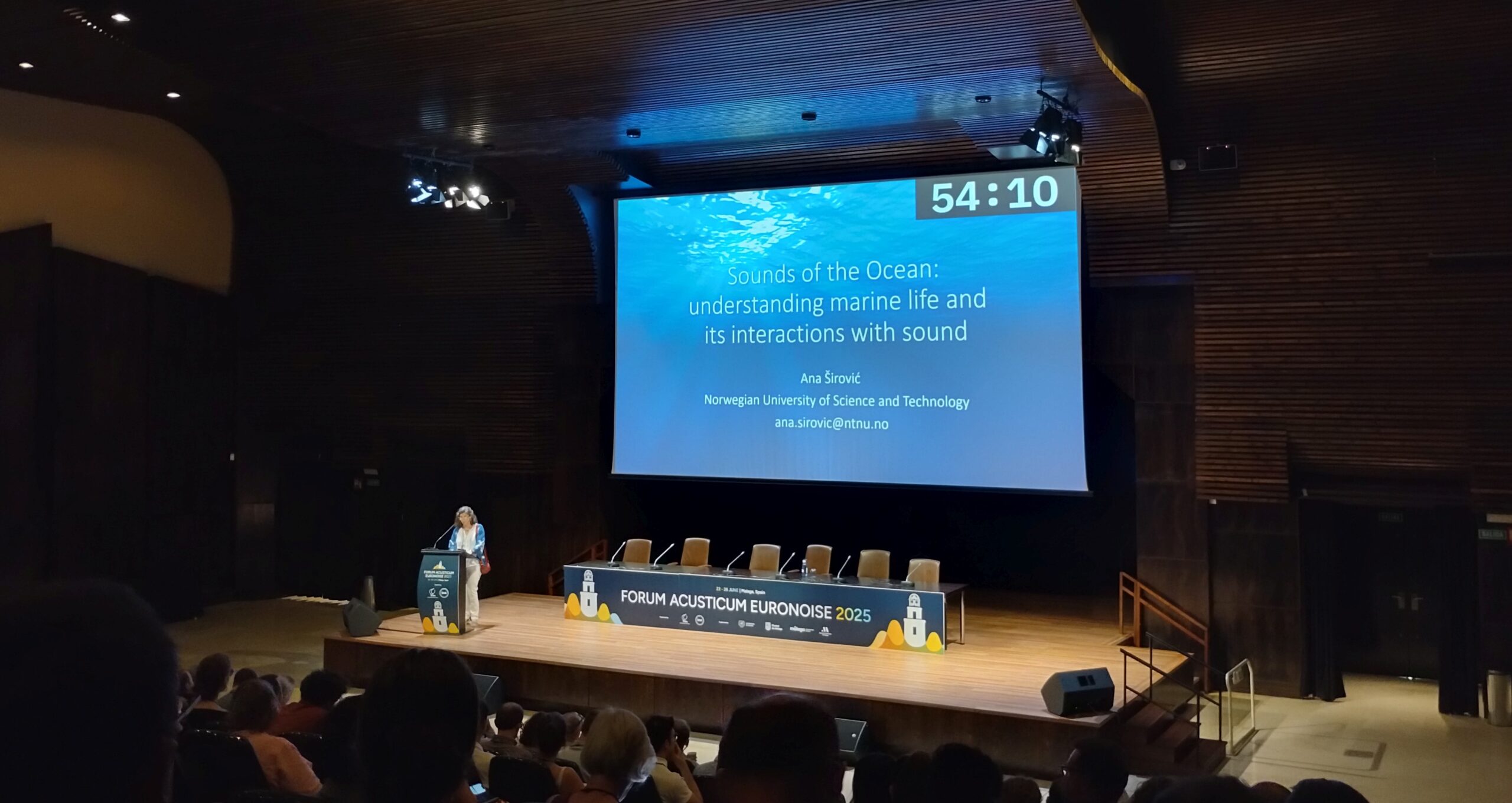
- Opening on Monday: Plenary lecture on underwater sounds by Ana Sirovic
-

- IHTA alumni group picture

-

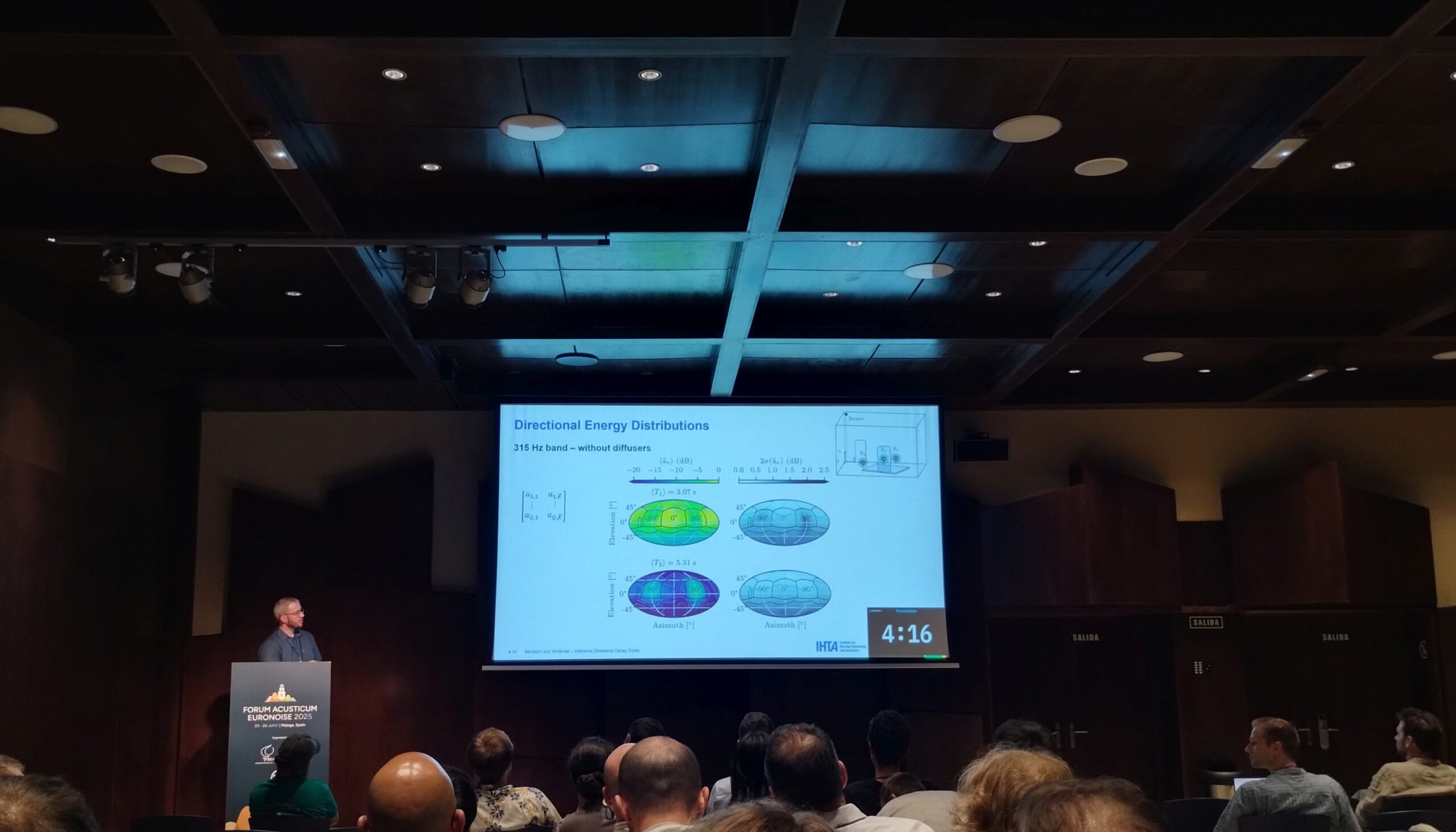
- Marco Berzborn during one of this presentation
Paper published: Activity-based acoustic situations in primary schools
We are happy to share a new publication by Julia Seitz and Janina Fels. Their journal paper „Activity-based acoustic situations in primary schools: Analyzing classroom noise and listening effort“ was published in the Journal of the Acoustical Society of America.
The publication introduces the concept of „activity-based acoustic situations“ in primary schools, shedding light on the everyday sound environment in classrooms.
Key findings include that different classroom activities result in significantly different noise levels, that noise levels decrease as students age—first graders experience higher levels than fourth graders—and that subjective listening effort does not differ significantly between activities. The results highlight the importance of activity-based assessment of classroom noise to create optimal learning environments.
Neues Graduiertenkolleg „MOSAIC“ zum Thema „Akustisches Wohlbefinden“ bewilligt
Die HEAD-Genuit-Stiftung unterstützt die Gründung des neuen Graduiertenkollegs „Akustisches Wohlbefinden im multi-domänen und kontextabhängigen Raumansatz (MOSAIC)“ an der RWTH Aachen. Das Graduiertenkolleg wurde durch den Profilbereich Built and Lived Environment (BLE) initiiert. Koordiniert von der RWTH, sind auch die Uniklinik RWTH Aachen sowie die TU Berlin beteiligt.
Die wissenschaftliche Leitung übernehmen Professor Marcel Schweiker vom RWTH-Lehrstuhl für Healthy Living Spaces und Professorin Janina Fels vom Lehrstuhl für Hörtechnik und Akustik der RWTH.
Das Graduiertenkolleg MOSAIC widmet sich der Erforschung des akustischen Wohlbefindens in unterschiedlichen Innen- und Außenräumen sowie bei verschiedenen Aktivitäten wie Lernen, Arbeiten und Erholen. Ein besonderes Augenmerk liegt auf der neuen Forschungsrichtung „Soundscape“, die Umgebungsfaktoren und ihren Einfluss auf die Hörempfindung untersucht.
Die interdisziplinäre Forschungsgruppe berücksichtigt dabei zahlreiche Faktoren, die das akustische Erleben beeinflussen. Dazu gehören Wechselwirkungen mit Temperaturen, Lichtverhältnissen, Luftqualität, sowie der Raumhöhe und -geometrie. Zudem wird erforscht, wie Menschen physiologisch auf verschiedene akustische Umgebungen reagieren. Um diese Fragen zu beantworten, setzt das Kolleg neben Laborexperimenten auch auf Feldstudien, Interviews und Umfragen.
Am Graduiertenkolleg sind insgesamt acht Lehrstühle beteiligt, davon sieben Lehrstühle der RWTH Aachen und des UKA und einer der TU Berlin. Zu den beteiligten Lehrstühlen gehören:
Sprecher und stellvertretende Sprecherin:
- Univ.-Prof. Dr. Marcel Schweiker, Healthy Living Spaces (HLS)
- Univ.-Prof. Dr.-Ing. Janina Fels, Hörtechnik und Akustik (IHTA)
Beteiligte Wissenschaftlerinnen und Wissenschaftler:
- Dr. André Fiebig, Technische Akustik, Psychoakustik (TUB)
- Univ.-Prof. Dr.-Ing. Christoph van Treeck, Energieeffizientes Bauen (E3D)
- Univ.-Prof. Dr.-Ing. Dirk Müller, Gebäude- und Raumklimatechnik (EBC)
- Univ.-Prof. Dr. med. Thomas Kraus, Arbeits-, Sozial- und Umweltmedizin (IASU)
- Univ.-Prof. Dipl.-Ing. Christa Reicher, Städtebau (SB)
- Univ.-Prof. Dipl.-Ing. Florian Fischer-Almannai, Wohnbau (WB)
Das Teilprojekt am IHTA beschäftigt sich mit der „Evaluierung der Einsatzmöglichkeiten der akustischen virtuellen Realität für Studien zum akustischen Wohlbefinden unter Einbeziehung von Komponenten des Indoor Environmental Quality (IEQ)“
Das Teilprojekt am Institut für Hörtechnik und Akustik adressiert bedeutende Forschungslücken im Bereich akustisches Wohlbefinden und IEQ. Bisherige Studien betrachten oft isolierte Komponenten wie Akustik oder Luftqualität, statt einer ganzheitlichen Analyse aller vier Hauptkomponenten. Es fehlt an umfassenden Ansätzen zur gleichzeitigen Bewertung in Lern- und Arbeitssituationen sowie an standardisierten Methoden zur Validierung der Auralisierungstechnologien. Das Projekt zielt darauf ab, einen robusten Rahmen für die Analyse des akustischen Wohlbefindens zu schaffen und die Anwendbarkeit der Techniken zu gewährleisten.
Unser Ziel ist es, einen umfassenden Ansatz zu entwickeln, der alle vier Hauptkomponenten der Indoor Environmental Quality (IEQ) – Thermisches Wohlbefinden, Akustik, Luftqualität und Beleuchtung – integriert.
Unser Projekt adressiert folgende Forschungsfragen:
- Welche Methoden zur Untersuchung des akustischen Wohlbefindens sind am effektivsten?
- Wie können realistische Auralisierungen entwickelt und validiert werden um sie anschließend in Wahrnehmungsexperimenten zu nutzen
- Inwiefern unterscheiden sich psychoakustische Bewertungen in realen Umgebungen von kontrollierten Szenarien?
- Welche Wechselwirkungen zwischen den IEQ-Komponenten beeinflussen das akustische Wohlbefinden?
Promotionsprüfung Karin Loh
Am 31.01.2025 hat Karin Loh erfolgreich ihre Promotionsprüfung bestanden.
Karin Loh promovierte über das Thema: „Noise Exposure in Pre- and Primary Schools – Exploring Noise Effects on Young Children„.
Das IHTA gratuliert sehr herzlich!
-

- Promotionskommission: (v.l.n.r) Dirk Heberling,, Janina Fels, Karin Loh, Kerstin Persson Waye, Antonello Monti; Foto: Michael Vorländer

-

- Dr. Loh, Foto: Janina Fels

Paper published: Listening effort in children and adults in classroom noise
We are happy to share the publication of our journal paper „Listening effort in children and adults in classroom noise“ in Scientific Reports as part of the Auditory processing and perception collection!
Julia Seitz, Karin Loh, and Janina Fels conducted a study to investigate listening effort in children aged 6-10 years and young adults using a child-appropriate dual-task paradigm. Realistic classroom scenarios with multi-talker babble noise at different signal-to-noise ratios in anechoic and simulated classroom environments were investigated.
The key findings
• Found differences in listening effort between noise conditions in 8-10-year-olds
• Demonstrated the importance of considering room effects in listening experiments
• Observed correlations between subjective and behavioral measures of listening effort
This research contributes to our understanding of how children process speech in noisy classroom environments and could help to improve learning conditions.
IEA HPT Annex 63 Meeting in Aachen
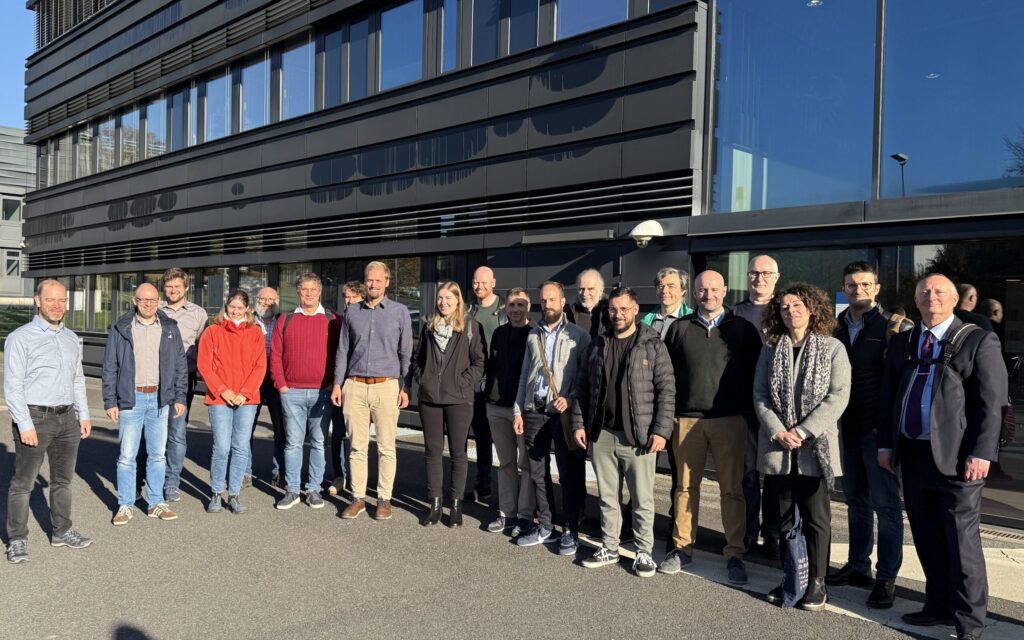
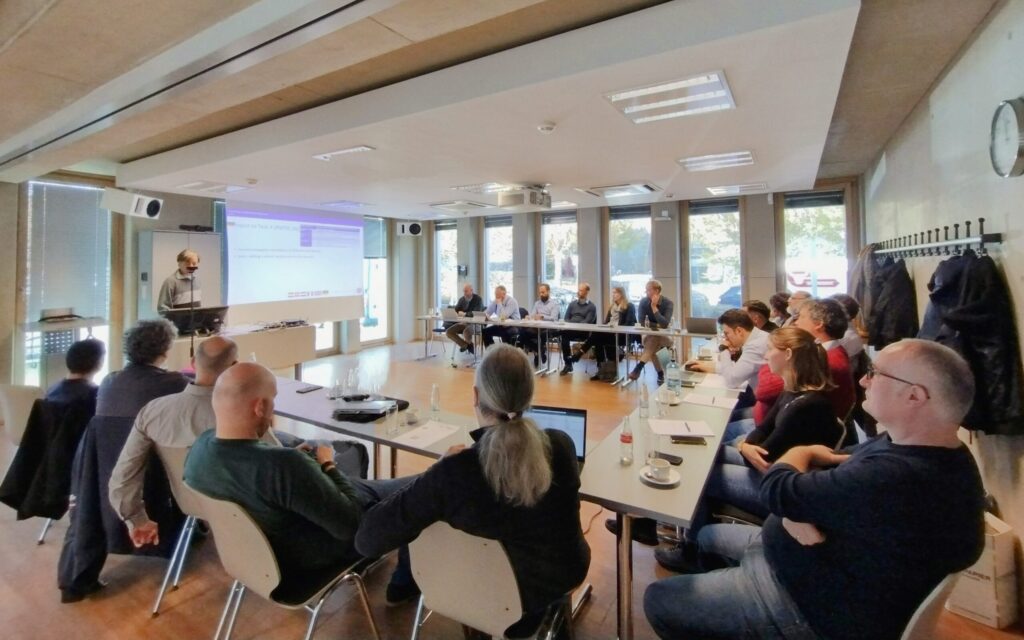
On October 23rd to 24th, 2024, the participants of the IEA HPT Annex 63 project met in Aachen for their first in-person meeting, hosted by RWTH Aachen University and HEAD Acoustics GmbH. Annex 63 is part of the International Energy Agency’s Heat Pumping Technologies initiative, focusing on the Placement Impact on Heat Pump Acoustics. The Annex 63 includes groups for five task areas: Building Acoustics Impact of Heat Pumps, Urban Acoustics Impact of Heat Pumps, Psychoacoustics of Heat Pumps, Digitally Assisted Heat Pump Placement, and Dissemination. During this fourth working meeting, all task groups presented their current status and opened up for discussions.
Our Institute is mainly involved in the third workgroup (Psychoacoustics of Heat Pumps), where the contents are closely linked to our research project LowNoise, in which the acoustic emissions of air-to-water heat pumps are investigated.
Besides the lively exchanges, the project members also got the chance to see the laboratory at HEAD Acoustics GmbH, as well as at the Institute for Energy Efficient Buildings and Indoor Climate and the Institute for Hearing Technology and Acoustics of the RWTH Aachen University. Thanks to everyone involved for their contributions, and a special thanks to Christoph Reichl from the Austrian Institute of Technology for organizing this interesting initiative, aiming to improve the noise impact of environment-friendly technologies such as heat pumps.
-

- Photo: Jonas Klingebiel
-
- Photo: Lukas Aspöck
Inter-Noise 2024 in Nantes
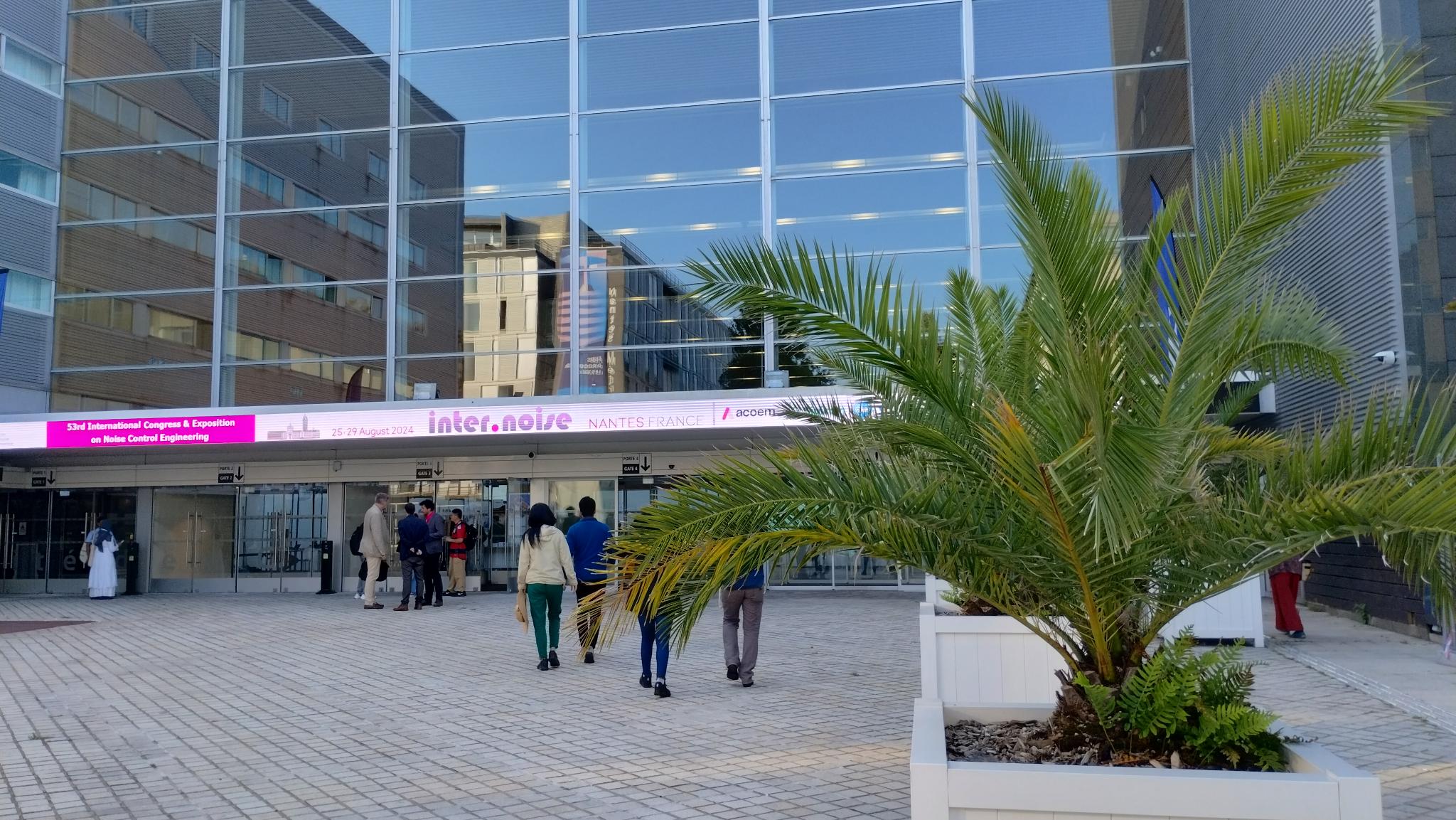
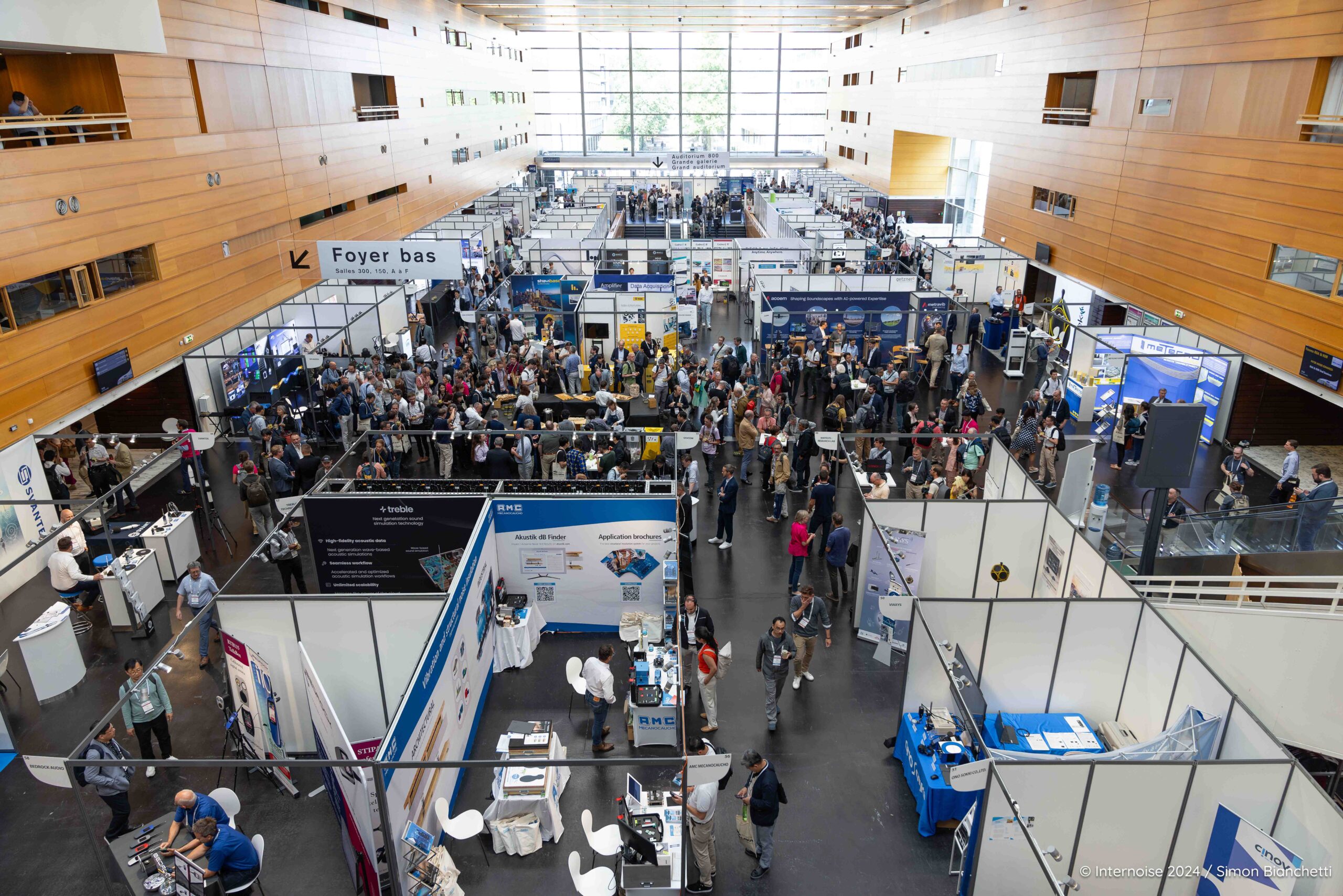
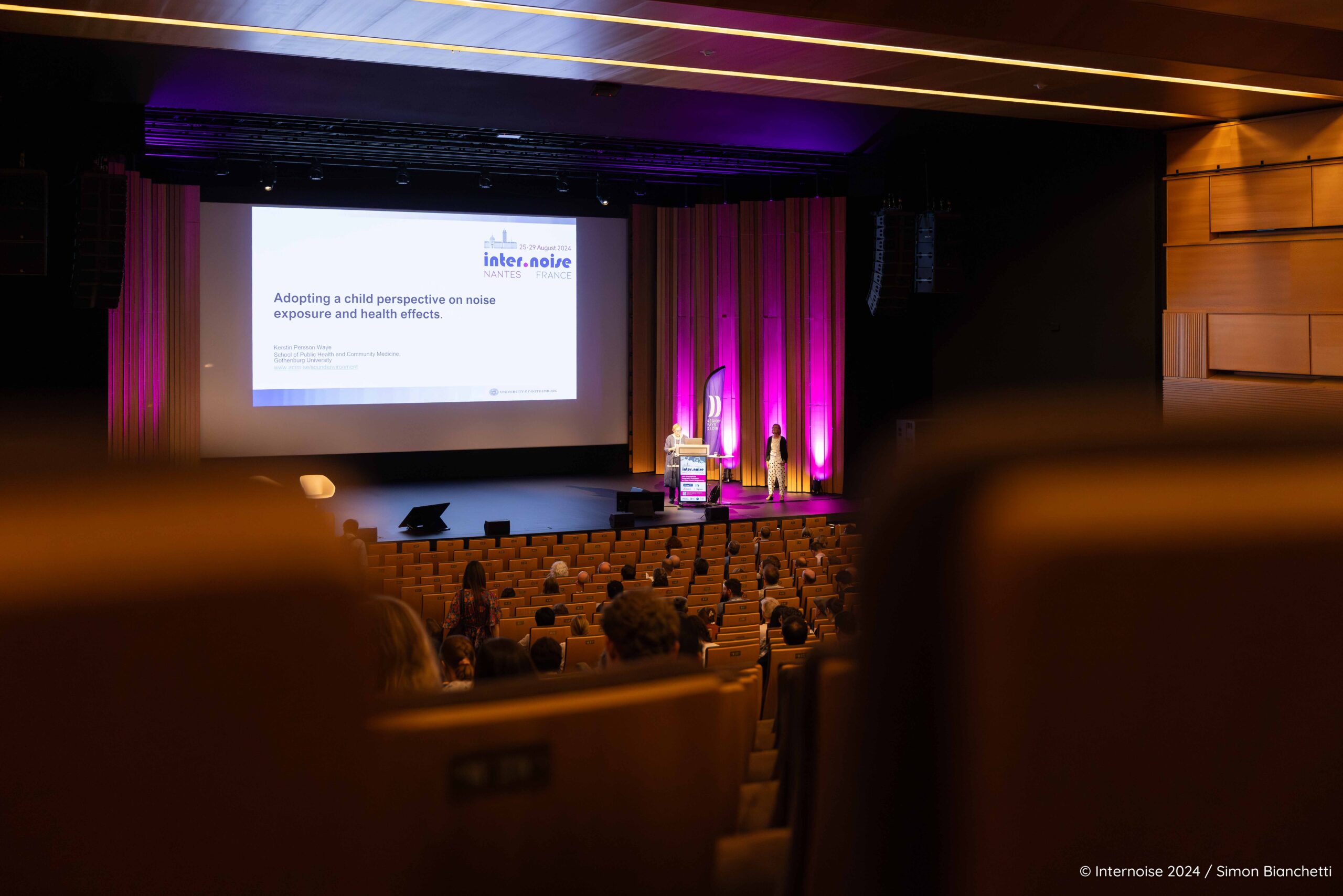
This year’s Inter-noise conference took place from August 25th to 29th in Nantes, France. More than 1500 delegates participated in this conference and presented interesting research in the field of acoustics and noise. Highlights of the conference included a plenary talk by Arnaud Can and Pierre Aumond (Joint Research Unit in Environmental Acoustics at Gustave Eiffel University, Nantes, France) on advanced characterization of urban sound environments and a keynote lecture about the child perspective on noise exposure and health effects, held by Kerstin Persson Waye from Gothenburg University, Sweden, who is also collaborating with IHTA in the Equal-Life project.
Members of IHTA travelled to the conference and presented the following research papers:
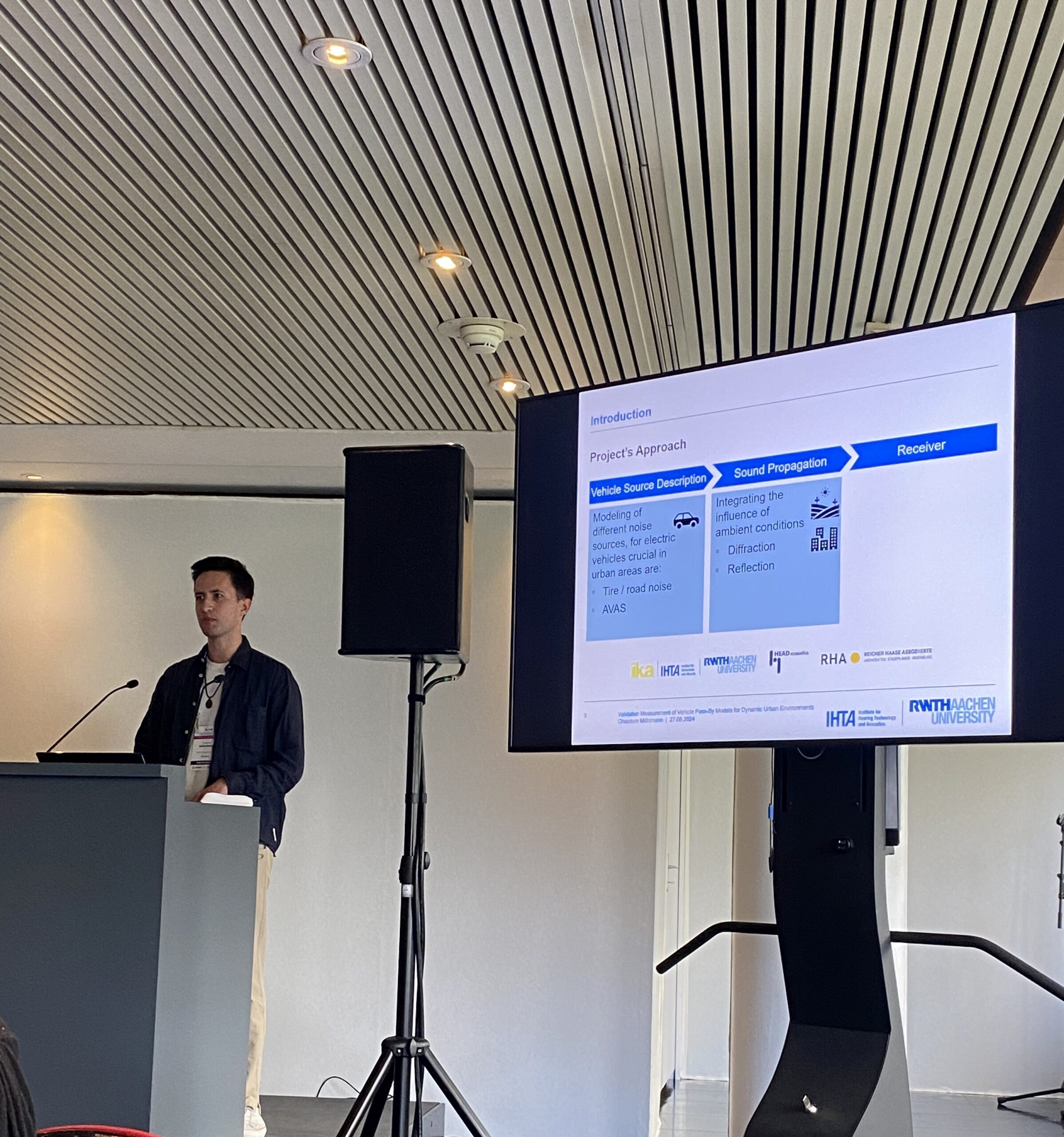
- Chalotorn Möhlmann: Validation measurement of vehicle pass-by models for dynamic urban environments (results of the BaLSaM project)
- Marco Berzborn: Inference of the acoustic properties of transversely isotropic porous materials
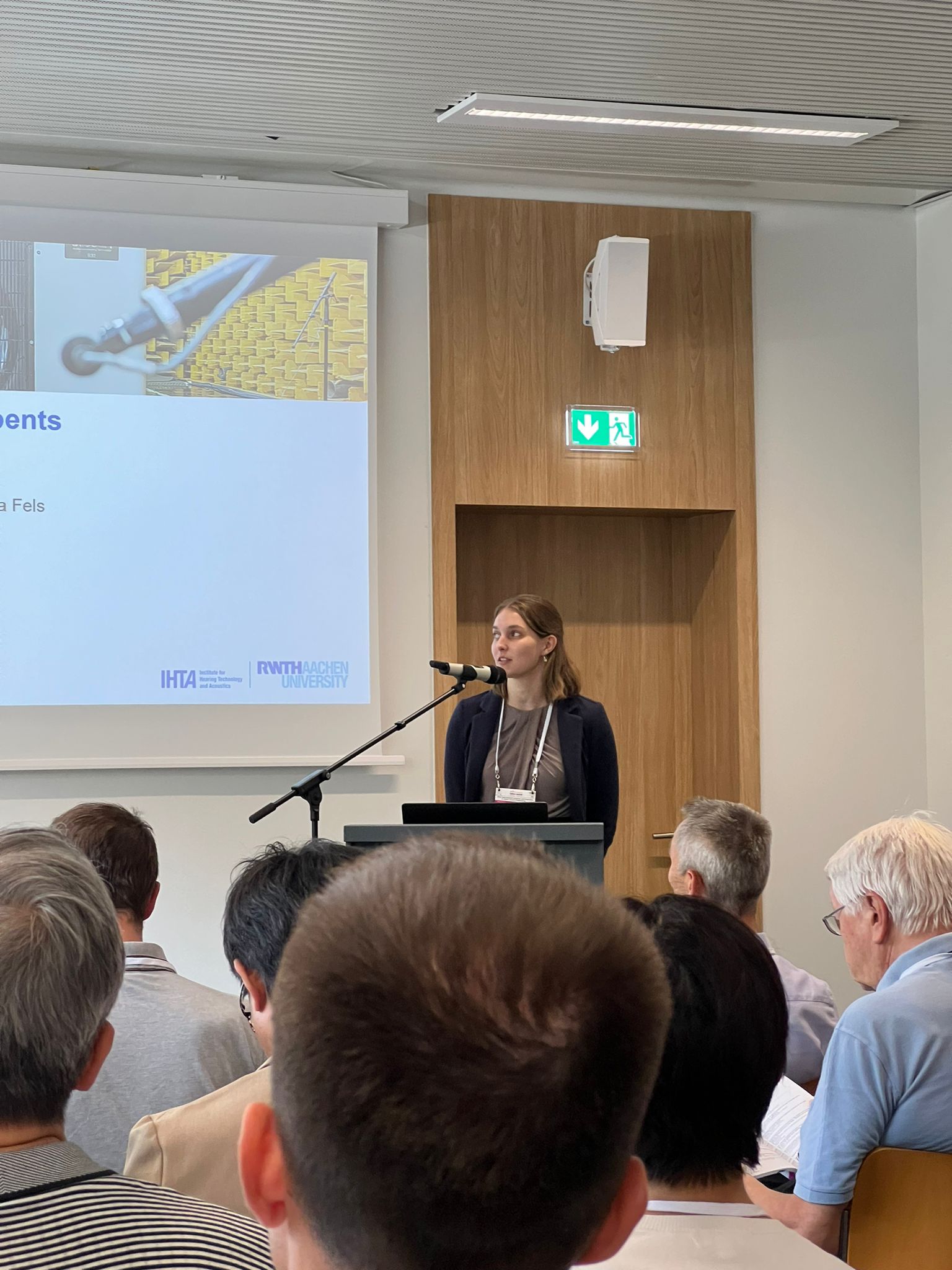
- Lara Stürenburg: Loudness and preference judgments for noises of a heat pump (results of the LowNoise project)
- Joao Fatela (Guest researcher from the University of Campania Luigi Vanvitelli, Naples, Italy):
An experimental setup to investigate relevant validation parameters for the auralization of commercial aircraft flyovers in complex urban contexts
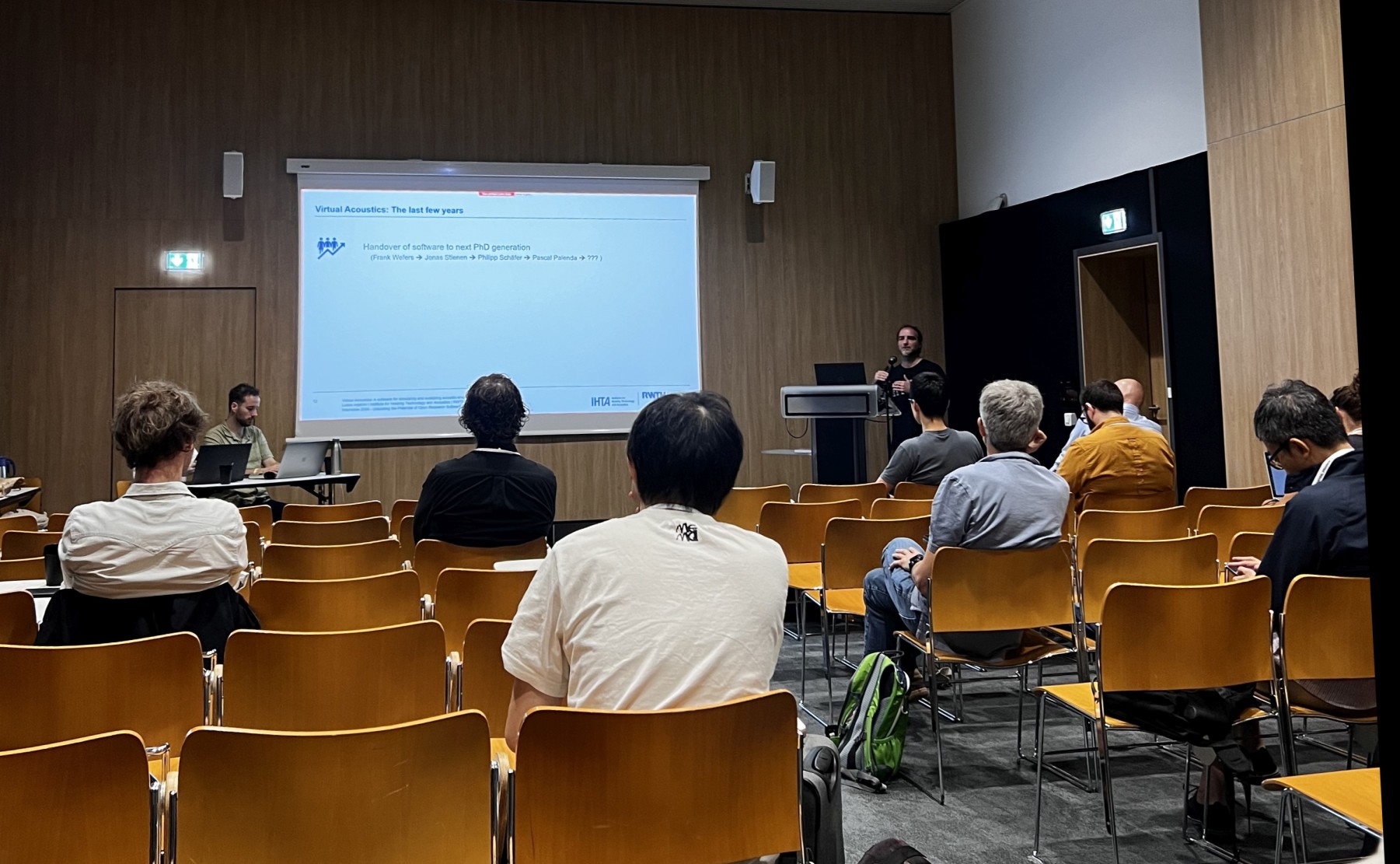
Directly after the closing ceremony of the conference, the satellite workshop “Unlocking the Potential of Open Research Software in Acoustics at Inter-Noise 2024” started. This event was organized by Maarten Hornikx and Huiqing Wang, from the Building Acoustics team of Eindhoven University of Technology, and included interesting exchanges and presentation on the development, maintenance, documentation and distrubtion of acoustics-related open-source software. As one of four invited speakers, Lukas Aspöck held a presentation about IHTA’s auralization software Virtual Acoustics. The slides of this presentation are available for download (CC BY-SA 4.0).
Next to insightful overview presentations by Maarten Hornikx and Huiqing Wang, further successful research software was presented: Pyroomacoustics by Eric Bezzam, NoiseModelling by Pierre Aumond and SoundScapy by Andrew Mitchell, along with many examples of challanges and best practices for open research and open-source software development. Many thanks to Maarten and his team for the invitation and the organization of this exciting event.
-

- Entrance of the InterNoise venue. Photo: Lukas Aspöck
-
- Exhibition area at Internoise. Photo: Simon Bianchetti.
-
- Internoise 2024 Macarons. Photo: Lukas Aspöck

-
- Kerstin Persson Waye at her keynote presentation. Photo: Simon Bianchetti.
-
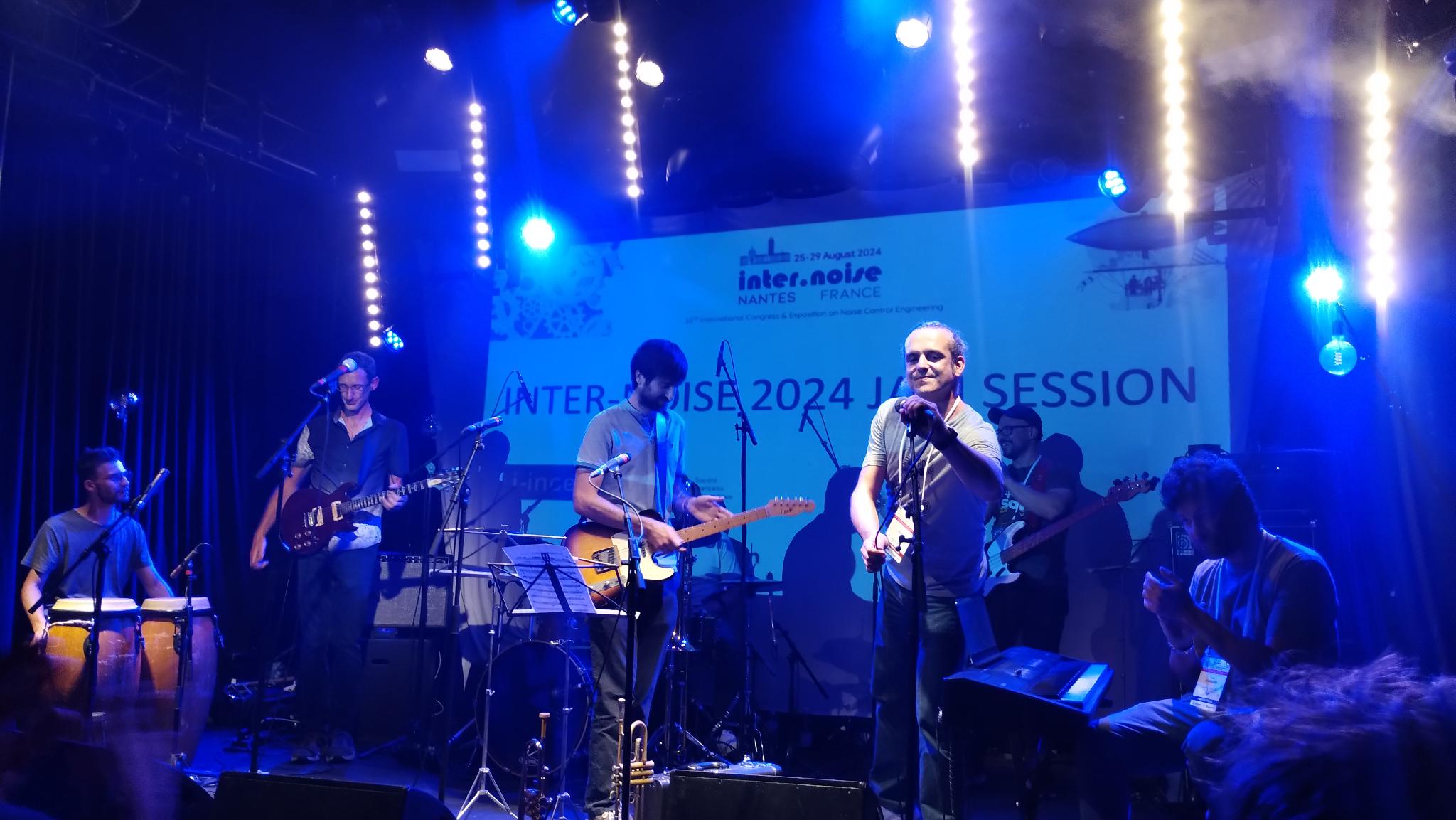
- Jam Session @ InterNoise. Photo: Lukas Aspöck
-
- Lara during her presentation. Photo: Lara Stürenburg.
-
- Chalotorn during his presentation. Photo: Carolin Schliephake.
-
- Lukas during the research software workshop. Photo: Enkela Alimadhi