

Kategorie: ‘United Kingdom’
My Research Internship at the University of Cambridge
- Chemistry M.Sc.
- United Kingdom, Cambridge
- University of Cambridge
- 10/2025 – 03/2026
Before the stay
Before organizing the internship, I asked myself: What do I want to get out of such an experience. From a career/academic point of view, I wanted to improve my English language skills in both everyday life and academic environments, my chemistry skills and learn from other talented people. Nevertheless, I also aimed to experience the student life in another country. With that I was able to narrow it down to the UK, and I applied to several professors at Cambridge whose research matched my field of interest. Fortunately, after a short Zoom meeting about potential research projects, I received an offer for an internship. From that point onward, two main bureaucratic matters had to be handled. The receiving institution required a number of documents and even after submitting those, the review process took quite a long time (2 Months) , and I received my invitation letter only four weeks before the start of the stay. The second aspect was the Erasmus+ process, which, in comparison, required much less time.
Accommodation/Expenses
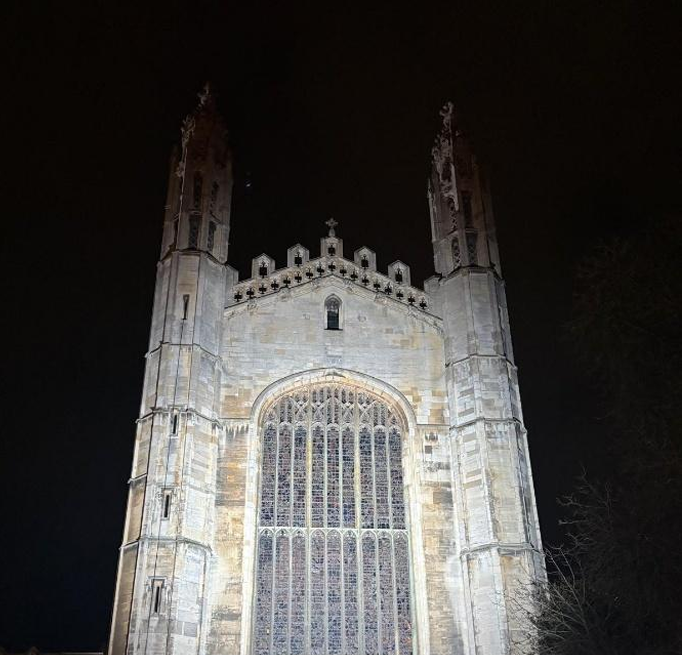
Kings College Chapel at night.
©International Office
Since short-term visiting students in Cambridge are generally not eligible for accommodation in a college dormitory, finding housing required some additional effort. Nevertheless, colleges may offer available rooms to visiting students if vacancies exist. For this reason, I contacted several accommodation officers of colleges located near my department and eventually received an offer. However, the room was relatively far from my department and also much more expensive than other options. In addition, access would have been limited to the accommodation itself, without the wider benefits of college facilities.
I therefore decided to continue searching through the University accommodation website. There, I found a room close to my department that was being sublet by an older couple for around €750 per month. This turned out to be a very fortunate arrangement. The couple was extremely kind and always made sure that I was doing well. They also helped me connect with other communities, which made settling into life in Cambridge much easier.
In Cambridge, the easiest and most convenient means of transportation is usually a second-hand bicycle. For groceries, the cheapest options are generally ALDI and LIDL.
Everyday life
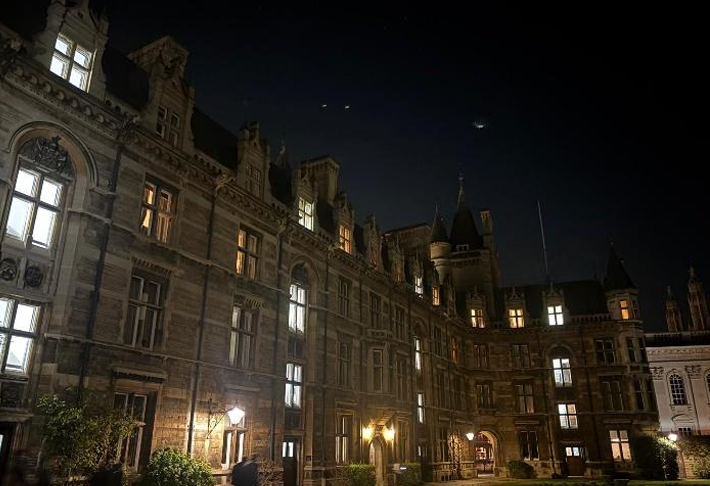
Gonville & Caius College at night.
©International Office
The research group, which mostly consisted of British students, welcomed me warmly and introduced me to everyone from the very beginning. On weekdays, I usually worked in the laboratory from 9:00 a.m. to 5:00 p.m. However, there was a certain degree of flexibility, so I was also allowed to leave earlier or work longer when necessary. My daily laboratory work generally involved the planning, execution, and evaluation of experiments. Whenever support was needed, other group members were always very helpful and provided training or advice. In addition, my supervisor checked in regularly and offered useful suggestions and ideas. Nevertheless, I worked mostly independently, which I appreciated very much. It allowed me to pursue my own ideas and approaches while still having support available whenever needed. In the group meetings, I presented my research results, and challenges or problems were discussed on a regular basis. This not only gave me valuable feedback on my own work but also allowed me to gain insight into other projects within the group. As a result, I was able to further improve both my problem-solving abilities and my communication skills. On special occasions, we went for lunch together, and after work we occasionally met at pubs.
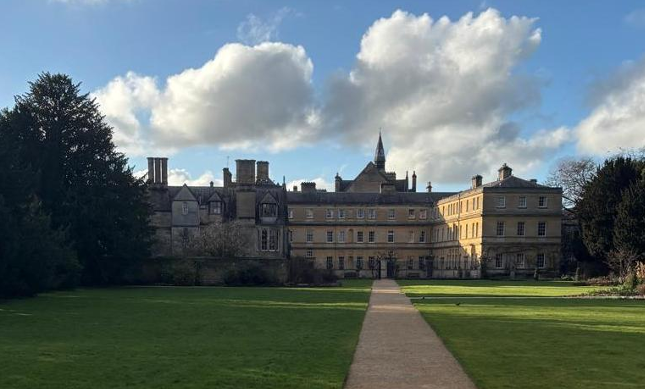
Oxford University.
©International Office
On weekends, I had the opportunity to explore Cambridge and its surroundings. I would strongly recommend visiting the colleges, as they are one of the most distinctive and impressive aspects of the city. Fortunately, my landlord, who was a former student, gave me several tours and was able to share interesting background knowledge. I would also highly recommend attending a “formal”, which is a traditional formal dinner held in a college. To take part in one, it is usually necessary to know someone who can invite you, and formal clothing is required for the occasion.
Besides that, I visited other tourist attractions in Cambridge, such as museums and shops. I also took trips to London and Oxford together with other international students from my department. London is definitely worth visiting because of its many famous and historic landmarks. Oxford, although quite similar to Cambridge in some ways, is also well worth a trip!
Conclusion
Academically, my internship was a very valuable experience. I learned a number of important laboratory techniques and practical skills, but also gained insight into how to manage my own project and develop original ideas independently. In this respect, the stay helped me grow as a laboratory researcher. In addition, I clearly improved my English skills. By working and communicating in English every day, I became much more fluent both in an academic context and in everyday life.
On a personal level, I also benefited greatly from the experience. I made a few friends, primarily within the research group, with whom I hope to stay in contact in the future. Overall, the internship was both academically and personally enriching, and I am very grateful for the opportunity to have spent this time in Cambridge.
My research internship at the University of Cambridge
- Chemistry M.Sc.
- United Kingdom, Cambridge
- University of Cambridge
- 10/2025 – 01/2026
Application/Finding an internship

©International Office
At the beginnings of my master’s studies at RWTH, I heard about invaluable experiences and strong recommendations from several students who had gone abroad for university-related stays. Intrigued by these stories, I wanted to combine academically high-impact research with improving my English language skills. Despite the common stereotype about rainy weather, I selected the UK as my host country. As I always have been impressed by the great history of the Universities of Oxford and Cambridge, I applied to three research groups at these universities by emailing the respective professors. Thereby, it gave me planning reliability to commence with the application process one year in advance to the intended time of the stay abroad. Gratifyingly, after one Zoom meeting with the professor, I was offered a research internship position at the University of Cambridge and was allowed to communicate my preferred research topics. Following the offer, I was confronted with a huge bureaucratic burden. However, helpful assistance and some flexibility regarding English language certificates from the host university simplified the process to some extent.
Accomodation & Living expenses
As far as I understood, living in colleges is rather not amenable to short-term visiting students. Hence, I had to search for private accomodation, some of which was advertised on a website of the university. This lowered the risk of scams, but rents of far more than 1000€ for the advertised accomodations were not affordable. Ultimately, I found a suitable accomodation, including a room, private bathroom, and a convenient distance to the uni, via the website “SpareRoom”. I lived together with my British landlord, which turned out to be a great opportunity for learning more about the (pub) culture and the language.
At the very beginning of my stay I realized that the primary means of transportation in Cambridge is the bicycle. Fortunately, the wide availability of second-hand bikes saved me from spending a fortune on a new one. In my experience, discount stores such as Aldi or Lidl are the most convenient options for grocery shopping at prices comparable to those in Germany.
Everyday life / the internship
During the week, I worked at the chemistry department, usually from 9:30 until 18:00. Without strictly fixed working hours, I could call it a day at my own discretion. After long days at work, I normally limited my activities to cooking or going to a gym near my accomodation.
I greatly enjoyed my work in the chemistry department due to the diverse combination of laboratory and office tasks, as well as frequent meetings. Contrarily to my experience with previous research projects conducted in germany, I worked quite independently on the project assigned to me. Initially, this felt unaccustomed, but over time I became increasingly comfortable planning and conducting experiments based on my own ideas. Furthermore, I could always consult my supervisor, and the group members were very supportive, especially in the beginning. Another surprising difference compared to germany, was my strong integration into academic discussions during group meetings. Throughout my stay, I presented my ideas and results every two weeks in a subgroup meeting and twice in the weekly group meeting. This helped me improving my english abilities and my academic communication skills in general.

©International Office
The research group consisted of many interesting personalities from different countries, rendering the group highly international. Since several new members joined the group around the same time as I did, we often shared similar questions and challenges. With the great assistance from experienced members, a group dynamic developed, leading to several evenings spent in pubs, visits to the Christmas market, as well as a trip to London. As a result, the atmosphere in both the laboratory and the office was very pleasant, friendly, and, especially, funny.
Free time / tips
Free time was mostly constrained to the weekends, during which I explored the centre of Cambridge and its impressive college buildings together with friends from the working group or visiting friends and family from Germany. In this regard, I strongly recommend booking a punting tour, during which a guide propels a small wooden boat along the River Cam by pushing a long pole against the riverbed while explaining aspects of the colleges’ history. Further adventures I undertook were trips to Oxford and London. The skyscraper scenery combined with historic landmarks such as the Palace of Westminster, the prominent Elizabeth Tower, and the Buckingham Palace, made the trip to London more than worthwhile. As a tip, the view from Sky Garden – London’s highest public garden at a height of 160 meters – is breathtaking, and, even better, access to the skyscraper is free of charge! Also, visiting the Tower Bridge by entering the towers and the former engine room was a highlight.

©International Office
Conclusion
All in all, it was an invaluable experience and great opportunity to foster both my academic and personal development. From an academic view, I worked independently on a research project, presented my ideas and experimental results in several meetings, and improved my english language abilities as aimed for. Personally, I made new friends from all over the world, experienced the beauty of Cambridge and London, and broadened my horizons by getting in touch with diverse cultures. I am very grateful for the support provided by Erasmus, enabling an adventure I will never forget.
Writing my Master’s Thesis at the UCL
- Environmental Engineering M.Sc.
- United Kingdom, London
- University College London
- 09/2024 – 03/2025
Application
In January 2024, I applied to AVT (Aachener Verfahrenstechnik) at RWTH for an external master’s thesis at University College London (UCL). The AVT offers not only Erasmus places for process engineering students, but also external master’s theses at partner universities. I was particularly interested in topics related to fuel cells and water electrolysis, and looking through the partner universities I found out that I could combine research in this field with living in one of my favourite cities in Europe! After my successful application to AVT, I was put in contact with the exchange student coordinator at UCL’s Department of Chemical Engineering to find a topic and a supervisor. From UCL side, I had to apply as an undergraduate exchange student to be part of the official exchange student programme, even though I wouldn’t be taking any courses but would be working full-time in the labs. For this application I had to take an IELTS language test and submit a letter of recommendation, which was provided by the Erasmus team at AVT. After an online interview with one of the Associate Professors of the Electrochemical Innovation Lab (EIL), I decided on a preliminary topic for the thesis. Once these steps were completed, I was able to apply for my Erasmus+ internship grant and my UK visa.
Accomodation & Cost of Living
As much as I love London, finding affordable accommodation can be challenging. UCL offers accommodation in the university’s halls to first year and exchange students. Accommodation in the halls is much more expensive than renting a room in Aachen, but still a good price for London. As I had already lived in London for an exchange semester during my undergraduate degree, I was not eligible for halls accommodation and spent my first two weeks in London looking for private accommodation. Especially in September a lot of people are on the lookout for a room as the university year is just starting. For my search I used Facebook groups and a website called Spareroom. Often rooms can only be rented on a yearly basis and for council tax reasons it is easiest for students to find accommodation in shared flats with other students. As well as finding rooms to rent, you can also use Spareroom to get in touch with other people who are looking for rooms. I went to a few flat viewings with a group of UCL students I had met through Spareroom. We didn’t end up renting together, but we remained friends for the rest of my time in London. The room I rented in the end was a six-month sublet in Camden and cost £950 a month. The area was great to live in (my favourite spot is Regents Canal) and I was spared many hot, stuffy and expensive tube rides as I could take the bus to UCL ☺️
Not only the rent, but the cost of living in general is a lot higher than in Aachen. Public transport is expensive, especially the tube if you use it regularly at peak times. Food in the UCL cantine costs ~£6 per meal (I always meal prepped as most of the students did). Also, there was a Lidl close to UCL where I usually did my shopping as the food is very reasonably priced there. There is an endless amount of things to do in a city like London. While eating out or going to the pubs will cost you a small fortune there are also things that can be done for free, as for example many of the museums. I can recommend the British museum which is just down the road from UCL, making it possible to visit the Rosetta stone during a lunch break.
Master’s Thesis in the EIL Labs
On a day-to-day basis, I arrived at UCL around 9am and started working in the EIL labs. Mostly PhD students and research fellows work in the EIL labs and from the beginning I was part of the team and shared an office with the group. Compared to my previous research experience in AVT, I worked much more independently with different PhD students helping me where my research overlapped with theirs. I had a lot of freedom in where to go with my Master’s thesis, which was a very valuable experience, but also challenging at times. The labs and the work were sometimes a little less structured than I was used to in Aachen. However, everyone there was very helpful, especially in the first few weeks and when I was collecting my equipment, which was very valuable. Even though I was there for a Master’s thesis, I was treated like a PhD student, with bi-weekly meetings with one of the academic leaders of the group. I was not the only international visiting the EIL labs, there were two PhD students on a six-month visit for the same period as my Master’s thesis. Towards the end of my stay, another Masters student joined the EIL group for a research project. Overall, I felt very welcome in the group and even though I was the only one doing a Master’s thesis, it felt very easy to connect and spend time with the others both inside and outside of the labs.
Life at UCL & in London
Needless to say, living in London is amazing! Over the course of my Master’s thesis I always took the weekends oft to enjoy the city. There is so much to do and even though I have spent 6 months doing all the touristy and not so touristy stuff, I still have things on my list. One of my favourite activities in London is to just walk around the streets or drive around in the red double decker busses as there is always something interesting to see.
Something I particularly enjoyed about studying at UCL is the societies. UCL has a very vibrant student community, and everyone can be part of it. When I went to the society fair at the beginning of my stay, I learned that there is a society for every hobby imaginable (ranging from a Taylor Swift Society to the Bubble Tea Society). I decided to join the Dance Society, the Hiking Society and the Photography Society (joining is very easy, you just need to pay ~£10 at the beginning of the semester to become a member). Joining the societies meant my calendar was full of social events from week one, but of course it took a bit longer to actually get to know the people in the societies. The society I enjoyed the most in the end was the Photography Society. How often do you get the chance to meet up with models (students from the modelling society) in a park in the middle of London and do a spring photo shoot as an amateur photographer?
Conclusion
The past six months have been incredibly intense, full of visits from old friends while making new friends. I had a steep learning curve academically through working more independently than I have before but also got the chance to dive into a more creative world through the societies and meet people who study something completely different from me. All of this in the setting of a huge and chaotic, yet also very beautiful city. Even though it took a lot of time to prepare and was an expensive time abroad, I am very glad I spent these six months in London ♡
Internship at Mercedes Formula One Team in the UK
- Business Administration and Engineering: Mechanical Engineering B.Sc.
- United Kingdom, Brackley
- Mercedes-AMG Petronas Formula One Team
- 07/2023 – 07/2024
Application/Finding an internship
The application process for the internship was quite lengthy and kicked off around September 2022 for a start in July 2023. In England, it is very common for students to include a year in industry in their studies, so you will find many available internships across various fields. The duration is usually one year because this is the standard period for university students unless it is a pure summer internship. Ultimately, the internship duration will depend on which internship you apply for and what is offered by the companies you are applying to. If it is a bigger, international company, it is very likely that they will help you a lot with the application process for a visa and put you on a company insurance scheme. This can differ significantly between companies. Following people from that company on LinkedIn can help you if internship positions become available as they are often shared there too.
Accomodation & Living expenses
While grocery prices are in a similar range as German grocery prices, the costs for housing and running costs such as electricity, gas, and water will be significantly higher in the UK. For me, they came out at around £80/month per person in a shared house with two other people, which is very high. Rent was over £500/month per person too, which is around what you can expect in this area and is comparable to what other interns living in or near Brackley had to pay as well. Still, this comes as quite a shock when moving to the English countryside from a German university city. Breakfast, lunch, and dinner were served in the company restaurant, and I usually ate lunch and dinner there for £2.80 per meal. The food was delicious, and the menu changes every week to offer great variety.
As Brackley is a small town, you will have to work through the local letting agencies’ websites, but there is a good network of incoming and leaving interns that provides opportunities to easily take over apartments, which I highly recommend. This also alleviates the pressure to buy furniture as the places either come furnished or you will be able to buy furniture off your predecessors at a low price. To be able to rent an apartment, you will need a valid visa. Many letting agencies will be understanding of these circumstances and offer to wait for your visa approval. After the visa gets confirmed, you can then take the next steps to set up a UK bank account, for which I recommend Revolut. Also, with a registered address, you will be able to apply for an NI (National Insurance) number, which is crucial for the company to pay you a salary.
Everyday life/ the internship
Apart from the amazing work atmosphere and interesting projects that the team entrusted me with, you will work alongside a young team and will join the company with a group of around 40 interns/industrial placements (short IPs). Working on projects together, enjoying lunches and dinners in the Hub (the company restaurant), quickly formed a big group of close friends. You’ll find yourself very quickly going to the local pubs or to parties in Banbury or Oxford together. Out of the 40 IPs, there is always a good mix of internationals with Brits. My year had people from Australia, the US, Canada, Luxembourg, Austria, Germany, the Netherlands, Croatia, Ireland, and England, which made for a very interesting mix of people.
Many other sports clubs give you the opportunity to mingle with locals, as Mercedes has its own cycling club, a football team, and many sports courses. Outside of the company, you will find a tennis club, a rugby club, and a leisure centre with a pool, so there are plenty of activities for you to do in your free time. I would also highly recommend volunteering at the local football club. Every Wednesday around lunchtime, they organize a lunch for the elderly and disabled at the clubhouse, and they are always looking for a helping hand. They have lovely stories to tell, and you will find that many of them can give you great recommendations as they know the area inside out.
Free time/tips
Weekend trips with my newly found friends took me to Liverpool, Bath, Bristol, Cornwall, and on a ski trip to the French Alps, and many smaller adventures. A fantastic weekend activity is trying to complete all the local parkruns, which is a local run event held every Saturday at 9 am over a distance of 5 km. You can put all your running experience to the test by competing in the annual Silverstone Race in May, where you lap the race circuit two times for a race distance of 10 km. Great views along the way and thousands of participating runners make it a great event.
Being located close to Banbury, which has a train station with a direct connection to Birmingham and London, one can hop on a bus to the neighbouring towns and villages to explore those or use them as a transit possibility to explore the country. A day trip or weekend trip to London is always great fun, and I’ve been many times now, as I’ve come to love London for the many different boroughs like Shoreditch, Camden, Kensington, Chelsea, and more. Each of them has a unique vibe, cool cafes, shops, restaurants, and pubs which are worth exploring.
Around Brackley, there are two airfields, both within walking distance. They make for a nice jog around them while small sports planes take off over your head or land on the small runways. For the daring, they even offer tandem parachuting. You can also visit the many golf clubs around and test your swing on the driving range. You only have to pay for balls as they will give you clubs to practice with if you don’t have any.
There are nice cafes all around Brackley as well, my personal favourites being The Old Fire Station in Brackley or the Post Office Café in Evenley. I can also recommend taking the bus to Oxford and visiting museums there, going punting on the canals, or visiting the local colleges.
There is also Stowe School in Buckingham only a few minutes away if you have a bicycle. The Stowe estate has a scenic park with many beautiful temples and arches. It makes for a nice afternoon stroll, especially on nice summer evenings.
Conclusion
All in all, I can only recommend committing to an international internship and immersing oneself in a foreign environment. Even though a full year exceeds the mandatory internship requirements of the RWTH, I can assure everyone it is an amazing experience, and I would do it again without a shadow of a doubt. I’ve greatly benefited from this year in the UK, not only professionally by working my dream job in F1 but also personally by meeting a lot of amazing people.
Research stay at the University of Oxford
- Business Administration and Engineering Mechanical Engineering M.Sc.
- United Kingdom, Oxford
- University of Oxford
- 04/2023 – 06/2023
Application/Finding an internship
During my master’s studies I developed an interest into various mathematical tools to model economic processes. Since I also wanted to take the chance to spend some more time abroad at the end of my studies, I decided to look for interesting chairs and institutes that align with my research interests to conduct my master thesis. Since the topic I was looking for was rather niche, there weren’t that many opportunities available and I quickly stumbled upon a research group at the University of Oxford after simple research on recent publicati
ons in my area of interest. With some background information on the coursework I have done previously and the research questions I was interested in, I reached out the administration of the institute. Luckily, two researchers reached out to me afterwards, stating that they have received my inquiry and would be happy to support the research for my thesis. After that, only some simple formalities had to be done for me to get an access card (“Bod card”) to the Universities’ libraries. I decided to physically stay in Oxford for the duration of one trimester (~2 months) since this didn’t require me to pay any fees to the University. This was a specific characteristic of the program of the receiving institute and does not necessarily hold true for other faculties as far as I know, so that should be kept in mind. The more “official” framework in which research stays in Oxford are processed through is the status of being a “recognised student”, which does require the payment of significant fees.
Accommodation & Living expenses
The University of Oxford consists of various colleges that typically provide for accommodation and food. Since I was a visitor to a specific institute and not a recognised student, it was unclear in the beginning whether I could make use of these services. Therefore, I decided to look for private accommodation. My receiving institute provided me with a short list of some possible opportunities and I decided to stay at the Commonwealth House, a well-located shared house affiliated with a local church at the rate of roughly 750 GBP a month including a simple but totally sufficient breakfast during weekdays in a common room with other tenants. While this seemed very pricey to me initially, this rate is more at the cheaper end in the center of Oxford and is similar to the ones that are paid for for college accommodation. Overall, I was content with the accommodation but for a prolonged period one might be better off with a different place, since the sanitary facilities and the kitchen were often in rather poor condition. As I found out later, often enough colleges do have some limited availability of rooms for non-members. To find out about that, a short email to the responsible person at the college is sufficient.
As mentioned, breakfast was included most of the time at my accommodation. For lunch, one typically went to one of the very beautiful dining halls at the colleges, where a meal was available for between roughly 3.5-5 GBP. Groceries in the supermarket were available for a small premium compared to German prices. Overall, the ERASMUS scholarship made up for any additional expenses compared to my German student life.
Everyday life/ the internship
During my time in Oxford, I was highly flexible regarding my schedule. Typically, I started working at around 9:30 am and left at 17:30. While I had a work desk available at my institute, I often went to one of the beautiful old libraries Oxford has to offer. Since I worked on a rather programming-heavy task which didn’t require any other infrastructure than my laptop I was very flexible on where to work. Once a week, I met with my supervisors to discuss my progress and any open questions. Apart from the thesis-related tasks, I was able to join the seminars at my group, which included visits from various academics or presentations from group members regarding their current research.
Free time/tips
The possibility of activities outside of studying are almost overwhelming during term time. For once, there is probably a student society for any kind of interest. Let it be the Wine Society with frequent wine tastings, the Diplomatic Society with visits from international diplomats or the German Society with Germany-related pub quizzes, there are plenty of things to do. Furthermore, one should look out for associate memberships at one of the
colleges if one is not affiliated with any of them as a regular or recognised student. The colleges offer further social activities, that are split between undergrads in the Junior Common Room (JCR) and grad students in the Middle Common Room (MCR). To find out about possibilities to join them as an associate member, one should look for the respective constitution by just googling a specific college + “MCR” [or JCR, depending on where you are in your studies] + “constitution”. Luckily, I had the chance to join New College as an associate member and therefore gained access to their activities as well, with the most noteworthy being the chance to attend their formal dinners. While these came at a cost of roughly 25 GBP, they provided a three-course meal of very high quality and the chance to mingle with other people and bring friends from other colleges. Typically, a suit or cocktail dress was obligatory for these dinners. Also, the colleges often have their own sports grounds where one can play tennis, squash or even rent a boat to go punting. The latter is something that is definitely to be done when in Oxford. The many canals and rivers provide a very scenic view on the city and the nature surrounding it. Furthermore, the University itself has a vast array of interesting talks and speeches by renowned academics which opens up further opportunities to spend free time on.
If one finds time for other things to do, Oxford also offers many nice museums, medieval colleges and pubs (my favorite being The Old Bookbinders) to explore during the day or in the evening. Also, the surroundings are worthwhile a visit. London is only a 1.5-hour bus ride away as well. I personally found it hard to find time for activities outside of Oxford during my limited time there, since the city itself has so much to offer.
Conclusion
Overall, I can highly recommend an academic stay in Oxford. Not only does the renowned university attract interesting and diverse people from all over the world, but the city also has a unique charm with its medieval colleges and libraries, creating an unparalleled atmosphere.
