
Kategorie: ‘Research’
IHTA Contributions to DAGA 2026
This year’s DAGA 2026 is the 52. annual meeting of the German Acoustical Society (DEGA). The conference takes place in Dresden from 23th to 26th of March, 2026. As usual, IHTA members will present their lovely work on the variety of research topics covered at IHTA. This year, the IHTA is involved in a total of 22 contributions. In addition, the IHTA has been very active in organizing special sessions and events (see below).
We are happy to invite you to our presentations and posters!
You can find the full conference program in the DAGA-Web-App Every contribution in the table below links to its entry in the web-app, where you can read its abstract and add it to your personal conference schedule.
We are looking forward to meet you there!
| Monday, March 13 | ||||
| Janina Fels | Audiovisuelle Interaktion in Virtueller Realität: Realitätsnahe Hörforschung im Labor | Vorkolloquium: Multimodale Interaktion und Virtuelle Realität | 13:10 | Konferenz 6 |
| Tuesday, March 24 | ||||
| Chalotorn Möhlmann, Janina Fels | Evaluation of Urban Vehicle Pass-By Noise Measurements and Auralizations Using Psychoacoustic Metrics | Fahrzeugakustik (Poster) | 15:20 | Poster-Forum |
| Maximilian Will, Karin Loh, Lukas Aspöck, Janina Fels, Anselm Goertz | Perception of phase distortion caused by Linkwitz-Riley crossover filters in a 3-way loudspeaker system | Elektroakustik und Audiosignalverarbeitung 2 | 16:40 | Saal 5 |
| Wednesday, March 25 | ||||
| Isabel S. Schiller, Karin Loh, Janina Fels, Sabine J. Schlittmeier | Effects of Background Noise and Visual Talker Cues on Memory for Content and Source in Heard Conversations | Auditory Cognition in Interactive Virtual Environments 1 | 08:40 | Konferenz 4 |
| Omar Fahmi Jubran, Maria Klatte, Carolin Breuer, Larissa Leist, Thomas Lachmann, Alexander Raake, Janina Fels | Effects of Monaural and Binaural Classroom Noise Scenarios on Speech Perception and Listening Comprehension in Native Speakers and L2 Learners | Auditory Cognition in Interactive Virtual Environments 1 | 09:00 | Konferenz 4 |
| Anne Heimes, Michael Vorländer | Angle Dependent Absorption Coefficients from Free-Field Measurement | Raumakustik 1 | 09:20 | Saal 1 |
| Gülnihan Atay, Josep llorca-Bofi, Michael Vorländer | Perception of Loudness Based on Source-Receiver Distance | Virtuelle Akustik 2 | 09:40 | Saal 2 |
| Carolin Breuer, Matthias Tillmann, Larissa Leist, Stephan Fremerey, Alexander Raake, Maria Klatte, Janina Fels | Exploring the Impact of Audiovisual Noise on Auditory Selective Attention | Auditory Cognition in Interactive Virtual Environments 1 | 11:00 | Konferenz 4 |
| Ann-Christin Schlupek, Franck Sgard, Kevin Carillo, Olivier Doutres, Janina Fels, Simon Kersten | From Ear Canal to Perception: Numerical Simulation of the Occlusion Effect for Hearing Technologies | Audiologische & Physiologische Akustik | 11:00 | Konferenz 6 |
| Jithin Thilakan, Lukas Aspöck, Janina Fels | Acoustic impact of UAS swarms: Auralization and objective evaluation | Akustik von Drohnen 1 | 11:20 | Seminar room 3-4 |
| Florian Denk, Sven Redlin, Aks Arora, Janina Fels, Christin Grill, Ralf Brinkmann, Hendrik Husstedt, Simon Kersten | Optical stimulation of the human eardrum for hearing devices – towards finite-element models for parameter optimization | Audiologische & Physiologische Akustik | 11:20 | Konferenz 6 |
| Aron Schliep, Konstantin Fontaine, Amneh Hamida, Alena Wagner, André Fiebig, Marcel Schweiker, Janina Fels | A survey instrument for measuring the affective component of acoustic well-being as part of the MOSAIC research training group | Soundscape 1 – Theorie und Praxis | 14:20 | Konferenz 6 |
| Hark S. Braren, Janina Fels | Localization Accuracy of Children using different HRTFs | Virtuelle Akustik & Binauraltechnik (Poster) | 15:20 | Terrassenebene (Posterinsel G) |
| Rouben Rehman, Aron Schliep, Simon Kersten, Janina Fels | Extending the Least-Squares-Based Transparency Equalization Method to Simulate Occlusion in Perception Experiments | Audiologische, physiologische & medizinische Akustik (Poster) | 15:20 | Konferenzebene (Posterinsel B) |
| Pascal Palenda, Michael Vorländer | Dynamic Auralizations Considering Diffraction | Virtuelle Akustik 3 | 16:00 | Saal 2 |
| Thursday, March 26 | ||||
| Lara Stürenburg, Abdurrahman Alakus, Janina Fels | Influence of an Image on Annoyance Ratings of Heat Pump Noise | Psychoakustik 2 | 08:40 | Saal 2 |
| Jana R. Berger, Julia Seitz, Janina Fels | Einfluss unterschiedlicher Unterrichtsformen auf Sprachverstehen und verhaltensbezogene Höranstrengung bei Kindern | Höranstrengung in alltäglichen Situationen | 08:40 | Konferenz 4 |
| Julia Seitz, Jana R. Berger, Janina Fels | Einfluss unterschiedlicher Unterrichtsformen auf subjektive und physiologische Höranstrengung bei Kindern | Höranstrengung in alltäglichen Situationen | 09:00 | Konferenz 4 |
| Anastasia Sinarso, Julia Seitz, Janina Fels | Unequal Burdens: Socioeconomic Background and Listening Effort in Noisy Classrooms | Höranstrengung in alltäglichen Situationen | 09:20 | Konferenz 4 |
| Cosima A. Ermert, Janina Fels | Listening Effort in Virtual Reality: The Role of Background Speech, Room Acoustics, and Talker Visualization | Höranstrengung in alltäglichen Situationen | 10:20 | Konferenz 4 |
| Jonas Heck, Michael Vorländer | Revisiting Ground Impedance Measurements for Predicting Outdoor Sound Propagation | Technische Akustik | 10:40 | Konferenz 2 |
| Thomas Deutsch, Luigi Falanga, Iring Koch, Janina Fels | Investigating Auditory Selective Attention Across Audio Reproduction Methods and Age Groups: Experimental Dissociation of Hearing Thresholds and Attention | Psychoakustik (Poster) | 11:00 | Posterinsel A |
| Organized Sessions | ||||
| Höranstrengung in alltäglichen Kommunikationssituationen 1 | Julia Seitz und Jan Rennies-Hochmuth | Thursday, 26.03.2026 | 08:40-11:00 | Konferenz 4 |
| Höranstrengung in alltäglichen Kommunikationssituationen 2 | Thursday, 26.03.2026 | 14:00-15:20 | ||
| Auditory Cognition in Interactive Virtual Environments 1 | Janina Fels and Carolin Breuer | Wednesday, 25.03.2026 |
08:40-11:40 | Konferenz 4 |
| Auditory Cognition in Interactive Virtual Environments 2 | Wednesday, 25.03.2026 |
14:00-15:20 | ||
| Junge DEGA Events | ||||
| Icebreaker | junge DEGA Jonas Heck and Lara Stürenburg |
Monday, 23.03.2026 | 15:30-17:00 | Foyer vor Saal 5 |
| Kneipenabend | Monday, 23.03.2026 | 19:00-23:00 | BBC – Bar Brasserie Cassis, Alaunstraße 16, 01099 Dresden | |
| Speed Dating — Meet the Acousticians | Thursday, 24.03.2026 | 16:40-18:00 | Restaurant (neben Saal 5) | |
| Research in short(s) & Power-Point-Karaoke | Wednesday, 25.03.2026 | 13:40-15:20 | Großer Saal | |
| Mentoring-Café | Wednesday, 25.03.2026 | 16:00-16:40 | Seminar 1-2 | |
| Other Events | ||||
| Hands-On Workshop: PYFAR – Python Packages for Acoustics Research | IHTA RWTH Aachen University, TU Berlin, TH Köln | Thursday, 26.03.2026 | 13:00-14:00 | Seminar 3-4 |
Paper published: Heard-text recall and listening effort under irrelevant speech and pseudo-speech in virtual reality
We are happy to announce that our paper „Heard-text recall and listening effort under irrelevant speech and pseudo-speech in virtual reality“ was published this week.
The paper by Cosima A. Ermert, , , and
Using the Heard-Text-Recall (HTR) paradigm in a dual-task design, this paper evaluates the relevance of semantic meaningful background speech compared to pseudo speech in virtual reality (VR). The results highlight the relevance of semantic content both for memory of spoken content and behavioural listening effort.
Read the paper at Acta Acustica.
Einladung zur Abschlussveranstaltung des BaLSaM-Projekts am 21.1.2026
Das Projekt “Braunkohlereviere als attraktive Lebensräume durch Straßengeräuschsimulation auf Basis bestehender Verkehrsdaten zur Minimierung von Lärm” (BaLSaM) lädt Interessierte zur öffentlichen Abschlussveranstaltung ein. Sie wird am 21.1.2026 von 8:30-11:30 Uhr im Institut für Hörtechnik und Akustik (IHTA) der RWTH Aachen University stattfinden (Adresse: Kopernikusstraße 5, 52074 Aachen, Deutschland).
Im Rahmen des BaLSaM-Projekts wurde die Modellierung der Schallausbreitung von Verkehrslärm in urbanen Umgebungen sowie deren Auswirkung auf die menschliche Wahrnehmung untersucht. Das BaLSAM-Konsortium setzt sich zusammen aus dem Institut für Kraftfahrzeuge (IKA) und dem Institut für Hörtechnik und Akustik (IHTA) der RWTH Aachen University sowie RHA REICHER HAASE ASSOZIIERTE GmbH und HEAD acoustics GmbH. Gefördert wird das Projekt von dem Bundesministerium für Verkehr im Rahmen der mFUND-Initiative.
Während der Abschlussveranstaltung werden die Projektpartner die Ergebnisse des Projekts zu präsentieren. Darüber hinaus wird das Event die Gelegenheit bieten, Erfahrungen auszutauschen und gemeinsam über zukünftige Fragestellungen zu diskutieren. Neben der Teilnahme vor Ort ist auch eine digitale Teilnahme an der Veranstaltung möglich.
Agenda:
| 08:30 | Anreise |
| 09:00 | Begrüßung |
| 09:15 | Vorstellung des Projektes |
| 09:30 | Vorstellung der Ergebnisse aus den Arbeitspaketen |
| 11:00 | Diskussion mit dem Teilnehmerkreis |
| 11:15 | Beginn der Demo & Ausklang des öffentlichen Teils |
| Im Anschluss: Projekt-interner Abschluss (nicht öffentlich) | |
— English version —
The BaLSaM project invites interested parties to the public closing event. It will take place on January 21, 2026, from 8:30 a.m. to 11:30 a.m. at the Institute for Hearing Technology and Acoustics (IHTA) at RWTH Aachen University (address: Kopernikusstraße 5, 52074 Aachen, Germany).
The BaLSaM project investigated the modeling of traffic noise propagation in urban environments and its impact on human perception. The BaLSAM consortium consists of the Institute for Automotive Engineering (IKA) and the Institute for Hearing Technology and Acoustics (IHTA) at RWTH Aachen University, as well as RHA REICHER HAASE ASSOZIIERTE GmbH and HEAD acoustics GmbH. The project is funded by the German Federal Ministry of Transport as part of the mFUND initiative.
During the closing event, the project partners will present the results of the project. In addition, the event will provide the opportunity to exchange experiences and discuss future topics. In addition to attending in person, digital participation in the event is also possible.
—————
Anmeldung / Registration:
https://www.balsam-projekt.de/de/abschlussveranstaltung.html
Digitale Teilnahme per Teams / Online participation via Teams:
Jetzt an der Besprechung teilnehmen
Besprechungs-ID: 317 428 128 635 50
Passcode: zg6pV6Yw
Joint meeting of ASA and ASJ in Honolulu
From December 1st to December 5th, the sixth joint meeting of the Acoustical Society of America (ASA) and the Acoustical Society of Japan took place in Honolulu, Hawaii. This conference included more than 70 special sessions covering various areas of of acoustics research, presented either in lecture or poster format. In addition to Michael Vorländer’s role as the president of the ASA, the Institute was involved in three scientific contributions at this conference:
- Recent Trends and Perspectives on the Use and Characterization of Acoustic Materials (Ana Jaramillo, Daniel Robinson, Arthur van der Harten, Anne Heimes, Michael Vorländer)
- Boundary Admittance Measurement Method (Peter D’Antonio, Michael Vorländer, Markus Müller-Trapet)
- Voice regulation in two-person conversations in simulated acoustic environments (Manuj Yadav, Ella Manor, Densil Cabrera, Janina Fels, Michael Vorländer)
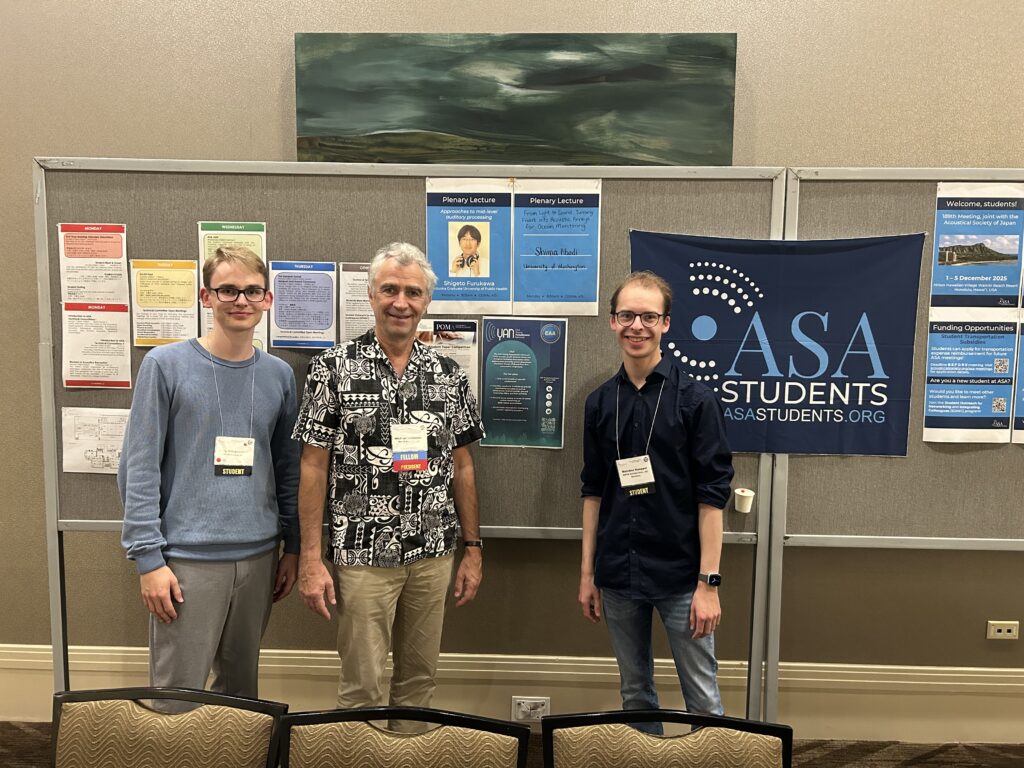
Also, IHTA students Filip Klingelnberg and Melchior Käppel attended their first international conference and represented the Young Acousticians Network (YAN) of the European Acoustics Association.
PAAD: Visual documentation of Berlin Philharmonie
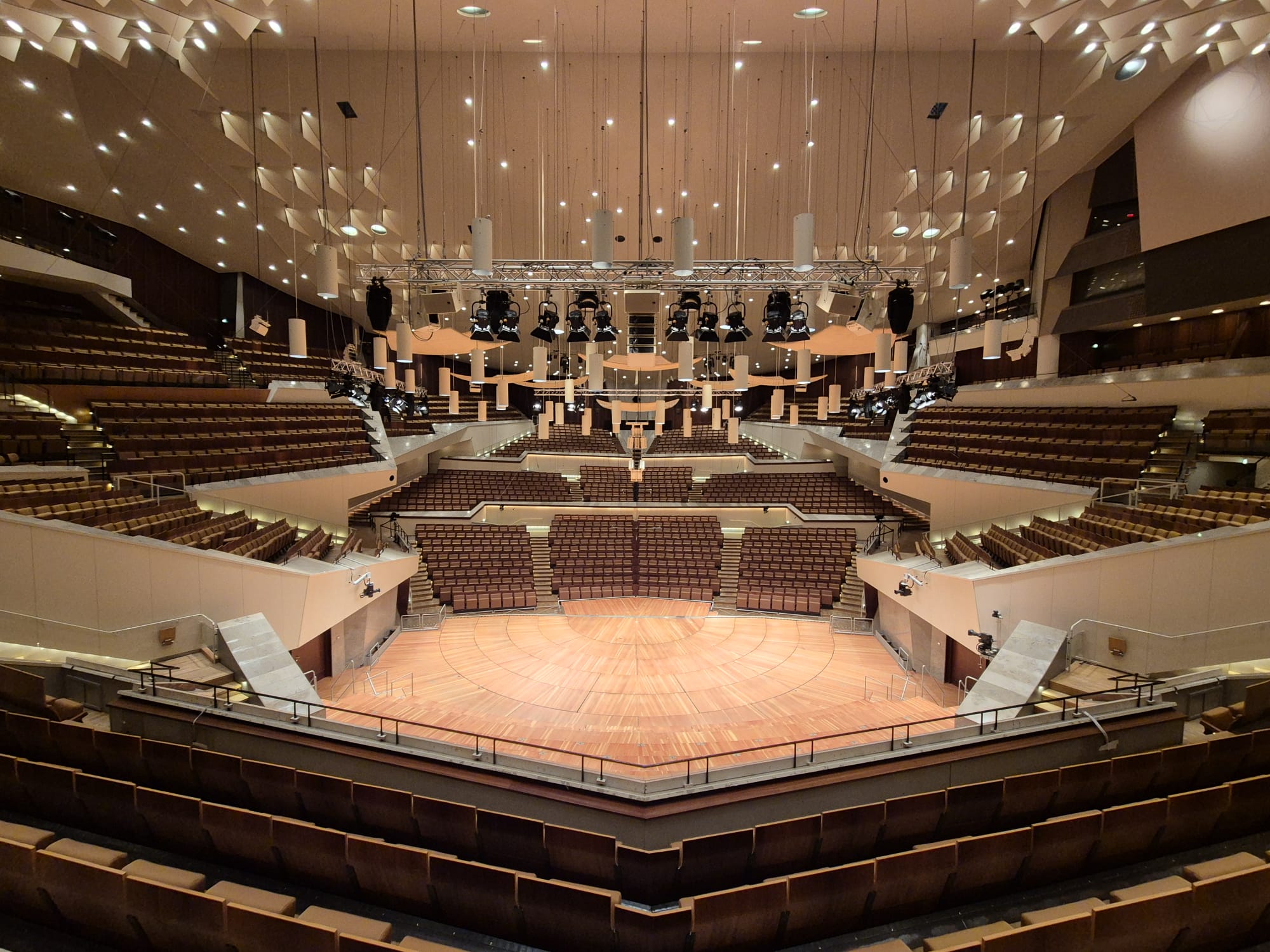
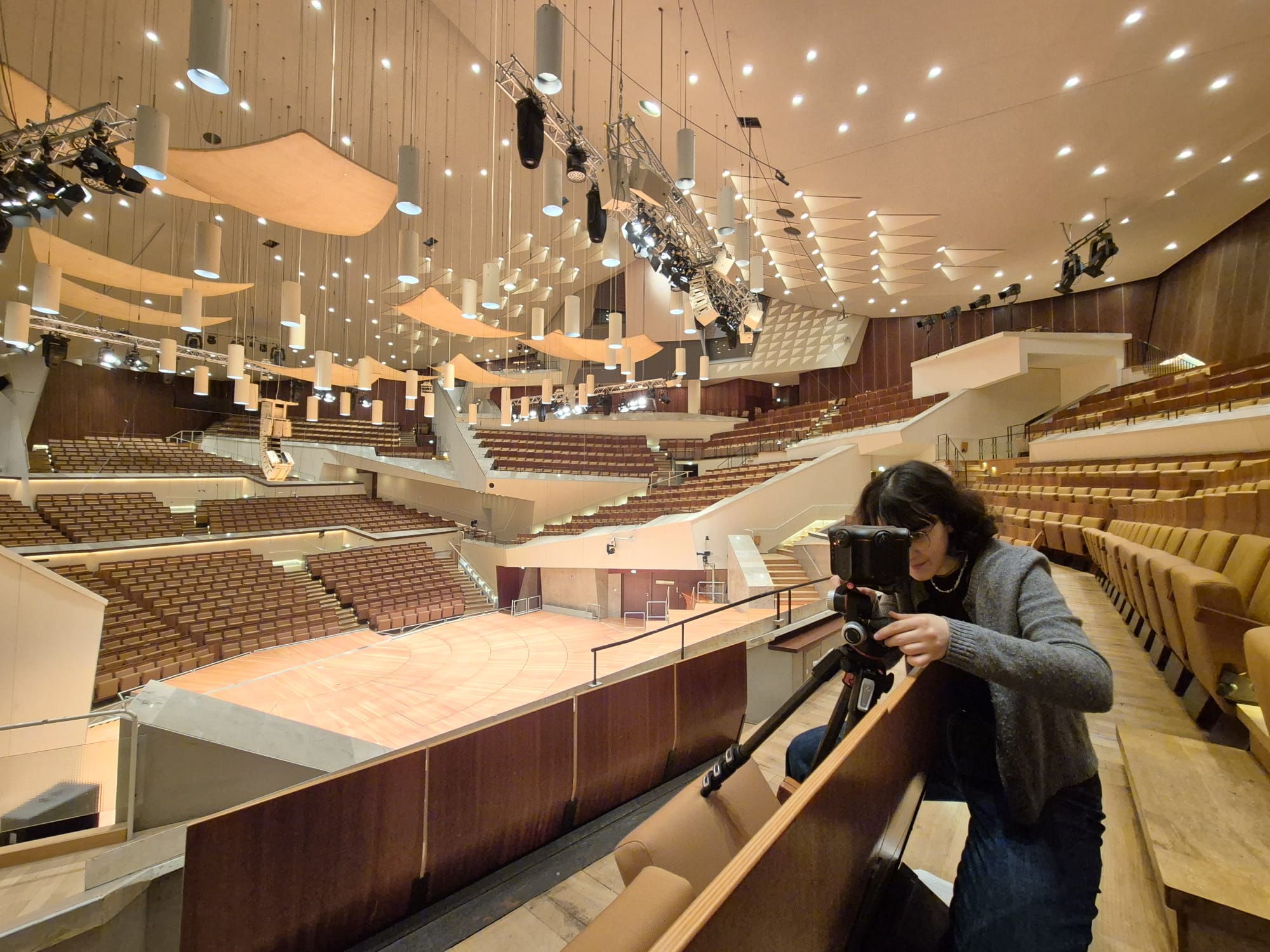
PAAD „Person-focused Acoustics of Architectural Design“ research group has recently visited Berlin Philharmonie to capture 3D data of the auditorium for the MUSKLA Database: a growing collection of narrow angle and spherical photographs of major concert halls in Europe. The goal is to support state of the art multimodal perceptual studies in auditoriums by providing a reference database accessible to the scientific community. In collaboration with our colleagues from Universitat Politècnica de Catalunya and Fraunhofer-Institut für Bauphysik, our team was able to conduct a comprehensive 3D capture of the auditorium.
We documented the auditorium combining imaging techniques to ensure both geometrical accuracy and photorealistic texture:
– 360° panoramic photography to record the spatial impression and visual atmosphere of the hall, located in multiple seating positions from the audience view.
– Narrow angle photo capture to enrich the textures and surface details needed for realistic visualization and to produce accurate photogrammetric model of the hall.
-

- Berlin Philharmonie
-
- Setting up the camera equipment
-

- Project team
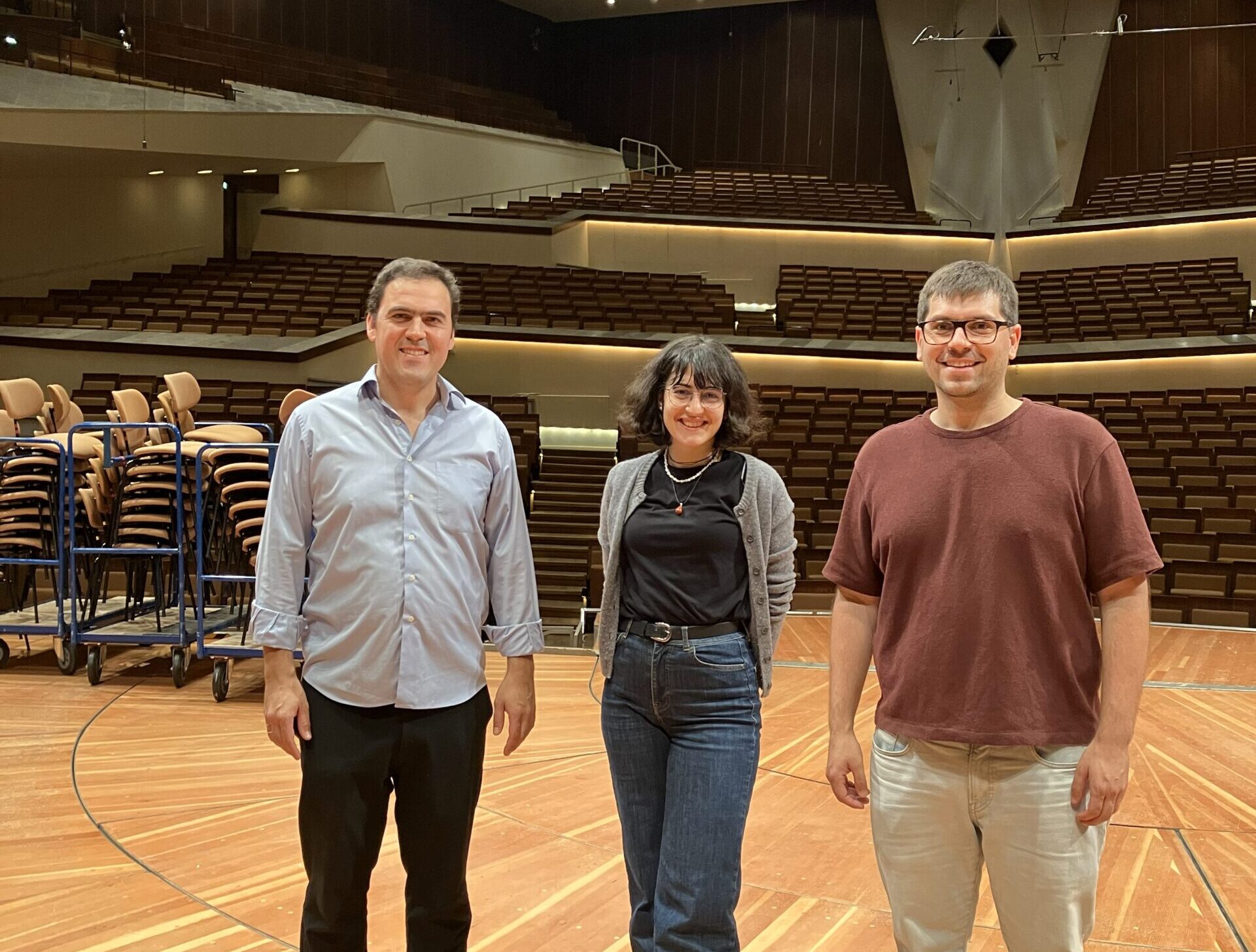
The data collected will become openly available through the MUSKLA database providing researchers and practitioners with resources to create immersive virtual experiences as well as accurate 3D models of major auditoriums.
We thank the staff who welcomed our team and supported a smooth operation throughout the day!
The GRAS Innovation Award – The Game-Changer 2025 – has been awarded to IHTA
We are proud to announce that we received the GRAS Award – The Game-Changer 2025 by GRAS Sound and Vibration. The project: A High-Resolution Head-Related Transfer Function Data Set and 3D-Scan of KEMAR by the authors Hark Braren and Janina Fels won the award in the category „the Game-Changer“.
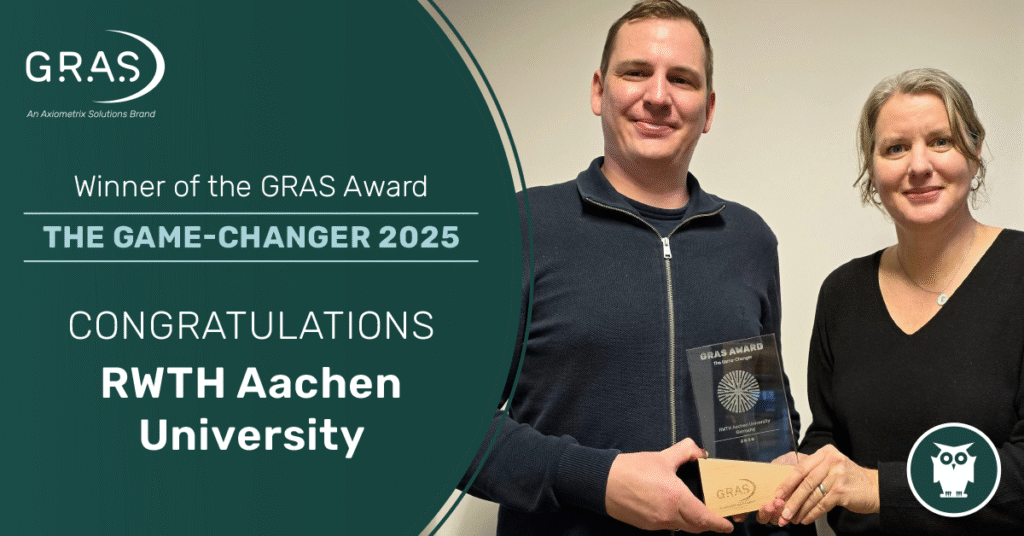
GRAS Award Winner – The Game Changer 2025, Hark Braren and Janina Fels, RWTH Aachen University
The RWTH team created an open, high-resolution HRTF dataset using the GRAS KEMAR Head and Torso Simulator — bridging physical measurement and acoustic simulation. Their work sets a new benchmark for spatial audio realism and paves the way for future breakthroughs in 3D sound and headphone design.
The innovation speaks directly to our core mission: enabling the highest quality in acoustic measurement and supporting industry breakthroughs.
The dataset can be found here: https://doi.org/10.18154/RWTH-2020-11307
We would like to express our sincere thanks to GRAS Sound & Vibration for this special award!
3rd IHTA Retreat
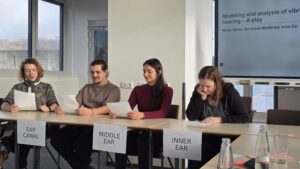
The third IHTA Retreat took place on November 21st. The day began with unconventional yet exceptionally entertaining and informative project presentations with an amazing view of Aachen from the Skylounge in the main building. Participants were challenged to present their projects either as a short, powerful science pitch or in a creative way. We heard short stories about children’s hearing experiences in classrooms and saw theater plays with the inner, middle, and outer ears as the main characters. There will surely be many new contestants for Research in Shorts at DAGA 2026.
During the afternoon, we discussed challenges related to writing and publishing scientific papers, as well as strategies for overcoming them. Most importantly, we took time to learn from one another, develop new inspiration, and take the first steps to overcome writer’s block and support each other.
Thank you to Bastian Hughes for guiding us through the day with his excellent moderation! Thanks also to Julia Seitz, Lara Stürenburg, and Carolin Breuer, who organized the event.
Paper published: Exploring auditory selective attention shifts in virtual reality: An approach with matrix sentences
We are happy to share that our paper “Exploring auditory selective attention shifts in virtual reality: An approach with matrix sentences” has been published in the Journal of the Acoustical Society of America:
https://doi.org/10.1121/10.0039864
In this study, we explored voluntary shifts of auditory selective attention in complex and more naturalistic acoustic environments. To move beyond earlier paradigms based on single-word stimuli, we introduced unpredictable German matrix sentences to simulate more realistic listening conditions.
Overall results were comparable to previous versions, but no strong reorienting effect emerged. Interaction patterns still indicate that shifting auditory attention is more demanding than maintaining it, and that preparing attention benefits performance, as reflected in decreasing reaction times for later target onsets.
This approach contributes a paradigm for investigating auditory perception and attention in dynamic room acoustic environments, helping to close the gap between laboratory setups and real-world listening.
This work was created by Carolin Breuer and Janina Fels and was funded by the German Research Foundation (DFG) as part of the Priority Program SPP2236 AUDICTIVE.
University Observation Week (Hochschulhospitationswoche) Electrical Engineering at IHTA
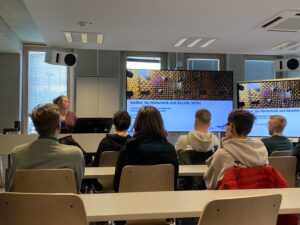
On November 6, 2025, the IHTA welcomed prospective students as part of the Electrical Engineering University Observation Week (Hochschulhospitationswoche). The tour through the world of acoustics began with an inspiring video and then introduced the participants to the diverse field of acoustics at IHTA.
Afterwards, the participants then went through three hands-on stations:
- Aliasing
- Binaural hearing – spatial hearing
- Audiometry
The experiments offered a vivid insight into key issues in hearing technology and acoustics.
Many thanks to Jana Berger, Hark Braren, and Carolin Breuer for supervising the stations.
The IHTA would like to thank the participants for their interest and enthusiasm, and looks forward to seeing some familiar faces in upcoming semesters.
Paper Published: Exploring cross-modal perception in a virtual classroom: the effect of visual stimuli on auditory selective attention
A new paper “Exploring cross-modal perception in a virtual classroom: the effect of visual stimuli on auditory selective attention” has been published in Frontiers in Psychology, as part of the Research Topic “Crossing Sensory Boundaries: Multisensory Perception Through the Lens of Audition”: https://doi.org/10.3389/fpsyg.2025.1512851
In a virtual classroom environment, we investigated how visual stimuli influence auditory selective attention. Across two experiments, congruent and incongruent pictures modulated performance during an auditory attention task: concurrent visual input increased response times overall, and incongruent pictures led to more errors than congruent ones. When visual stimuli preceded the sounds, the timing mattered — positive priming at 500 ms, but semantic inhibition of return at 750 ms.
These results highlight that cross-modal priming differs from multisensory integration, and that temporal dynamics between modalities substantially shape attentional behaviour.
This work was a collaboration between Carolin Breuer, Lukas Jonathan Vollmer, Larissa Leist, Stephan Fremerey, Alexander Raake, Maria Klatte and Janina Fels.
It was funded by the Priority Programme SPP2236 AUDICITVE and the Research Training Group (RTG) 2416 – MultiSenses, MultiScales, both of which are funded by the German Research Foundation (DFG).
Many thanks to everyone involved.
Paper published: The influence of complex classroom noise on auditory selective attention
We are very glad to share that our paper “The influence of complex classroom noise on auditory selective attention”, based on the bachelor’s thesis of Robert Schmitt, which we co-authored, has just been published in Scientific Reports: https://www.nature.com/articles/s41598-025-18232-2
It has been a real pleasure to supervise this work and to see it evolve into a full publication. In the study, we examined how plausible classroom noise affects auditory selective attention in a virtual reality classroom environment.
Our results underline the importance of studying realistic and complex acoustic scenarios to gain more reliable and valid insights into auditory perception by showing higher error rates in the auditory attention task under complex noise conditions, as well as an increased perceived listening effort when the background contained intelligible speech.
The paper was developed within the ECoClass-VR project, part of the DFG Priority Program SPP 2236 AUDICTIVE on Auditory Cognition in Interactive Virtual Environments. More information at www.spp2236-audictive.de.
We hope these findings contribute to advancing our understanding of auditory attention in complex, real-world listening situations.
Many thanks to the co-authors Robert Schmitt, Larissa Leist, Stephan Fremerey, Alexander Raake, Maria Klatte, and Janina Fels, and to the AUDICTIVE community for the inspiring collaboration and support.
Research data publications at IHTA
In recent years, the importance of open data in academic research has become increasingly prominent. Open data in the context of scientific research refers to the practice of making datasets publicly accessible, either as separate data publications or as supplementary material along with the research article. Making such (documented) data available allows other researchers to build upon existing work or to verify findings. This makes research more efficient, transparent and reproducible. Research data publications are usually assigned a DOI, providing a permanent link to the dataset, which can be cited properly in related scientific work.
Researchers from the Institute for Hearing Technology and Acoustics have published several datasets in the past years – many of them being different kind of HRTF datasets, but also other acoustic measurements, input data for simulations and stimuli for listening experiments. To give a better overview of these data publications, we recently updated the corresponding section on our website, which also lists IHTA’s research software. Further datasets, if published on the Zenodo platform, can also be found in IHTA’s Zenodo-Community.
Paper published: Serial recall in spatial acoustic environments: irrelevant sound effect and spatial source alternations
We are happy to announce that Cosima Ermert, Manuj Yadav, John E. Marsh, Sabine Schlittmeier, Torsten W. Kuhlen, and Janina Fels recently published their article Serial recall in spatial acoustic environments: irrelevant sound effect and spatial source alternations in Scientific Reports!
Environments with multiple, spatialized sound sources present unique challenges for verbal short-term memory – particularly in the presence of background noise and when the location of target talkers changes. In this study, we investigated how switches of spatial location and the type of irrelevant background sounds in complex acoustic scenes influence the ability to remember sequences of items within the serial recall.
Our findings reveal that the type of background noise plays a crucial role in memory performance, strongly affecting the recall of sequences. Interestingly, changes in spatial location only disrupt memory when switches occur at a fast rate – much faster than rates in natural conversations. This highlights the importance of both acoustic content and movement dynamics in understanding listening and memory challenges in realistic conversational situations.
This research was carried out within the priority program SPP2236 AUDICTIVE funded by the German Research Foundation (DFG).
Janina Fels und Cosima Ermert beim „International Symposium on Auditory and Audiological Research – ISAAR 2025“
Vom 19. bis 22. August 2025 reisten Janina Fels und Cosima Ermert nach Dänemark, um das „International Symposium on Auditory and Audiological Research – ISAAR 2025“ in Nyborg zu besuchen.
Janina Fels hielt einen eingeladenen Vortrag zum Thema „Exploring Auditory Cognition: Connecting Real-World Contexts with Interactive Virtual Environments” und stellte dabei mehrere laufende Forschungsvorhaben vor, die sich speziell mit selektiver auditiver Aufmerksamkeit und Höranstrengung (Listening Effort) bei Kindern in Klassenräumen unter realistischen Hörbedingungen befassen.
Cosima Antonia Ermert präsentierte dazu ein Poster mit dem Titel „Listening Effort in Populated Audiovisual Scenes Under Plausible Room Acoustic Conditions”.
Einen Tag vor der ISAAR reiste Janina Fels zum „Pre-ISAAR Mini-Symposium“ beim Eriksholm Research Centre. Sie hatte die Gelegenheit, mehr über aktuelle Themen und Projekte zu erfahren und diese ausführlich zu diskutieren. Es fand eine exzellente Führung durch die Labore statt und es wurden zahlreiche hochinteressante Posterpräsentationen abgehalten. Zudem wurden eine Vielzahl neuer Ideen für zukünftige Kooperationen diskutiert.
Währenddessen nahm Cosima Ermert am „Workshop in Communication in Hearing Science” von WS Audiology teil. Dieser Workshop beschäftigte sich mit dem Thema „Understanding how noise and hearing impairment affect communication”. Cosima präsentierte für das IHTA ein Poster mit dem Titel „Bringing real-life into the lab: Investigating speech in virtual auditory environments – which aspects contribute to a plausible simulated conversational situation?”.


Paper published: Audiovisual angle and voice incongruence do not affect audiovisual verbal short-term memory in virtual reality
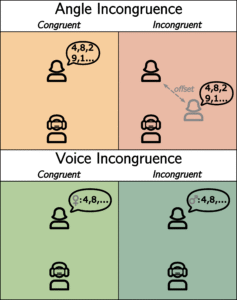 We are happy to announce that our paper Audiovisual angle and voice incongruence do not affect audiovisual verbal short-term memory in virtual reality by Cosima A. Ermert, Manuj Yadav, Jonathan Ehret, Chinthusa Mohanathasan, Andrea Bönsch, Torsten W. Kuhlen, Sabine J. Schlittmeier, and Janina Fels has just been published in PLOS ONE.
Virtual reality is increasingly used in research to simulate realistic environments – possibly increasing ecological validity. However, the visual component in virtual reality can affect participants, especially if there are incongruencies between auditory and visual information. In this study, we investigated verbal short-term memory under two types of audio-visual incongruencies: an angle incongruence, where the perceived position of the sound source did not match that of the visual representation, and a voice incongruence, where two virtual agents switched voices. The task was presented either on a computer screen or in virtual reality. We found no effect of the incongruencies or the display modality (computer screen vs. virtual reality), highlighting the complexity of audio-visual interaction.
This research is part of the priority program AUDICTIVE and was a cooperation with researchers from the Visual Computing Institute and the Work and Engineering Psychology at RWTH Aachen University.
Project Kick-off: SWOISE – UAS Swarms for Noise Reduction
Unmanned aerial systems (UAS), such as drones, are becoming increasingly popular for wide range of applications, ranging from delivery and mapping to surveillance. The emergence of the UAS swarm systems, where multiple UAS operate in coordinated formations, might offer advantages regarding improved efficiency and reduced logistical effort. However, UAS swarms also raise concerns about noise pollution, especially in urban environments. The SWOISE project aims to address this issue by investigating the noise generated by drone swarms, how it is perceived by humans, and how swarm configurations can be optimized to minimize acoustic impact. Within the project, the task of IHTA is to focus on the psychoacoustic analysis of UAS swarm noise by creating binaural sound samples using simulations of urban overflights, and analyzing them through perceptual and objective evaluations. This research will be mostly carried out by our post doctoral researcher Jithin Thilakan, who recently joined our team.
SWOISE is funded by the German aviation research program LuFo VI-3 and brings together four research partners:
- Institute of Air Transport Systems (ILT), TU Hamburg (Prof. Dr.-Ing. Volker Gollnick)
- Chair of Flight Guidance and Air Traffic, TU Berlin (Prof. Dr. ir. Maarten Uijt de Haag)
- Institute for Hearing Technology and Acoustics (IHTA), RWTH Aachen University (Prof. Dr.-Ing. Janina Fels)
- German Aerospace Center (DLR Hamburg: Institute of Air Transport – associate partner)
The project officially launched with a kick-off meeting on July 8th, 2025, at TU Hamburg, where researchers from all partner institutions gathered to discuss the research plans and future steps. We look forward to advancing this collaborative effort and contributing towards quieter and more environment-friendly aviation.

The SWOISE research team at the official kick-off meeting at TU Hamburg
IHTA at Forum Acusticum Euronoise 2025 in Malaga
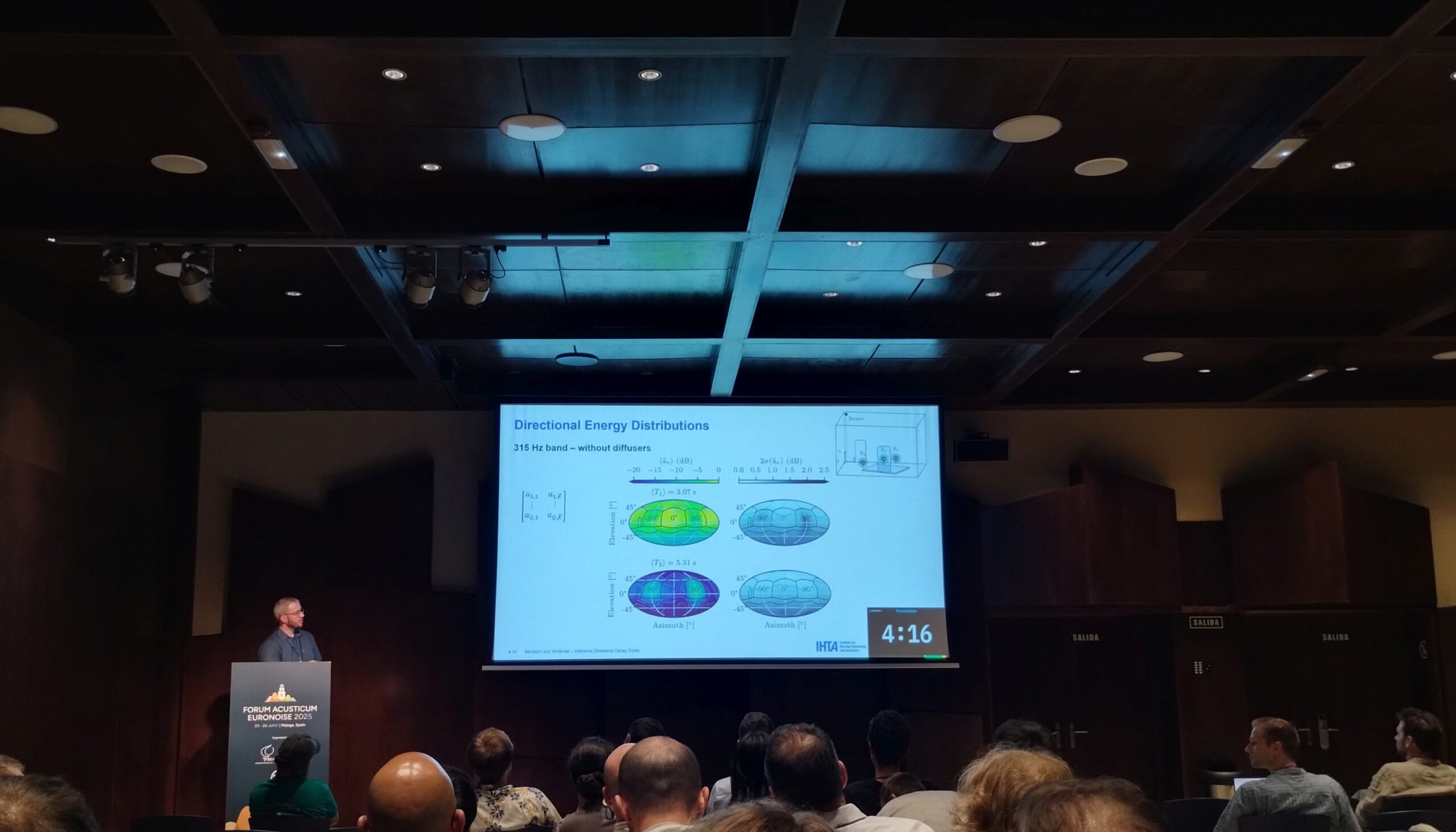
At the end of last month, the scientific conference Forum Acusticum Euronoise successfully took place in Malaga, Spain, organized by members of the Spanish Acoustics Society (SEA). Across four days, a total number of 1250 delegates participated and presented interesting research results in the field of acoustics and noise, accompanied by an engaging social program. The Institute for Hearing Technology and Acoustics was represented by Lukas Aspöck and our former colleague Marco Berzborn, who altogether organized three technical sessions and contributed to five papers:
- Marco Berzborn and Michael Vorländer: Stochastic Variational Inference of Directional Decay Times in a Reverberation Room
- Lukas Aspöck, Michael Vorländer and Janina Fels: Rendering complex acoustic scenes for perception experiments
- Marco Berzborn and Michael Vorländer: Analysis of the relationship between sound field isotropy and errors in the results of Sabine’s absorption coefficient
- Lukas Aspöck, Pascal Palenda, Janina Fels and Michael Vorländer: Application of room acoustics simulation software in university teaching
- Fabian Brinkmann, Marco Berzborn, […] Anne Heimes, Simon Kersten, Pascal Palenda et al.: Open educational resources for acoustics and audio signal processing using Jupyter notebooks and pyfar
-

- Entrance of conference venue in Malaga

-

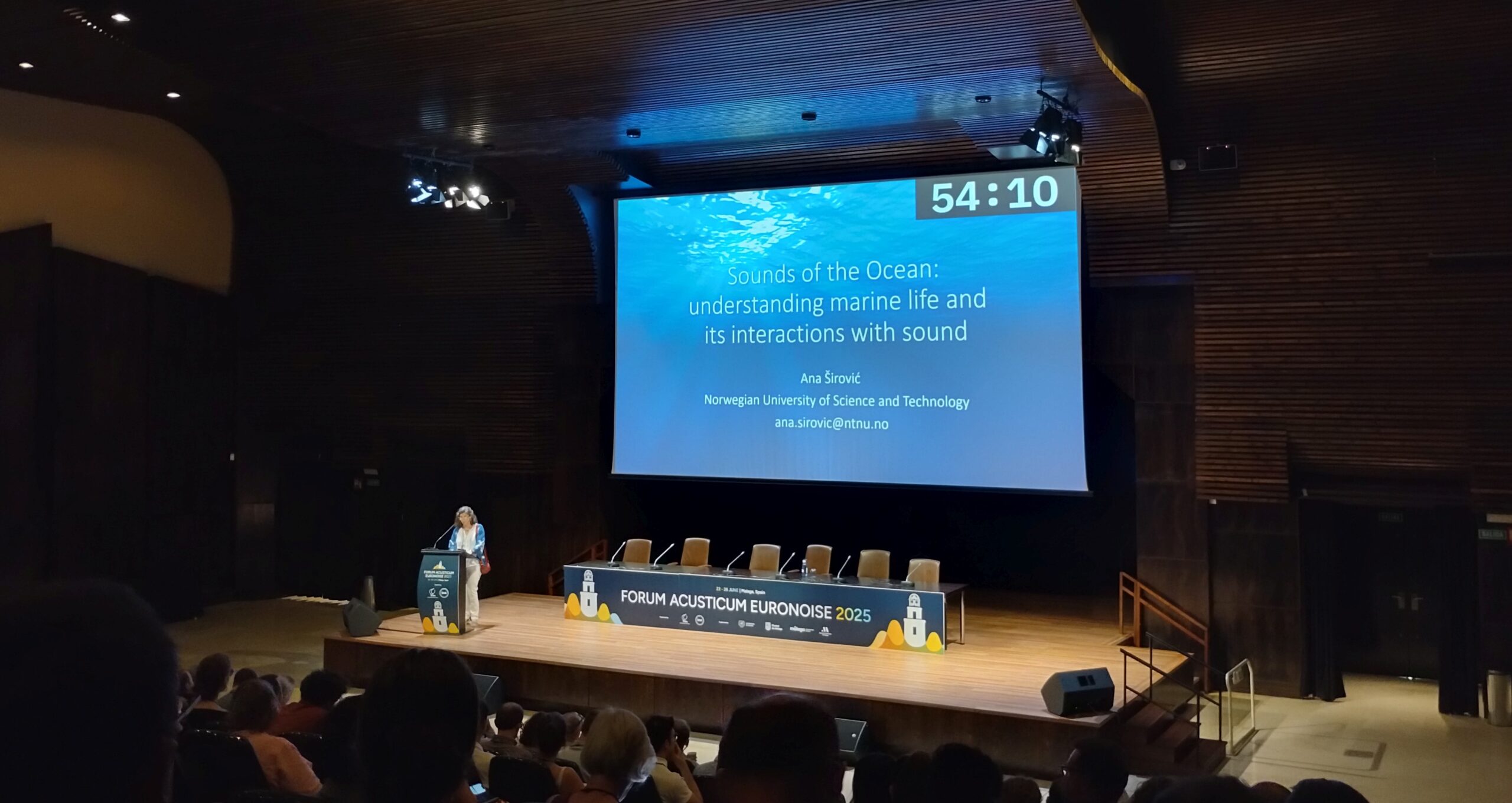
- Opening on Monday: Plenary lecture on underwater sounds by Ana Sirovic
-

- IHTA alumni group picture

-

- Marco Berzborn during one of this presentation
IHTA at ICA/ASA Meeting in New Orleans
From May 18 – May 23, 2025, the 188th Meeting of the Acoustical Society of America (ASA) joint with the 25th International Congress on Acoustics (ICA) takes places in New Orleans, Louisiana. Seven IHTA members have traveled to the USA in order to present their latest research and to meet the international acoustics community. The following presentations will be given with contributions from our institute:
Cosima Ermert, Andrea Bönsch, Torsten Kuhlen, Janina Fels: The impact of coverbal visual cues on speech intelligibility and cognitive load in virtual reality environments
May 20, 1:40 – 2:00 pm (UTC -5), Location: SALON F/G, Presentation Number: 2pPP3
Julia Seitz, Janina Fels: How do classroom activities influence noise levels and student’s listening effort?
Poster Session, May 20, 1:20 – 4:20 pm (UTC -5), Location: STUDIO FOYER/STUDIOS 1-4, Presentation Number: 2pSC13
E.K. Ellington Scott, Lukas Aspöck, Herbie Klinger, Michael Vorländer, Jillian Willis, Jonas Braasch: A database of anechoic modern-jazz recordings for auralization
May 20, 3:20 – 3:40 pm (UTC -5), Location: GALERIE 6, Presentation Number: 2pMUa4
Simon Kersten, Henning Taschke, Michael Vorländer: On the sound pressure distribution in the inner ear during bone conduction stimulation
May 22, 1:00 – 1:20 pm (UTC -5), Location: SALON F/G, Presentation Number: 4pPPa1
Jonas Heck, Ronny Roos, Josep Llorca-Bofí, Michael Vorländer: Complex surface impedances and spherical wave approximations in image source models for outdoor auralization
May 23, 1:20-1:40 pm (UTC -5), Location: GALERIE 5, Presentation Number: 5pNS2
You can find the full conference program and abstracts on the website https://acousticalsociety.org/new-orleans-2025/.
We are looking forward to meet you in New Orleans!

Research results on acoustic directivity patterns of road-traffic vehicles
In the Journal of the Acoustical Society of America (JASA), a research paper by our former research assistant Christian Dreier and Prof. Michael Vorländer was recently published: Speed-dependent directivity patterns of road-traffic vehicles.
This paper explores the spatial and speed-dependent directivity patterns of various road-traffic vehicles, including electric, hybrid, and combustion-powered models. By employing time-variant wave backpropagation on microphone array signals, the research reveals significant insights into how driving conditions and engine characteristics influence vehicle noise emissions. The findings are compiled in an open-access database (http://doi.org/10.5281/zenodo.14142914), providing valuable data for noise mapping and auralization applications. The main parts of this research was supported by the HEAD-Genuit Foundation.
More details of Christian’s research will also be presented at his PhD defense, which will take place end of July 2025.
We’re happy that one of the paper’s figure was also chosen to be featured on the title page of the JASA’s current issue.

Title page of JASA, Volume 157, Issue 4
Paper published: Cross-modal congruency modulates evidence accumulation, not decision thresholds
We are happy to announce that our paper „Cross-modal congruency modulates evidence accumulation, not decision thresholds“ was published as part of the Research Topic „Crossing Sensory Boundaries: Multisensory Perception Through the Lens of Audition“ in Frontiers in Neuroscience.
In this study, we collaborated with Björn Kampa from the Systems Neurophysiology Department of the Institute of Zoology here at RWTH Aachen University, and Christoph Kayser from the Department of Cognitive Neuroscience at Universität Bielefeld. We explored how audio-visual stimulus pairs—linked either by co-occurrence or by shared meaning—affect behavior and brain activity during decision-making.
By combining behavioral data from a decision-making task with brain activity measured via electroencephalography (EEG), we found two key stages that shape perceptual decisions: an early, sensory-driven stage, and a later, decision-related stage. Interestingly, whether the stimulus pairing was expected in terms of co-occurrence or meaning played a major role in how these early and late components contributed to the decision-making process.

