

- Computer Science M.Sc.
- USA, Stanford
- Stanford University
- 02/2026 – 07/2026
In 2026, I had the wonderful opportunity to spend six months in the United States, conducting research and working on my master’s thesis as a Visiting Student Researcher in the Autonomous Systems Lab at Stanford University. What began as a chance to pursue research in a new environment became an experience that taught me just as much outside the lab as inside it. In this post, I would like to share what I learned along the way, in the hope that others might benefit from my experience.
Preparation and organization
The initial contact with Stanford came about through a professor, whose group at the Institute for Data Science in Mechanical Engineering I had already gotten to know through several courses and my work there as a student research assistant. When I approached him about possible topics for my master’s thesis, he offered to put me in touch with his colleague at Stanford to explore a potential research collaboration. To get things started, I put together a few research ideas that interested me and seemed like a good fit for both groups. We discussed these in a joint meeting and eventually settled on a promising topic. With the research direction agreed upon and an official invitation from Stanford in hand, I could begin organizing the practical aspects of my stay.
One of the first things to arrange was my visa. For a research stay in the United States, international visitors generally need an appropriate visa, which in my case was a J-1 for short-term scholars. The process must be initiated by the hosting institution, which has to issue the necessary documentation before the actual visa application can be submitted to a U.S. consulate. Stanford handled this part incredibly well, providing clear instructions and guidance throughout the process. Nevertheless, the administrative steps take time. Stanford’s internal processing after the official invitation can take two to four weeks, after which applicants still need to secure a visa appointment and complete the application process. In Germany, this generally involves an in-person appointment at a U.S. consular office in Berlin, Frankfurt, or Munich, followed by additional processing before the passport is returned. Fortunately, in my case, everything went smoothly, but I strongly recommend allowing at least two months between receiving the invitation and expecting to have the visa in hand. Given recent changes and temporary disruptions to U.S. visa processing, starting early is advisable.
Alongside the visa application, I began looking for accommodation. Finding a place to live in the Bay Area can be challenging, not least because of the high rents and competitive housing market. Stanford offers a wide range of student housing options on campus, but Visiting Student Researchers are not regularly enrolled students and therefore receive low priority in housing assignments. I would certainly recommend applying for university housing, but it is important to explore alternatives rather than count on receiving an offer. In the end, I was fortunate enough to secure a place in on-campus housing, which made settling in considerably easier. For those looking off campus, Mountain View or Redwood City may be worth considering. From conversations with other visiting students, I learned that these locations can offer a reasonable compromise between rent and proximity to Stanford, since housing tends to be somewhat more affordable than in Palo Alto while the campus remains accessible by bike or public transport. In any case, I would recommend beginning the housing search as early as possible.
Another important aspect to consider well in advance is health insurance. By default, visiting students are enrolled in Stanford’s own health insurance plan, Cardinal Care. While the coverage is excellent, it is also expensive. Stanford allows students to waive Cardinal Care if they can demonstrate that they have equivalent coverage elsewhere. Although visiting students can request such a waiver even after arriving at Stanford and outside the usual deadlines, I would strongly recommend looking into the available options early. Navigating health insurance in the United States can be surprisingly complicated, and understanding the differences in coverage, costs, and conditions takes some time. On a related note, I would also recommend checking Stanford’s immunization requirements well before departure. Stanford requires proof of certain vaccinations in a prescribed format, and my German vaccination booklet turned out not to be sufficient in every case because my name was not printed on every page. Having overlooked this requirement, I found myself coordinating with my childhood doctor back in Germany to obtain the necessary documentation. Everything worked out in the end, but it would have been considerably easier to sort this out before leaving. My advice is therefore to consult Stanford’s official health and immunization guidelines early and make sure all the required documentation is in order before your flight.
Overall, organizing the stay involved a fair amount of paperwork and planning, but the process was much less daunting than I had initially expected. Much of this was thanks to the excellent administrative support I received from both RWTH and Stanford, which allowed me to navigate the formalities without major difficulties and focus on preparing for the experience ahead.
Arrival and settling in
My arrival in California went remarkably smoothly. Given the recent changes to U.S. immigration policies, I had expected the border controls to be rather strict and time-consuming. In practice, however, the process was straightforward, and I was through immigration without any difficulties. Getting from the airport to Stanford is equally easy, since Caltrain and ride-hailing services offer convenient ways to reach the campus from the airport. One practical tip: make sure you have mobile service arranged before your flight, as having internet access immediately upon arrival makes navigating your way around considerably easier.
©International Office
Checking into my apartment on campus was just as uncomplicated, and I was delighted with the accommodation. I lived in a modern, spacious apartment in a recently built residence, sharing the kitchen and living room with a PhD student while having my own bedroom and bathroom. The apartment came furnished with all the essentials, and the building also offered several communal spaces for studying, working, and relaxing. More importantly, my flatmate was incredibly friendly and welcoming, which made settling into an unfamiliar environment much easier. When applying for Stanford housing, you can choose between different living arrangements, and I would strongly recommend considering a shared apartment. Besides being somewhat more affordable, living with other students is a great way to make connections from the outset. The people I met at Stanford were exceptionally open and welcoming, and having a friendly flatmate made those first days feel much less unfamiliar.
Of course, there are also a few administrative matters to take care of after arriving. In particular, international visitors must complete the necessary immigration check-in procedures and register their U.S. residential address with Stanford shortly after arrival. I would also recommend retrieving and printing your I-94 arrival record, which documents your admission to the United States, and keeping a copy with your other immigration documents. Although I never encountered any problems, having your documentation readily available can provide some peace of mind.
Another important first stop is Stanford’s Bechtel International Center, which supports international students and researchers. Bechtel organizes regular orientation sessions covering important immigration requirements, administrative procedures, and practical aspects of life at Stanford. I would strongly recommend attending one of these sessions, not only for the useful information but also because they provide an excellent opportunity to meet other international visitors who have just arrived. The center also organizes more informal social events, making it a good place to start building connections outside your research group.
Finally, one of the first things worth arranging is your Stanford ID card. This little card quickly becomes an essential part of everyday life on campus: it provides access to the libraries, recreational facilities, and various other university services. For those living in Stanford housing, it can also serve as your room key, although you will receive a temporary key when you first check in, so there is no need to arrange everything immediately upon arrival.
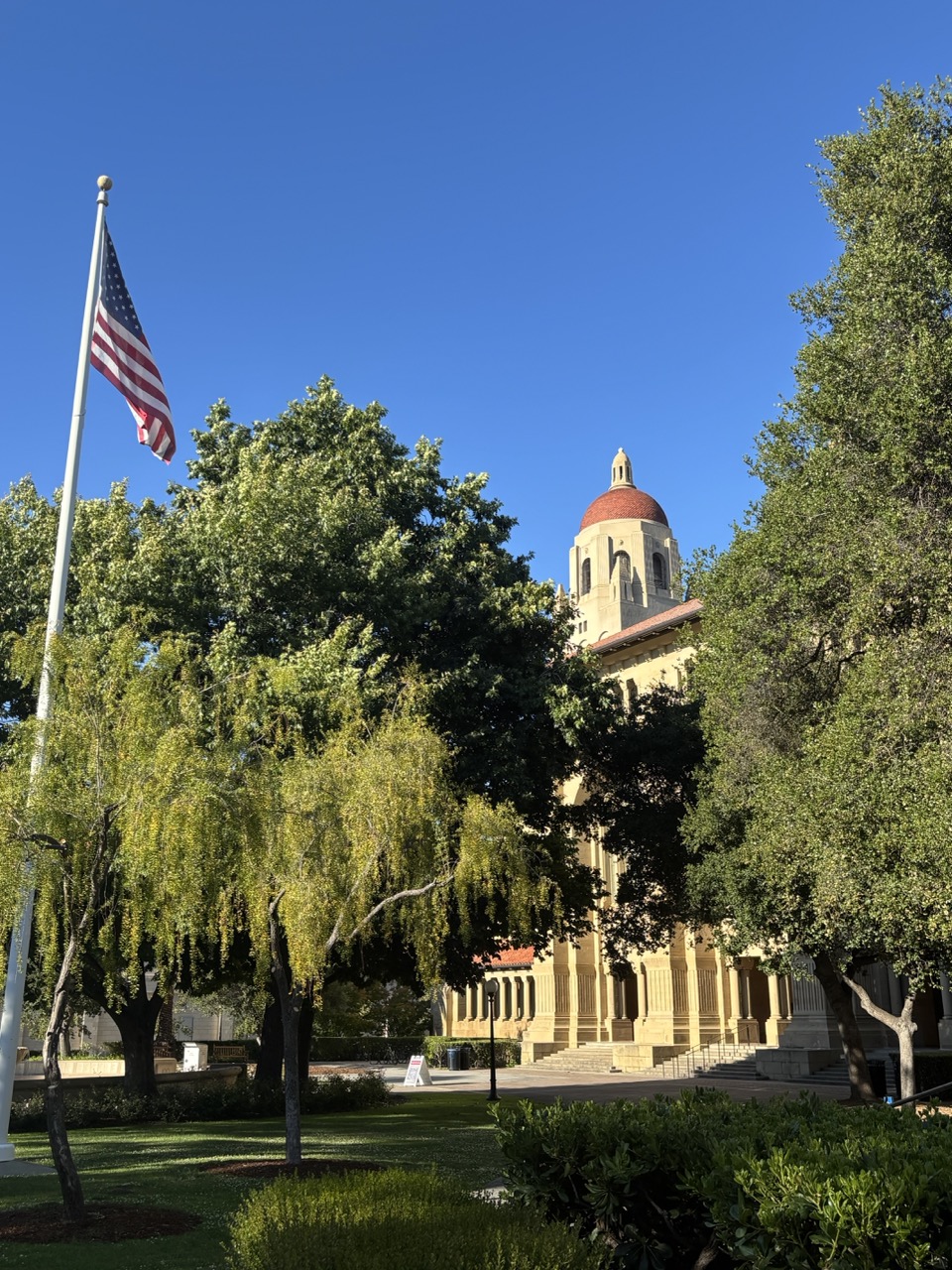
Beyond all the practicalities of settling in, one of my strongest first impressions was just how beautiful the Stanford campus is. With its warm California sunshine, palm-lined walkways, elegant Spanish-style architecture, and countless little courtyards and fountains, the entire campus feels almost like an oasis. It is also enormous, with far more to explore than I had expected. You can easily spend your first few days simply wandering around, and I can guarantee that you will discover another beautiful corner you had not noticed before each day. Even after six months, I never quite lost that sense of wonder when walking across campus.
Academic and research experience
As a Visiting Student Researcher, my everyday life at Stanford was quite different from that of a regularly enrolled student. Rather than attending lectures and taking exams, I spent most of my time conducting research, working in the lab, and making use of Stanford’s excellent libraries. While this meant missing out on some aspects of the traditional student experience, it also gave me the opportunity to immerse myself in the university’s research environment and gain a much closer look at how cutting-edge research is conducted.
One of the most exciting aspects of my stay was the chance to experience Stanford’s vibrant research community firsthand. Through discussions with other researchers, group meetings, seminars, and talks by visiting scientists, I gained insights into the latest developments in robotics, artificial intelligence, and a variety of other fields. There always seemed to be something interesting happening, often well beyond my own area of research. I found the research culture particularly inspiring: people were open to exchanging ideas, questioning established approaches, and exploring ambitious new directions, with a strong emphasis on thinking from first principles and pursuing interesting new ideas.
This environment also had a profound impact on my own research. I received excellent guidance and supervision throughout my master’s thesis, while also contributing to two research papers that ultimately became conference publications. Working closely with experienced researchers and engaging in discussions about ongoing work taught me a great deal about developing research ideas, approaching difficult problems, and communicating scientific results. Perhaps most importantly, it gave me a better understanding of what it means to pursue research professionally, from the initial spark of an idea to the process of turning it into a scientific contribution.
Looking back, the academic experience was undoubtedly one of the most valuable aspects of my stay. Beyond the concrete research results, I returned with a broader perspective on my field, greater confidence in my own abilities as a researcher, and a much clearer sense of the directions I would like to pursue in the future. I am certain that the experience will continue to shape both my academic development and my future career.
Leisure and exploring California
Beyond research, Stanford and the surrounding area offer plenty of opportunities to unwind and explore. The campus itself has an impressive range of recreational facilities, including gyms, swimming pools, tennis courts, and beautiful parks and green spaces. Stanford also hosts major sporting events and concerts, some of which draw visitors from across the Bay Area. One of my personal highlights was attending the “California Clásico”, the soccer rivalry between the San Jose Earthquakes and LA Galaxy, at Stanford Stadium. It was quite an experience to watch such a major match in the university’s own stadium! There was even a large BTS concert during my stay, although, not being much of a K-pop fan myself, I gave that one a miss. Still, with so much happening right on campus, there is no shortage of ways to spend your free time.

©International Office
One of my strongest recommendations is to hike up to the Stanford Dish early in your stay. Located in the hills just south of campus, the Dish is home to a large radio telescope surrounded by scenic walking trails. The hike is not particularly demanding, but the views are spectacular. From the hills, you can look out over the entire Stanford campus and the surrounding Bay Area. On a clear day, the panorama stretches from the mountains of the Diablo Range in the east all the way to the San Francisco skyline in the north. It is a wonderful way to get a sense of the area and appreciate just how beautiful this part of California is.
Stanford’s location in Palo Alto, at the heart of Silicon Valley, also comes with an interesting trade-off. While you are surrounded by some of the world’s most influential technology companies and research institutions, the immediate surroundings lack the lively urban atmosphere you might expect from a major university city. Fortunately, San Francisco is relatively easy to reach by Caltrain and makes for an excellent day trip or weekend excursion. With its colorful neighborhoods, distinctive architecture, and famously steep hills, it is a fascinating city to explore, with more than enough to justify multiple visits. I would particularly recommend visiting the De Young museum, and spending time in the Mission District and Chinatown, two neighborhoods that offer very different glimpses into the city’s cultural diversity. Among the further highlights are the Golden Gate Bridge, which is especially beautiful around sunset on a clear evening, and Twin Peaks, where you can enjoy breathtaking views across the entire city. Just remember to bring a jacket, as the wind up there can be surprisingly strong! For those who enjoy hiking, the Marin Headlands just north of the Golden Gate Bridge are also well worth a visit, with beautiful trails and spectacular coastal scenery. If you are looking for a more traditional California beach experience, however, I would recommend heading south to Santa Cruz and the surrounding coastline. While San Francisco has some beautiful beaches, the often chilly and windy weather makes them less inviting for swimming or surfing. Santa Cruz, by contrast, offers beautiful stretches of coastline, a laid-back atmosphere, and some excellent surfing spots. Even if you are not particularly interested in water sports, exploring the coast is well worth the trip.
One practical consideration when planning excursions is transportation. The Caltrain connection between Palo Alto and San Francisco is convenient and makes visiting the city easy without a car. Beyond this corridor, however, public transportation becomes considerably less practical, especially if you want to explore California’s natural landscapes or travel farther afield. For many destinations, having access to a car makes an enormous difference. Renting one occasionally is certainly an option, although my personal recommendation would be to befriend someone who already has one!
Beyond the places I visited and the activities I enjoyed, living in California also gave me a chance to experience everyday life in a different cultural environment. While I would not say that American life felt fundamentally different from what I was used to in Germany, there were certainly some differences that stood out. I particularly appreciated how open and welcoming many of the people I met were. There was also a certain enthusiasm and optimism in the way people approached new ideas and opportunities, particularly in the Stanford community, that I found refreshing. Of course, six months in Silicon Valley hardly provide a representative picture of the entire United States, but experiencing these differences firsthand was an enriching part of my stay.
Costs and financing
One aspect that should not be underestimated when planning a research stay at Stanford is the financial cost. The Bay Area is one of the most expensive regions in the United States, and living expenses can add up quickly. Visiting Student Researchers pay a university fee of approximately $1,400 per month, even though they are not enrolled in regular courses. On top of this come rent, health insurance, flights, and everyday expenses, making a six-month stay a substantial financial commitment. As a rough guideline, Stanford recommends budgeting at least $4,000 per month, and proof of sufficient financial resources is required as part of the visa sponsorship process. In my case, I was fortunate to receive partial financial support through an RWTH Research Ambassador Scholarship, for which I am very grateful. The scholarship helped considerably in making the stay possible, although I still had to cover part of the expenses from my own savings. Depending on the circumstances, a stay of this kind can require a significant personal contribution, so it is worth looking into available scholarships and other sources of financial support as early as possible.
On a more practical note, managing payments at Stanford was very straightforward. University-related expenses, including housing fees and meals at the dining halls, can be handled through Stanford’s online payment system, which also supports payments from German bank accounts. I made frequent use of the dining halls and would particularly recommend Arrillaga, which offers a convenient way to get a good and affordable meal on campus without having to cook every day. In my experience, opening a U.S. bank account was not necessary. I would, however, strongly recommend bringing a proper credit card, ideally one without foreign transaction fees, as card payments are ubiquitous in the United States.
Sustainable character of my stay abroad
An extended research stay overseas inevitably comes with an environmental footprint, particularly due to intercontinental air travel. While this environmental impact cannot be ignored, I believe it is also worth considering the lasting benefits of such an experience. Beyond the research conducted during my stay, I established professional connections and collaborations that have continued after my return to Germany. These allow us to keep exchanging ideas and working together remotely, without requiring further travel. In this sense, the value of the stay extends well beyond the six months I spent at Stanford.
Conclusion
Looking back, my six months at Stanford were an incredibly rewarding experience, both academically and personally. I had the opportunity to pursue exciting research, learn from outstanding scientists, meet wonderful people, and experience life in a different part of the world. While organizing and financing such a stay requires considerable effort, I believe the experience was more than worth it, and I would wholeheartedly encourage anyone considering a similar opportunity to pursue it! You may come back with much more than you initially expected.

Leave a Reply