
Archive for January, 2026
My Research Stay at Stanford University
- PhD Candidate for Product Engineering of E-Mobility Components
- USA, Stanford
- Stanford University
- 06/2025 – 11/2025
Preparation and organization of the stay
I am currently a fourth-year PhD candidate at the PEM at RWTH Aachen University. From early on in my academic career, it was a clear personal and professional goal to spend part of my doctoral studies abroad. During my Master’s degree, this plan could not be realized due to the COVID-19 pandemic, which made international research stays largely impossible at the time.

©International Office
As a result, I continuously sought opportunities later on and remained in close exchange with professors and group leaders from relevant research groups in the United States. These discussions helped me sharpen my research interests and identify potential host institutions. Ultimately, a combination of persistence and good fortune led to an exciting opportunity at Stanford University, where I was offered a visiting research stay within the STEER research group.
Following the initial contact, the process moved forward very quickly, and I received an official invitation from Stanford. A particularly positive aspect was the excellent administrative support on the host side: a dedicated contact person at the department guided me through all formalities, including visa-related questions and institutional requirements. This support significantly reduced the bureaucratic burden and made the overall process smooth and manageable.
In parallel, I applied early for on-campus housing through Stanford’s internal housing lottery system. Although I was not allocated permanent housing through this route, I was able to secure two consecutive sublets directly on campus. This required some flexibility and a bit of luck, but it was strongly facilitated by an active and supportive German community at Stanford. In this context, I can highly recommend joining relevant community groups or chat channels, as they are extremely helpful for housing, administrative questions, and general orientation.
Regarding financing, a small portion of the travel and stay expenses could be covered through my research project, with explicit support from the project sponsor. Institutionally, the entire stay was handled as an extended business trip, which simplified internal approval processes and reimbursement procedures.
Overall, the preparation phase required initiative and coordination but was greatly eased by strong institutional support on both sides, proactive networking, and early planning – especially with respect to housing and administrative requirements.
First steps after arrival in host country
My stay effectively started immediately after arrival. I was able to move directly into my sublet room, which was located on campus at Stanford University. This proved to be extremely convenient, as it allowed for very short walking distances to all relevant facilities, including offices, laboratories, and shared infrastructure.
Since I was not enrolled as a regular student, I did not have to select or attend any courses. Instead, I was able to start my research activities in the host research group right away, without any delay. Administrative formalities, such as obtaining a student or visiting researcher ID card and access credentials, were handled very efficiently and could be completed within a single day.
One practical recommendation that cannot be overstated is to obtain a bicycle as early as possible. University campuses in the United States are typically very large and spatially cohesive. Compared to Aachen, distances are significantly longer, and daily mobility without a bike is impractical. A bicycle quickly became an essential part of everyday life and greatly improved flexibility and efficiency on campus.
Academic experience
I was officially registered as a Visiting Student Researcher at Stanford University. In this status, I was neither required nor formally allowed to enroll in regular courses for credit. However, in coordination with the respective principal investigators, it was possible to sit in on lectures and attend courses informally. I would strongly recommend making use of this opportunity, even if it is not mandatory.
The teaching quality at a university like Stanford is exceptionally high. Courses are very well structured, clearly motivated, and highly engaging. Beyond their academic value, some lectures are also extremely beneficial from a personal and professional development perspective. A particularly striking example was the course “Personal Finance for Engineers”. The way financial literacy, personal finance, and investment strategies are taught to engineering students is exemplary and forward-looking. This is an area that, in my view, should receive significantly more emphasis in engineering education in Germany as well.
In terms of social and academic integration, the German community at Stanford plays an important role. It is the second-largest international community on campus, which made integration very easy. I was warmly welcomed and quickly connected with like-minded people, both academically and socially. This network not only facilitated everyday life but also enabled valuable exchanges on research, career paths, and life in the US more broadly.
Overall, despite not being formally enrolled in courses, the academic exposure, high-quality teaching environment, and strong community integration resulted in a highly enriching professional and personal experience.
Financing
The research stay was financed primarily through private means, supplemented by funding from my ongoing research project and the support of the RWTH Ambassador Scholarship. This combination made it possible to cover the essential costs associated with the stay, including travel, insurance, and part of the living expenses.
It comes as no surprise that private universities in the United States – and especially in the Bay Area – are associated with very high costs. As a visiting researcher, I was required to pay a monthly university fee. In addition, general living expenses, particularly for food and daily necessities, are significantly higher than in Germany. Housing costs also represent a substantial share of the overall budget, even when living in shared or sublet accommodations.
Nevertheless, the stay is absolutely manageable from a financial perspective with appropriate planning and funding support. More importantly, it should be viewed as a strategic investment in one’s own education and professional development. The return on this investment – through academic exposure, international experience, networking, and personal growth – is exceptionally high and, in my assessment, clearly justifies the associated costs.
Leisure
©International Office
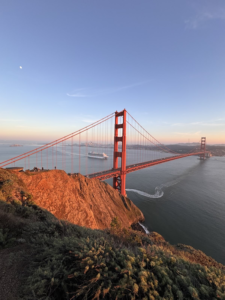
California is, quite simply, breathtaking. This is often said – but experiencing it firsthand truly confirms it. The diversity of landscapes along the US West Coast is remarkable, ranging from dramatic coastlines and deserts to mountains and forests. Combined with the consistently pleasant climate throughout most of the year, California offers exceptional conditions for outdoor and leisure activities.
One absolute highlight – and a clear recommendation for anyone spending time in the region – is visiting the national parks. They are unique on a global scale and offer experiences that are difficult to compare with anything in Europe. In particular, trips to Yosemite National Park, Sequoia National Park, Kings Canyon National Park, Death Valley National Park, Joshua Tree National Park, and the Grand Canyon are strongly recommended. Each of these parks is distinctive in its own way – whether through scale, geology, climate, or biodiversity – and all are truly unforgettable.
What added value did the stay have for my career prospects?
For me personally, the stay was particularly valuable due to the different working culture and the strong attention to detail within the host research group at Stanford University. The way research questions were approached – often with a high level of precision, openness, and constructive discussion – was both refreshing and intellectually stimulating.
The people I worked with were, without exception, highly interesting personalities with very diverse and inspiring backgrounds. This diversity of perspectives significantly enriched daily research interactions and broadened my own way of thinking. Beyond the immediate academic collaboration, one of the most lasting outcomes of the stay is the international network that emerged and continues to exist beyond the exchange itself.
At the same time, the exchange was not a one-way transfer. Through my own research background and prior project experience, I was able to contribute concrete technical expertise and practical insights to the group on site. This mutual exchange of knowledge and perspectives was a key strength of the stay.
On a broader level, California and Germany share more similarities than is often assumed, particularly with regard to innovation-driven industries and technology ecosystems. This is especially true in my field of work, the battery industry, where comparable ambitions exist in terms of sustainability, industrial scaling, and technological leadership. Many of the approaches, mindsets, and organizational structures observed in California offer valuable learnings that should be examined more closely and, where appropriate, adapted for application in Germany.
Especially in the current politically turbulent times, it is becoming increasingly important to identify partners with shared values and to strengthen cooperation with regions such as California. Building closer ties in strategically relevant technology fields can help enhance resilience, innovation capacity, and long-term competitiveness – benefiting both individual researchers and society as a whole.
To what extent does my stay abroad have a sustainable character?
The stay abroad has a clearly sustainable character, as the exchange of experience and knowledge extends well beyond the physical duration of the visit. The professional and personal connections established during the stay continue to enable ongoing scientific dialogue, informal consultation, and mutual learning over time.
Conclusion
I can wholeheartedly recommend such an exchange stay to anyone considering it. Despite the organizational and financial challenges involved, the personal and professional benefits clearly outweigh the costs. One should not be discouraged by the financial effort required – when viewed in the context of long-term career development, the investment is more than justified.
