
Kategorie: ‘Allgemein’
Internship in Paris
- Architecture B.Sc.
- France, Paris
- LAN Architecture
- 04/2023 – 10/2023
After finishing my bachelor’s degree in Aachen, I planned to do an internship in an architecture firm in Paris.
Reworking my portfolio was time-consuming because I had to translate all the texts into French. I would recommend anyone who has to submit similar application documents to plan enough time for this.
The internship search turned out to be relatively relaxed at first, as I received feedback quickly and didn’t have
to send out too many applications overall.
I had 2 interviews that were promising. What was particularly exciting was that I hadn’t spoken French for
a long time, especially I didn’t know business French. So I spent the week before the interviews talking to
myself, in everyday life to warm up again.
The two offices I liked gave me more or less a commitment in the interview, I just had to get back to them
and confirm. With this information in mind, I decided to opt for one of the offices and wrote to them, but
they replied that they didn’t have the capacity for it at the moment. The second office I wrote to did not
answer me for quite some time, while the time was getting closer and I had to look for flats.
I took a month to look for a flat. It’s difficult to plan longer in advance as most listings are uploaded quite
spontaneously. My cousin living in Paris helped me to find out which neighbourhoods are preferable and
what prices are reasonable. In a city like Paris, there are a lot of flat ads but also a lot of scams, so you
should be especially careful. After I had been looking on the usual platforms for a while, I searched for
ads in Paris on ‘ WG-gesucht’, a German flat platform, and actually found something. German tenants in
Paris often advertise there for possible new tenants. So I finally came across a very nice couple in their
40s. They both work either in the theatre or in the film sector and therefore know a bit about the cultural
scene in Paris.
My room was about 12 square metres in a 55 square metre flat, which was relatively spacious by Parisian
standards. With a rent of 760€ per month, I was around the upper average. The flat was in the 19th
arrondissement, inside the ring road near the Parc de La Vilette, Paris’ largest park. This neighbourhood
is very well connected and, with its location by the canal and between two large parks, is in a not so
densely built-up area, which is very nice for walking or jogging. It took me no more than 20 minutes by
bike to get to work, and I could ride along the canal.
My employment at LAN Architects lasted 6 months. This office consists of about 25 employees aged
20-40.When I arrived and for the first few weeks I was shocked. There seemed to be a strict and tense
atmosphere in the air. My colleagues were very much among themselves and it was relatively difficult to
get access to them.
The office was largely made up of Italians, as the boss is Italian, which unfortunately often resulted in
groupings and conversations in Italian that were hard to follow. I was also not used to their working
hours. A normal day started at 10 a.m. and ended between 7 and 7:30 p.m., sometimes longer or shorter.
Although everyone had a contractual working time of 35 hours a week, they worked overtime every day,
which was rarely recovered. As a trainee, I tried to stick a bit more to the 35 hours, but this didn’t always
work, especially in the beginning. So for the future, I would recommend that aspiring interns clarify the
working hours in advance or any arrangements for overtime. What I had difficulties with in my day-to-day
work were the long hours at my desk. From my studies, I was used to taking my breaks in such a way
that I always had something to move around, but in the office this was not so common.
Gradually, relationships in the office became more relaxed and I began to integrate myself more and
more. This was helped by the office parties that were organised when staff left. Unfortunately, there was a
high fluctuation of staff, as the working environment was not easy, especially with the two bosses. I later
learned that the office is known among architects for having a high work pressure with strict bosses.
So we often went out for a drink after work or did something with some colleagues at the weekend.
Unfortunately, the best time I had with my colleagues was at the end of the internship when it was time to
leave. But that’s probably how it is when you’re there for a short time. The office was planned and built by
the managers. It had a perfect location in the 11th arrondissement on the top two floors with a roof
terrace, so you could eat lunch with a beautiful view over the Parisian mansard roofs.
Since France, unlike other countries, has national regulations for internships, and these can only be
completed as school internships, the pay is also lower than in neighbouring countries. My salary was
around 550 € per month. With the Erasmus grant, which was about the same, I had 1100 a month at my
disposal, as my parents paid for my room. I got by on 800 euros a month. The cost of living in Paris is
very high.
This applies to supermarket shopping, restaurants, bars and snack bars. For example, a pint of beer
costs around 8 euros in a traditional pub, and 10 euros in a restaurant. So you couldn’t always afford to
go out for a drink, or you knew the special low-priced bars.
During the working day, I also tried to cook for the week, but that didn’t work for all days, because after
the late end of the working day, you also wanted to have time for leisure and not have to cook again
immediately. But since eating out often cost just as much as eating out in the supermarket, it was worth it
if I was unable to cook. It must also be said that half of the French capital consists of great restaurants
and brasseries that are part of Parisian culture.
One reason that brought me to Paris was the city’s cultural heritage and offerings. I often spent my free
time in the beautiful museums or libraries of Paris or at events such as concerts, jazz evenings or with
friends in the cafés of Paris. I tried to explore a new place or visit a new museum every week. However, I
can say that I only saw a fraction of the city, as it is so rich in things to do and beautiful places to see. At
the same time, you like to revisit places you already like. So it’s a balance act between discovery and
relaxation.
I would recommend to anyone who is there for a longer period of time not to use the metro and instead
take the bike, and every now and then after work or on weekends try different routes and see where it
takes you. It’s guaranteed that if you keep your eyes open curiously, all sorts of different scenes will
reveal themselves.
I could probably write pages and pages about the city, and about my time here, because the experience
here is very varied. It wasn’t just enthusiasm, but varied from fascination to frustration about the cramped
living conditions, the density or the hustle and bustle of this city. This is probably also part of the Paris
experience. I can recommend a stay here to anyone who speaks some French and is interested in
culture, cities or people. I learned and understood a lot about myself in the confrontation with this way of
life here. Even though I know that I don’t want to live here forever, this time was very special and I would
repeat it.
Research stay at Georgia Institute of Technology
- Aerospace Engineering M.Sc.
- USA, Atlanta
- Georgia Institute of Technology, Aerospace System Design Laboratory (ASDL)
- 05/2023 – 09/2023
Application and Preparation
There has been a long-standing relationship between the Institute of Aerospace Systems (ILR) and the renowned Aerospace System Design Laboratory (ASDL) in Atlanta. Due to my activities as a bachelor student and as a student assistant for many years at ILR, I was given the unique opportunity to spend a research period at ASDL and to work there. The cooperation exists between the professors at both institutes.
In November 2022, I started planning and approached ILR about my desire to go there. Due to the choice of my area of work – the ASDL has six great research branches – the visa issuance and the related working documents took a few months. In May 2023, I could already start working remotely and got to know the team. From July until the end of September, I was on site at the Laboratory and worked there as a research assistant. Since I worked in a project belonging to the Defense & Space division, I had to wait some time for my DS-2019 (important work permit).
Accommodation and Living Situation in Atlanta
Finding housing in Atlanta is proving to be difficult. You must be careful at what time you are there because the semester times are very different from ours. In the summer, it is relatively easy to get an apartment for subletting. Facebook groups are excellent for this purpose. However, as always with such portals you must be warned of potential scammers. I first moved into a shared apartment and later into an Airbnb because the semester starts again at the end of August and the apartment search is extremely difficult then. The rental costs are at least about 1500$ per month. Georgia Tech supports you with the purchase of a monthly ticket for the local bus and train transport, called MARTA.
These cost $66 per month and the network is well developed by American standards. From time to time, buses and trains are cancelled, but with the appropriate apps and enough scheduled time, I had no problems moving freely in Atlanta and the surrounding area. At night, however, you just must watch out and always be aware of your surroundings. Atlanta can be dangerous at night but also very beautiful. Common sense is highly recommended here and in case of emergency, you should always use services like Uber or Lyft. On Georgia Tech’s campus, there are several bus lines that make regular stops during the week, so it’s easy to get anywhere. I don’t recommend biking because of the traffic and the heat in the summer, though of course it depends on how far away you live.
The Work
I was working in the Defense & Space division on a project that dealt with the active removal of space debris and developed corresponding systems. My activities included work with complex FEM software, simulation of spacecraft control and simulation of the satellite systems and practical tests on tensile testing machines as well as larger test environments for validation and verification of the performed simulation work. It was a joint project between different laboratories and research institutes. NASA engineers were consolidating every couple of weeks. Various other institutions were involved in the project besides the
Aerospace System Design Laboratory. The most important were Georgia Tech Research Institute, Space System Design Laboratory, various NASA labs, and Georgia Tech’s College of Design. Because of this diversity of partners, meetings were always necessary to keep each other up to date. I worked together with 8 other Graduate Research Assistants. In parallel to my work, I was still working on the DLR Design Challenge remotely. My working hours were 9am-5pm and I spent every day at the institute but was also able to work from home at times. The project does not fall under US export control yet, which made it possible to work in this sector as a foreigner. So, it was a unique opportunity to get to know US work in the space sector.
Free Time and Tips for Atlanta
Atlanta offers a wide range of activities, all of which are accessible by bus and train. Besides the famous attractions like the Georgia Aquarium, Hall of Fame College Football, the World of Coca-Cola and the huge Mercedes-Benz Stadium, there are also beautiful parks. Take a walk through the Botanical Garden or visit the photo spot in Piedmont Park overlooking the Midtown skyline. Many series and movies have been filmed in and around Atlanta, including Stranger Things and The Walking Dead. Some movie locations exist in reality and can be visited. A trip to Hawkings Lab from the series Stranger Things, for example, was very memorable. At the Mall of Georgia, movies are shown in real (!) IMAX format. A trip there to see Christopher Nolan’s Oppenheimer was very worthwhile. A trip to Buckhead to visit the design and art museums and see the town there is also ideal for spending free time. For American football, field hockey or – the Americans call it soccer – football fans, there is a wide range of things to do, and watching an authentic football game at Mercedes-Benz Stadium was an unforgettable experience. For connoisseurs and lovers of the famous Rocky Horror Picture Show I can only recommend to experience it with authentic disguises and get a quasi-4D cinema show.
The food scene in Atlanta is diverse and a culinary feast for the eyes. Excellent fried chicken, barbecue and coffee shops make you forget the hot summer temperatures there. Rooftop pool parties and cooking together as well as barbecuing together were also part of the everyday unwinding after work.
Conclusion
My research stay in Atlanta was a great enrichment for me personally and an optimal opportunity to apply what I had learned at RWTH and to actively participate in a professional work environment. In addition to the linguistic education, I was able to learn a lot of positive things about American culture. There, a healthy competitive spirit, and a positive attitude towards passionate ambition prevail. These attributes are much more practiced in the U.S. than I thought. The idea of a life’s dream or achieving a good life’s goal is strong there. The students see themselves together in a team, and they also encourage each other to overcome difficult phases in life. I will carry this optimistic and motivating attitude forward. It is a great opportunity for a RWTH student to be able to do such research stays and to represent RWTH and Germany abroad.
Writing a master thesis at KTM Forschungs & Entwicklungs GmbH in Austria
- Automotive Engineering and Transport M.Sc.
- Austria, Salzburg
- KTM Forschungs & Entwicklungs GmbH
- 04/2023 – 09/2023
During this summer semester I did an internship at KTM in Mattighofen, Austria to work on my master thesis. It was a great experience and I totally recommend both, Austria and the company KTM, for an internship abroad.
Application process
In November 2023, I started looking for job postings for a master thesis for the summer semester 2023. I did not particularly look for advertisements abroad, but it was always an option to write my master thesis abroad. Writing your master thesis in a company is an excellent way to recommend yourself for a future employment. At the time of my application, KTM did not offer any master thesis in the relevant fields in their job portal. So, I decided to write a speculative application. I can recommend everyone to do the same if you are interested in a specific company. Often, the departments already have ideas for topics for a thesis, but these have not yet been published as a job advertisement. A few days after my application, I was contacted by the HR department to make an appointment for an interview. At this appointment, the company presented several topics that would have been possible for the master’s thesis. The application process was clearly structured and the HR department always kept me updated.
After finding a company for the master thesis, you need to find a supervisor at university. This can be very challenging. I could not accept an offer from another company be
cause I could not find a supervisor at the university in a reasonable amount of time. In general, I would advise you to ask multiple institutes for supervision at the same time. Even tough I study automotive engineering, my master thesis was not supervised by one of the institutes, which are directly related to automotive engineering, but by a more general mechanical engineering institute. For most institutes, you can see their detailed research fields on their website. The fastest way is to contact the research assistants of the relevant research field directly.
For the Erasmus scholarship application, you need a learning agreement. When I had to submit the application, my learning agreement was not signed by the faculty yet. I could hand in the learning agreement afterwards. In general, applying for the Erasmus internship grant requires less effort than applying for an Erasmus semester at a university. This is mostly related to the recognition process at your faculty.
Accommodation and Living Expenses
After the acceptance by the company, it was time for me to start looking for accommodation. Since Mattighofen is a relatively small town, I looked for shared apartments in Salzburg. The commute from Salzburg to Mattighofen takes about 45 minutes by car or one hour by train. In general, the accommodation search in Salzburg was rather difficult. Especially the fact that I was looking for a room for half a year led to one or the other rejection. I only found a room in a shared apartment a few days before starting work, even though I started looking for a room almost 3 months in advance.
In general, living expenses in Austria are a bit higher than in Germany. Buying groceries and eating in restaurants is more expensive. If you have a car, you can drive to Freilassing in Germany to buy cheaper groceries there. For my room in a shared flat I paid 500 € per month including utilities.
The salaries in Austria for interns are usually higher than in Germany, especially if you already have a bachelor’s degree. Then, the company has to pay you a minimum salary defined in the relevant Kollektivvertrag (collective labor agreement).
Everyday life/the internship
I worked in the vehicle dynamics team at KTM. Of course, most of the time I worked on the research topics of my master thesis. In addition, my colleagues and my supervisor showed me their work, so that I can get a broader overview what the vehicle dynamics team is doing overall. For example, I could sometimes join them on the test track. I felt very comfortable in the team. If I had any questions, everyone took time to help me.
In addition, I was very satisfied with the supervision by university. When writing an external master thesis, it is your job as a student to reconcile the requirements of university and the company. This was eased by the approaches of my supervisors. We agreed that the company was responsible for the research scope requirements and that the university was in lead for the requirements about the documentation. Nevertheless, the university’s supervisor contributed many helpful ideas and provided approaches to solve problems during the research.
Some words about the working conditions: my full-time contract included 38,5 hours per week. I had flexible work time with core times and could take days off using overtime (maximum one day per week). You can work from home maximum 2 days per week. Of course, this also depends on your tasks. In Austria, you usually have 5 weeks of holidays per year. KTM offers many additional benefits for their employees.
Free time/tips
Austria in general is a great destination for an Erasmus semester or internship if you are into outdoor activities. The landscape in the area around Salzburg is amazing! Almost every weekend I went hiking, mountain biking, or similar. I would definitely recommend doing some hikes in Salzkammergut and combine this with swimming in one of the lakes afterwards.
Salzburg is a beautiful city with an amazing old town. There is always something to explore. In addition, many students live in Salzburg. If you try to connect with other people outside work, contact the ESN Salzburg even though you are not an Erasmus student at University of Salzburg. They organize many events, and you can try to connect with other Erasmus students via their WhatsApp group chat.
Conclusion
All in all, I am super happy with my decision to write the master thesis in Austria. I enjoyed the stay there and made many new friendships. I would recommend this to everyone who is interested in going abroad. In the end, I continue working at KTM after finishing my master’s degree.
It is to mention, that an Erasmus internship is a completely different experience than studying at university abroad. Before going to Austria, I already did two Erasmus semesters at universities. When studying, you are way more flexible in planning your free time, for example for travelling. But of course, this does not mean that you do not have any free time during an internship. Especially if you have flexible work time, you can find enough opportunities to extend your weekends for travelling and exploring the country.
Writing a master thesis at Chalmers University of Technology in Gothenburg
- Chemical Engineering M.Sc.
- Sweden, Gothenburg
- Chalmers tekniska högskola
- 04/2023 – 09/2023
Application/Finding an internship
The interest of going abroad was raised in a presentation of my home institute AVT, when they presented their different possibilities for exchange programs in other countries. And since I still wanted to live in another country for a period and improve my English skills, I haven chosen for Sweden. Sounds weird in the first place because Sweden is not officially an English-speaking country. However, I knew that almost all Sweds can fluently speak English. Therefore, I applied at AVT for the exchange of writing my master thesis at Chalmers University of Technology in Gothenburg, Sweden. The exchange between AVT and Chalmers is not a typical type of exchange program that is embedded officially in a Erasmus+ program, but more an agreement between both AVT and the Energy Technology Division of Chalmers. After a while I received feedback from AVT that I can go there in Summer 2023.
However, since the Professor of Chalmers, who has organized the exchange in the past, has left to another University, I had to apply informally to one of the professors at the Energy Technology Division. I then sent my application to a professor who luckily accepted me as well and so the first step of organizing my exchange was done.
Accomodation & Living expenses
As I already read that finding a good accommodation for a reasonable price can be difficult in Gothenburg, I immediately started to queue in for student housing at the student union. For Chalmers, there are the SGS and Chalmers Studentbostäder, which both offers single and shared rooms for students for low prices. However, the queues are extraordinarily long so that normally students must wait for more than one year to get the chance of renting such an accommodation. Therefore, the hope was not too high to get such a chance, and in December 2022 the hope was completely gone as I heard from my Professor at Chalmers that I won’t be enrolled as a student at Chalmers during my exchange. Unfortunately, Chalmers changed some of their regulations for exchange students that are not in an official exchange program, so that officially I was at Chalmers just as an intern. And interns can’t apply for student housing.
I then started to search for private accommodation on housinganywhere.com and eventually got lucky with a room in a shared flat with three other people. Housinganywhere is a platform designed for exchange students coming from other countries. When renting a room or an apartment, the first rent is paid to Housinganywhere, and they are sending it to the landlord. In any case something went wrong, or one is fooled by the landlord, Housinganywhere will give you the money back for the first rent, which gave me a good feeling since I had to rent this room without visiting the house or seeing the room in advance.
The room was fully furnished and around 16 m² big. Together with three other students I shared the ground floor with them. We had a very nice and well-equipped kitchen and a – I would say – pretty nature-like garden. It was not a typical student house with many flat, but more a house, which might be built and used by a family in the past. The house was in very calm housing estate in the south-east of Gothenburg called Lunden. In total, my room was 6000 SEK per month, which was around 530 € at that time.
The living cost are generally higher in Sweden than in Germany. However, prices were not that high as I expected them before I came since the prices in Germany for example in the supermarkets got already high due to inflation. In total, I would say that living expenses were around 20 % higher compared to Germany.
Everyday life/ the internship
After arrival, I went to the university the day after and was kindly welcomed by my new colleagues at the division. My supervisor showed me everything important at the division and has already organized me a desk in advance. From then on, I started to dive into my project with reading into literature and defining the scope. I had the possibility to work from home. However, since the working atmosphere was nice, I went to the division almost every day. Therefore, my every-day-life was more like a typical working-life with a good structure. And since I did not have to take any other courses, I had enough time during the week so that I had not to work on weekends during the whole period of my exchange and was still good in time. In general, I must say that the support my supervisors at Chalmers and my supervisor from AVT was excellent. I never had the problem of not making progress or going into a completely wrong direction. I also have to say that the colleagues of the Division of Energy Technology at Chalmers are so kind and helpful. Everyone offered my help in any case, and I always felt welcome there.
Free time/tips
For me, free time was highly influenced by the people I me there. Due to my flat mates, I already had a group of people who I shared my free time with. We often were out for a BBQ or on parties, enjoyed the nature or city together or just hang out. Besides spending time with my friends, I enjoyed nature either while running or hiking in the woods. Around Gothenburg there are mainly two long hiking paths called Bohusleden and Gotaleden, which I can highly recommend to everyone who loves nature. The track can be found online, but navigation along the track is not needed since there are sings every 100 meters. Besides hiking, Gothenburg itself offers many possibilities to spend time. My favorite places were the park Slottsskogen where you can see Moos, Kafé Magasinet (delicious pizza & beer), Universeum and Liseberg. Additionally, one should look out for concerts which might take place during the stay. In the stadium Ullevi, many great artists show concerts, and I visited Coldplay there, which was breathtaking. Below, you can find some impressions of my free time in Gothenburg.
Conclusion
Summarized, the stay in Gothenburg was a very nice experience and a good way to end my whole student life. Even though I sometimes missed my friends and family, I enjoyed my time there, met and got nice friends and can always remember back with a smile on my face. I can recommend Sweden and particularly Gothenburg to everyone who wants to make a new experience outside Germany.
Research Internship in Dublin
- Chemistry M.Sc
- Ireland, Dublin
- Trinity College Dublin (TCD), Trinity Biomedical Sciences Institute (TBSI)
- 04/2023 – 09/2023
Application and Preparation
I have thought about completing part of my studies abroad during my master’s degree in chemistry ever since the first semesters of my bachelor’s degree, and because Ireland has always been a very fascinating country to me that I have planned on visiting anyway, I chose Dublin as the place where I wanted to do a research internship. Additionally to the beautiful landscape and the friendly people I envisioned to encounter, Ireland has the advantage of being an English-speaking country with many excellent universities to choose from. During the master’s in chemistry at RWTH Aachen University, students are required to do several research internships in different groups and fields of chemistry, but we are free to select the location and the group, so I decided to do an internship in Ireland instead of a semester abroad where I have to take courses. Therefore, I began applying to different groups about six months before I wanted to start the internship, which is quite late in hindsight, and I would definitely recommend starting earlier. Unfortunately I had the experience that most professors did not answer when I directly applied with a CV and a letter of motivation via e‑mail, which is why I asked a professor from Aachen to help me out in this regard, and that ended up bei
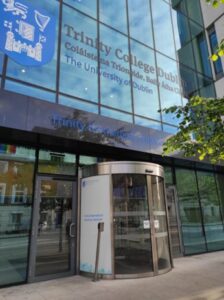
The Trinity Biomedical Science Institute – my workplace.
© Hannah Höche
ng the solution to my problems. After finding a group where I could complete my research internship and agreeing on the duration of the internship and the topic I would be working on, I started applying for Erasmus funding and filling out all necessary documents like the Traineeship Certificate. In addition, I applied for a leave of absence during that semester, which has to be done during the registration period for the following semester.
Accommodation and Living Situation in Dublin
Before I start explaining how I found an apartment in Dublin, I want to mention that this city is very, very expensive compared to Aachen and it is a real struggle to find an accommodation, which I was aware of before moving to Dublin, but the rent and the general cost of living is even higher than I would have expected. I would recommend starting to look for an accommodation as soon as possible, since a lot of apartments and rooms are listed for up to a year in advance, so even though I was searching for apartments where I could move in in April 2023, I saw a lot of offers for the following year. I used the popular websites daft.ie and let.ie, where you can also filter options like the number of rooms, the price or the duration of the rent. A lot of apartments and rooms can unfortunately only be rented for at least one year. I also looked up the location of the building I would be working in so I could find an accommodation reasonably near to be able to walk everywhere. In contrast to Germany, where you can use your semester ticket for public transportation, in Ireland you have to pay for every trip, but more on that later.
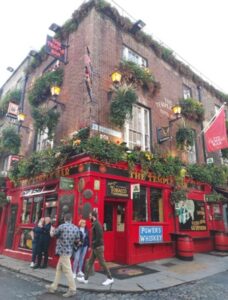
The Temple Bar.
© Hannah Höche
When finding a suitable apartment, I wrote to the landlord, but the reality is that they rarely answer, especially when the apartments have been uploaded to the websites for a few days. Therefore, I adapted my strategy and I searched for several times during a day to be able to immediately message the landlord when an apartment was uploaded – and I messaged a lot of people. It also helps to have a pre-written text where you only change the address. Sometimes they also offer online tours of the apartment, which is helpful when looking for apartments when still in Germany, but generally I had the experience that tours are in person. I also strongly advise to not just get an accommodation and transferring the money without having seen it and signing a contract, because there are rental scams in Dublin and even the websites of the different universities warn students to be careful. To be able to actually look for apartments and rooms, I would suggest to come to Ireland about one to two weeks before starting the internship or semester and then to actively go to apartment tours. I also prepared all the necessary documents so I could immediately express my interest in the accommodation. Generally, Dublin is divided into two areas by the river Liffey, and the south side is considered to be the “better” and safer area of Dublin. There are student accommodations, but they are also very expensive and generally hard to get, and my professor actually advised against trying to apply for the housing
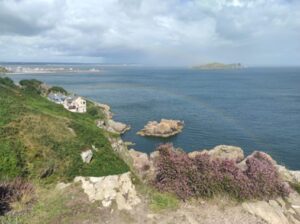
Howth, a peninsular village and outer suburb of Dublin.
© Hannah Höche
program and instead look for apartments.
In addition to the high rent, groceries and other necessities are more expensive than in Germany, so definitely try to save up beforehand. The public transportation also has to be considered, but you can save some money by getting the so-called TFI Leap Card, or the Leap Card for young adults in particular (aged 19 to 23). Although you can get pretty much everywhere by bus or the Luas, especially busses tend to be late and unreliable (at least outside of the city center). In this context, it has to be mentioned that tickets for the busses have to be bought from the bus driver when not using the Leap Card, and only coins are accepted.
Furthermore, I suggest checking with your insurance company whether you are insured for a stay abroad. Regarding phone calls, I just used my existing contract, there was no need to get a new one. Getting Wi-Fi for the apartment was a bit more tricky, because most internet contracts are only for at least a year, so I had to get a “pay as you go contract”, where you pay a certain amount every four weeks before you can use the internet, and I also had to buy a mobile router for that. You generally do not need to carry cash in Ireland (except for the bus as mentioned above), debit cards are widely accepted – if not everywhere. A lot of people also use Revolut (or sometimes PayPal). What I highly recommend is getting a credit card, because a lot of the tours I booked or sights I wanted to see could only be paid using a credit card. The bus companies that are driving to the airport (like Dublin Express or Aircoach) also only accept a credit card.
The Internship
I can honestly say that my research internship was one of the best experiences I had so far in a group. My professor Mathias Senge was a wonderful mentor and supervisor, who gave me my own project to work on and I learned a lot of skills that are useful and transferrable to any lab I will be working in in the future. My work day usually began at 9 am and ended at 5 or 6 pm and consisted of synthesizing my target compounds and purifying them, as well as literature research and the usual lab work. We also had regular meetings where we either presented our own research or papers from the literature we found interesting and helpful. I even got the opportunity to visit a conference and present some of my work in the form of a scientific poster. My colleagues in the lab were all incredibly nice and welcoming and helped me with any questions and problems. As for the requirements of the internship, I had to give an introductory talk and a final presentation for both my professor in Dublin and the professor supervising my internship from RWTH Aachen University, and I had to turn in a research report. In addition, I had to write monthly progress reports, but that was expected from my professor in Dublin and may not be a general requirement.
Free Time and Tips for Ireland
A lot of the Irish people I met told me that I have not really experienced Ireland if I only visit Dublin, and I can absolutely confirm that, Nevertheless, I want to start with some of the sights of the capital that I really enjoyed. Some of the museums in Dublin (The Dead Zoo, The National Gallery, The Archaeological Museum) are free of charge and definitely worth a visit. There are also several beautiful parks (Phoenix Park, St. Stephen’s Green, …) to enjoy, as well as distilleries that offer tours and tastings. Of course the popular tourist attractions like the Dublin Castle, Christ Church Cathedral or the
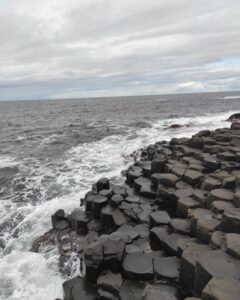
The Giant’s Causeway.
© Hannah Höche
Guinness Storehouse are also to mention, but they do cost money. A stroll through Temple Bar and along the river Liffey is also nice and free of cost. One of my favorite things was a visit to the Kilmainham Gaol, where I learned a lot about the history of Ireland – but tickets are very limited, so plan a visit 28 days beforehand to be able to get one (although there are sometimes returned tickets you might be able to get spontaneously). Lastly, a visit to any pub is pretty much a requirement and a lot of them have live music on the weekends, which makes a trip even more enjoyable.
Ireland has to offer such a wide variety of landscapes and nature spots, it is difficult to pick only a few. Not far from Dublin and reachable by the DART are Howth and Bray, where you can enjoy Cliff Walks and hiking trails. In order to comfortably travel, I recommend either the Irish Rail, bus services or booking trips from the popular tour operators, whereby the latter are quite expensive. Travelling by train is fairly straightforward and discounted tickets for students (a Young Adult Leap Card is necessary) are offered. The tickets can be bought online, but they have to be printed at the ticket machines at the train station (e.g. Heuston Station). Cities like Cork, Waterford and Killarney are easily reached via the train. Also, as a tip when visiting Cork, a little trip to Cobh, a seaport town and the last departure point of the Titanic, is absolutely recommended.
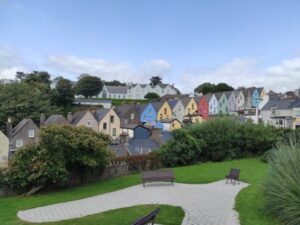
Cobh, a seaport town on the south coast of County Cork.
© Hannah Höche
In general, trips to Galway and the Cliffs of Moher, Kilkenny, Glendalough or even to Belfast and the Giant’s Causeway in Northern Ireland are an absolute highlight. The latter has to be one of the most beautiful spots I have seen, even though it is hard to pick a favorite. Even though a lot can be travelled by train or bus, some hiking trails or even cities and counties are unfortunately best reached by car.
Conclusion
I am incredibly grateful to have had the opportunity to spend a whole semester abroad completing a research internship. Not only could I acquire skills and knowledge in the laboratory and grow as a person and chemist, I got to make wonderful friends and see and visit the most beautiful spots I could imagine. My research internship taught me to work independently on my own project, which is very helpful as a preparation for both my master’s thesis and my aspiration to do a PhD. The only negative aspect about my stay abroad is the cost of living in Dublin, which would probably not have been possible for me to pay if I would not have had savings. Otherwise, I think it is an incredible experience to spend some time in another country and get to know the culture, and I would of course recommend Ireland as I really enjoyed my time there.
Research stay in Marseille
- Chemistry M.Sc
- France, Marseille
- Aix-Marseille Université
- 06/2023 – 09/2023
The possibilities for doing an internship abroad are endless. This made it difficult for me to decide, so I had to narrow down my choices. Thanks to my professor, I got in touch with iSM2 at the University of Aix Marseille in France. It was a dream for me to live by the sea for once in my life and improve the French I
learned in school. I emailed my contact person at iSM2 and she was happy about my interest and offered me an internship right away.
I found my accommodation through the website “La Carte des Coloc”. For a room of about 14 m^2 in an 80 m^2 apartment with 4 bedrooms I paid about 530 € per month. The start was difficult because there was no wifi and no electricity when I arrived. We had no electricity for 3 days and I had to sign a contract with EDF myself. Luckily my contact person at iSM2 helped me with a 30 minute phone call and we had electricity. But the tale of woe with this apartment and the agency “Colivers” would not fit into this report. Short conclusion: I do not recommend “Colivers” to others…. The apartment was located in Castellane, a very good area to live. From Castellane there are two metro lines, one of the three streetcars, many buses going to Cassis, La Ciotat and Marseille beaches and 15 minutes walk to the city center “Vieux Port”. A lot of restaurants are also nearby: McDonalds, Burger King, Vapiano, Go Ramen (5/5!), Shuriken Sushi (5/5!), … The boulangerie is also across the street and open 24 hours. To buy food, there are the supermarkets: Monoprix (super expensive), Franprix (close, small and expensive), Carrefour and Lidl (further away, 10 minutes walk). Compared to Germany, food is more expensive: in the supermarket and in the restaurants. In a bar, beer costs 6-8 € (50 cl) and long drinks for the same price. For a meal in a restaurant you pay between 15 € (cheap) and 23 €. The younger people go to Cours Julien and La pleine. Here there are many bars and restaurants at a cheaper price.
A lab day was always between 9/10 and 17/18. I took the metro and then the bus, which took about 30 minutes. Unlike in Germany, the entrance to the university is guarded.
The PhD student I was allowed to work with introduced me to her research and soon I was working independently. I was working on the catalysis of the degradation of cellobiose with LMPO-like catalysts. In a short time, I collected a lot of data using UV-Vis spectroscopy, fluorescence spectroscopy and HPLC. During the group meeting on Friday, I presented my results. The group was mixed with French, Indians, Brazilians, Spanish, Americans and probably more, everyone is welcome, and I felt very comfortable. Since I was there in the summer, the lab was pretty empty, and so was the campus. Everyone was fleeing the heat. I was able to try touch rugby on campus during a couple of practice sessions. It was a lot of fun, and I was sad that the practice was discontinued during the hot summer months. For lunch, you could bring something and eat with the others in the break room, or you could go there while the cafeteria was still open.
In my free time I spent a lot of time at the beach. My favorite places in Marseille are Vallon des Auffres, Prado (very beautiful sunset and many different beaches), Maldormé and Plage Catalans is nice because it was only 15 minutes from my apartment. I spent a lot of time in the Calanques, especially in the Calanques of Cassis. And there, the Calanque Port Pin is my favorite place. Once you reach the beach, you hike and climb a bit on the right side and then you reach a rock where you can lie down. The calanques of the Côte Bleue are also very beautiful. There my favorite place in La Redonne is
the port and the Calanque des Anthénors. To visit this place you can use the TER and with the Pass Côte Bleue you only pay 5 or 6 € and you can take the train all day. Many people also like Niolon, but I haven’t managed to go there yet, but I will on my next visit. Since I am very interested in sports, I tried climbing for the first time. I did it three times in the Calanques and I also bouldered in Arkose. It was so much fun and it is definitely a sport that I will continue to do in Germany. With Monde Vertical I discovered the Calanque of Sormiou and the one in Cap Canaille. The view of the different types of rocks and the sea was fantastic!
Since I was in a shared apartment, it was easier to make friends. But I also met some people through Bumble and the Erasmus Student Network (ESN). Unfortunately, the ESN didn’t offer any activities during the summer. But Marseille is so friendly and open that it’s easy to make friends even when walking around the city alone. I was also allowed to invite four different visitors so that we could explore the city together. I also had the opportunity to travel a bit. With a friend we went to Nice and Gordes du Verdon. Gordes du Verdon was fantastic and the Aqua rando where you float through the gorge was a lot of fun with an amazing view. Nice was a nice smaller town, but you could feel the different atmosphere. People were more well dressed and seemed more arrogant. We never had any really friendly service in the restaurants…. After our trip, we were very happy to return to Marseille. That’s what I love about Marseille. You can be who you want to be, and people don’t judge you. Some other tips in Marseille are: Bouillabaisse TURFU for a delicious
and small portion of bouillabaisse, Flashback at Vieux Port for a drink, co-working, lunch…, Green Meal for vegan and vegetarian food, Friche la Belle Mai as a nice event location, generally the metro card “la carte”, a visit to Cassis: a very cute little town, L’Art Haché: a hidden bar at La Pleine with jazz music (when we were there) and they only accept cash.
Feedback: Before I came to Marseille, I seemed very happy in Germany and didn’t want to leave. In the first weeks I could not imagine life in Marseille. Compared to Germany, it is very chaotic and disorganized, rules have less importance, and it is very dirty (the city has a big garbage problem…). But once I got used to the city and the lifestyle, I started to love it. I had a fresh start and could be who I wanted to be. I made some friends and the scenery with the Calanques is just amazing! I was very sad to leave Marseille and the lab, even though I didn’t quite like the topic in the internship. I gained a lot of valuable experience, and I am so grateful that I had the opportunity to be in Marseille and in the iSM2 lab! I am very sad to leave and if a new opportunity to come back to Marseille arises, I will be very happy.
Making magical memories in Paris
- Medicine
- France, Paris
- Sorbonne Université
- 07/2023 – 09/2023
Application/Finding an internship.
For quite a long time I dreamed of going to Paris for working and living there. That`s why I decided to spend 2 months in this beautiful city during the practical year in my medical studies. Once my intention was clear I started looking for contact persons being responsible for international affairs at my preferred university, the Sorbonne. After several email exchanges with the head of the international office at the medical faculty, I received a list with free spots left for my preferred period. Fortunately, I sent my application early enough (nearly one year in advance), so a few free places were still available; I hereby confirm applying as soon as possible because even one year in advance, places were limited and already reserved for French students. In the following, I had to upload my application with all the necessary documents (including CV, proof of language, Health insurance, Letter of motivation, Erasmus-Learning Agreement) on a Sorbonne interne platform to complete my application. I also applied at the medical service directly (even when the head of the international office will manage this for you) to get sure of having tried my best for realising my dream.
Accommodation & Living expenses.
Living in Paris is quite expensive. As all the big cities in the world, cheap apartments near to the city centre are rare and the housing market is hardly disputed. Personally, I was quite lucky because I knew another Erasmus-student who was looking for the next tenant. What I can really recommend for finding an accommodation is to participate in a preparing course of “Campus France Deutschland”. There you will get plenty of tips on which platforms you can find a room for your stay for example “La carte des collocs”, “leboncoin” or “A partager”. For the monthly rent the average price in Paris should be estimated with 700-1000 Euro. If you are lucky enough to get a place in a student housing, like “The Crous”, the rent will be lower, but places are hard to get, and you have to apply early in advance.
Paris is divided into different districts. I have lived in a multicultural area near to the train station “Gare du Nord” not far away from famous Montmartre, known for its artistic history and the well-known church Sacré-Coeur. Even when this area is renowned for many conflicts in the past due to poverty issues and immigration conflicts, I really appreciated living in this area during my stay because it gave me the possibility to get an authentic insight how it feels to live in Paris not as a tourist but as an inhabitant. Besides, there are many charming restaurants in the streets around the hill of Montmartre and street life is always vibrant. Compared to Germany, food prices are much higher in the supermarkets. For vegetables and fruit, the cheapest way is to go to the local market which takes place on Wednesdays and Saturdays just near to the metro station Barbes-Rochechouart.
Everyday life/ the internship
During my internship I worked at the university hospital Saint Antoine in the 12th arrondissement, near to “Place de la Nation”. To get there I took the metro, the Parisian subway, which is quite the easiest way to move around the city. Sometimes I went by bike which was also a wonderful experience. I really enjoyed cycling the big boulevards and nearly everywhere you can find spots to rent a bike, I truly recommend discovering Paris by this. In the hospital, medical students so called “externs”, work under the supervision of “interns”, who have already finished their studies. Thanks to the system that every student is guided by a certain medical staff member, there is always an experienced person which you can ask for help. My daily tasks included the anamnesis and physical examination of patients, including the medical documentation of each patient concerning their progress of disease and therapy. Two times per week there were assemblies where the disease history of every patient was discussed with all doctors of the service. Normally medical teachings for students were planned for Friday mornings but not during summer. In general, my working day started at 9 in the morning and ended in the afternoon. All in all, I got the impression that patients were treated in detail and that the medical staff invested a lot of time for personal contact.
Free time/tips
Paris as a city has so much to offer: Whether museums, parks, bars and restaurants – there is something for everyone. Since I had already been to this wonderful city several times before my Erasmus stay, I was able to focus on a Paris off the beaten path during these 2 months. 4 days after my arrival, one of the biggest events of the summer was on the agenda: “La fête nationale”, the French National Day. In addition to the morning parade over the Champs-Elysées, where President Emmanuel Macron was received like a pop star, the Eiffel Tower shone in full colour on the “Champs de Mars” in the evening. With such an impressive firework, which is unparalleled, one can get an idea of the pride with which the French revere their country. And they are right! When thinking of France, everyone immediately conjures up images of fragrant croissants, picturesque cafés and a good glass of wine – if a country had invented pleasure, the French would be right at the forefront. Paris itself has so many boulangeries and delicacies to offer- probably a whole year would not be enough to test all of them. Since I lived in Montmartre district, I went on a culinary discovery tour especially there, what I can recommend to everyone. In the small streets not far away from the church “Sacré Coeur”, your own taste buds are sent on a world tour: Whether it’s a typical local flan, oriental couscous from Morocco or Argentinian empanadas – the 18th arrondissement lives cultural diversity on all levels. In case you feel homesick, you should order a portion of potato salad with Wiener Schnitzel including wheat beer fresh from the tap at the beer garden of the “Kiez Kanal, a lovely place near to the “Bassin de la Vilette” . In addition to culinary variety, Paris also offers an immense wealth of mental nourishment: from classics such as the Louvre, the Eiffel Tower or the Champs-Elysees to lesser-known leisure activities such as a walk along the disused railroad line “Petite Ceinture” or a visit to the impro theatre “Theatre de la Gaite” at Montparnasse district – boredom is a foreign word in Paris! On the other hand, if you feel more like nature and relaxation after the hustle and bustle of the crowds, you will find plenty of green spaces in numerous parks, such as the “Buttes Chaumont” or “Bois de Vincennes”, to unwind.
Conclusion
Describing Paris in a few words remains impossible. This city simply has so much to offer that even the Parisians admit discovering new facets each day again and again. For me, it has always been a dream to live in Paris one day and to be able to immerse myself in everyday life. After these 2 months I am incredibly grateful to have made this experience. I’m taking with me a suitcase full of magical memories back to Germany; impressions of a city whose charming atmosphere is always worth a trip. I was able to learn a lot, both professionally and personally, and I am firmly convinced that I can make use of the skills I learned here in the future. To anyone who has good command of the French language (or is willing to learn it), without exception, I would immediately recommend doing an internship abroad in this wonderful city, it is a once-in-a-lifetime opportunity that may not return anytime soon! Or as Audrey Hepburn put it: Paris is always a good idea!
Writing a Master’s thesis in Sweden
- Business, Economics and Management M.Sc.
- Sweden, Västerås
- Scandinavian Real Heart
- 04/2023 – 09/2023
Application
First, a little context: In addition to my Master’s degree in Mechanical Engineering with a focus on R&D, Production and MedTech, I enrolled in the Business, Economics and Management M.Sc. programme at RWTH Aachen University. In order to wrap up my time at university, I was looking for an opportunity to write a Master’s thesis. Since I had already spent some time abroad for my Bachelor’s thesis, I wanted to dive headfirst into a new adventure. Preferably at a company with an interesting product. As luck would have it, a research assistant friend of mine knew of my ambitions and pointed me to an posting on LinkedIn where a company was looking for a student. I updated my CV, spent some more time refining it, and applied via the company’s homepage. I had my interview and was accepted. Officially, I was an intern there and not enrolled as a student at a university. This is important because it meant I could hardly take advantage of the benefits that Erasmus or Swedish students get.
If you are looking for an internship or a thesis, institutes are a good place to start because they often work with companies or at least are in contact with some. In my experience, research assistants and lecturers are happy to help or guide you if you approach them in a friendly way.
Accommodation and Living expenses:
After spending about six months here, I can say that Sweden was expensive for me. The company is located in Vasteras, an hour’s drive west of Stockholm. I would estimate that the cost of living in Sweden is the same or up to 20% higher than in Germany. However, this is highly seasonal and depends on where in Sweden you are and your standard of living. In addition, wages are lower in comparison. This is due to the non-financial and social benefits that Swedes, and Swedish students in particular, receive. You should always ask for student discounts as they exist in most places.
Although I was offered help with finding accommodation, this was not very successful. Good places to look for rooms or flats are blocket.se, facebook market place or facebook groups. There you have a good chance of finding an affordable flat. Facebook market places and second-hand shops are also a good way to buy things you need.
It is important to know that Sweden is striving to become cashless.Some places don’t even accept cash and I personally haven’t used it once.For a Swedish bank account, you need a personalised number issued by the government, which might be hard to get if you stay less than a year.The Swedish equivalent to paypal, which is rarely found in Sweden, is called Swish.Most Swedes use it and you can even pay in shops with it.Unfortunately, it must be linked to a Swedish bank account. Make sure you can pay cashless and in Swedish kronor.
Everyday life/internship
I arrived in Sweden in April and stayed until September. There were about 15 full-time employees at the company’s headquarters in Vasteras. Most of them came from all over the world and it was fun to get to know and work with them. Typically, hierarchies in Sweden can be rather flat, so I got to know everyone and the atmosphere was fantastic. I was also introduced to the concept of fika, which are short breaks where you sit together and typically drink coffee and eat the famous cinnamon buns while talking about anything but work. I think that’s something I want to incorporate into my life in the future.
One slightly strange thing I didn’t know is that Swedes take four weeks off during summer, usually in July and August, which meant that I was the only team member in the office most of the time during those months.
Especially in these summer months, people spend a lot of time outside when the sun hardly sets. However, it took some time to get used to the excessive daylight hours. The sun set at 11pm on average and rose again at 3am in early summer. Since it doesn’t really get dark at night, more than once I woke up at 4am thinking I had to get up and go to work, only to find that I still had plenty of time to sleep. This gives you plenty of time to explore the surroundings. Although public transport is good in Sweden, many people walk or cycle in the cities. I highly recommend getting a bike and locking it up. For more exploring, you should either look for a bus or train connection.
Free time/tips
During my stay in Sweden I was very busy, so I spent most of my time either in the city or in Stockholm. I can only speak for the summer time, which is the best time to stay in Sweden according to the locals. If you like nature and exercise, you’ll get your money’s worth. You can do everything here: Hiking, cycling, kayaking, fishing, swimming, camping and much more.
There are many places to visit and weekend trips are a great way to see different towns and parts of the country. There are many Facebook groups you can join to find things to do. If you want to go out to eat, the lunch deals that most restaurants offer are a good and cheap option. I tried a lot of venues this way without breaking the bank. The Highlights for me where the midsummer bonfire, the northern lights and the nearby lake.
Conclusion
I enjoyed my time in Sweden. Since almost everyone speaks fluent English, you don’t have any problems communicating. I learned a bit of Swedish using an app and other resources. Which was fun because it’s very similar to German and English for me. I spent a lot of time outside and had a blast. But there are also some downsides. First, almost everything is expensive, and at least for me, the quality for what you get is not really up to par. Especially on a small budget, this can affect your time in Sweden and limit the options you have. Fresh produce is expensive and the quality and quantity was really lacking for me at times. The same goes for going out. Although Vasteras is one of the biggest cities in Sweden, it feels more like a small town. Depending on what you are looking for, you might be really disappointed. If you want to have a drink, you will also quickly find out that alcohol is very expensive. You can usually only buy it in special shops that close at 6 pm.
Overall, you should inform yourself about what you are getting yourself into. There is a lot of information to find out if Sweden is right for you. I had a lot of fun and learned a lot.
Internship in Liechtenstein
- Electrical Engineering, Information Technology, and Computer Engineering M.Sc.
- Liechtenstein, Schaan
- Hilti Group
- 03/2023 – 09/2023
Application
My internship was mandatory for the completion of my master’s degree in electrical engineering. For this,
I went to the headquarters of Hilti AG in Liechtenstein. Hilti is a tool manufacturer and one of the big
players within the construction market. Being an electrical engineer, initially I was not sure about
opportunities I would have there to combine the internship with my studies. However, through the main
careers page, I filtered all “electrical engineering” positions and found an intriguing position on battery
research. For me, the application was quite straight forward. After submitting my documents, my
supervisor reached out to me just a couple of days later. Here I have heard different stories. Some interns
were waiting for weeks for their response and still got accepted. The answering time depends on the
team, so a fast or slow response does not have to mean anything. My supervisor invited me to a technical
interview. In my case I did not get any detailed questions on certain processes or calculations.
Afterwards, HR invited me to a second interview. The main purpose was to check that I comply with all
regulations. Between submitting my application and receiving the offer, less than two weeks passed. After
I signed the contract, HR sent me a pdf containing all sorts of information on the area, leisure activities,
the dress code in the office, data to put in the forms for the Erasmus+ scholarship etc.
Accommodation
I applied about four months in advance, giving me a lot of time to prepare the stay. Shortly before the
start of my internship, HR sent me some forms, because the workplace is in Liechtenstein, but because of
EU regulations I was only allowed to live in Austria. With few exceptions, all interns live in Feldkirch, the
town at the border to Liechtenstein. For finding an apartment I recommend the websites wg-gesucht and
laendleanzeiger.at. I personally found my apartment on wg-gesucht. Since I wanted to move in with a
friend, we had some troubles to find a suitable apartment because there is not a lot of offers. In general, I
got the impression that many rooms are rented to people through personal contacts rather than the
internet. The rent is usually between 500 and 700 euros. For a restaurant visit I would account around
20€. Feldkirch has a large Interspar in the centre and another Spar towards the Liechtenstein border,
which are both quite expensive. There is also a Lidl and an Aldi (called Hofer) as cheaper options. Since
most shops close between 6 and 7pm already, I usually managed my weekly groceries on a Saturday.
Getting started in the first few days
No matter where you live in Feldkirch, the commute to work will always take around 20 minutes to work.
There is a train with four stops in Feldkirch and a stop right in front of Hilti. At the main station in Feldkirch
you can buy a yearly ticket allowing to take all trains and buses in Vorarlberg for free including the train to
Hilti. The ticket will always be valid from the start of the next month, so if you are in the area a couple of
days earlier, consider checking out the train station as soon as possible. Since many interns come and
go, it is also easy to get a bike which was especially nice during the summer days. Hilti also has some e-bikes that can be borrowed for 24 hours through the urban connect app. Next to figuring out
transportation, you also have to register at the town hall and at the tax office in Feldkirch. The tax office
will hand you out a form specifically for the commute between Austria and Liechtenstein, where you will
have to state your monthly income, expenses and enter personal data. After some time, you will receive a
letter stating the total amount of taxes that you have to pay for the year. Taxes are around 20% and HR
can always answer your questions regarding this topic. Finally, I also had to create a bank account for
Swiss Franks, because Hilti pays its salary in this currency. There are two main options. The ups bank in
Buchs and the Sparkasse Feldkirch. I decided to open a free Swiss Frank bank account on top of an
obligatory Euro bank account at Sparkasse Feldkirch. I had the option to transfer the money myself. This
option worked out well for me.
Everyday life
My daily routine started with getting up to get to work early. Although no one set any rules, everybody
arrived around 8am. There is a small gym on campus, and I went there in the mornings, since after work
it gets quite busy. The tasks vary a lot from one internship to another. I was mostly working
independently, but I also heard from interns with a packed schedule of meetings. In Liechtenstein, lunch
is already at 12 and some teams go even earlier. There is a canteen on campus, but the prices are more
on the Swiss side. With a few exceptions I always brought my own lunch and joined my team then. Every
floor has multiple kitchens that include a microwave to heat up food. Typically, everyone stays in the
office until 5pm. At Hilti, you are usually always occupied, and you get the opportunity to overtake some
responsibility. I had less free time, than I expected, because with the commute, sports, and cooking, a big
amount of the evening was consumed already.
Nonetheless, I had an amazing experience during my internship. There is always a huge number of
interns at the headquarters. HR organises get togethers every week, so I got to know many people
already from the start. A small team of interns organises workshops in a more or less monthly schedule.
The topic comes from employees within Hilti, so every time you discover challenges in a new area of the
company. I joined this organisation team, so I stayed in touch with these case owners and had the
opportunity to work on my presentation and organisation skills. Next to being insightful, the workshops
were a great opportunity to meet new faces and just have some fun. Furthermore, Hilti has a broad
offering of leisure teams. I joined the football team that meets once a week. During winter, we played
indoors and after April we went outside on a big pitch. Hilti also organised a campus run, sponsored
tickets for a concert in the opera in Schaan and took over the fee for the Zurich marathon. The sign up for
all these events is on a first come first serve basis, but they are announced in advance on the internal
webpage.
What to do around the area
During the weekends, I was mostly hiking. Cool hikes around the area are Schesaplana which can be
reached by public transport or Hoher Kasten. I definitely recommend doing Säntis and three sisters, but
they are a bit tricky in some parts, so they should not be done as the very first hike. On warmer days, you
can always find people who want to join to go to one of the close by lakes. There is Gamprin in
Liechtenstein, which is a small lake for bathing including changing rooms, a small football pitch, a
basketball court, and a beach volleyball net. Another nice lake is in Feldkirch. Everybody refers to it as
the Hilti Lake, but on a closer look at google maps, the actual lake is next to the Hilti Loch. A bit further
away, but a lot bigger is Walensee. During my time I also visited some cities. During one of the long
weekends around May and June there was enough time to spend several days in Vienna. There is a
direct night train between Feldkirch and Vienna.
Conclusion
Overall, I can recommend spending an internship at the headquarters of Hilti. The application process is
straightforward and the organisation before the start of the internship is also not too hard. HR knows
about all the regulations quite well and is always happy to answer questions. It is easy to find new friends
because there is so many interns there. The area with all the mountains and lakes is nice in summer as
well as in winter
Practical year in Innsbruck
- Medicine
- Austria, Innsbruck
- University Hospital Innsbruck
- 07/2023 – 09/2023
- application
I sent an application with a letter of motivation, curriculum vitae and certificate of matriculation to Monika Schlager about 1 ½ years in advance. She is the international coordinator of the medical faculty and responsible for Erasmus students.
Ms. Schlager answers very reliably and quickly and sent me an internship confirmation within a few days. The places in Innsbruck are very popular, which is why it is worth applying early.Only whole months can be done in Innsbruck, so it is only possible to start on the 01st of the month. The wards Oncology and Gastroenterology were assigned to me by Mrs. Schlager, but if you have desired wards, you can certainly indicate that.2 Accomodation/ Living
Austria and especially Innsbruck are a bit more expensive compared to Germany.
I started looking for accommodation about two months before the start of my internship. I mainly looked through the site WG-gesucht and found there a two person shared appartement in close proximity to the main train station as well as 5 minutes by bike to the clinic.
The rent was quite expensive at 630 euros for a shared apartment.
Overall, it is quite difficult to find an apartment/room in Innsbruck. In the summer months from July-September it is a bit easier, because the students have semester break and many sublet their apartments. In November/December or in March it is a bit more difficult to find something.
Food prices in Innsbruck are also about 20-30% more expensive than in Germany.
You get free lunch in the hospital, but you only get the Erasmus money and don’t get a salary anymore.3. the internship
I liked the internship in internal medicine very much. In Innsbruck, unlike in Germany, there is not such a great shortage of doctors. On the oncology ward, we were partly three doctors and I for a total of 8 patient rooms.
The working hours are also much better than in German university hospitals. It is rare that the interns have to work overtime.
The relaxed atmosphere made the internship very pleasant for me. There was always a doctor who had time to show or explain something to me.
My main duties were admitting and educating patients, writing discharge letters, some blood draws (when nurses couldn’t do it) and pulling CVCs and drains as well as helping to supervise famulants. When there was time, I could always grab the ultrasound machine and practice on patients. My working day usually lasted from 8 am – 4 pm, but if there was little to do, I was often sent home around noon.
The head physician and the senior physicians of the ward are also very friendly and like to explain or do a little teaching during rounds. I was there for a total of two months.
The last month I was in gastroenterology. Here the doctors were also very well staffed and my tasks were similar to those in oncology. Overall, however, I liked the ward work a little less, as hardly anything was explained and there was little teaching.
Unfortunately, it was not possible/desired to look after patients myself from the beginning to the end of treatment.
What I found very positive was that, unlike in Germany, less attention was paid to the money and the patients were very well cared for and treated.
Overall, I can still highly recommend an internship in Innsbruck. The doctors are all very nice and always have an open ear for questions. You can work independently but also leave earlier if there is little to do. It is also possible to accompany doctors on duty in the emergency room, where you can learn and see a lot.4. free time
Innsbruck is a paradise for those who love climbing/hiking/mountain biking or road biking. In winter it is of course also a dream for skiing/snowboarding.
During the week I was often in the climbing/bouldering hall, where you often saw world famous climbers.
On the weekends I went hiking and climbing in the surrounding area. Unfortunately, I met few other Erasmus students. However, through various Facebook groups, it is easy to make friends with other people who are new to the city and thus find connections quite quickly. The mountains around Innsbruck are beautiful and you can go there easily by bus/ train.
- conclusion
Overall, I can recommend an internship or a tertial in Innbruck to anyone who wants to get a good teaching and something out of the internship, but who also knows how to value his free time and especially likes outdoor activities.
I found the comparison to Germany, where doctors in university hospitals often work 4-5 overtime hours a day and the treatment of patients is much more focused on money, very impressive.
