
Kategorie: ‘Bachelor’
My semester abroad in Chile, Valparaíso
- Business Administration and Engineering: Civil Engineering B.Sc.
- Chile, Valparaíso
- Pontificia Universidad Católica de Valparaíso
- 07/2025 – 12/2025
Before the stay
The application process went smoothly, but the final confirmation from the host university arrived relatively late, just two and a half months before the start of the semester abroad. Due to the late confirmation, I did not apply for a visa but entered the country on a 90-day tourist visa and then left the country after three months for some days (a 10-hour bus ride to Argentina), which was very straightforward and is what most exchange students did.
The language requirement was B2 in Spanish, which I was able to prove through the RWTH Language Centre.
Arrival in the host country
©International Office
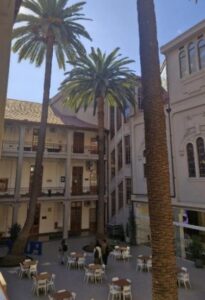
I lived with a Chilean host family for the first month, which I can highly recommend if you want to arrive in a relaxed manner, but it is of course more expensive than a shared flat. After that I moved to a shared flat with Chilean students I got to know in the first month. A week before lectures began, the PUCV organised an orientation week for us, which was very well structured and provided interesting insights into the culture and helpful information about safety, the university and the peculiarities of Chilean Spanish.
It also provided an opportunity to meet other exchange students and make friends. During the first few weeks, I did a lot with the other exchange students, as we all wanted to get to know the area and didn’t have much to do for university yet.
Academic Experience
During orientation week, everyone had a personal meeting with the coordinator to finalise their course selection based on the timetable.
©International Office
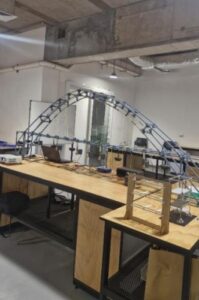
I successfully completed four of my five courses (14 CP) and was able to get Massivbau 1 and Operations Research credited at RWTH. I dropped the fifth course because it built on a course I hadn’t taken in Germany. Overall, it was quite a challenge due to a lack of prior knowledge in some areas because Chilean Spanish (even that spoken by the professors) is not so easy to understand. However, my Chilean fellow students were very open and helpful, so I was able to keep up well everywhere and, over time, it became easier for me to understand everything. Compared to Germany, the system is definitely much more school-like, with obligatory attendance, group work, tests and mid-term exams. If you do well there, you often don’t even have to take the final exam. If you choose a lot of courses, you should definitely be prepared for the university to take up a lot of your time during the semester, but the exam period is significantly shorter than at RWTH.
Overall, I was very satisfied with my university, as the support for exchange students was very good and the professors were very accommodating when problems arose. I also found the atmosphere in class very pleasant, as the courses are much smaller (max. 30 people) and the relationship with the professors is very relaxed. There were very few other exchange students in the engineering faculty, as most of them go to Santa Maria University, but this made it easier for me to socialise with my Chilean fellow students, who were very interested in getting to know an exchange student. The group work definitely helps with this too.
Tips for interested students
©International Office
If you want to live in a shared flat, it is a good idea to stay in a hostel at first and then view shared flats on site to get a better impression of the condition of the flat and the location. There are lots of offers on the compartodepto website, most of which are available immediately.
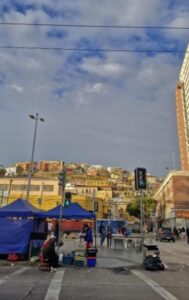
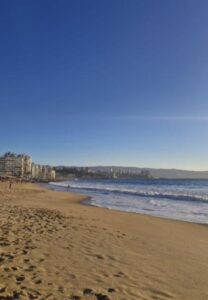
Although my university was in Valparaíso, I lived in Viña del Mar, as it is much easier to get to the beach there and it is also much safer than Valparaíso, especially at night. However, if you want the full South American experience, I would recommend living in Valparaíso, as it is much livelier and more colourful. Nevertheless, if you want to move to one of the hills, you should find out about safety beforehand.
In general, criminality is kind of a problem in Valparaiso, but if you listen to the tips of the locals and e. g. do not walk alone in the streets at night and take care of your valuables, you don’t have to worry.
©International Office
Valparaíso and Viña del Mar have a lot to offer in terms of leisure activities. I especially enjoyed being so close to the beach. On Fridays and Saturdays in particular, exchange students often had the opportunity to go to clubs for free. I really liked the Dichere event (formerly MundoLingo), which took place every Wednesday evening in a bar in Viña, where you had the opportunity to meet other exchange students and Chileans.
The university also offered fun activities, I participated for example in a traditional dance class.
In Concon, you can go surfing for little money, and the conditions are usually good for beginners. Other cool places to visit nearby are the botanical garden, the Cerro Alegre district and the dunes of Concon. Special highlights for me were the national holiday on 18 September, which is celebrated extensively in Chile (all through September) and the New Year’s Eve fireworks over the sea. I would also highly recommend travelling to both the north (Atacama desert) and south (Patagonia) of Chile, but you need to plan enough time for this due to the distances involved.
Finances
For the first month, I lived with a host family on full board for $550, then much cheaper in a shared flat. I received the PROMOS scholarship, which mainly helped me cover the flight costs and health insurance costs. Food in Chile is not much cheaper than in Germany, but leisure activities and single tickets for public transport (less than 1 euro) are. Overall, if you exclude travel, thanks to the scholarship, I managed well with the money I would normally spend in Germany.
Academic value of my stay
From a civil engineering perspective, I found the topic of earthquake-proof construction very interesting, which is why I took a course on it. It was very exciting to experience a few little earthquakes myself and see how well the buildings dampen the movement in reality so that you hardly notice anything. It was also very interesting to see how different the building standards are between Chile and Germany and what impact this has on the calculations.
My Spanish improved enormously during the semester and I also learned many technical terms that are needed in a professional context.
Sustainable character of my stay
In terms of CO2 emissions, the long-haul flight to Chile and back is obviously very harmful, but during my travels through Chile I tried to avoid flying as much as possible and travelled by bus instead, which is really comfortable in Chile!
Personally, the semester had a lasting positive impact on me and helped me mature, as I learned to live outside my comfort zone, adapt to unfamiliar circumstances and solve problems independently.
The Chileans were very open-minded towards me and welcomed me into their groups of friends, which allowed me to make some very good friends and gain a deep insight into the culture. With this new cultural understanding, I can well imagine working in an international context one day, and it gives me a better understanding of how foreigners living in Germany feel.
I have also learned to appreciate the privileges I have in Germany – for example, the freedom to walk around alone at night, the good infrastructure and financial security.
Conclusion
I am very grateful that I had the opportunity to take part in this exchange and get to know a new culture and make new friends. Of course, it was also exhausting to be outside my comfort zone, speaking Spanish all the time and having to adapt to a foreign culture, but it was definitely worth the effort. If I had been able to get more credits for my courses, I could well have imagined staying for a whole year.
My Internship at the Manuscriptorium in Czechia
- Philosophy, Literary and Linguistic Studies B.A.
- Czechia, Prague
- Manuscriptorium Digital Library of Written Cultural Heritage
- 06/2025-07/2025
Application
I heard about the internship opportunity at the Manuscriptorium (part of the National Library in Prague) from an online article I read. I applied online and after a short period of time they agreed to let me do the internship in Prague. I applied for the Erasmus internship support with the help of RWTH. After filling out the forms I received the confirmation shortly after. The whole process was easy and straightforward.
Accommodation
Finding accommodation in Prague is very difficult and the prices have risen over the years. The locals in Prague told me that finding a flat is even difficult for them. I got a small furnished room in a shared flat with five other people who were also mostly international students. My room was close to the city centre, and I paid 15900 Kč (~640€). For other students I recommend getting a room further away from the centre and looking through Facebook. The public transport in Prague is cheap and amazing, especially the trams and the metro. I paid around 20€ a month and could use every tram, metro, bus and train inside the centre and the surrounding area.
Everyday life in Prague and tips for other students
I really enjoyed living in Prague as it is a very beautiful and big city so there is always something to do. I tried learning some Czech, but it is very difficult and since I only spend two months in Prague and the language at my internship was English, I only learned a few words and sentences.
During the first weeks I often visited the famous tourists’ spots like the Prague castle or the Charles bridge. There are also a lot of beautiful churches that I visited, however in Prague you often must pay to go inside them. Since the city is so beautiful and has a lot of amazing architecture, I also often just walked through the city looking at the buildings. I also met some Czech students that I went climbing with or went to the cinema or the bar. I also visited a lot of exhibitions. In my time in Prague, I went to the Mucha and the Kafka Museum and saw a David Lynch exhibition as well as one focusing on women artists throughout the ages. Surrounding Prague is also a lot of nice nature. I went to Divoká Šárka, which is a nature reserve with a big lake that was perfect for swimming. There is a website called goout.net that I would recommend to all students going to Czechia, it shows concerts, museums, parties and many other events happening in Czechia, but it is also available for Slovakia and Poland.
I also went to some tea rooms that are very cozy and nice if you enjoy freshly brewed tea. In Prague there were also many bistros. Many of these are affordable (the price is calculated based on the weight of your meal) and offer vegan/vegetarian food. Because I am vegetarian I ate at these places a lot. Since Czech food is often made with meat, I could not try a lot of it but there is a meal called Smažený sýr which is fried cheese and fries and tastes nice. Many places also sell homemade lemonades that I can highly recommend, the one I liked the most is Malinovka, which is raspberry flavoured.
Work
I really enjoyed working at the National Library which is inside a beautiful building near the Charles bridge. It was my job to help catalogue medieval manuscripts with XML according to the TEI guidelines and prepare the files for publishing. For this I was first given a good introduction into XML and the cataloguing of medieval manuscripts. I would then start by doing a rough draft for each manuscript and then refining the files multiple times, adding more information about the manuscript and fixing mistakes. The people working at the library were very nice and helpful.
As well as the cataloguing I helped by popularizing the manuscripts by writing articles about them. I really liked the internship since I got to learn XML as well as the TEI-Guidelines which are often used in digital humanities projects. I also enjoyed that I got to learn about medieval manuscripts in the process, since I am very interested in history.
Conclusion
I really enjoyed my time in Prague and met a lot of amazing people. I was a bit nervous at first about going away, however it was a good time, and I would like to experience something like this again. The city is beautiful, and I appreciate that I got to do the internship and learn new skills.
My Internship at a Geotourism Company on the Island of Ischia
- Applied Geography B.Sc.
- Italy, Ischia
- Eurogeopark
- 04/2025 – 06/2025
Application / Search for an Internship
In February, I was faced with the task of finding an internship for my bachelor’s degree. I wanted to do something exciting and varied – preferably nothing that took place solely in an office. So I searched the internet and came across an advertisement for a ‘GEO internship on the island of Ischia’ from the company Eurogeopark. My interest was immediately piqued: a green island in the Mediterranean, just off the coast of Naples, geological hiking tours on volcanic, geological and botanical topics – and all of this for three months in Italy. I was immediately convinced. I applied directly via the email address provided with the required documents and received confirmation of the internship starting on 1 April on the same day. However, before I could get started, I had a few things to organize: the university had to recognize the internship abroad, I applied to Erasmus+ for financial support, looked for accommodation and planned my journey.
In the end, I decided to travel by train. A few days before I was due to start, I packed my things and travelled via Zurich – with an overnight stay – to Naples, from where I took the ferry to my destination island: Ischia.
Accommodation & Living Expenses
Eurogeopark did not provide me with accommodation, so I initially looked for a flat myself – which proved difficult. Three months is too long for holiday flats, but too short for regular rental contracts. Finally, I turned to my boss, who put me in touch with someone locally. I found a great flat in Ischia Porto, only about a 20-minute walk from the harbor and center of the city.
The flat was large – almost too large for one person – but it was perfect for entertaining guests. It had two bedrooms, a bathroom, a dining/living room, a kitchen, a balcony and was equipped with everything I needed: stove, oven, pots, dishes, washing machine, WiFi, etc. I paid €17 per day, which was quite cheap compared to the offers on the internet. At the end of my stay, I had to pay about €70 for utilities (gas, electricity, etc.).
The location was very convenient: two supermarkets were about ten minutes away, and mini markets for fruit, vegetables and everyday items were also nearby. I received €235 per month from my internship provider as salary and for the bus ticket. I would definitely recommend the monthly ticket (€33.90) – the bus system is well developed and takes you almost everywhere on the island. Alternatively, you can rent a scooter or an (e-)bike, but you should bear in mind the chaotic traffic and narrow streets.
Everyday life/Internship
Eurogeopark offers geological and botanical tours in the form of hikes and minibus tours on Ischia. The focus is less on cultural content and more on scientific topics such as volcanism and geology. There were a total of five full-day tours, two short tours and three minibus tours, which were offered daily or weekly. The aim of the internship was for us – three interns – to be able to lead the tours independently. At the beginning, we therefore walked each tour twice together with the employed geologist Yvonne in order to familiarize ourselves with the content, routes and procedures. After that, the three of us led our first tours to gain confidence. We had access to a comprehensive internal file with background information on each tour. From about the third week onwards, a fixed three-week rhythm of home office, short tours and day tours established itself. The tours usually started at 10:00 a.m., and we were supposed to be at the meeting point at around 9:30 a.m. Depending on the tour, the day ended around 3:00 or 4:00 p.m. Afterwards, I took care of organisational tasks from home.
Saturdays were work days – but without guided tours. Instead, we distributed brochures in hotels, restaurants and bars to draw attention to the offer.
Working from home, we took care of social media channels (e.g. Instagram, Facebook, GetYourGuide, TripAdvisor), created posts about events, planned posts and promoted the channels. I also wrote hotel descriptions for tourists. If we didn’t finish everything on Saturday, we distributed more brochures during the week. Depending on what was needed, we also helped maintain the hiking trails – for example, by clearing overgrown paths.
At the end, each of us was given our own topic for a blog post. My topic was mapping the vegetation along the trail, which I did while working from home. This allowed me to significantly expand my botanical knowledge.
Language
It was not necessary to speak Italian for the internship, as the guided tours and internal communication within the company were conducted in German. Even when it came to organizational matters, such as in hotels or with transfer drivers, I usually got by fine with German or English. Nevertheless, it was nice to use simple Italian phrases from time to time in everyday life – especially when making small purchases or in cafés.
Support & Contact Persons
I did not need to seek direct support from Erasmus+ or the university during the internship, as everything worked well in terms of organization. I was also lucky with my accommodation: if there were any minor problems, I could always contact my landlady. She was very friendly and helpful, which made it much easier for me to settle in and get through everyday life on the island.
Free Time/Tips
In Italy, a 6-day working week is still common, so I had Sundays off. I usually spent this day with the other two interns exploring the island or the surrounding area. We already knew some a lot places from the guided tours, but on our days off we discovered things like thermal baths with natural thermal water or visited sights such as the Castello Aragonese. A day trip to the neighbouring island of Procida is highly recommended – there you will find classic Italian idyll with colourful houses and narrow streets. For those interested in geology, trips to Pozzuoli (Solfatara) or Vesuvius are worthwhile. Sometimes, however, I simply stayed on Ischia, relaxed on the beach with a book, went swimming or strolled through the narrow streets. A personal highlight was Pelara Bay: secluded, surrounded by volcanic nature and with fantastically clear water – perfect for unwinding.
As I had no direct contact with the university or other student groups, I didn’t meet many new people. I spent most of my time with the two other interns and friends who visited me. The atmosphere at the company was more businesslike than friendly, so I didn’t develop any close relationships outside of work. There were many festivals during my stay. The traditional Easter festival with the ‘angel run’ on Easter Sunday and the colourful broom festival were particularly enjoyable. These events offered a great opportunity to get to know the local culture better.
Conclusion
The internship on Ischia was a formative experience abroad that taught me a lot, both professionally and personally. I was able to take on responsibility in many areas, independently led tours, prepared content and learned to react flexibly to new situations. I particularly enjoyed working with the guests. Living abroad also worked out very well for me: I quickly found my feet on Ischia, felt safe and comfortable, and really enjoyed island life with its nature, culture and cuisine. Although I gained valuable insights during my time at Eurogeopark, there were certain structural and interpersonal aspects that raised concerns and somewhat affected my overall impression of the organization. A lot of challenges made it difficult to fully view the company as a reliable internship provider. However, this does not detract from the overall enriching experience of having lived and worked abroad – an opportunity I would definitely seize again.
