
Schlagwort: ‘Valparaiso’
My semester abroad in Chile, Valparaíso
- Business Administration and Engineering: Civil Engineering B.Sc.
- Chile, Valparaíso
- Pontificia Universidad Católica de Valparaíso
- 07/2025 – 12/2025
Before the stay
The application process went smoothly, but the final confirmation from the host university arrived relatively late, just two and a half months before the start of the semester abroad. Due to the late confirmation, I did not apply for a visa but entered the country on a 90-day tourist visa and then left the country after three months for some days (a 10-hour bus ride to Argentina), which was very straightforward and is what most exchange students did.
The language requirement was B2 in Spanish, which I was able to prove through the RWTH Language Centre.
Arrival in the host country
©International Office
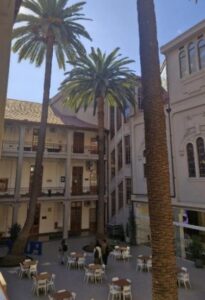
I lived with a Chilean host family for the first month, which I can highly recommend if you want to arrive in a relaxed manner, but it is of course more expensive than a shared flat. After that I moved to a shared flat with Chilean students I got to know in the first month. A week before lectures began, the PUCV organised an orientation week for us, which was very well structured and provided interesting insights into the culture and helpful information about safety, the university and the peculiarities of Chilean Spanish.
It also provided an opportunity to meet other exchange students and make friends. During the first few weeks, I did a lot with the other exchange students, as we all wanted to get to know the area and didn’t have much to do for university yet.
Academic Experience
During orientation week, everyone had a personal meeting with the coordinator to finalise their course selection based on the timetable.
©International Office
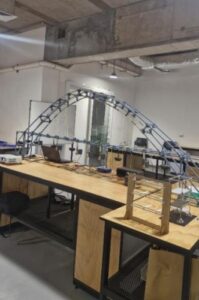
I successfully completed four of my five courses (14 CP) and was able to get Massivbau 1 and Operations Research credited at RWTH. I dropped the fifth course because it built on a course I hadn’t taken in Germany. Overall, it was quite a challenge due to a lack of prior knowledge in some areas because Chilean Spanish (even that spoken by the professors) is not so easy to understand. However, my Chilean fellow students were very open and helpful, so I was able to keep up well everywhere and, over time, it became easier for me to understand everything. Compared to Germany, the system is definitely much more school-like, with obligatory attendance, group work, tests and mid-term exams. If you do well there, you often don’t even have to take the final exam. If you choose a lot of courses, you should definitely be prepared for the university to take up a lot of your time during the semester, but the exam period is significantly shorter than at RWTH.
Overall, I was very satisfied with my university, as the support for exchange students was very good and the professors were very accommodating when problems arose. I also found the atmosphere in class very pleasant, as the courses are much smaller (max. 30 people) and the relationship with the professors is very relaxed. There were very few other exchange students in the engineering faculty, as most of them go to Santa Maria University, but this made it easier for me to socialise with my Chilean fellow students, who were very interested in getting to know an exchange student. The group work definitely helps with this too.
Tips for interested students
©International Office
If you want to live in a shared flat, it is a good idea to stay in a hostel at first and then view shared flats on site to get a better impression of the condition of the flat and the location. There are lots of offers on the compartodepto website, most of which are available immediately.
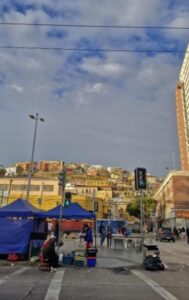
Although my university was in Valparaíso, I lived in Viña del Mar, as it is much easier to get to the beach there and it is also much safer than Valparaíso, especially at night. However, if you want the full South American experience, I would recommend living in Valparaíso, as it is much livelier and more colourful. Nevertheless, if you want to move to one of the hills, you should find out about safety beforehand.
In general, criminality is kind of a problem in Valparaiso, but if you listen to the tips of the locals and e. g. do not walk alone in the streets at night and take care of your valuables, you don’t have to worry.
©International Office
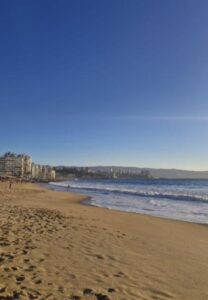
Valparaíso and Viña del Mar have a lot to offer in terms of leisure activities. I especially enjoyed being so close to the beach. On Fridays and Saturdays in particular, exchange students often had the opportunity to go to clubs for free. I really liked the Dichere event (formerly MundoLingo), which took place every Wednesday evening in a bar in Viña, where you had the opportunity to meet other exchange students and Chileans.
The university also offered fun activities, I participated for example in a traditional dance class.
In Concon, you can go surfing for little money, and the conditions are usually good for beginners. Other cool places to visit nearby are the botanical garden, the Cerro Alegre district and the dunes of Concon. Special highlights for me were the national holiday on 18 September, which is celebrated extensively in Chile (all through September) and the New Year’s Eve fireworks over the sea. I would also highly recommend travelling to both the north (Atacama desert) and south (Patagonia) of Chile, but you need to plan enough time for this due to the distances involved.
Finances
For the first month, I lived with a host family on full board for $550, then much cheaper in a shared flat. I received the PROMOS scholarship, which mainly helped me cover the flight costs and health insurance costs. Food in Chile is not much cheaper than in Germany, but leisure activities and single tickets for public transport (less than 1 euro) are. Overall, if you exclude travel, thanks to the scholarship, I managed well with the money I would normally spend in Germany.
Academic value of my stay
From a civil engineering perspective, I found the topic of earthquake-proof construction very interesting, which is why I took a course on it. It was very exciting to experience a few little earthquakes myself and see how well the buildings dampen the movement in reality so that you hardly notice anything. It was also very interesting to see how different the building standards are between Chile and Germany and what impact this has on the calculations.
My Spanish improved enormously during the semester and I also learned many technical terms that are needed in a professional context.
Sustainable character of my stay
In terms of CO2 emissions, the long-haul flight to Chile and back is obviously very harmful, but during my travels through Chile I tried to avoid flying as much as possible and travelled by bus instead, which is really comfortable in Chile!
Personally, the semester had a lasting positive impact on me and helped me mature, as I learned to live outside my comfort zone, adapt to unfamiliar circumstances and solve problems independently.
The Chileans were very open-minded towards me and welcomed me into their groups of friends, which allowed me to make some very good friends and gain a deep insight into the culture. With this new cultural understanding, I can well imagine working in an international context one day, and it gives me a better understanding of how foreigners living in Germany feel.
I have also learned to appreciate the privileges I have in Germany – for example, the freedom to walk around alone at night, the good infrastructure and financial security.
Conclusion
I am very grateful that I had the opportunity to take part in this exchange and get to know a new culture and make new friends. Of course, it was also exhausting to be outside my comfort zone, speaking Spanish all the time and having to adapt to a foreign culture, but it was definitely worth the effort. If I had been able to get more credits for my courses, I could well have imagined staying for a whole year.
