
Schlagwort: ‘Göteborg’
My experiences at Volvo Technology
- Energy Engineering M.Sc.
- Sweden, Göteborg
- Volvo Technology
- 10/2024 – 05/2025

Masthugget Church Viewpoint East ©Marc Müllenbach
Hello, my name is Marc. I am a German studying Master Energy Engineering at RWTH Aachen University, Germany, and participated in a research stay funded by the Erasmus+ Internship program during my master’s thesis at Volvo Technology – one of the most Swedish companies imaginable – in the second largest city Göteborg, Sweden. Getting this opportunity, to work on practical research in a company, was very difficult and almost did not work out. I started applying more than a year ahead, but this was way too early for most cases. In Sweden, there are no mandatory internships of up to 6 months; Swedish students gain practical experience during their summer break. Yes, you heard right: all students have a 2-3 month study-free period during the summer, without the need to prepare for exams, since they finish them before Midsommar (the summer solstice). Their internship culture comes from the fact that students do not receive their student funding during vacation, so many rely on summer jobs to survive financially until the next study period. Because internships are limited to these three months, companies don’t know about longer internships, especially not outside this period, as is common in Germany. Another aspect is that thesis work usually starts in January, as Swedish studies are separated into four periods, and are mainly carried out in groups of two—eliminating most chances if you want to start according to the German semester dates and alone. However, you would not be reading this if I hadn’t made it despite the low chances. I applied a lot, sent unsolicited applications to companies, connected with people on LinkedIn, and sent dozens of requests for an internship with the opportunity to follow up with a master’s thesis, which is usually the catch in Germany. The position was acquired via an unsolicited application to an industrial PhD student in cooperation between Chalmers University of Technology and Volvo Group, which led to the position at Volvo Technology. Other research internships would have been possible at Chalmers, but the research topic and work environment at Volvo were the best option.
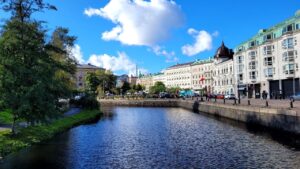
Moat of the old city fortifications, Bazarbron ©Marc Müllenbach
Finding a suitable accommodation without being registered as a Swedish student brings further problems, since you are not eligible for student accommodations. Some shared living opportunities always exist but are highly requested and not available in sufficient quantity. Some international students even live in hotels or cabins for the first year. In Swedish metropolitan areas, housing agencies require you to be in the queue for several years. Even colleagues at my workplace, who were in the queue for up to three years, were not able to find suitable accommodation (for their living standard) and ended up buying instead. I found mine with a lot of luck on Facebook (which is widely used in Scandinavia and also serves as an online marketplace and for international exchange). The accommodation had two rooms, one bedroom, and one living room/kitchen. The monthly costs were approximately €450 per person, with all additional costs included. I lived there with my girlfriend, who also studied at Göteborg University. For grocery shopping, I highly recommend using “Too Good To Go,” which offers a full bag of vegetables close to expiration for under €5—this saves money since vegetables and fruits are noticeably more expensive compared to Germany. Monthly expenses for groceries were roughly €200 per person, including all food and household costs and eating out every two weeks. Since the canteen at Chalmers was €6 (student) or €8 (visitor), and at Volvo Group €10, I decided to always prepare my own food, which is popular in Sweden. There are always spaces with microwaves and cutlery. For transportation, you can use rental bikes for €30 per year (Nextbike/Sty&Ställ). Since I needed to get to the other side of the harbor to Göteborg Lundby, I bought a tram ticket, which was €60 (student) or €75 (non-student) per month. Even though I was a student, I couldn’t use the student discount for many occasions, since in Sweden your student status is verified by a “Mecenat” app account issued by a Swedish university, which I did not have.
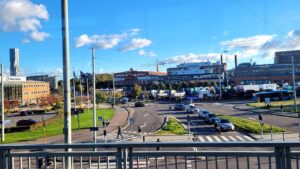
Volvo Group, Gropegårdsgatan 10 ©Marc Müllenbach
Everyday life during the research stay was a 40-hour workweek, starting at 9:00 and ending at 17:00. It is common to have a one-hour lunch break at 11:00, which I always spent with coworkers. Since I started in October, I was the only student at the company until January, when two other thesis workers joined, as is usual during this time. From Volvo, I received a laptop for my research work, which was mainly self-guided and supervised by weekly meetings with my supervisor. I highly enjoyed short coffee breaks with colleagues around 14:00-15:00, called “fika,” to discuss technical topics or daily life. There was one 30-minute fixed slot per week where the whole department met, and one colleague always brought sweet pastries or cake. The department worked great as a team, and I think this weekly contact, as well as spontaneous meetings on other days, helps with teambuilding. I also enjoyed that Volvo Group is an international environment, and you can get into contact with everyone on a casual basis since in Sweden you always call people by their first name; titles and positions do not mainly define your personality.

Vrångö Island ©Marc Müllenbach
During the winter, I came home from work when it was already dark, but there are many options available. Monthly sports membership at “Fysiken” cost €33 per month (3-month period) for students, including gym, courses, team play, and climbing/bouldering. I used to go every second day and made friends during climbing and basketball. It seems much easier to make international friends, as Swedish students usually already have their friend groups. Getting into those groups takes time and is comparable to making friends in Germany. With friends found that way, at the company or through international university programs such as ESN, you will definitely find people to spend time with—though more likely internationals who will leave after six months. However, Göteborg is a city where you can spend your time at many places, such as bars with after-work discounts and pub quizzes, museums, or at the ice hockey arena watching “Frölunda HC.” Around February, you will get home when it is still bright outside and can spend the sunset at famous places such as “Skansen Kronan.” On weekends, I recommend visiting the local historical
amusement park “Liseberg,” the islands in the archipelago near Gothenburg, one of the beaches, or hiking around lakes such as “Delsjön.” Trips around Sweden to Stockholm, Malmö, Helsingborg, or even Oslo in Norway are easy to do on a small budget. ESN also offered a one-week trip to Swedish Lapland, which everyone recommended to me, but I was quite
occupied by research work and also took vacation to visit my family over Christmas.
In conclusion, I liked Swedish culture before, and this trip increased its attraction. Sometimes it was tough to receive the same rights as locals, since you always need digital proof such as Swedish student status (“Mecenat”). For foreigners, it is also impossible to buy at a local food market or farm since “Swish,” the Swedish version of PayPal for payment, requires a Coordination Number for a Swedish ID, a Swedish bank account, and BankID. There are also several special days with traditions such as St. Lucia around Christmas, Valborg/Walpurgis Night and Swedish National Day in spring, and Midsommar in summer. However, my girlfriend and I decided to continue our time in Sweden and enjoy one or more summers at the coast and in nature, where Sweden has much to offer.
Building a metro tunnel under the city of Göteborg
- Business Administration and Engineering: Civil Engineering M.Sc.
- Göteborg, Sweden
- Wayss & Freytag Ingenieurbau AG
- 06.04.2022 – 07.10.2022
1. Application/Finding an internship
During the pandemic and especially the lockdown I decided that I want to do an internship abroad. A fellow student recommended me an internship with Wayss & Freytag Ingenieurbau AG in Göteborg, Sweden. Because I always wanted to explore the Scandinavian region, I knew that would be a great opportunity. After two video calls with the responsible site manager, I got the positive feedback to go there during the summer semester and directly applied for the Erasmus scholarship. For the internship I would recommend applying at least 3 months ahead. It is important that you apply for the Erasmus scholarship at least six weeks before the internship starts. For that scholarship you need to do an EU survey and an OLS language test. The most critical part is the Online Learning Agreement (OLA), where you need signatures from all parties involved.
2. Accommodation & Living expenses
The accommodation was provided by the company. It was a small but very well-equipped apartment in Frihamnen. Even though Frihamnen is on the northern site of the river, I liked the location because the city center is reachable within 10 min bike ride and the public transport is very good. The apartment complex is called ‘waterfront cabins’. They have long- and short-term renting. When visiters came from Germany, they could book them via Airbnb for an affordable price. Otherwise the living expenses are higher than back home. Especially living costs are from what I have heard quite high and for foreigners difficult to get. For renting an accommodation, Sweden is dividing into first and second hand contracts. As a foreigner you can only get second hand contracts, which basically means temporary sublease. The daily expenses are a bit higher, but obviously depends on where you go. For grocery stores I enjoyed going to Lidl. Not only for some German stuff, but also the price/performance is great. From my point of view going out is quite expensive. Clubs usually cost at least 200 SEK (= 20 €) entry fee. Also eating in restaurants or having some drinks in a bar is pricy. As a reference point: 0,4l beer costs in between 45-90 SEK. Again, it really depends on where you go.
3. Everyday life/ the internship
The German company Wayss & Freytag is building a metro tunnel under the city as part of the “West Link” (Västlänken) project in Göteborg. Västlänken is one of the biggest infrastructure projects in Scandinavia. During my internship I was stationed as a project engineer on the construction site in Liseberg. The tunnel line of this site is going to be around 300m long. One of the biggest difficulties is a river going through the construction pit, which makes a lot of heavy foundation works necessary. For that I was mainly supporting the site managers and sometimes the supervisors in the production. I was responsible for the short-term planning as well as different documentary and design tasks. The team I worked with was young and super friendly from the beginning. I got along with them very quickly and we started doing stuff after work and on the weekends immediately. That helped a lot to get along in a new country with a new language. Because the joint venture partner is a Swedish company (NCC), it was roughly 50% Swedish and 50% German speaking coworkers. That made the cultural exchange super interesting. I really enjoyed the work atmosphere with all the colleagues, even though the work attitude/ethic between German and Swedish people may differ. The company also organized afterworks or Friday-breakfasts on a regular basis. One highlight was the summer party. I think those events are helping a lot for team building purposes and gives you a different connection with your coworkers – besides it was very fun. 😉
4. Free time/tips
After work I usually did sports (paddle, running or boulder) with coworkers. During the warm summer months, we sometimes went for a swim in one of the beautiful lakes or the ocean. On the weekends I tried to explore the surroundings of Göteborg. Whether the archipelago near Göteborg or the stunning nature inland, there is so much to discover. Kayaking, hiking or go fishing were only a few activities. Some of my German colleagues started kite surfing or sailing. The opportunities of outdoor activities are just amazing. Göteborg as a city has everything you can imagine. There are clubs and bars, museums, parks and a lot of nice cafes. We often went to the street food market in Lindholmen for a ‘Fika’. If you are looking for a bar with affordable drinks, Tullen’s or Café Magazinete is recommendable. TaKeT is a rooftop bar with an amazing view over the river and one of my favorite places in a sunny afternoon. For weekend excursions, Göteborg is located in a triangle between Oslo, Copenhagen and Stockholm. All three destinations are reachable within 4 hours drive. There is a fast Flixtrain connection to Swedens capital. For Copenhagen and Oslo distance buses are recommended, as they are usually cheaper than train connections. One of the biggest highlights was spending traditional Midsummer in a Swedish summer house. The amount of daylight in the summer was an excellent experience.
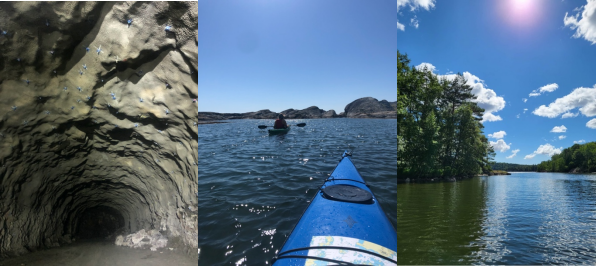
© Johannes Bennewitz
5. Conclusion
In summary, I can say that I absolutely benefited from the internship in many ways. Not only to getting to know the Scandinavian culture and the way of how a big infrastructure project works, but I also made a lot of new friends. For me personally I loved Göteborg as well as the Swedish nature and I will certainly be going there many more times in the future. I can highly recommend the internship program at Wayss & Freytag and I’m proud to be part of the Västlänken project.
